Plot Explained Spoilers guaranteed!
Plot Explained

Browse by genre

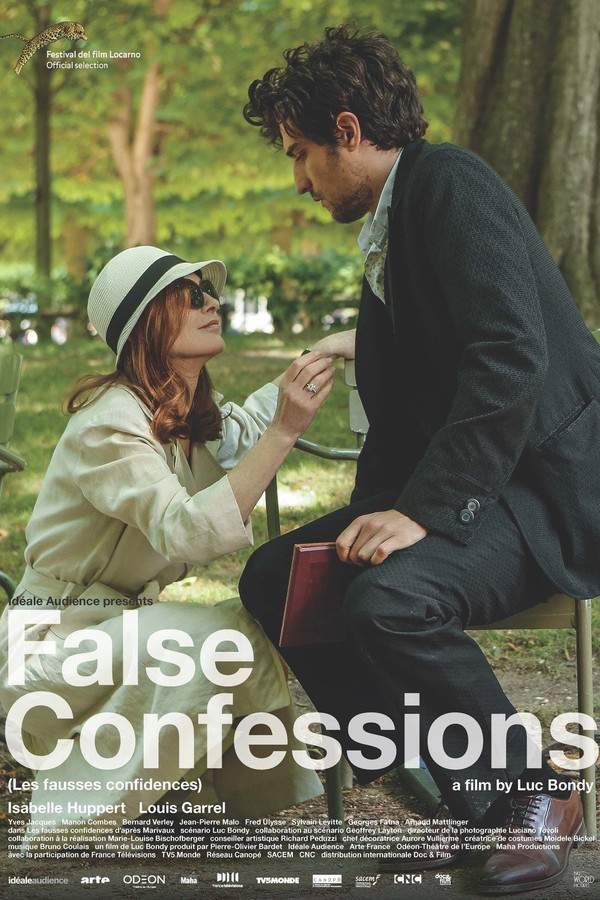
False Confessions (2017) movie poster

Timeline

False Confessions (2017) Timeline Explained – Every Event in Order

Release, runtime and language
2017 · 82 min · French
Echo score 48
Loading streaming availability…
Directed by
Luc Bondy, Marie-Louise Bischofberger
Starring
Isabelle Huppert, Louis Garrel, Bulle Ogier, Bernard Verley, Yves Jacques, Fred Ulysse

A charming but awkward man, Dorante, attempts to win the affections of a wealthy widow, Araminte, through elaborate schemes and deception. As he navigates the intricacies of high society, his elaborate plans become entangled with Araminte's devoted friend and her interfering mother. Dorante's pursuit of love is fraught with challenges, and it remains to be seen if his true feelings will ultimately be revealed and accepted.

On this page (5)
  1. 1 Where to watch
  2. 2 Events in order (13)
  3. 3 Timeline questions answered
  4. 4 Movie threads
  5. 5 Every angle
Loading streaming availability…

13 events in order · contains spoilers

False Confessions Timeline: Events in Chronological Order

Every key event of False Confessions (2017) in order, scene by scene, with when and where it takes place. Use it to untangle flashbacks, time jumps and parallel storylines, to refresh your memory before the sequel or to find the exact scene you are thinking of.

  1. Introduction to Araminte

    In the vibrant backdrop of 21st century Paris, the story begins with Araminte, a wealthy widow, played by Isabelle Huppert. Unbeknownst to her, she has hired Dorante, a lovestruck young man, as her accountant, setting the stage for the unfolding romantic complications.

    Where
    Paris
  2. Dorante's Deception

    Dorante, played by Louis Garrel, enters the scene as both a pitiable figure and a crafty schemer. He orchestrates a romantic scheme to gain Araminte's affection, demonstrating his ability to play with emotions while concealing his true intentions.

    Where
    Araminte's residence
  3. Marton's Role

    Marton, portrayed by Manon Combes, serves as Araminte's loyal friend and confidante. As Dorante weaves his web of deception, Marton finds herself caught in a series of misunderstandings, further complicating the relationships between the characters.

  4. Dubois' Manipulation

    Dubois, the cunning accomplice of Dorante, played by Yves Jacques, plays a crucial role in the scheme to win Araminte's heart. His manipulative tactics add layers to the narrative, showcasing the lengths individuals will go to achieve their desires.

  5. Araminte's Mother

    Araminte's mother, portrayed by Bulle Ogier, enters the fray with doubts about Dorante's intentions. Her maternal instincts pull her towards encouraging a match with a financially struggling older Count, played by Jean-Pierre Malo, intensifying Araminte's predicament.

  6. The Romantic Scheme Unfolds

    As the romantic scheme unfolds, Dorante's true feelings for Araminte begin to complicate his initial intentions. The audience witnesses an intricate dance of desire as he oscillates between manipulation and genuine affection.

  7. The Pressure of Social Status

    The film explores the impact of social and class dynamics on relationships. As Araminte grapples with her wealthy status and potential match with the older Count, the tension escalates, navigating love's complexities amid societal expectations.

  8. The Role of Secrets

    Secrets and deception play pivotal roles as the characters navigate their tumultuous relationships. The layers of deceit lead to misunderstandings that challenge the notion of truth in love and the actions taken for romantic pursuits.

  9. Théâtre de l’Odéon

    Part of the film is shot at the Théâtrde l’Odéon, merging theater and film. This creative backdrop not only enhances the visual experience but also emphasizes the dramatic elements of love, creating a unique atmosphere for the unfolding tale.

    Where
    Théâtre de l’Odéon
  10. Climactic Revelations

    As the story progresses, revelations emerge that shake the foundations of the characters' relationships. Dorante's duality is exposed, leading to critical decisions that redefine love and trust among the main players.

  11. Confrontation and Resolution

    In a climactic showdown, Araminte confronts Dorante about the deceptions. This confrontation ultimately leads to resolutions that allow them to reckon with their feelings and the consequences of their actions.

  12. Reflection on Love's Psychology

    The film concludes by inviting the audience to reflect on the psychology of love and desire. The intricate dance between affection, ambition, and class encapsulates the struggles and triumphs of human emotions.

  13. Final Impressions

    With Luc Bondy's final masterpiece, viewers are left with a profound understanding of love's complexities. The cast and setting culminate in a stirring adaptation that resonates with the timeless nature of romantic entanglements.

    Where
    Paris

Last updated: November 04, 2024 at 00:37

Was this helpful?

Timeline questions answered

False Confessions Timeline Explained: Your Questions Answered

When does it happen, and why in that order? The questions people ask about the chronology of False Confessions (2017): time jumps, flashbacks, cause and effect between scenes and the correct order of events, each answered with spoilers.

Q1

Why does Dorante use elaborate schemes instead of simply telling Araminte he loves her?

Dorante employs deception because directly confessing his feelings would expose his vulnerable position as a suitor with no real wealth or status. By positioning himself as her accountant rather than a romantic candidate, he can remain close to Araminte while orchestrating situations designed to make her fall for scheme him. His also allows him to test whether her affection would be genuine or merely driven by his fabricated circumstances.

Foreshadowing: Early scenes establish Dorante's dual nature as both a pitiable figure and a crafty schemer, hinting at his preference for manipulation over honest communication.

  • dorante
  • araminte
  • deception
  • love confession
  • romantic scheme
Q2

What is Dubois' role in Dorante's romantic scheme?

Dubois serves as Dorante's cunning accomplice, helping orchestrate the elaborate plan to win Araminte's affection. His manipulative tactics add layers to the narrative, executing the intricate deceptions that Dorante designs. Together, they create misunderstandings and staged situations intended to gradually win Araminte's heart.

Foreshadowing: Dubois is introduced early as Dorante's partner in deception, establishing the collaborative nature of the scheme.

  • dubois
  • dorante
  • accomplice
  • manipulation
  • scheme
Q3

Why does Araminte's mother encourage her to marry the Count instead of Dorante?

Araminte's mother harbors doubts about Dorante's genuine intentions and sees the older Count as a more financially secure and socially appropriate match for her wealthy daughter. Her maternal instincts drive her to protect Araminte from what she perceives as a potentially dishonest suitor, despite the Count's financial struggles.

Foreshadowing: Araminte's mother enters the story with immediate skepticism about Dorante's motivations, setting up the tension between security and genuine affection.

  • araminte mother
  • count
  • marriage
  • social class
  • financial security
Q4

How does Marton get caught in Dorante's web of deception?

As Araminte's loyal friend and confidante, Marton naturally becomes entangled in the romantic complications arising from Dorante's schemes. Her position close to Araminte means she witnesses and gets involved in the misunderstandings that the deception creates, further complicating the relationships between all characters.

Foreshadowing: Marton's role as confidante is established early, making her inevitable involvement in the unfolding romantic complications predictable.

  • marton
  • dorante
  • confidante
  • misunderstanding
  • complication
Q5

Why does the adaptation set Marivaux's play in 21st century Paris instead of its original period?

The contemporary Paris setting updates the classic themes of love, class, and social maneuvering for modern audiences while demonstrating their timeless relevance. The 21st century backdrop highlights how romantic scheming and the complexities of social status remain central to relationships, even in a technologically advanced era.

Foreshadowing: The opening establishes the modern Paris setting immediately, signaling this is a contemporary reinterpretation rather than a period piece.

  • paris
  • modern setting
  • marivaux
  • adaptation
  • contemporary
Q6

What triggers Araminte's confrontation with Dorante about his deceptions?

As Dorante's scheme unfolds, his true feelings begin to complicate his initial intentions, causing his carefully constructed facade to crack. The accumulated weight of secrets and the eventual revelations about his duality shake the foundations of their relationship, leading Araminte to demand answers about his manipulations.

Foreshadowing: The buildup of secrets throughout the narrative creates the tension necessary for the eventual confrontation.

  • confrontation
  • revelation
  • deception truth
  • climax
Q7

What is the significance of filming at the Théâtre de l'Odéon?

The Théâtre de l'Odéon setting merges stage and cinema, emphasizing the theatrical nature of the characters' performances and deceptions. This creative choice visually reinforces the themes of role-playing, illusion, and the blurred lines between authentic emotion and performed sentiment that permeate the story.

Foreshadowing: The location is introduced as part of the film's distinctive visual identity from the beginning.

  • théâtre de l'odéon
  • theater setting
  • metatheatrical
  • staging
Q8

How do social class and wealth differences impact the characters' relationships?

The film explores how Araminte's wealthy status creates both opportunity and obstacle for Dorante's pursuit. His lack of financial security forces him to hide behind deception rather than present himself as an equal suitor. Meanwhile, her mother's preference for the Count reflects how class considerations traditionally influence marriage decisions in their social circle.

Foreshadowing: The introduction establishes Araminte as a wealthy widow and Dorante as someone employed by her, immediately setting up the power imbalance.

  • class
  • dorante
  • araminte
  • social status
  • wealth
  • money
Q9

Does Dorante develop genuine feelings for Araminte beyond his original scheme?

As the romantic scheme unfolds, Dorante's true feelings become increasingly complicated by genuine affection. His oscillation between manipulation and authentic emotion suggests his original strategic pursuit transforms into real love, though the deception he created makes it difficult to distinguish between performed and genuine sentiment.

Foreshadowing: The description notes Dorante's transition from pitiable schemer to someone whose true feelings complicate his initial intentions.

  • dorante
  • true feelings
  • genuine affection
  • authentic love
  • motivation
Q10

How does the story resolve after Araminte confronts Dorante?

The climactic confrontation leads to resolutions where the characters reckon with their feelings and the consequences of deception. Araminte and Dorante must navigate the aftermath of revealed truths, ultimately addressing whether their relationship can survive the honesty that their earlier deceptions prevented.

Foreshadowing: The buildup of tension throughout the scheme creates the necessary foundation for this confrontational resolution.

  • resolution
  • confrontation
  • truth
  • aftermath
  • relationship outcome

Movie threads

More Movies Like False Confessions, by Mood & Story

Curated lists built around what makes False Confessions tick: the same mood, the same kind of story or the same emotional payoff. Each list explains why these movies belong together.

Movies with sophisticated romantic scheming like False Confessions

Stories where elaborate romantic ruses unfold within high society. If you enjoyed the clever deceptions and social maneuvering in False Confessions, explore more movies like it. These films feature characters navigating the intricate rules of courtship and class through witty dialogue and elaborate romantic plots, perfect for fans of charming, character-driven stories.

  • witty
  • charming
  • deceptive
  • romantic
  • sophisticated
  • scheming
  • Tone: light, witty, charming
  • Pacing: steady, conversational
Why these movies?

The story pattern: The narrative typically follows a protagonist, often of lower status or with a secret, who creates an elaborate persona or plan to win the affections of someone seemingly unattainable. The plot revolves around the maintenance of the deception, the risk of exposure, and the ultimate question of whether true feelings will be revealed and accepted, often with a light, comedic touch.

Why they belong together: Movies in this thread are united by their focus on romantic pursuit through intellectual means rather than raw passion. They share a light tone, steady pacing, and a focus on the psychology of attraction and the humor inherent in social performance, creating a consistently charming and reflective viewing experience.

Movies exploring the psychology of love and status like False Confessions

Explorations of how social standing influences romance and desire. For viewers who liked how False Confessions examined love within the confines of high society, this thread finds similar movies. Discover stories that explore the tension between genuine emotion and social expectation, where romantic pursuits are complicated by class differences and societal rules.

  • reflective
  • sophisticated
  • romantic
  • psychological
  • class-conscious
  • dramatic
  • Tone: reflective, sophisticated, light
  • Pacing: steady, character-driven
Why these movies?

The story pattern: The narrative pattern involves a central romantic attraction that is complicated or forbidden by differences in social class or wealth. The journey focuses on characters navigating these external barriers—often through deception, self-reinvention, or challenging convention—while exploring the authenticity of their feelings versus the pressures of their society.

Why they belong together: These films are grouped by their shared thematic focus on the intersection of romance and social hierarchy. They possess a moderate complexity arising from the clash of personal desire and public expectation, and a reflective mood that thoughtfully examines the psychology behind why we love and how society influences those choices.

Every angle

False Confessions (2017) Explained: Plot, Timeline & Characters

Everything about False Confessions in one place: what happens in the plot summary, the timeline in chronological order, the characters and meaning and a spoiler-free summary. What's After the Movie adds the cast, box office and post-credit scenes.

Coming soon on iOS and Android

The Plot Explained Movie Summary App

Plot summaries, endings explained and timelines on your phone. Catch up on any movie in minutes, save your favorites and never miss a twist again.

Be the first to know when we launch. Your email stays private, always.

Learn more about the app