Year: 2002
Runtime: 112 min
Language: Portuguese
Director: Clare Peploe
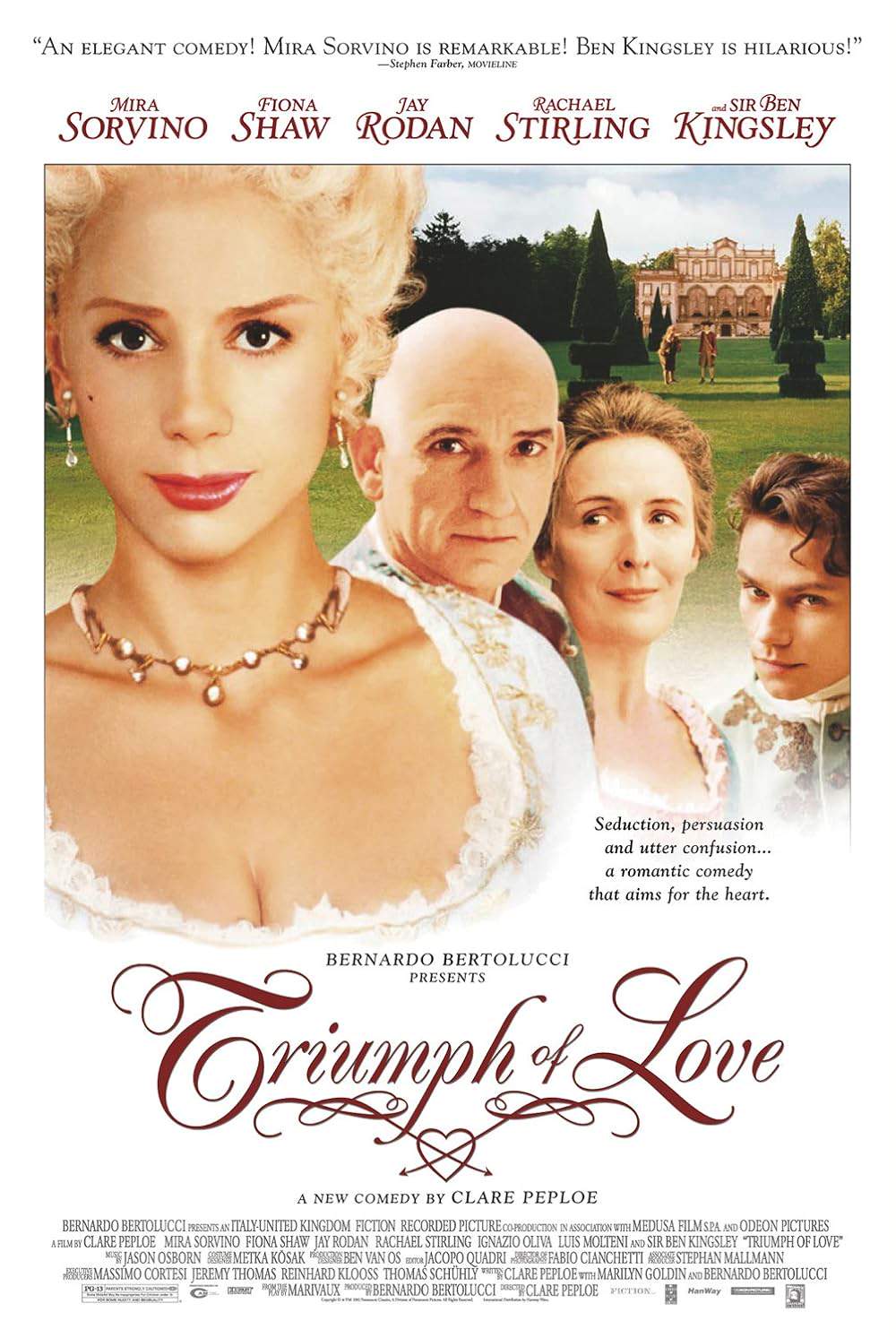
In this whimsical romp, an 18th-century poet and his loyal friend embark on a globe-trotting adventure to discover a love so divine, it defies rational explanation.
Find where to stream, rent, or buy The Triumph of Love (2002) in the US with current JustWatch availability, up-to-date pricing, and platform listings for subscription, rental, and digital purchase options.
Warning: spoilers below!
Haven’t seen The Triumph of Love yet? This summary contains major spoilers. Bookmark the page, watch the movie, and come back for the full breakdown. If you're ready, scroll on and relive the story!
Read the complete plot breakdown of The Triumph of Love (2002), including all key story events, major twists, and the ending explained in detail. Discover what really happened, and what it all means.
In the 18th century Europe, a princess named Aspasie finds herself in a precarious situation, largely due to her family’s criminal actions. As she travels in a horse-drawn carriage alongside her lady-in-waiting, Corine, Aspasie reveals a shocking truth: the rightful heir to the throne, Prince Agis, was whisked away after the untimely death of his parents and remains unaware of his royal lineage. In order to navigate the complexities of their world, both women decide to disguise themselves as men.
In a flashback, Aspasie is enchanted by a moment when she stumbles upon Agis, who is revealed to be naked in the woods. However, she is thwarted from getting closer by Hermocrates, the philosopher, who becomes a barrier between her and Agis. Back in the present, Aspasie confides in Corine that to approach the prince, she’ll have to pose as a man since he harbors a strong dislike for women.
Upon arriving at Hermocrates’ esteemed residence, Aspasie takes on the identity of Phocion and requests to meet the great philosopher. Harlequin, the servant, unfortunately informs her that such a meeting is out of the question. Aspasie, determined to maintain her ruse, introduces Corine as her male counterpart.
Phocion subsequently encounters Leontine, Hermocrates’ sister, who is persistent in her scientific pursuits. Aspasie, keen to remain at the estate, flirts with Leontine, coaxing her into believing she is still attractive, contrary to her own insecurities. In a bizarre twist, Leontine starts seeing an audience in the garden, adorned in outfits reminiscent of the 20th century, amplifying the strangeness of their escapade.
While the two women navigate their dual identities, they are invited to stay at Hermocrates’ estate, where Aspasie, as Phocion, finally meets the philosopher. Although Hermocrates suspects he recognizes Phocion, Aspasie cleverly keeps her royal secret hidden while insinuating attraction towards him, despite his belief in the moral failings associated with relationships with women.
In due course, Phocion encounters Agis, who is preoccupied with shooting arrows at a target that resembles the princess he detests. Aspasie expresses a desire to befriend him under her male guise, hoping to bond with him over the art of archery. Unbeknownst to her, Harlequin seems to harbor feelings for Corine, adding yet another layer of complication to their charade.
As events unfold, Agis ultimately discovers that Aspasie is indeed a woman and that her intentions extend beyond mere friendship. Meanwhile, Aspasie must skillfully maintain her charade before both Hermocrates and Leontine, leading to romantic misunderstandings that culminate in marriage proposals from both. The situation spirals into chaos when Leontine discovers the truth, leading her to faint from the shock.
A pivotal moment arises when a response to a message intended for the princess finds its way back to her. Soon, Aspasie reemerges in a lavish carriage, donning the attire of royalty, accompanied by a troop of mounted men. With courage, she confesses her deception and declares that she will relinquish her claim to the throne, affirming that Agis is the true king. This revelation stirs anger in Agis, who commands the princess to leave and never return.
Ultimately, amidst the turmoil, Leontine sees success in her experimental endeavors and finds joy in her achievements. Meanwhile, Agis reflects on his own mistake regarding Aspasie and rushes after her—not with malicious intent, but with hopes of reconciling and inviting her back into his life.
As the narrative draws to a conclusion, the audience witnesses a remarkable transformation, applauding as the cast transitions into 20th-century attire, embodying the whims of time and the complexities of love and identity.
Last updated: May 21, 2025 at 07:31
Explore frequently asked questions about The Triumph of Love (2002) with spoiler-rich answers covering the full plot summary, major story beats, character motivations, hidden details, and ending meaning. This movie summary FAQ helps explain confusing scenes, plot twists, and narrative decisions in clear, searchable detail.
Aspasie disguises herself as a man named Phocion because Prince Agis harbors a strong aversion to women. Since she needs to get close to him to reveal his true identity as the rightful heir to the throne, she adopts a male persona to gain his trust and friendship.
Earlier in a flashback, Aspasie was thwarted from approaching Agis by the philosopher Hermocrates, establishing the need for a more subtle approach.
Both marriage proposals stem from the dual disguises. Hermocrates believes Corine is a man (Phocion's male companion) yet still proposes, while Leontine falls for Aspasie's flirtation as Phocion and believes romantic feelings are reciprocated. The proposals create chaotic confusion because each person is unaware of the true genders and identities involved.
Leontine faints from shock when she discovers that Aspasie is actually a woman who has been deceiving her. The revelation shatters the romantic connection she believed she had with Phocion, and the emotional impact of this betrayal causes her to collapse.
Leontine was already insecure about her attractiveness and believed Phocion was genuinely romantically interested in her.
A critical message arrives at the princess's residence, which serves as the catalyst for Aspasie to end her charade. She returns in a grand royal carriage, openly admitting her deceptions and declaring that she will relinquish her claim to the throne, affirming that Agis is the rightful king.
Aspasie gives up her claim to the throne because she recognizes that Agis is the rightful heir to the monarchy. Her love for him outweighs her desire for power, and she chooses to prioritize their relationship over her royal position.
After angrily commanding Aspasie to leave and never return, Agis reflects on his harsh words and realizes he made a mistake. His regret drives him to pursue Aspasie not with hostility, but with hopes of reconciling and inviting her back into his life.
In the film's closing moments, the cast transitions into 20th-century clothing in a theatrical spectacle. This whimsical time shift represents the blending of eras and underscores the movie's themes of identity, truth, and love transcending social conventions and time periods.
Leontine begins seeing an audience adorned in 20th-century attire during her scientific experiments. This bizarre visual represents her imaginative or experimental state of mind, adding to the film's whimsical tone and blurring the lines between reality and theatrical performance.
In a flashback, Aspasie stumbles upon Agis in the woods where he is revealed to be naked, and she experiences a strong physical attraction to him. This initial encounter sparks her determination to pursue a connection with him, despite the obstacles she will face.
Although Hermocrates suspects he recognizes Phocion from somewhere, he allows Aspasie to stay at his estate and even becomes romantically attracted to her. His philosophical nature and perhaps his own vulnerabilities lead him to give her the benefit of the doubt, though this ultimately contributes to the chain of misunderstandings.
Discover curated groups of movies connected by mood, themes, and story style. Browse collections built around emotion, atmosphere, and narrative focus to easily find films that match what you feel like watching right now.
Whimsical comedies where elaborate deceptions lead to comedic chaos and romantic revelation.If you enjoyed the mischievous disguises and comedic confusion in The Triumph of Love, you'll love these movies. This collection features whimsical romantic comedies and farces where elaborate deceptions create hilarious romantic entanglements and satisfying, happy endings.
The narrative typically revolves around a main character adopting a false identity to achieve a goal, which inadvertently complicates multiple relationships. The plot unfolds steadily as new characters are drawn into the ruse, leading to a series of amusing misunderstandings before the truth is revealed, ultimately resolving the conflicts and uniting the right couples.
Movies in this thread share a core DNA of playful deception, a light emotional touch, and a steady pacing that allows the comedy of errors to build naturally. They are grouped by their whimsical tone, focus on romantic and situational humor, and their commitment to delivering a delightfully convoluted but ultimately joyous experience.
Joyful historical adventures where romance and comedy triumph over social convention.Fans of The Triumph of Love will enjoy this selection of charming and lighthearted period films. These movies share a whimsical spirit, a focus on romantic comedies of manners, and a joyful escape into worlds where love and laughter conquer all, much like the experience of The Triumph of Love.
Stories in this thread use a historical setting not for gritty drama, but as a playful playground for romance. The journey is one of courtship and connection, often challenging the era's social rules with a modern sensibility. The conflict is typically light, arising from romantic rivals or gentle societal pressures, and is always resolved in favor of happiness and true love.
These films are united by their charming blend of a romantic historical setting with a consistently light and whimsical tone. They provide a similar viewing experience: an escape into a prettier, funnier version of the past where the stakes are emotional rather than mortal, and the ending is guaranteed to leave you smiling.
Don't stop at just watching - explore The Triumph of Love in full detail. From the complete plot summary and scene-by-scene timeline to character breakdowns, thematic analysis, and a deep dive into the ending - every page helps you truly understand what The Triumph of Love is all about. Plus, discover what's next after the movie.
Track the full timeline of The Triumph of Love with every major event arranged chronologically. Perfect for decoding non-linear storytelling, flashbacks, or parallel narratives with a clear scene-by-scene breakdown.
Discover the characters, locations, and core themes that shape The Triumph of Love. Get insights into symbolic elements, setting significance, and deeper narrative meaning - ideal for thematic analysis and movie breakdowns.
Discover movies like The Triumph of Love that share similar genres, themes, and storytelling elements. Whether you’re drawn to the atmosphere, character arcs, or plot structure, these curated recommendations will help you explore more films you’ll love.
The Triumph of Love (2002) Scene-by-Scene Movie Timeline
The Triumph of Love (2002) Movie Characters, Themes & Settings
The Triumph of Love (2002) Spoiler-Free Summary & Key Flow
Movies Like The Triumph of Love – Similar Titles You’ll Enjoy
Love & Friendship (2016) Spoiler-Packed Plot Recap
Shakespeare in Love (1998) Spoiler-Packed Plot Recap
Love's Labour's Lost (2000) Full Movie Breakdown
A Midsummer Night's Dream (1999) Full Summary & Key Details
Love’s Labour’s Lost (2017) Full Summary & Key Details
Formula of Love (1984) Plot Summary & Ending Explained
The Pleasure of Love (1991) Plot Summary & Ending Explained
The ABC of Love (1916) Full Movie Breakdown
Love’s Labour’s Lost (1985) Detailed Story Recap
The Lucky Lady (1926) Detailed Story Recap
Love Is a Ball (1963) Movie Recap & Themes
The Love Specialist (1957) Plot Summary & Ending Explained
Fanfare of Love (1935) Detailed Story Recap
The Art of Love (1965) Story Summary & Characters
It’s Love I’m After (1937) Spoiler-Packed Plot Recap