Plot Explained Spoilers guaranteed!
Plot Explained

Browse by genre

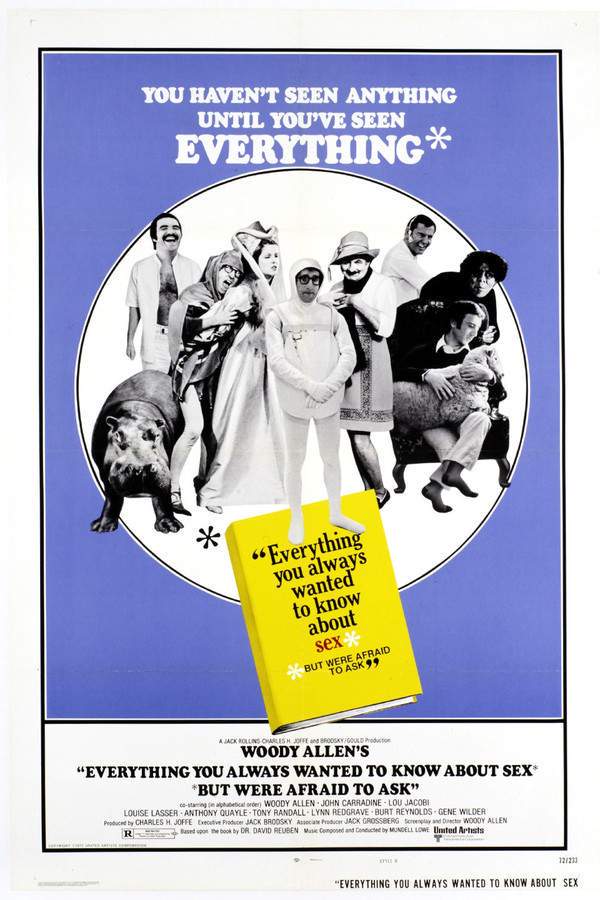
Everything You Always Wanted to Know About Sex * But Were Afraid to Ask (1972) movie poster

Plot Summary

Everything You Always Wanted to Know About Sex * But Were Afraid to Ask (1972) Plot Summary Explained

Release, runtime and language
1972 · 88 min · English
Loading streaming availability…
Starring
Woody Allen, Gene Wilder, Louise Lasser
Budget
$2M

This comedy presents seven interconnected stories exploring the complexities of human intimacy. Drawing inspiration from David Reuben's book, the vignettes cover a wide range of topics, from the customs of medieval romance to the science behind desire. Each segment offers a humorous and unconventional look at the challenges and joys of relationships, and the universal search for connection and understanding.

On this page (6)
  1. 1 Where to watch
  2. 2 What happens: full plot
  3. 3 Plot questions answered
  4. 4 Movie threads
  5. 5 Movies like Everything You Always Wanted to Know About Sex * But Were Afraid to Ask
  6. 6 Every angle
Loading streaming availability…

Full plot summary · contains spoilers

What Happens in Everything You Always Wanted to Know About Sex * But Were Afraid to Ask: Full Plot Summary

The whole story of Everything You Always Wanted to Know About Sex * But Were Afraid to Ask (1972) explained, from the opening scene to the final frame: every key event, every twist and what it all adds up to. Read it as a quick recap before the sequel, to check a scene you missed, or to finally understand what really happened.

The film opens with credits rolling over an enchanting scene filled with a multitude of white rabbits, all set to the lively tune of "Let's Misbehave" by Cole Porter. This colorful backdrop introduces viewers to a series of seven whimsical vignettes, each delving into the absurdities of love, lust, and human desire.

### "Do Aphrodisiacs Work?"

Set in the Elizabethan era, the jesting fool, played by Woody Allen, faces wrath from the king (Anthony Quayle), who finds his antics far from amusing. The plot thickens when our fool shadows the queen (Lynn Redgrave) into the gardens and unexpectedly becomes bold. From beyond the grave, the ghost of his father instructs him to pursue the queen. After acquiring an aphrodisiac from a sorcerer, which the sorcerer ominously warns may lead to his demise if discovered by the king, the fool succumbs to temptation and presents it to the queen. After she drinks it, her desires emerge, leading to a ludicrous scenario. Just as the fool tries to unfasten her chastity belt, the approaching guards ignite panic, resulting in a frantic struggle to conceal their compromising position. Ultimately, despite his best efforts, the king uncovers the fool and condemns him to execution.

### "What Is Sodomy?"

Meanwhile, in the bustling practice of Dr. Ross, portrayed by Gene Wilder, an extraordinary visit from Armenian shepherd Milos Stavros (Titos Vandis) shocks everyone. Milos confesses his inexplicable love for a sheep he claims is named Daisy. Initially taken aback, Dr. Ross is drawn deeper into bewilderment when Milos reveals that he has already been intimate with her, with the sheep now perceived as distant. The bewilderment only escalates when Milos pleads for the doctor to mediating a conversation with Daisy, leading Ross down an increasingly twisted path of attraction to the very sheep he is meant to counsel. As Ross indulges in this absurd love affair, confusion ensues, stripping him of his family and profession, culminating in a pitiful scene of despair as he grapples with the consequences of his bizarre obsession.

### "Why Do Some Women Have Trouble Reaching an Orgasm?"

In an Italian segment, Fabrizio (also portrayed by Woody Allen) faces disheartening intimacy issues with his wife Gina (Louise Lasser). After their marriage, Fabrizio's expectations of passion are thwarted by Gina's indifference. Desperation fuels his quest for understanding, leading him to confide in his priest to no avail. One serendipitous day, as they shop, Gina's unexpected arousal transforms their relationship dynamic, igniting a series of risqué escapades in public venues that push the limits of societal conventions. The couple joyously embraces their newfound spontaneity, though Fabrizio's fears of discovery loom large.

### "Are Transvestites Homosexuals?"

In a humorous twist, Sam (Lou Jacobi) and Tess engage in a dinner with their daughter's future in-laws. Sam's compulsion leads him to sneak away and don his future mother-in-law's dresses, amusingly unaware of the chaos that follows. As the dinner proceeds, the family unwittingly gets embroiled in Sam's antics, which escalate into a scene of electric tension, culminating when Tess loudly identifies him as her husband. This revelation adds layers of humor and social critique, as Tess expresses her devotion amidst the absurdity of Sam's multitudes.

### "What Are Sex Perverts?"

Transitioning to a scene riddled with innuendo, a game show titled "What's My Perversion?" thrives on comedic revelations about the bizarre sexual whims of contestants. The show, captivating audiences with its playful yet probing nature, records the speculative guesses of celebrity panelists about a contestant who admits to exposing himself on subways. As witticisms and misunderstandings cascade, the show evolves into a reflection on sexuality’s many forms, revealing the often absurd boundaries of human desire.

### "Are the Findings of Doctors and Clinics Who Do Sexual Research and Experiments Accurate?"

In yet another playful scenario, Woody Allen returns as Victor Shakapopulis, a para-scientist embarking on a journey to uncover the bizarre world of sexual research. The ensuing misadventures explore the shocking results of dubious sexual experiments. As an unexpected collaboration with an eccentric Dr. Bernardo (John Carradine) unfolds, Victor and a young reporter, Helen (Heather MacRae), find themselves plunged into the chaotic realm of mad science and absurdity. The culmination of their efforts reveals a narrative that not only parodies scientific methods but critiques the sensationalism surrounding sexual research.

### "What Happens During Ejaculation?"

In the final vignette, the storyline culminates inside the mind of a man as operators manage the physiological turmoil leading to ejaculation. An adventurous ride through a mission control-like scenario, where sperm launch in a hilariously choreographed manner, showcases not only an exploration of sexual science but also a humorous commentary on the pressures and expectations surrounding male performance. The delightful satire unfolds as operators race against time, intertwining exuberance with a farcical take on human physiology.

In conclusion, this film interweaves humor, historical references, and societal critiques, while exploring the tangled web of human desire through a comedic lens. Each vignette delivers unique perspectives, ensuring the audience is both entertained and provoked to consider the intricacies of sexuality and interpersonal relationships.
Last updated: January 18, 2025 at 14:36

Was this helpful?

Plot questions answered

Everything You Always Wanted to Know About Sex * But Were Afraid to Ask Plot Explained: Your Questions Answered

The questions people ask most about Everything You Always Wanted to Know About Sex * But Were Afraid to Ask (1972): what happens in the confusing scenes, why the characters do what they do, the twists, hidden details and what the ending means. Each answer contains spoilers.

Q1

Why does the fool decide to pursue the queen after seeing his father's ghost?

The ghost of his father appears in the garden and directly instructs the fool to pursue the queen. This supernatural command gives the fool the confidence to proceed with his plan, despite the obvious danger. The ghost's intervention is presented as the catalyst that pushes the fool into action.

Foreshadowing: The father's ghost first appears when the fool follows the queen into the garden, establishing the supernatural guidance that drives his fateful decision.

  • fool
  • queen
  • ghost
  • father
  • aphrodisiac
  • elizabethan
Q2

Why is the fool executed at the end of the first segment?

The fool is caught by the king while attempting to undo the queen's chastity belt during the aphrodisiac's effect. The king discovers them in a compromising position and sentences the fool to death by beheading. His attempt to satisfy the queen while evading discovery ultimately fails, leading to his execution.

Foreshadowing: The sorcerer warns that the aphrodisiac could lead to the fool's demise if discovered by the king, foreshadowing the fatal outcome.

  • fool
  • execution
  • king
  • queen
  • chastity belt
Q3

Why does Dr. Ross begin a relationship with the sheep named Daisy?

After Milos confesses his love for Daisy and asks Dr. Ross to help mediate, Ross becomes increasingly drawn into the bizarre situation. His professional curiosity transforms into genuine emotional attachment, leading him to visit Daisy himself at a hotel. This descent from professional counselor to obsessed lover represents the film's absurdist take on desire and boundaries.

Foreshadowing: Milos mentions that Daisy has become distant, setting up the idea that she needs attention, ironically prompting Ross to fill that role.

  • dr ross
  • daisy
  • sheep
  • bestiality
  • obsession
Q4

What causes Dr. Ross to lose his family and medical license?

Dr. Ross's obsession with Daisy becomes public when his wife discovers his affair with the sheep. This scandal leads to the loss of his medical license and his family, as his wife leaves him. The film presents this as the tragic consequence of his descent into absurdity.

Foreshadowing: The narrative shows Ross progressively more entangled in the situation, from counseling Milos to directly pursuing Daisy.

  • dr ross
  • wife
  • divorce
  • medical license
  • scandal
Q5

Why does Gina change from passive to sexually aggressive after shopping?

The exact catalyst is left ambiguous, but while shopping together, Gina experiences a sudden transformation in which she becomes sexually assertive. This spontaneous change allows the couple to explore their relationship dynamically. The film treats this as a humorous moment of spontaneous desire breaking through social constraints.

Foreshadowing: Fabrizio's desperation and conversations with the priest set up the tension that is released when Gina's change occurs.

  • gina
  • fabrizio
  • desire
  • transformation
  • public intimacy
Q6

Why does Sam dress in his future mother-in-law's clothes during dinner?

Sam has a compulsion to wear women's clothing, specifically his future mother-in-law's dresses. During dinner with his daughter's future in-laws, he sneaks upstairs to try on her clothes, unable to control his urge. This act reveals his secret transvestite tendencies and creates the comedic chaos that follows.

Foreshadowing: The dinner setting and Sam's nervous behavior establish his internal struggle before he acts.

  • sam
  • transvestite
  • cross-dressing
  • identity
  • comedy
Q7

Why does Sam claim to be pregnant during the police encounter?

When police arrive at the scene, Sam declares he is three months pregnant as part of the absurd comedic escalation. This farcical claim plays with gender expectations and adds another layer of humor to the segment, highlighting the film's ridiculous approach to sexuality and identity.

Foreshadowing: The escalating chaos of the dinner disaster builds toward this absurd peak.

  • sam
  • pregnancy
  • police
  • farce
  • gender roles
Q8

What is the game show "What's My Perversion?" about?

The game show features contestants revealing their unusual sexual desires or practices to a panel of celebrities who must guess what their "perversion" is. In the shown segment, a contestant admits to exposing himself on subways, and the celebrity panelists make increasingly ridiculous guesses. The segment satirizes both game shows and society's attitudes toward sexual deviance.

Foreshadowing: The show's title and setting establish it as a comedic exploration of sexuality's boundaries.

  • game show
  • perversion
  • celebrities
  • subway exhibitionist
Q9

What is the "Fiendish Tit" segment about?

Victor Shakapopulis and a reporter visit Dr. Bernardo's clinic where they witness grotesque sexual experiments. One experiment goes wrong and creates a giant breast that terrorizes the area. Victor ultimately defeats it using an absurd method involving a giant match. This segment parodies both mad science and the sensationalism of sexual research.

Foreshadowing: The gas station encounter with the sex expert sets up the journey to the clinic.

  • victor
  • dr bernardo
  • giant breast
  • experiment
  • mad science
Q10

How does the final brain segment depict ejaculation?

The final vignette portrays the inside of a man's brain as a mission control center where operators manage the physiological process leading to ejaculation. These operators coordinate the "launch" of sperm in a choreographed, frantic manner, treating the biological process like a space mission. The scene culminates in celebration when they successfully achieve their goal, humorously anthropomorphizing male sexual response.

Foreshadowing: The title "What Happens During Ejaculation?" signals this technical, scientific approach to the topic.

  • brain
  • mission control
  • sperm
  • ejaculation
  • physiology
Q11

Why does the film use seven separate vignettes instead of one continuous story?

The film structures itself as seven distinct vignettes based on David Reuben's book about sex, with each segment addressing a different question about human sexuality. This anthology format allows Woody Allen to explore varied aspects of desire, from historical traditions to modern science, while maintaining a whimsical tone. The vignettes are connected thematically rather than narratively, unified by the film's comedic exploration of human intimacy.

Foreshadowing: The opening credits with white rabbits and the Cole Porter song establish the whimsical, episodic structure.

  • anthology
  • vignettes
  • structure
  • woody allen
  • themes

Movie threads

More Movies Like Everything You Always Wanted to Know About Sex * But Were Afraid to Ask, by Mood & Story

Curated lists built around what makes Everything You Always Wanted to Know About Sex * But Were Afraid to Ask tick: the same mood, the same kind of story or the same emotional payoff. Each list explains why these movies belong together.

Playful Social Satire Movies like Everything You Always Wanted to Know About Sex * But Were Afraid to Ask

Films that use humor and absurdity to poke fun at social norms and taboos. If you enjoyed the irreverent humor of 'Everything You Always Wanted to Know About Sex', explore these other movies like it. This collection features comedies that use satire and farce to playfully examine societal norms, offering a similar witty and absurd take on human quirks.

  • satirical
  • irreverent
  • witty
  • absurd
  • playful
  • farce
  • Tone: whimsical, irreverent, satirical
  • Pacing: variable, often comedic timing
Why these movies?

The story pattern: Stories in this thread often present exaggerated versions of reality to highlight societal absurdities. The narrative structure can vary, from straightforward plots to episodic vignettes, but the central drive is a comedic exploration of cultural or personal taboos through clever scenarios and witty dialogue.

Why they belong together: These films are grouped together because they share a primary goal of making audiences laugh while thoughtfully questioning social conventions. They maintain a whimsical or irreverent tone, prioritizing cleverness and humor over heavy drama, creating a consistently entertaining and thought-provoking experience.

Anthology Comedies with Absurd Vignettes like Everything You Always Wanted to Know About Sex * But Were Afraid to Ask

Collections of short, bizarre stories linked by a common, humorous theme. Fans of the segmented, whimsical structure of 'Everything You Always Wanted to Know About Sex' will enjoy these similar anthology films. Discover movies like it that present a series of comedic or absurd short stories, all exploring a unifying theme in inventive and hilarious ways.

  • anthology
  • episodic
  • absurd
  • bizarre
  • eclectic
  • unconventional
  • Tone: whimsical, absurd, playful
  • Pacing: variable, segmented rhythm
Why these movies?

The story pattern: The defining narrative pattern is an anthology structure where several self-contained stories explore variations on a core theme. Each segment has its own characters, setting, and comedic rhythm, creating a varied viewing experience that builds a multifaceted, and often absurd, exploration of the central topic.

Why they belong together: These movies are grouped by their shared anthology format and their use of that format for comedic and thematic exploration. They offer a unique, variable-paced experience where the joy comes from the diversity of ideas and the clever ways they connect back to the film's central premise.

If you liked this

Movies Like Everything You Always Wanted to Know About Sex * But Were Afraid to Ask

Similar movies to Everything You Always Wanted to Know About Sex * But Were Afraid to Ask: the same genre, themes or kind of story. Each one comes with its own plot summary, timeline and ending explained.

Browse all movie summaries

Every angle

Everything You Always Wanted to Know About Sex * But Were Afraid to Ask (1972) Explained: Plot, Timeline & Characters

Everything about Everything You Always Wanted to Know About Sex * But Were Afraid to Ask in one place: what happens in the plot summary, the timeline in chronological order, the characters and meaning and a spoiler-free summary. What's After the Movie adds the cast, box office and post-credit scenes.

Coming soon on iOS and Android

The Plot Explained Movie Summary App

Plot summaries, endings explained and timelines on your phone. Catch up on any movie in minutes, save your favorites and never miss a twist again.

Be the first to know when we launch. Your email stays private, always.

Learn more about the app