Plot Explained Spoilers guaranteed!
Plot Explained

Browse by genre

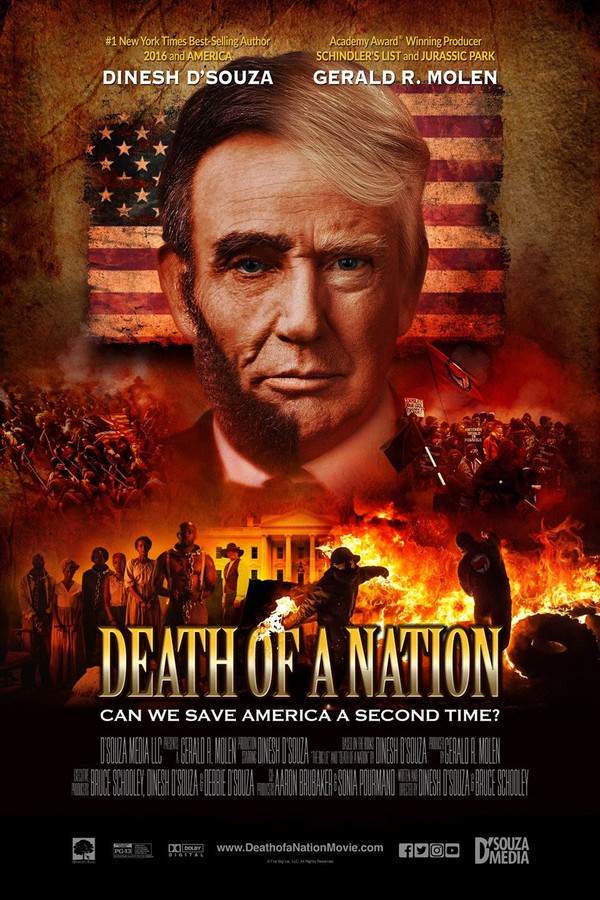
Death of a Nation (2018) movie poster

Plot Summary

Death of a Nation (2018) Plot Summary Explained

Release, runtime and language
2018 · 108 min · English
Echo score 30
Directed by
Dinesh D'Souza, Bruce Schooley
Starring
Pavel Kríz, Richard Spencer, Angela Primm, Debbie D'Souza, James McVan, Karel Dobrý
Budget
$6M

This documentary explores the history of political division in America, drawing parallels between the attacks on Abraham Lincoln in 1860 and the criticism faced by President Trump. It examines the use of divisive tactics and rhetoric throughout history, investigating themes of racism, fascism, and white supremacy. The film aims to reveal the recurring patterns of political vitriol and their impact on the nation.

On this page (6)
  1. 1 Where to watch
  2. 2 What happens: full plot
  3. 3 Plot questions answered
  4. 4 Movie threads
  5. 5 Movies like Death of a Nation
  6. 6 Every angle

Where to watch

Where to Watch Death of a Nation (2018)

Where can you watch Death of a Nation? Stream, rent or buy it in the US, including on Fawesome, Fandango at Home Free and Tubi TV: current JustWatch availability with up-to-date prices.

Streaming availability powered by JustWatch

Full plot summary · contains spoilers

What Happens in Death of a Nation: Full Plot Summary

The whole story of Death of a Nation (2018) explained, from the opening scene to the final frame: every key event, every twist and what it all adds up to. Read it as a quick recap before the sequel, to check a scene you missed, or to finally understand what really happened.

The film Death of a Nation presents an in-depth examination of fascism's origins, tracing its pathways from figures like Adolf Hitler, Pavel Kríž, to Gentile and Mussolini, exploring how these leaders, who regarded themselves as progressives, drew inspiration from various policies in the United States. The narrative utilizes reenactments to illustrate which political factions in the U.S. supported these policies and how they influenced the dictators.

The documentary opens with a haunting depiction of Hitler's demise, which leads into director Dinesh D'Souza's reflections on his early life in India, his fascination with history, and his deep affection for America. He provocatively questions whether America is now under threat from emerging movements, particularly AntiFa. D'Souza posits that Democrats have historically targeted Lincoln: after winning a contentious election, they waged war against him, culminating in his assassination by a Democrat. The film draws parallels between this historical narrative and contemporary political dynamics, suggesting that President Trump and his supporters might now face similar adversities.

Through a series of insightful interviews with scholars and experts on fascism, as well as visits to significant historical sites rendered in dramatic fashion, the movie delves into the evolution of political ideologies. It examines how Margaret Sanger's push for eugenics contributed to Nazi policies on ethnic cleansing, discussions on the Nuremberg trials, and critiques the rebranding of fascist ideology by progressives to falsely associate it with right-wing concepts. D'Souza suggests AntiFa's violent actions mirror the very fascist ideologies they oppose.

The film provocatively queries the origins of systemic racism and white supremacy, challenging viewers to consider which political party historically upheld these phenomena. It features interviews with figures like Richard Spencer, who self-identifies as a socialist rather than a conservative Republican. In its exploration of American slavery, Death of a Nation highlights influential figures such as Woodrow Wilson and FDR, arguing that the roots of racism lie not within the conservative right but rather in the Democratic and progressive ideologies of the left.

As the narrative unfolds, it emphasizes the ideologies that paved the way for Lincoln's election and the lengths to which Democrats went to maintain racial inequality, including the formation of the KKK and Jim Crow laws. In closing, the filmmakers assert that while Trump might not resemble Lincoln in character, he encounters a resistance from the left strikingly similar to Lincoln's experiences, characterized by a slim electoral victory, ongoing efforts to undermine his authority, and an escalating tide of opposition to his vision for America.

The film also features two poignant musical pieces: the director's wife, Debbie D'Souza, performs "O'America" mid-film, while Angela Primm closes the movie with the "Battle Hymn of the Republic," accompanied by a gospel choir, embedding a soundtrack of resilience within this compelling narrative.

Last updated: October 25, 2024 at 11:49

Was this helpful?

Plot questions answered

Death of a Nation Plot Explained: Your Questions Answered

The questions people ask most about Death of a Nation (2018): what happens in the confusing scenes, why the characters do what they do, the twists, hidden details and what the ending means. Each answer contains spoilers.

Q1

What is the main argument of Death of a Nation?

The documentary argues that fascism originated in progressive and left-wing ideologies, not conservative ones. It contends that historical figures like Adolf Hitler and Benito Mussolini drew inspiration from American policies, and claims that modern progressive movements like AntiFa employ tactics similar to the fascism they claim to oppose.

  • fascism
  • progressive
  • documentary thesis
  • anti-fa
Q2

Why does the film compare Abraham Lincoln to Donald Trump?

Dinesh D'Souza argues that both Lincoln and Trump won contentious elections with narrow margins and subsequently faced intense opposition from Democrats. The film suggests both leaders encountered efforts to undermine their authority, including Lincoln's assassination by a Democrat, implying Trump faces similar political resistance.

  • lincoln
  • trump
  • comparison
  • election
  • political opposition
Q3

How does the film connect Margaret Sanger to Nazi Germany?

The documentary argues that Margaret Sanger's advocacy for eugenics and birth control influenced Nazi Germany's policies on ethnic cleansing. It contends that Nazi leaders studied Sanger's work and adopted similar eugenic principles in developing their racial hygiene programs.

  • margaret sanger
  • eugenics
  • nazi
  • germany
  • ethnic cleansing
Q4

What does the film claim about Democrats and the KKK?

The documentary asserts that the Democratic Party historically supported white supremacy, including founding the Ku Klux Klan and implementing Jim Crow laws to maintain racial inequality. It argues that these historical facts contradict contemporary narratives about which political party upholds racist policies.

  • democrats
  • kkk
  • jim crow
  • white supremacy
  • history
Q5

How does the film connect AntiFa to fascism?

D'Souza argues that AntiFa's use of violence, suppression of speech, and intimidation tactics mirror the fascist methods they claim to oppose. The film contends that this irony proves fascism is a left-wing ideology, not a right-wing one.

  • anti-fa
  • antifa
  • fascism
  • violence
  • political tactics
Q6

What does the film say about the origins of fascism?

The documentary argues that fascism originated from progressive and socialist movements, not conservative or capitalist ideologies. It claims that Mussolini, Hitler, and other fascist leaders viewed themselves as progressive reformers and drew policy inspiration from American institutions.

  • fascism
  • origins
  • progressive
  • socialism
  • mussolini
  • hitler
Q7

What does the film claim about Woodrow Wilson and racism?

The documentary argues that Woodrow Wilson, a Democrat and progressive reformer, reinforced systemic racism during his presidency by segregating federal government offices and promoting white supremacist views in his film 'The Birth of a Nation.'

  • woodrow wilson
  • racism
  • segregation
  • birth of a nation
  • progressive
Q8

How does the film connect FDR to racism?

The documentary argues that Franklin D. Roosevelt, a Democrat, continued and expanded discriminatory policies. It claims FDR's New Deal programs excluded many Black Americans and that his administration delayed intervention in the Holocaust.

  • fdr
  • franklin roosevelt
  • discrimination
  • new deal
  • racism
Q9

Why does the film feature Richard Spencer?

The documentary includes an interview with Richard Spencer, who self-identifies as a socialist rather than a conservative Republican. The film uses this to support its argument that white supremacists align with left-wing ideology, not conservative politics.

  • richard spencer
  • socialist
  • white supremacist
  • interview
Q10

What does the film say about the Nuremberg Trials?

The documentary discusses the Nuremberg Trials as an example of accountability for fascist atrocities. It argues that the trials established fascism as a left-wing ideology tied to progressivism, since many defendants claimed they were following progressive-era scientific and social theories.

  • nuremberg trials
  • accountability
  • fascism
  • justice
  • wwii
Q11

Why did Dinesh D'Souza make this documentary?

D'Souza states he made the film because of his deep affection for America and concern about what he perceives as emerging threats, particularly from AntiFa. He questions whether America is facing similar political division and violence as during the Lincoln era.

  • dinesh dsouza
  • motivation
  • director
  • america
  • threats

Movie threads

More Movies Like Death of a Nation, by Mood & Story

Curated lists built around what makes Death of a Nation tick: the same mood, the same kind of story or the same emotional payoff. Each list explains why these movies belong together.

Urgent political documentaries like Death of a Nation

Documentaries that sound an urgent alarm about threats to democracy. This collection features movies like Death of a Nation: tense documentary films that issue strong warnings about societal threats. If you were gripped by its historical parallels and alarming tone, you'll find similar films here that explore fascism, political division, and cautionary tales from history.

  • alarming
  • provocative
  • confrontational
  • sobering
  • ideological
  • urgent
  • Tone: tense, confrontational, alarming
  • Pacing: steady, argument-driven
Why these movies?

The story pattern: These documentaries typically build a structured argument, often moving chronologically or thematically to draw direct parallels between past and present. The narrative arc is one of escalating threat, aiming to persuade the viewer of a specific, urgent danger through evidence and comparison, culminating in a call for awareness or action.

Why they belong together: They are grouped together by their shared mission to provoke and alarm, rather than simply inform. They share a high-intensity, tense tone, a heavy emotional weight due to their subject matter, and a direct, often argumentative approach to filmmaking that prioritizes a specific political perspective.

Movies that draw historical parallels like Death of a Nation

Films that connect past and present through the lens of societal division. Explore films like Death of a Nation that use comparative history to analyze conflict. These movies, whether documentaries or dramas, connect past events like civil wars or the rise of extremism to contemporary issues, offering a similar pattern of historical analysis for viewers who enjoy these thematic connections.

  • historical
  • analytical
  • sobering
  • ideological
  • comparative
  • unsettling
  • Tone: sobering, analytical, historical
  • Pacing: steady, methodical
Why these movies?

The story pattern: The narrative pattern involves establishing a clear historical case study and then meticulously mapping its events, figures, and tactics onto a contemporary situation. The structure is often dialectical, moving back and forth between time periods to highlight similarities, and building towards a conclusion about the significance of these recurring patterns.

Why they belong together: These films are united by their methodological focus on comparison. They share a sobering, historical mood, a moderate complexity from weaving together different timelines, and a thematic focus on deep-seated societal issues like racism, political violence, and ideological warfare that transcend a single era.

If you liked this

Movies Like Death of a Nation

Similar movies to Death of a Nation: the same genre, themes or kind of story. Each one comes with its own plot summary, timeline and ending explained.

Browse all movie summaries

Every angle

Death of a Nation (2018) Explained: Plot, Timeline & Characters

Everything about Death of a Nation in one place: what happens in the plot summary, the timeline in chronological order, the characters and meaning and a spoiler-free summary. What's After the Movie adds the cast, box office and post-credit scenes.

Coming soon on iOS and Android

The Plot Explained Movie Summary App

Plot summaries, endings explained and timelines on your phone. Catch up on any movie in minutes, save your favorites and never miss a twist again.

Be the first to know when we launch. Your email stays private, always.

Learn more about the app