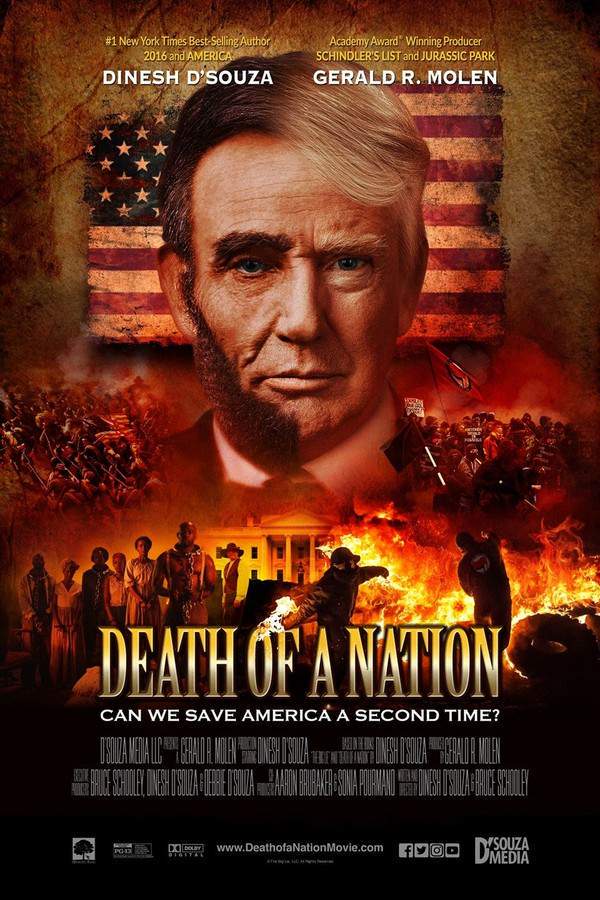
Death of a Nation

Death of a Nation

Year: 2018

Runtime: 108 min

Language: english

Directors: Dinesh D'Souza, Bruce Schooley

Echo Score: 30

Budget: $6M

HistoryDocumentary

This documentary explores the history of political division in America, drawing parallels between the attacks on Abraham Lincoln in 1860 and the criticism faced by President Trump. It examines the use of divisive tactics and rhetoric throughout history, investigating themes of racism, fascism, and white supremacy. The film aims to reveal the recurring patterns of political vitriol and their impact on the nation.

Where to Watch Death of a Nation?

Find where to stream, rent, or buy Death of a Nation (2018) in the US with current JustWatch availability, up-to-date pricing, and platform listings for subscription, rental, and digital purchase options.

Warning: spoilers below!

Haven’t seen Death of a Nation yet? This summary contains major spoilers. Bookmark the page, watch the movie, and come back for the full breakdown. If you're ready, scroll on and relive the story!

Timeline – Death of a Nation (2018)

Trace every key event in Death of a Nation (2018) with our detailed, chronological timeline. Perfect for unpacking nonlinear stories, spotting hidden connections, and understanding how each scene builds toward the film’s climax. Whether you're revisiting or decoding for the first time, this timeline gives you the full picture.

1

Hitler's Demise

The film opens with a haunting depiction of Adolf Hitler's last moments, illustrating the dramatic and tragic end of one of history's most notorious figures. This incident serves as a catalyst for exploring the broader themes of fascism and its origins.

2

Dinesh D'Souza's Reflections

Director Dinesh D'Souza reflects on his early life in India, sharing his fascination with historical events and the pivotal role they play in shaping modern ideologies. His deep affection for America is evident as he raises critical questions about contemporary political threats.

3

Historical Parallels

D'Souza draws parallels between the past and present, arguing that Democrats have strategically targeted figures like Abraham Lincoln. He highlights the contentious election that led to Lincoln's presidency and the subsequent efforts to undermine him, culminating in his assassination.

4

Exploring Fascism's Influences

Through reenactments and expert interviews, the film examines the influences of various political factions in the U.S. that inspired figures like Mussolini and Hitler. This includes a critical look at policies that paved the way for fascist ideologies in the early 20th century.

5

Margaret Sanger and Eugenics

The narrative explores Margaret Sanger's advocacy for eugenics and its chilling contributions to Nazi policies on ethnic cleansing. This portion of the film illustrates how these progressive ideas can become intertwined with deeply harmful ideologies.

6

The Nuremberg Trials Discussion

The film features discussions on the Nuremberg Trials, focusing on the consequences faced by Nazi leaders for their actions during World War II. This segment serves to connect past atrocities with current political climates and the legacy of accountability.

7

AntiFa and Fascism

D'Souza provocatively argues that the violent actions of AntiFa mirror the fascist ideologies they oppose. This claim sparks discussions about the modern interpretation of fascism and the complexities of political labels in contemporary society.

8

Systemic Racism Origins

The film challenges viewers to consider the sources of systemic racism and white supremacy within American politics. It prompts an exploration of which political parties have historically perpetuated these issues, shifting the focus from the right to the left.

9

Influential Figures in Racism

The documentary highlights influential historical figures like Woodrow Wilson and Franklin D. Roosevelt, emphasizing their roles in racial oppression. This segment argues that the roots of racism lie deeply embedded in Democratic and progressive ideologies, contradicting common narratives.

10

Democrats and the KKK

As the film unfolds, it addresses the lengths to which Democrats historically went to maintain racial inequality. It discusses the formation of the Ku Klux Klan and the introduction of Jim Crow laws, revealing the turbulent racial history of America.

11

Trump and Lincoln

The filmmakers assert that while President Trump may not resemble Lincoln in character, he faces challenges eerily similar to those encountered by Lincoln. This includes a narrow electoral victory and persistent opposition from the left, echoing historical struggles.

12

Musical Performances

The film features poignant musical segments that enhance its emotional depth. Notably, Debbie D'Souza performs 'O'America' at a critical moment, while Angela Primm closes the film with the 'Battle Hymn of the Republic,' invoking a sense of resilience.

13

Political Dynamics Reflection

The narrative critically examines contemporary political dynamics, considering the ongoing adversities faced by those who hold similar beliefs to Lincoln. It posits that current political factions are drawing from historical events to inform their strategies and positions.

14

Enduring Themes of Resistance

In closing, the film encapsulates the enduring themes of resistance and the cyclical nature of political struggles. It challenges viewers to reflect on the parallels between past and present, allowing for a deeper understanding of America's political landscape.

Last updated: October 25, 2024 at 11:49

Was this helpful?

Death of a Nation (2018) Timeline Questions Answered – Chronology FAQ

Find frequently asked questions about the Death of a Nation (2018) timeline, including chronological order, nonlinear jumps, cause-and-effect links, and scene sequence clarifications. This timeline FAQ helps explain when key events happen, how moments connect, and why the story unfolds in that specific order.

Q1

What is the main argument of Death of a Nation?

A.

The documentary argues that fascism originated in progressive and left-wing ideologies, not conservative ones. It contends that historical figures like Adolf Hitler and Benito Mussolini drew inspiration from American policies, and claims that modern progressive movements like AntiFa employ tactics similar to the fascism they claim to oppose.

fascismprogressivedocumentary thesisanti-fa
Q2

Why does the film compare Abraham Lincoln to Donald Trump?

A.

Dinesh D'Souza argues that both Lincoln and Trump won contentious elections with narrow margins and subsequently faced intense opposition from Democrats. The film suggests both leaders encountered efforts to undermine their authority, including Lincoln's assassination by a Democrat, implying Trump faces similar political resistance.

lincolntrumpcomparisonelectionpolitical opposition
Q3

How does the film connect Margaret Sanger to Nazi Germany?

A.

The documentary argues that Margaret Sanger's advocacy for eugenics and birth control influenced Nazi Germany's policies on ethnic cleansing. It contends that Nazi leaders studied Sanger's work and adopted similar eugenic principles in developing their racial hygiene programs.

margaret sangereugenicsnazigermanyethnic cleansing
Q4

What does the film claim about Democrats and the KKK?

A.

The documentary asserts that the Democratic Party historically supported white supremacy, including founding the Ku Klux Klan and implementing Jim Crow laws to maintain racial inequality. It argues that these historical facts contradict contemporary narratives about which political party upholds racist policies.

democratskkkjim crowwhite supremacyhistory
Q5

How does the film connect AntiFa to fascism?

A.

D'Souza argues that AntiFa's use of violence, suppression of speech, and intimidation tactics mirror the fascist methods they claim to oppose. The film contends that this irony proves fascism is a left-wing ideology, not a right-wing one.

anti-faantifafascismviolencepolitical tactics
Q6

What does the film say about the origins of fascism?

A.

The documentary argues that fascism originated from progressive and socialist movements, not conservative or capitalist ideologies. It claims that Mussolini, Hitler, and other fascist leaders viewed themselves as progressive reformers and drew policy inspiration from American institutions.

fascismoriginsprogressivesocialismmussolinihitler
Q7

What does the film claim about Woodrow Wilson and racism?

A.

The documentary argues that Woodrow Wilson, a Democrat and progressive reformer, reinforced systemic racism during his presidency by segregating federal government offices and promoting white supremacist views in his film 'The Birth of a Nation.'

woodrow wilsonracismsegregationbirth of a nationprogressive
Q8

How does the film connect FDR to racism?

A.

The documentary argues that Franklin D. Roosevelt, a Democrat, continued and expanded discriminatory policies. It claims FDR's New Deal programs excluded many Black Americans and that his administration delayed intervention in the Holocaust.

fdrfranklin rooseveltdiscriminationnew dealracism
Q9

Why does the film feature Richard Spencer?

A.

The documentary includes an interview with Richard Spencer, who self-identifies as a socialist rather than a conservative Republican. The film uses this to support its argument that white supremacists align with left-wing ideology, not conservative politics.

richard spencersocialistwhite supremacistinterview
Q10

What does the film say about the Nuremberg Trials?

A.

The documentary discusses the Nuremberg Trials as an example of accountability for fascist atrocities. It argues that the trials established fascism as a left-wing ideology tied to progressivism, since many defendants claimed they were following progressive-era scientific and social theories.

nuremberg trialsaccountabilityfascismjusticewwii
Q11

Why did Dinesh D'Souza make this documentary?

A.

D'Souza states he made the film because of his deep affection for America and concern about what he perceives as emerging threats, particularly from AntiFa. He questions whether America is facing similar political division and violence as during the Lincoln era.

dinesh dsouzamotivationdirectoramericathreats
Mobile App Preview

Coming soon on iOS and Android

The Plot Explained Mobile App

From blockbusters to hidden gems - dive into movie stories anytime, anywhere. Save your favorites, discover plots faster, and never miss a twist again.

Sign up to be the first to know when we launch. Your email stays private, always.

Explore Movie Threads

Discover curated groups of movies connected by mood, themes, and story style. Browse collections built around emotion, atmosphere, and narrative focus to easily find films that match what you feel like watching right now.

Urgent political documentaries like Death of a Nation

Documentaries that sound an urgent alarm about threats to democracy.This collection features movies like Death of a Nation: tense documentary films that issue strong warnings about societal threats. If you were gripped by its historical parallels and alarming tone, you'll find similar films here that explore fascism, political division, and cautionary tales from history.

alarmingprovocativeconfrontationalsoberingideologicalurgentcautionary

Narrative Summary

These documentaries typically build a structured argument, often moving chronologically or thematically to draw direct parallels between past and present. The narrative arc is one of escalating threat, aiming to persuade the viewer of a specific, urgent danger through evidence and comparison, culminating in a call for awareness or action.

Why These Movies?

They are grouped together by their shared mission to provoke and alarm, rather than simply inform. They share a high-intensity, tense tone, a heavy emotional weight due to their subject matter, and a direct, often argumentative approach to filmmaking that prioritizes a specific political perspective.
Movies that draw historical parallels like Death of a Nation

Films that connect past and present through the lens of societal division.Explore films like Death of a Nation that use comparative history to analyze conflict. These movies, whether documentaries or dramas, connect past events like civil wars or the rise of extremism to contemporary issues, offering a similar pattern of historical analysis for viewers who enjoy these thematic connections.

historicalanalyticalsoberingideologicalcomparativeunsettlingthought-provoking

Narrative Summary

The narrative pattern involves establishing a clear historical case study and then meticulously mapping its events, figures, and tactics onto a contemporary situation. The structure is often dialectical, moving back and forth between time periods to highlight similarities, and building towards a conclusion about the significance of these recurring patterns.

Why These Movies?

These films are united by their methodological focus on comparison. They share a sobering, historical mood, a moderate complexity from weaving together different timelines, and a thematic focus on deep-seated societal issues like racism, political violence, and ideological warfare that transcend a single era.

Unlock the Full Story of Death of a Nation

Don't stop at just watching - explore Death of a Nation in full detail. From the complete plot summary and scene-by-scene timeline to character breakdowns, thematic analysis, and a deep dive into the ending - every page helps you truly understand what Death of a Nation is all about. Plus, discover what's next after the movie.

Death of a Nation Summary

Read a complete plot summary of Death of a Nation, including all key story points, character arcs, and turning points. This in-depth recap is ideal for understanding the narrative structure or reviewing what happened in the movie.

Death of a Nation Summary

Characters, Settings & Themes in Death of a Nation

Discover the characters, locations, and core themes that shape Death of a Nation. Get insights into symbolic elements, setting significance, and deeper narrative meaning - ideal for thematic analysis and movie breakdowns.

Characters, Settings & Themes in Death of a Nation

Death of a Nation Spoiler-Free Summary

Get a quick, spoiler-free overview of Death of a Nation that covers the main plot points and key details without revealing any major twists or spoilers. Perfect for those who want to know what to expect before diving in.

Death of a Nation Spoiler-Free Summary

More About Death of a Nation

Visit What's After the Movie to explore more about Death of a Nation: box office results, cast and crew info, production details, post-credit scenes, and external links - all in one place for movie fans and researchers.

More About Death of a Nation