Plot Explained Spoilers guaranteed!
Plot Explained

Browse by genre

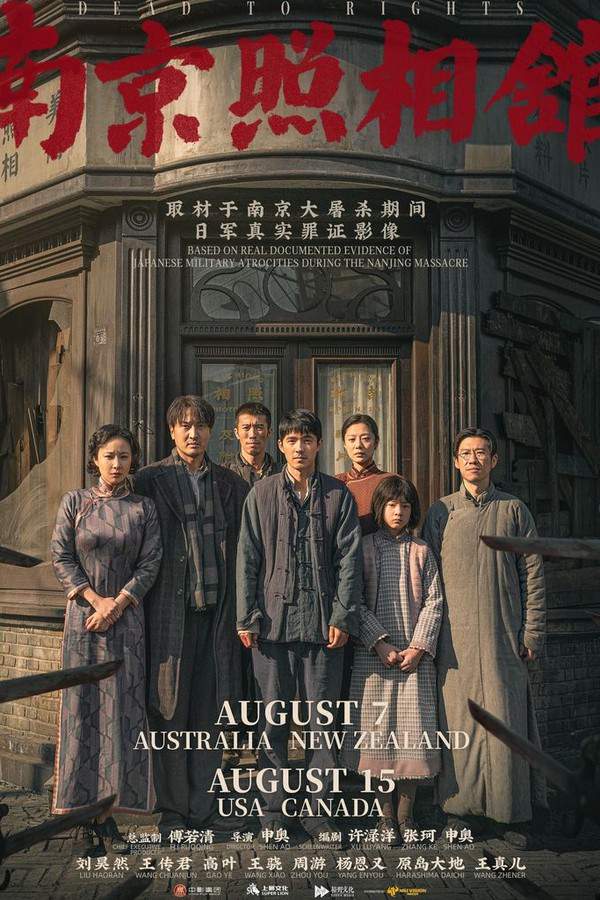
Dead to Rights (2025) movie poster

Characters & Themes

Dead to Rights (2025) Characters, Setting & Themes Explained

Release, runtime and language
2025 · 2 h 17 m · Chinese
Echo score 93
Loading streaming availability…
Directed by
Ao Shen
Starring
Haoyu Yang, Haoran Liu, You Zhou, Daichi Harashima, Xiao Wang, Chuan-jun Wang

Set amid the 1937 Nanjing Massacre, postman A Chang masquerades as a photo developer, cooperating with Japanese troops while covertly sheltering Chinese refugees. He ultimately risks his life to evacuate them and expose photographic proof of the brutal atrocities.

On this page (7)
  1. 1 Where to watch
  2. 2 Characters explained (7)
  3. 3 Where & when it takes place
  4. 4 Themes & meaning (3)
  5. 5 Character & meaning questions
  6. 6 Movie threads
  7. 7 Every angle
Loading streaming availability…

7 main characters · contains spoilers

Dead to Rights Characters Explained: Who Is Who

The main characters of Dead to Rights (2025), heroes and villains: what drives them, how they change over the course of the story and what each of them reveals about the film's bigger ideas.

  • Itō Hideo (Daichi Harashima)

    A Japanese military photographer assigned to document the massacre. He begins with a veneer of civility but reveals a capacity for cruelty, participating in or endorsing atrocities to prove loyalty. He tests and ultimately manipulates the studio workers, and, after failing to prevent exposure of the truth, commits suicide rather than face accountability.

    • 🎭 Villain
    • 📷 War photography
    • 🗡️ Cruelty
  • Wang Guanghai (Chuan-jun Wang)

    A quisling translator who helps the Japanese consolidate control over Nanjing. He leverages fear and the promise of passports to pressure others, and he orchestrates dangerous ruses to secure benefits for his own family at the expense of others. His opportunism intensifies the danger faced by Lin and the studio group.

    • 🤝 Collaboration
    • 🗺️ Occupation
    • 💢 Exploitation
  • Lin Yuxiu (Ye Gao)

    An opera actress who performs to survive under occupation and becomes romantically entangled with Wang. She proves loyalty to China by risking everything, including hiding Song Cunyi and revealing the existence of a family in the studio. She endures humiliation yet remains resilient as the group presses toward an escape.

    • 🎭 Survivor
    • 💃 Performer
    • 🗝️ Loyalty
  • Jin Chengzong (Xiao Wang)

    A studio owner who uses his space for shelter and leverage, ultimately sacrificing himself to enable Lin and the infant to reach the Nanjing Safety Zone. He negotiates danger and death with quiet resolve, helping to keep the group alive long enough to pursue safety and justice.

    • 🛡️ Protector
    • 🧠 Strategist
    • 💪 Courage
  • Song Cunyi (You Zhou)

    A hidden soldier smuggled into the studio who becomes a crucial ally. He commits to protecting the group and sacrifices himself by martyring during a mission, enabling others to survive within the studio’s fragility.

    • 🗡️ Sacrifice
    • 🛡️ Ally
    • 🪖 Soldier
  • Ah Chang

    The postman who lies to protect himself and helps develop the photographs, acting as a bridge between the studio and the outside world. His trust is betrayed, and he dies in the fire while trying to cover up the truth behind the negatives.

    • 🗝️ Trust
    • 📷 Photography
    • 🛡️ Survivor
  • Jin Wanyi (Enyou Yang)

    The infant son of Jin Chengzong who becomes the focus of the group’s survival plan. The quest to safeguard him drives the protagonists to accept dangerous risks and make difficult choices, culminating in a flight for safety with Lin.

    • 👶 Innocence
    • 🛡️ Protector
    • 🧭 Hope

Last updated: October 01, 2025 at 12:45

Was this helpful?

Setting

Where and When Does Dead to Rights Take Place?

The setting of Dead to Rights (2025): the year and time period, the places and locations, and how they shape the characters, the mood and the tension of the story.

Time period

1937–1938

The events take place during the late 1930s when Japan's invasion of China culminates in the Nanjing Massacre. The film portrays the chaotic months of occupation, cold calculations for survival, and the attempt to document atrocities for global audiences. This period is defined by mass violence, censorship, and the international reaction to the crimes.

Location

Nanjing, China

Nanjing is depicted as a city under brutal occupation during the Second Sino-Japanese War. The story unfolds around a cramped photo studio that becomes a microcosm of survival amid killings, looting and public terror. The setting emphasizes the precarious line between life and death as civilians endure the occupation's violence.

  • 🗺️ Nanjing under Japanese occupation
  • 🏙️ War-torn city
  • ⚔️ Mass atrocities

Last updated: October 01, 2025 at 12:45

Was this helpful?

3 major themes

Dead to Rights Meaning: Themes & Message Explained

What is Dead to Rights (2025) really about? The emotional, social and philosophical themes the film keeps returning to, its symbolism and the message beneath the surface.

  • War Crimes

    The narrative centers on the mass killings, sexual violence, and looting that accompany the occupation. It questions how easily photographs can be weaponized for propaganda and how survivors bear witness to atrocities. The film follows characters who navigate moral compromises to document and expose the crimes. It also contrasts the brutality of occupation with acts of courage and resistance.

  • Propaganda & Photography

    Images become currency in the occupation: the Japanese use photography to manufacture a narrative, while the studio crew fights to reveal the truth. The development process mirrors the manipulation of memory, blurring lines between truth and staged harmony. As negatives are discovered and duplicated, the group battles to ensure real events reach a wider world. The theme raises questions about responsibility of photographers and witnesses.

  • Survival & Loyalty

    In the face of terror, families and strangers form precar alliances to protect each other. Characters are forced to choose between loyalty to country, family, or their own survival, often at a heavy cost. The resolution hinges on whether they can preserve evidence of the crimes and reach safety. The narrative frames survival as both a personal and moral test.

Last updated: October 01, 2025 at 12:45

Was this helpful?

Character & theme questions

Dead to Rights Characters & Meaning: Your Questions Answered

The questions people ask about Dead to Rights (2025): who the characters really are, their relationships, what the symbols mean, where it takes place and what the movie is really about. Each answer contains spoilers.

Q1

What is the setting of the movie?

The film takes place in Nanjing, China, during the Japanese occupation following the Nanjing Massacre. The primary setting is a cramped photo studio that serves as both a workplace and a hidden refuge for Chinese civilians. The city is depicted as a war-torn landscape of killings, looting, and public terror, where survival hangs by a thread.

  • nanjing
  • nanjing massacre
  • china
  • japanese occupation
  • photo studio
  • war setting
Q2

When does the story take place?

The events occur during 1937–1938, specifically during the infamous Nanjing Massacre when Japan's invasion of China reached its brutal peak. This period was defined by mass violence, strict censorship, and the desperate attempt by witnesses to document atrocities for international audiences.

  • 1937
  • 1938
  • nanjing massacre
  • second sino-japanese war
  • historical period
Q3

What role does the photo studio play in the story?

The photo studio serves as the central microcosm of survival in the film. It functions as both a literal shelter for refugees and a metaphorical space where truth and manipulation collide. The Japanese military uses photography to manufacture propaganda, while the studio workers secretly develop evidence of the atrocities.

  • photo studio
  • photography
  • propaganda
  • nanjing
  • evidence
  • negatives
Q4

What are the main themes of the film?

The film explores three interconnected themes: War Crimes, documenting the mass killings and sexual violence of the occupation; Propaganda & Photography, examining how images are weaponized to manipulate truth and memory; and Survival & Loyalty, focusing on the moral compromises characters make to protect each other while preserving evidence of the crimes.

  • war crimes
  • propaganda
  • photography
  • survival
  • loyalty
  • themes
  • nanjing massacre
Q5

How does the film address propaganda and photography?

The film portrays photography as a currency of power during occupation, Japanese forces use it to manufacture a false narrative of order, while the studio crew fights to reveal the actual atrocities. The development process becomes a metaphor for how memory is manipulated, blurring the line between truth and staged harmony as the characters battle to get real evidence to the outside world.

  • propaganda
  • photography
  • truth
  • memory
  • evidence
  • negatives
  • documentary
Q6

Who is Itō Hideo in the film?

Itō Hideo (real name Daichi Harashima) is a Japanese military photographer assigned to document the massacre. He initially presents a veneer of civility but reveals a capacity for cruelty, actively participating in or endorsing atrocities to prove his loyalty to the military. He manipulates the studio workers and ultimately commits suicide when he fails to prevent the truth from being exposed.

  • ito hideo
  • daichi harashima
  • japanese photographer
  • military
  • atrocities
  • suicide
Q7

Who is Wang Guanghai and what motivates him?

Wang Guanghai is a quisling translator who collaborates with Japanese forces to help consolidate control over Nanjing. He uses fear and the promise of passports to pressure others into compliance, orchestrating dangerous ruses to secure benefits for his own family at the expense of others. His opportunism creates additional danger for Lin and the studio group.

  • wang guanghai
  • translator
  • quisling
  • collaborator
  • opportunism
  • passport
Q8

Who is Lin Yuxiu and what is her role?

Lin Yuxiu is an opera actress who performs under occupation to survive. She becomes romantically entangled with Wang Guanghai but ultimately proves her loyalty to China by risking everything, including hiding Song Cunyi and revealing a hidden family in the studio. She endures humiliation yet remains resilient as the group works toward escape.

  • lin yuxiu
  • opera actress
  • survival
  • loyalty
  • china
  • resistance
Q9

Who is Jin Chengzong and why is he important?

Jin Chengzong is the owner of the photo studio who uses his space to shelter refugees and leverage against danger. He negotiates with threat and death with quiet resolve, ultimately sacrificing himself to enable Lin and the infant Jin Wanyi to reach the Nanjing Safety Zone. His selflessness helps keep the group alive long enough to pursue safety and justice.

  • jin chengzong
  • studio owner
  • sacrifice
  • safety zone
  • father
  • infant
Q10

Who is Song Cunyi and what happens to him?

Song Cunyi is a hidden soldier smuggled into the studio who becomes a crucial ally to the group. He commits to protecting the others and ultimately sacrifices himself by martyring during a mission, enabling others to survive within the studio's fragile ecosystem.

  • song cunyi
  • hidden soldier
  • martyr
  • sacrifice
  • protection
Q11

Who is Ah Chang and what is his role?

Ah Chang is a postman who masquerades as a photo developer while cooperating with Japanese troops, though he covertly shelters Chinese refugees. He acts as a bridge between the studio and the outside world. His trust is ultimately betrayed, and he dies in a fire while trying to cover up the truth behind the photographic negatives.

  • ah chang
  • postman
  • photo developer
  • refugee
  • fire
  • death
Q12

Who is Jin Wanyi and why is the infant important?

Jin Wanyi is the infant son of Jin Chengzong. The quest to safeguard him becomes the driving force behind the protagonists' survival plan. The group accepts dangerous risks and makes difficult choices specifically to protect the child, culminating in a desperate flight for safety with Lin.

  • jin wanyi
  • infant
  • baby
  • child
  • survival
  • protection
  • escape
Q13

How do characters make moral choices under occupation?

Characters in the film are forced to navigate impossible moral compromises, collaborating with occupiers while secretly resisting, documenting atrocities at personal risk, and choosing between family loyalty and broader survival. The narrative frames survival as both a personal and moral test, where every choice carries weight beyond individual life or death.

  • moral choices
  • occupation
  • survival
  • loyalty
  • ethics
  • collaboration
  • resistance
Q14

What is the central conflict between truth and propaganda?

The film centers on the clash between Japanese forces using photography to create a false narrative of the occupation, and the studio workers fighting to develop and expose genuine evidence of the mass atrocities. This conflict raises questions about the responsibility of photographers and witnesses in documenting war crimes and ensuring the truth reaches a wider world.

  • truth
  • propaganda
  • evidence
  • atrocities
  • documentation
  • witnesses
  • responsibility

Movie threads

More Movies Like Dead to Rights, by Mood & Story

Curated lists built around what makes Dead to Rights tick: the same mood, the same kind of story or the same emotional payoff. Each list explains why these movies belong together.

Movies about courageous witnesses like in Dead to Rights

Stories of ordinary people who risk everything to document and expose terrible truths. If you were gripped by the act of bearing witness in Dead to Rights, this list is for you. Discover similar war dramas and historical films where characters risk their lives to expose atrocities, documenting truth against all odds in morally complex and tense scenarios.

  • tense
  • somber
  • courageous
  • morally complex
  • claustrophobic
  • anxious
  • Tone: dark, tense, morally complex
  • Pacing: variable, suspenseful
Why these movies?

The story pattern: Films in this thread follow a pattern of discovery, moral crisis, and clandestine action. A character is thrust into a position where they see a grave injustice or atrocity. Faced with immense personal risk, they make a covert plan to gather proof and expose the truth, creating a narrative defined by tension, sacrifice, and the power of evidence.

Why they belong together: These films are grouped because they all explore the specific, high-stakes narrative of bearing witness. They share a focus on moral courage, the psychological toll of keeping terrible secrets, and the tension of operating under the enemy's nose. The experience is consistently tense, somber, and focused on the power of truth.

Grim survival stories with moral compromise like Dead to Rights

Gripping stories where survival demands walking a fine, dangerous line with the enemy. For viewers who appreciated the complex survival tactics in Dead to Rights. Explore more movies like it, featuring characters forced into difficult alliances or morally ambiguous actions to protect themselves and others in war zones and oppressive settings, resulting in heavy, tense dramas.

  • oppressive
  • tense
  • morally complex
  • anxious
  • grim
  • claustrophobic
  • Tone: grim, oppressive, anxious
  • Pacing: variable, shifting between suspense and chaos
Why these movies?

The story pattern: The narrative arc here is defined by a Faustian bargain. A character, to ensure their own or others' survival, enters into a fragile and ethically fraught arrangement with a hostile force. The story builds tension from the precariousness of this arrangement and the protagonist's struggle with their own conscience, culminating in a test of their ultimate loyalty.

Why they belong together: These movies are united by their exploration of the gray areas of survival. They focus on the psychological and emotional cost of making deals with the devil, creating a consistently oppressive and anxious mood. The shared experience is one of high-stakes tension and deep moral questioning.

Every angle

Dead to Rights (2025) Explained: Plot, Timeline & Characters

Everything about Dead to Rights in one place: what happens in the plot summary, the timeline in chronological order, the characters and meaning and a spoiler-free summary. What's After the Movie adds the cast, box office and post-credit scenes.

Coming soon on iOS and Android

The Plot Explained Movie Summary App

Plot summaries, endings explained and timelines on your phone. Catch up on any movie in minutes, save your favorites and never miss a twist again.

Be the first to know when we launch. Your email stays private, always.

Learn more about the app