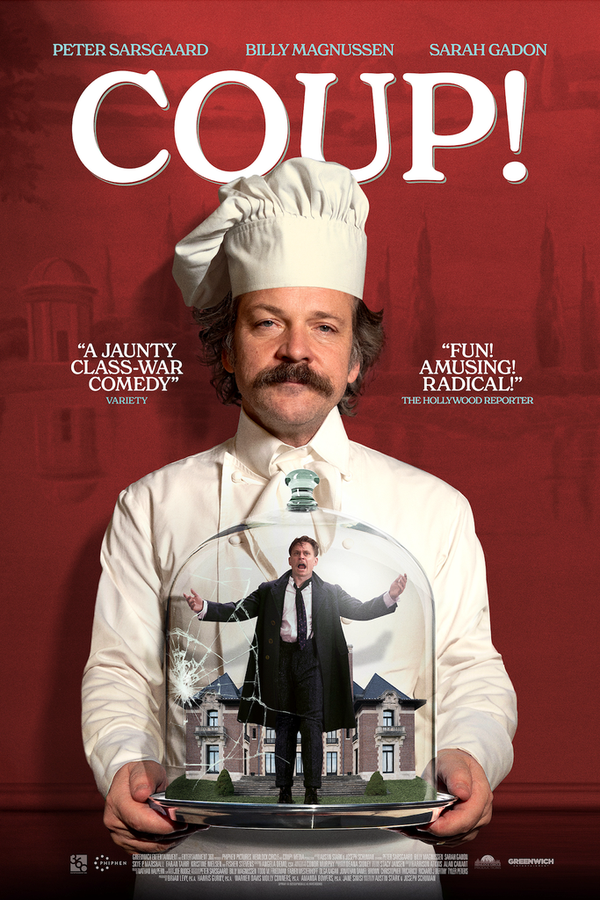
Plot Summary
Coup! (2024) Plot Summary & Ending Explained
- Release, runtime and language
- 2024 · 1 h 38 m · English
- Echo score 68
- Loading streaming availability…
- Directed by
- Austin Stark, Joseph Schuman
- Starring
- Peter Sarsgaard, Billy Magnussen, Sarah Gadon, Fisher Stevens, Kristine Nielsen, Faran Tahir
A journalist and his socialite wife are taken by surprise when a charming con artist arrives as their private chef at their coastal estate. Unbeknownst to the couple, a strange illness is affecting the staff, creating an atmosphere of rising tension. The resourceful chef secretly plots a daring rebellion against the wealthy hosts, leading to a suspenseful and unpredictable power struggle.
On this page (5)
Full plot summary
Coup! (2024) Plot Summary Coming Soon
We are working on the full plot summary and ending explained of Coup! (2024). Check back soon, or request it now to move it up the list.
Ending explained
What Happens at the End of Coup!?
How Coup! (2024) ends, in short: the final scene, the last twist and what it means for the characters. The full ending explained, with every spoiler, lives on its own page.
Floyd’s ultimate fate in the movie serves as a culmination of the story’s core themes, especially the idea that social hierarchies are deeply ingrained and resistant to genuine change. Throughout the film, Floyd, who initially appears as a charming but suspicious outsider, reveals that he is not the real Floyd Monk but a man from the working class seeking revenge and justice against the oppressive upper class, to which Jay and his family belong. His true purpose is to shake up the comfortable, insulated life of the mansion’s inhabitants and expose their ignorance and complicity in societal inequality. When Floyd is finally shot and killed by Jay, it symbolically signifies the tragic failure of revolutionary effort within a system that is too entrenched to be fundamentally altered by violence or individual acts.
In his death, Floyd achieves many of his goals — he outsmarts Jay, takes Jules’ affections fleetingly, and demonstrates that the social divide can be turned upside down — yet the broader impact remains limited. Jay, now appearing as a hero who saved his family, returns to his oppressive life, and Jules chooses to ignore the truth of what transpired. The death of Floyd signifies that, despite moments of rebellion and upheaval, the existing power structures and societal hierarchies largely persist. Floyd’s demise isn’t just about killing a man; it’s about illustrating that radical change, especially through violence, rarely rewires the ingrained social fabric but often reinforces it. Ultimately, the ending leaves viewers with the idea that true societal transformation requires more than just drastic acts — it demands deep, systemic change that cannot be achieved through individual revenge or covert coups. Floyd’s death is both an individual triumph and a tragic reminder of the stubbornness of societal inequality.
Continue reading the ending (6 more paragraphs)
Floyd’s death in the film symbolizes the futility of attempting to fundamentally alter an entrenched social hierarchy through violent rebellion. Throughout the story, Floyd, who is not actually the original Floyd Monk but a man driven by resentment against the upper class, aims to deliver a lesson by infiltrating and destabilizing Jay’s mansion. His ultimate act of being shot by Jay signifies the failure of revolution to truly dismantle systemic inequality. Although Floyd manages to overturn Jay’s authority temporarily, he also manages to seduce Jules and fulfill his personal vendetta, suggesting that he has achieved his goals of exposing the hypocrisy and fragility of the upper classes.
However, the broader message is that violence or individual acts of defiance rarely lead to lasting societal change. After Floyd’s death, Jay and Jules return to their privileged lives, with Jules choosing silence and normalcy, in spite of their moral conflict. This highlights a bleak reality: despite moments of chaos and rebellion, the top-down social order remains largely intact. Floyd’s death, therefore, functions as both a personal victory for him — as an agent of upheaval — and a tragic symbol of how deeply rooted inequalities persist, unaffected by individual acts of defiance. The film suggests that genuine change requires more than coups or violence; it demands systemic overhaul, which seems unlikely to occur merely through the destructions Floyd initiated. In the end, Floyd’s death underscores the stubbornness of societal hierarchy and the tragic limits of rebellion within it.
Floyd’s death signifies the fleeting nature of rebellion against an unchanging social order. He successfully undermines Jay, exposes his hypocrisy, and briefly disrupts the stability of the mansion, achieving his personal vendetta and delivering his lesson. But in the larger scheme, Floyd’s death—that final act of violence—does little to alter the society that created such divides. Jay, recovering from his weakness, ultimately reverts to his role as the archetypal privileged elite, shooting Floyd to restore his sense of control and normalcy.
This ending suggests that real societal change is elusive; violence and coups may temporarily shake the surface, but they rarely dismantle the deep-rooted inequalities. Floyd’s death is a tragic reminder that systemic oppression is resilient, and the structures that uphold class divisions tend to survive individual upheavals. While Floyd might have momentarily succeeded in his revolutionary act, the film posits that lasting transformation requires more than violent revolt—it calls for systemic change that is far more complex and difficult. Floyd's demise symbolizes both his personal victory in exposing the rot beneath the façade and the grim reality that entrenched power and inequality tend to withstand even the most dramatic upheavals.
Floyd’s death highlights the tragic truth that efforts to overthrow a deeply rooted social hierarchy often end in failure and loss. Although he manages to outsmart and temporarily destabilize Jay, and even win Jules’s affection, his death symbolizes the persistent strength of the class system in the long run. Jay’s revenge — shooting Floyd and assuming his position — restores the status quo, ensuring that the social divide remains intact.
This conclusion reinforces the idea that revolutionary acts, especially violent ones, rarely produce lasting change. Floyd, despite his success in exposing the corrupt elite, ultimately becomes a martyr whose death underscores the resilience of the societal structures that keep the wealthy and powerful in their place. The film suggests that true transformation requires more than chaos and revenge; it demands systemic reform, which seems unlikely to happen just through individual acts of rebellion. Floyd’s death is both a personal victory, as he destroys the illusion of the perfect social order, and a tragic reminder that real societal change is extraordinarily difficult, if not impossible, to achieve through violence alone. In the end, his demise signifies that the oppressive hierarchy is stubborn, and any attempt to overthrow it is likely to be only temporarily effective, leaving the fundamental inequality unaltered.
If you liked this
Movies Like Coup!
Similar movies to Coup!: the same genre, themes or kind of story. Each one comes with its own plot summary, timeline and ending explained.
The Cook, the Thief, His Wife & Her Lover
1990

The Cook, the Thief, His Wife & Her Lover
1989

Who Is Killing the Great Chefs of Europe?
1978

Rough Cut
1980
Eating Raoul
1982

Cum to live
2001
Amuck!
1972

Duet for Cannibals
1969
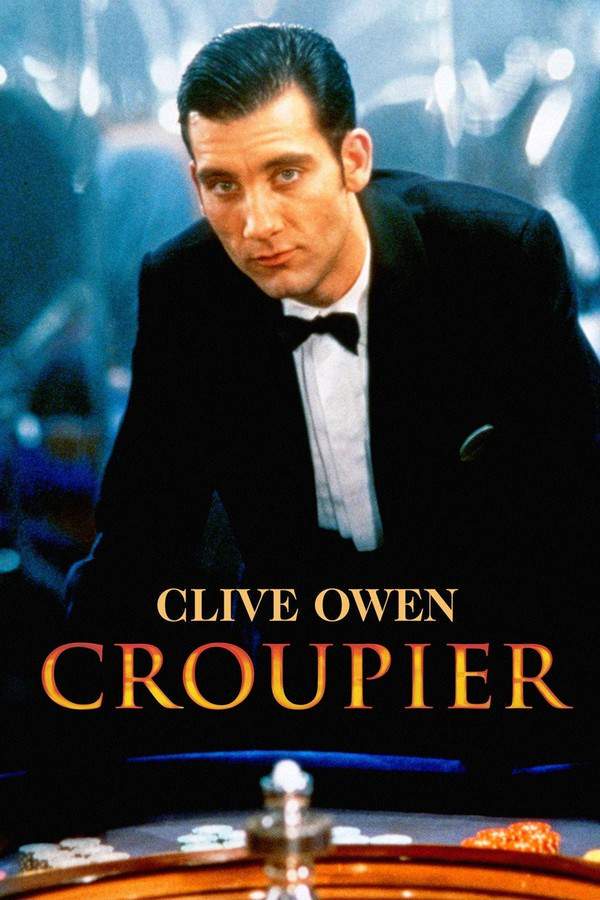
Croupier
2000

A Night at the Ritz
1935

Headhunters
2012

Vicious and Nude
1980
Every angle
Coup! (2024) Explained: Plot, Ending, Timeline & Characters
Everything about Coup! in one place: what happens in the plot summary, the timeline in chronological order, the characters and meaning, the ending explained. What's After the Movie adds the cast, box office and post-credit scenes.
- Coup! Timeline Every key event in chronological order, ideal for flashbacks and time jumps.
- Coup! Characters & Themes Who is who, where it takes place and what the movie really means.
- Coup! Ending Explained What happens at the end, the final scene and what it means.
- Coup! on What's After the Movie Cast and crew, box office, post-credit scenes and more.
Coming soon on iOS and Android
The Plot Explained Movie Summary App
Plot summaries, endings explained and timelines on your phone. Catch up on any movie in minutes, save your favorites and never miss a twist again.
Be the first to know when we launch. Your email stays private, always.
Learn more about the app