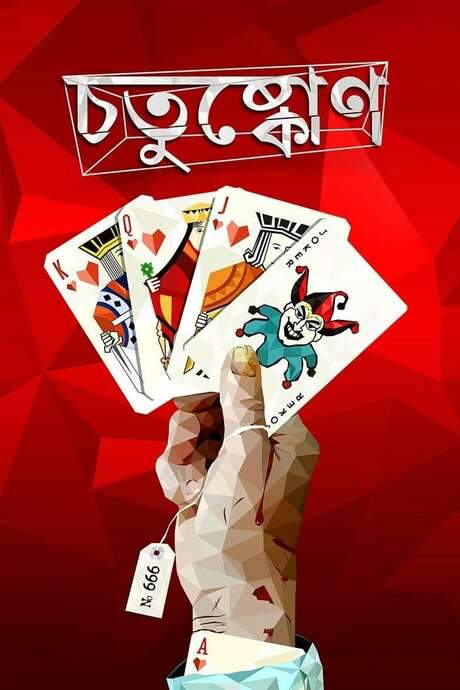
Year: 2014
Runtime: 148 mins
Language: Bengali, Bangla
Director: Srijit Mukherji
Four acclaimed directors and longtime friends are brought together by a mysterious producer to collaborate on a unique anthology film. Each director is tasked with creating a short story centered around the theme of death, resulting in a diverse and thought-provoking exploration of mortality through different perspectives and cinematic styles.
Find where to stream, rent, or buy Chotushkone (2014) in the US with current JustWatch availability, up-to-date pricing, and platform listings for subscription, rental, and digital purchase options.
Warning: spoilers below!
Haven’t seen Chotushkone yet? This summary contains major spoilers. Bookmark the page, watch the movie, and come back for the full breakdown. If you're ready, scroll on and relive the story!
Trace every key event in Chotushkone (2014) with our detailed, chronological timeline. Perfect for unpacking nonlinear stories, spotting hidden connections, and understanding how each scene builds toward the film’s climax. Whether you're revisiting or decoding for the first time, this timeline gives you the full picture.
Last updated: October 03, 2025 at 10:35
Find frequently asked questions about the Chotushkone (2014) timeline, including chronological order, nonlinear jumps, cause-and-effect links, and scene sequence clarifications. This timeline FAQ helps explain when key events happen, how moments connect, and why the story unfolds in that specific order.
Joy planned to kill Trina, Dipto, and Shakyo because of his brother's breakdown. Years earlier, these three had abandoned his brother's film project during a disagreement, which triggered his brother's descent into madness. Joy blamed them for destroying his brother's life and career, leading him to orchestrate the deadly Russian roulette game as revenge.
During the road trip, Dipto's story about a cigarette addict who dies at midnight mirrors how Joy's plan ultimately claims a life, his own.
Joy set up the Russian roulette game to kill all four of them, intending to sacrifice himself last. However, when the gun was pointed at Trina, it misfired, instead striking Joy himself. He died instantly, turning his own murder plot against him. The survivors were left to grapple with his death and the revelation of his motives.
The film's opening image of a hanging woman foreshadows that death will come unexpectedly to someone in the group.
The opening scene shows an unknown woman writing a suicide note and hanging herself while a man clutches a child and watches. This image establishes the film's pervasive theme of death and serves as a visual anchor for the mortality-focused stories the directors will tell. It sets the dark, tense tone that permeates the entire narrative.
The suicides and deaths discussed throughout the anthology stories all echo this initial image of death as an inescapable force.
Joy's brother was a filmmaker whose movie was abandoned by Trina, Dipto, and Shakyo during a dispute. This betrayal caused him to spiral into madness. By the time the group reaches the bungalow, he has been institutionalized and no longer recognizes anyone, leaving Trina and Dipto to face the consequences of their past actions at the end.
Shakyo's pitch about a writer who kills his characters and dies himself foreshadows how the directors' creative decisions have real-life consequences.
Each director told a story that reflected their personal relationship with death and guilt. Shakyo's tale showed a writer who dies because of his creations. Dipto's story emphasized life's fragility. Trina's planchette story connected the living with the dead. Joy's story about his brother was actually a confession about his real-life grudge. These stories served as both thematic foreshadowing and character revelation.
Joy's story about his brother mirrors the real betrayal that motivated his murder plot, showing how fiction reflected reality.
The car breaking down was a plot device that forced the four directors to shelter in Mr. Gupta's bungalow. This delay created the tense, enclosed setting where Joy could execute his revenge plan. Without the breakdown, they might have reached the producer and avoided the deadly confrontation.
The sudden breakdown mirrors how life can interrupt even the best-laid plans, echoing Dipto's story about a man who steps out at exactly the wrong moment.
The producer was the mysterious figure who brought the four directors together for the anthology film about death. However, he never physically appears in the story, his invitation sets the plot in motion by getting them to travel to Henry's Island. His identity remains ambiguous, and he may have been manipulated by Joy or simply provided the catalyst for the deadly reunion.
The producer's invitation brought together old friends with unresolved conflicts, setting the stage for the explosive confrontation.
Trina told a story about a dead woman who reaches out to the living through a planchette, attempting to communicate from beyond the grave. This tale heightened the atmosphere of supernatural dread and explored the blurred boundary between the living and the dead. It also reflected Trina's own grappling with mortality and guilt over past actions.
The story foreshadows how the characters themselves would soon be haunted by the consequences of their decisions, Joy's death and his brother's unreachable state.
Dipto shared a story about a cigarette addict who thinks he's finally free from his addiction, but steps out at midnight and is struck by a car. The fatal twist emphasized how fragile life is and how death can come in an instant. This narrative reflected Dipto's dark outlook and paralleled how Joy's elaborate murder plan ultimately failed in unexpected ways.
The story's theme of unexpected death at a precise moment echoed the Russian roulette misfire that killed Joy.
Shakyo told the story of a TV serial writer who kills his characters in brutal ways. When he finally witnesses the death of a character on screen, he suffers a fatal heart attack and dies. This meta-tale explored the power of storytelling and how creators can become consumed by the death they depict. It foreshadowed how the directors' own creative work about death would have real-world consequences.
The writer's death from witnessing his characters' deaths mirrored how the directors' abandonment of Joy's brother led to real tragedy.
Discover curated groups of movies connected by mood, themes, and story style. Browse collections built around emotion, atmosphere, and narrative focus to easily find films that match what you feel like watching right now.
Multiple stories connected by a single, somber theme that eventually blurs fiction and reality.Explore movies like Chotushkone that use an anthology structure to explore a dark theme. If you enjoyed the way separate stories converged into a tense psychological thriller, you'll find similar complex and unsettling narratives here, where the act of storytelling becomes part of the danger.
These films typically feature a group of characters brought together to create or discuss stories around a specific theme (like death, fear, or guilt). The individual tales serve as thematic foreshadowing, and the narrative tension builds from the gradual intrusion of the stories' darkness into the real lives of the framers, culminating in a crisis that merges the two layers.
Movies are grouped here by their unique narrative structure and thematic execution. They share a focus on meta-storytelling, a steady pacing that builds towards a revelatory convergence, and a tone that is both intellectually engaging and psychologically tense.
Characters trapped in tense situations, forced to confront their pasts and secrets through manipulation.If you liked the tense, claustrophobic mind games in Chotushkone, this list features similar thrillers. These movies trap characters in high-stakes psychological scenarios, exploring themes of betrayal, guilt, and madness with a heavy emotional weight and often a bleak resolution.
The narrative pattern involves isolating characters—emotionally or physically—and introducing a catalyst that forces them to play a high-stakes game of truth and deception. The journey is one of escalating paranoia and revelation, where personal histories are weaponized, trust erodes, and the characters are pushed toward a breaking point with dire consequences.
These films are united by their core mechanism: psychological manipulation within a confined group. They share a high-intensity, tense tone, a steady pacing that methodically increases pressure, and a heavy emotional focus on themes like guilt, betrayal, and existential dread.
Don't stop at just watching - explore Chotushkone in full detail. From the complete plot summary and scene-by-scene timeline to character breakdowns, thematic analysis, and a deep dive into the ending - every page helps you truly understand what Chotushkone is all about. Plus, discover what's next after the movie.
Read a complete plot summary of Chotushkone, including all key story points, character arcs, and turning points. This in-depth recap is ideal for understanding the narrative structure or reviewing what happened in the movie.
Discover the characters, locations, and core themes that shape Chotushkone. Get insights into symbolic elements, setting significance, and deeper narrative meaning - ideal for thematic analysis and movie breakdowns.