Plot Explained Spoilers guaranteed!
Plot Explained

Browse by genre

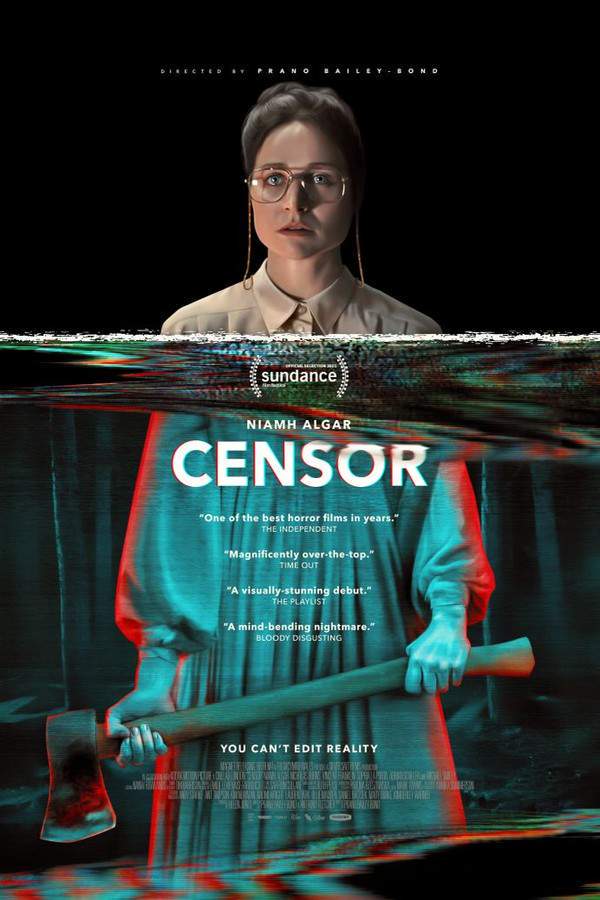
Censor (2021) movie poster

Ending Explained

Censor (2021) Ending Explained – Final Scene & Meaning

Release, runtime and language
2021 · 84 min · English
Echo score 78
Loading streaming availability…
Directed by
Prano Bailey-Bond
Starring
Niamh Algar, Michael Smiley, Andrew Havill, Sophia La Porta, Adrian Schiller, Clare Holman

A film censor named Enid takes her duty seriously, protecting audiences from disturbing content. Haunted by the unresolved disappearance and presumed death of her sister, she becomes increasingly disturbed when a mysterious film surfaces. The movie triggers unsettling memories and forces Enid to confront a dark and troubled past, leading her down a dangerous path to uncover buried secrets and the truth about what happened to her sister.

On this page (7)
  1. 1 Where to watch
  2. 2 What happens at the end
  3. 3 Final events in order
  4. 4 Ending questions answered
  5. 5 Movie threads
  6. 6 Movies like Censor
  7. 7 Every angle
Loading streaming availability…

Ending explained · contains spoilers

What Happens at the End of Censor?

How Censor (2021) ends, what the final scene means, which earlier moments set it up and how to read the ending if the film leaves it open. The full ending explained, with every spoiler.

In the end, Censor leaves us with a haunting and ambiguous conclusion that blurs the line between reality and illusion. Throughout the film, Enid’s obsession with violent films and her work at the censorship board gradually erodes her sanity, especially after a traumatic incident involving a film producer. Her fragile mental state is compounded by her childhood trauma—the mysterious disappearance of her sister, Nina—hidden deep within her subconscious. Enid becomes increasingly delusional, believing that the director Frederick North is responsible for her sister’s abduction and that he has a connection to her missing sibling. This hallucination prompts her to stalk and confront North, leading to a violent breakdown where she kills him. However, it’s revealed that all this was a hallucination; Enid’s perception was distorted, and she was mistaking reality for her delusions.

In the climax, Enid’s mind creates a fantasy where she reunites her sister and her parents, but the final scenes are intentionally ambiguous. The actress Alice Lee, who played her sister, is not actually related to her—they are only figures in Enid’s mind. The closing shot shows Enid shouting for help in a glitchy, surreal sequence, blurring the boundary between her mental state and what might be real. The film ends on this note of uncertainty, emphasizing that Enid’s psyche has been deeply fractured by her exposure to violent images, her trauma, and her grief. Censor ultimately explores how censorship, trauma, and mental illness intertwine, leaving viewers pondering whether Enid’s reality is truly shattered or if she has found some form of release or escape within her warped mind.

Last updated: June 25, 2025 at 08:58

Was this helpful?

The last 4 events

How Censor Ends: The Final Events in Order

The last events of Censor (2021) in chronological order, the run-up to the ending explained above. The complete timeline has all 14 events, scene by scene.

Open the full timeline
  1. North is decapitated

    Enid corners Frederick North and decapitates him, erasing the person she believes stands between Nina and her own truth. The act completes her violent rescue fantasy and seals her break from reality. The film's underground terror fully takes hold.

    When
    night
    Where
    North's residence / film set
  2. Woods encounter and the remote

    In the woods, Alice denies being Nina and pleads for help as Enid pursues her. Enid collapses, a remote control appears in her hand, and she presses a button, signaling a shift back into a dreamlike state. The scene blurs nightmare with potential kidnapping.

    When
    night
    Where
    the woods
  3. Vision of Nina and the car ride home

    Enid awakens to a seemingly happy vision of Nina thanking her for finding her. She and Nina drive toward their parents' home, while the car radio reports that all violent films have been banned, crimes are eradicated, and unemployment no longer exists. The escape becomes a bitter commentary on censorship and fantasy.

    When
    morning
    Where
    car ride
  4. The final twist: Alice kidnapped and the VHS reveal

    The fantasy abruptly collapses as it is revealed that Enid has kidnapped Alice. Alice begs her parents for help as Enid smiles, and the camera pulls back to show a TV screen with a VHS tape labeled Censor emerging from a VCR. The ending reinforces the film's themes of censorship and control.

    When
    ending
    Where
    woods then parents' home; TV/VCR reveal

Ending questions answered

Censor Ending: Your Questions Answered

The questions people ask most about the ending of Censor (2021): what the final scene means, how the twist works, what happens to each character and how to read the ending. Each answer contains spoilers.

Q1

Did Enid actually kill Frederick North in the end?

No. The confrontation where Enid attacks and kills Frederick North is revealed to be entirely a hallucination. In reality, Enid's fragile mental state caused her to distort her perception of reality, and the violent encounter only happened in her mind. This revelation is central to the film's ambiguity about what is real and what exists only in Enid's fractured psyche.

Foreshadowing: Earlier scenes show Enid becoming increasingly paranoid and seeing connections that may not exist, setting up the possibility that her reality is distorted.

  • Enid
  • Frederick North
  • kill
  • hallucination
  • violence
Q2

Is Enid's sister Nina real or imagined?

Nina is based on a real person, a real traumatic event from Enid's past. However, the version of Nina that appears throughout the film, especially in the final reunion sequence, is revealed to be a projection of Enid's mind. The actress Alice Lee, who plays Nina, is not actually related to Enid in the story, confirming she exists only within Enid's psychological narrative.

  • Nina
  • sister
  • hallucination
  • Alice Lee
  • trauma
Q3

What does the final glitchy sequence mean?

The closing shot shows Enid shouting for help in a glitchy, surreal visual style that deliberately blurs the boundary between her mental state and external reality. This stylized sequence suggests Enid is trapped in her own fractured mind, either calling out from a psychotic break or struggling against the fantasy world she created. The ambiguity is intentional, the film leaves it unclear whether she is crying for help to escape her delusions or to return to the false paradise she constructed.

  • glitch
  • surreal
  • Enid
  • mind
  • reality
  • fantasy
Q4

Was Enid's reunion with her family real?

No. The touching scene where Enid reunites her sister Nina with their parents in a peaceful, happy setting is entirely a fantasy constructed by Enid's mind. This fantasy represents the closure and healing she desperately craves but can never have in reality. The film reveals this as wish-fulfillment rather than actual events, emphasizing how deeply Enid's trauma has fractured her grip on reality.

  • reunion
  • family
  • fantasy
  • parents
  • closure
Q5

Why does Enid become delusional at the end?

Enid's descent into delusion results from a combination of factors: her years of exposure to violent film content through censorship work, her unresolved trauma over her sister Nina's disappearance, and the recent traumatic incident involving a film producer. These elements gradually erode her mental stability, causing her to mistake her hallucinations for reality and to believe Frederick North was responsible for her sister's abduction when there is no actual evidence connecting him to the real Nina.

  • delusion
  • trauma
  • mental illness
  • censorship
  • violence
Q6

Was Frederick North actually responsible for Nina's disappearance?

No concrete evidence in the film confirms Frederick North had any connection to Nina's disappearance. Enid's belief that North was responsible for her sister's abduction appears to be a delusion born from her deteriorating mental state. The film presents this connection as something Enid constructed in her mind, possibly because North worked in the film industry that she had become obsessed with and suspicious of.

  • Frederick North
  • Nina
  • abduction
  • responsible
  • delusion
Q7

What happens to Enid at the end?

Enid's fate is left deliberately ambiguous. The final scenes suggest she has experienced a complete psychological break, unable to distinguish between her fantasy and reality. She either remains trapped in her shattered mental state, or she has retreated entirely into the fantasy world where she reunited with her sister. The shouting for help could be interpreted as either a cry to escape her delusions or a desperate plea to hold onto the comforting fiction she created.

  • Enid
  • fate
  • mental breakdown
  • psychosis
  • ending
Q8

What does the ending mean thematically?

Thematically, the ending explores how censorship, trauma, and mental illness intertwine to devastating effect. By exposing Enid to constant violent imagery while she carries unresolved grief over her sister, the film suggests that consuming violent content without processing its emotional impact can fracture a vulnerable mind. The ambiguous ending leaves viewers questioning whether Enid's reality is truly shattered beyond repair or if her fantasy represents a form of escape from unbearable grief.

  • thematic
  • censorship
  • trauma
  • mental illness
  • violence
  • meaning
Q9

Why does the film end without confirming what is real?

The film ends ambiguously because the story is fundamentally about the blurring of reality and illusion. The ambiguity is not a narrative weakness but a thematic choice that mirrors Enid's fractured mental state. By refusing to clarify whether the final fantasy represents escape, death, or continued delusion, the film forces viewers to experience the same uncertainty that defines Enid's existence, emphasizing how trauma can permanently alter one's perception of what is real.

  • ambiguous
  • ending
  • reality
  • illusion
  • unclear

Movie threads

More Movies Like Censor, by Mood & Story

Curated lists built around what makes Censor tick: the same mood, the same kind of story or the same emotional payoff. Each list explains why these movies belong together.

Psychological Thrillers with Fractured Reality like Censor

Protagonists who can no longer trust their own perception of reality. If you enjoyed the disorienting journey in Censor, explore more movies where protagonists question their own sanity. These films feature unreliable narrators, blurred fantasy and reality, and a descent into paranoia, perfect for fans of complex psychological horror.

  • unreliable narrator
  • psychological
  • surreal
  • paranoid
  • dreamlike
  • disorienting
  • Tone: dark, paranoid, unsettling
  • Pacing: steady, deliberate
Why these movies?

The story pattern: These narratives follow a character, often haunted by past trauma, whose investigation or obsession leads them to a point where external events and internal psychological distress become indistinguishable. The plot structure is frequently driven by the protagonist's subjective experience, culminating in a climax that forces a confrontation with a potentially horrifying truth—or a complete break from reality.

Why they belong together: Movies in this thread are grouped by their shared focus on a subjective, fractured point of view. They create a specific, unsettling viewing experience where the audience is deliberately kept off-balance, sharing the protagonist's confusion and paranoia through deliberate narrative ambiguity and surreal imagery.
Slow Burn Descent into Madness Movies like Censor

A steady, unsettling unraveling of a character's sanity. For viewers captivated by Enid's psychological collapse in Censor, this collection features films about characters spiraling into obsession and madness. These stories share a steady pace, heavy emotional weight, and a dark tone, delivering intense and disturbing character studies.

  • descent into madness
  • obsessive
  • disturbing
  • melancholic
  • unsettling
  • claustrophobic
  • Tone: dark, disturbing, melancholic
  • Pacing: steady, building relentlessly
Why these movies?

The story pattern: The narrative pattern is a steady, character-driven progression from a state of relative stability to complete psychological disintegration. The pacing is deliberate, building tension as the character's coping mechanisms fail and their obsession consumes them. The climax typically involves a violent act or a complete break from reality that feels both shocking and inevitable.

Why they belong together: These films are united by their core focus on a character's mental unraveling. They share a specific, heavy mood built on dread and unease, a methodical pacing that makes the breakdown feel earned, and a high intensity that comes from witnessing a human mind come apart at the seams.

If you liked this

Movies Like Censor

Similar movies to Censor: the same genre, themes or kind of story. Each one comes with its own plot summary, timeline and ending explained.

Browse all movie summaries

Every angle

Censor (2021) Explained: Plot, Ending, Timeline & Characters

Everything about Censor in one place: what happens in the plot summary, the timeline in chronological order, the characters and meaning, the ending explained and a spoiler-free summary. What's After the Movie adds the cast, box office and post-credit scenes.

Coming soon on iOS and Android

The Plot Explained Movie Summary App

Plot summaries, endings explained and timelines on your phone. Catch up on any movie in minutes, save your favorites and never miss a twist again.

Be the first to know when we launch. Your email stays private, always.

Learn more about the app