Plot Explained Spoilers guaranteed!
Plot Explained

Browse by genre

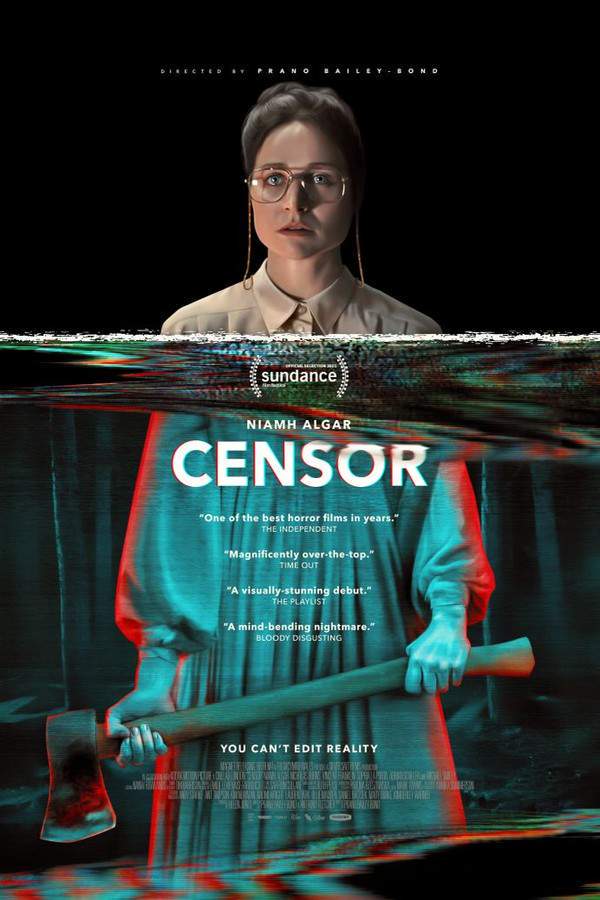
Censor (2021) movie poster

Plot Summary

Censor (2021) Plot Summary & Ending Explained

Release, runtime and language
2021 · 84 min · English
Echo score 78
Loading streaming availability…
Directed by
Prano Bailey-Bond
Starring
Niamh Algar, Michael Smiley, Andrew Havill, Sophia La Porta, Adrian Schiller, Clare Holman

A film censor named Enid takes her duty seriously, protecting audiences from disturbing content. Haunted by the unresolved disappearance and presumed death of her sister, she becomes increasingly disturbed when a mysterious film surfaces. The movie triggers unsettling memories and forces Enid to confront a dark and troubled past, leading her down a dangerous path to uncover buried secrets and the truth about what happened to her sister.

On this page (7)
  1. 1 Where to watch
  2. 2 What happens: full plot
  3. 3 Plot questions answered
  4. 4 How it ends
  5. 5 Movie threads
  6. 6 Movies like Censor
  7. 7 Every angle
Loading streaming availability…

Full plot summary · contains spoilers

What Happens in Censor: Full Plot Summary

The whole story of Censor (2021) explained, from the opening scene to the final frame: every key event, every twist and what it all adds up to. Read it as a quick recap before the sequel, to check a scene you missed, or to finally understand what really happened.

In 1985, Enid Baines works for the British Board of Film Classification during the height of the video nasty controversy, a period when violent content was under intense scrutiny. Her colleagues nickname her “Little Miss Perfect” because of her unwavering stance on cutting or banning graphic material. During a family dinner, Enid’s parents discuss her sister Nina, who disappeared when they were children. Though Nina has since been legally declared dead, Enid clings to the belief that she might still be alive somewhere out there.

A brutal murder spree soon makes headlines when a man kills his wife and children, and a tabloid links the killings to a film Enid had rated months earlier, naming her as the censor who approved it. The accusation triggers a torrent of threatening and insulting phone calls that never seem to stop. Then a film producer named Doug Smart approaches her with a startling claim: veteran horror director Frederick North has personally requested she screen one of his old, banned works, Don’t Go in the Church. As she watches the film, Enid is struck by how its events echo her memories of Nina’s disappearance, blurring the line between memory and nightmare.

Driven to uncover the truth about North, Enid acquires a copy of one of his banned films. She notes that the lead, Alice Lee, bears a striking resemblance to her missing sister, fueling a growing fixation. Believing that Lee is, in some sense, Nina, Enid becomes consumed by a mission to find North and “save” her sister from the exploitation surrounding the film industry. Her search leads her to Smart, hoping to learn North’s whereabouts, but Smart offers a troubling mix of reassurance and manipulation. He tells her that North is planning a sequel to Don’t Go in the Church near his home, and he presses closer, giving her alcohol and creating an uncomfortable intimacy. Enid rejects Smart’s advance, and his reaction turns volatile; when she pushes him away, he trips and impales himself on a film award, dying before her eyes.

Determined to track North down, Enid steals his address from work and infiltrates the set of his latest project, where the crew mistake her for an actress. As the boundary between reality and fantasy grows increasingly unstable, Enid’s actions become dangerously distorted. She kills an actor named Charles with an axe, convinced he intends to hurt her presumed sister. In a final, chilling moment, she decapitates North. Alice — who insists she is not Enid’s sister — flees into the woods as Enid pleads for her to be the one: > "please be her."

The narrative pivots to a moment of unsettling revelation: Enid envisions a joyous reunion with her sister Nina, and the two drive toward their parents’ home. Yet the dream fractures when a car radio report announces a society-wide ban on violent films, the eradication of crime, and the disappearance of unemployment, hinting at a world altered by censorship. The fantasy intrudes again, revealing that Enid has in fact kidnapped Alice, who begs for help from Enid’s parents as Enid smiles. The camera pulls away from a TV screen to show a VHS tape labeled Censor ejecting from a VCR, leaving viewers with a haunting sense that the truth of Nina’s fate and Enid’s psyche may be inseparable from the film that haunts them both.
Last updated: January 08, 2026 at 12:00

Was this helpful?

Plot questions answered

Censor Plot Explained: Your Questions Answered

The questions people ask most about Censor (2021): what happens in the confusing scenes, why the characters do what they do, the twists, hidden details and what the ending means. Each answer contains spoilers.

Q1

Why does Enid become obsessed with Alice Lee?

Enid becomes obsessed with Alice Lee after watching one of Frederick North's banned films and noticing that the lead actress bears a striking resemblance to her missing sister Nina. Combined with the disturbing parallels between the film's plot and the circumstances of Nina's disappearance, Enid convinces herself that Alice is somehow Nina and that she needs to be rescued from the exploitation film industry.

Foreshadowing: During dinner with her parents, Enid reveals she still believes Nina might still be alive somewhere, establishing her inability to accept her sister's death.

  • alice lee
  • nina
  • obsession
  • frederick north
  • missing sister
Q2

How does Doug Smart die?

Doug Smart dies in an accidental impalement when he tries to make sexual advances on Enid at his office. After he drugs her with alcohol and gets too close, Enid pushes him away in self-defense. He trips backward onto a sharp film award trophy and dies before emergency services arrive.

  • doug smart
  • death
  • impalement
  • film award
  • accident
Q3

Why does Enid kill Charles on the film set?

Enid kills the actor Charles with an axe because she has become completely convinced that he intends to harm Alice, whom she still believes is her sister Nina. In her fractured state of mind, she perceives Charles as a threat and acts to protect her "sister," resulting in a violent act she sees as a heroic rescue.

Foreshadowing: The screening of Don't Go in the Church begins blurring the lines between Enid's memories and on-screen violence, foreshadowing her inability to distinguish fantasy from reality.

  • charles
  • axe murder
  • film set
  • alice lee
  • violence
Q4

Why does Enid decapitate Frederick North?

Enid decapitates Frederick North because she views him as the final obstacle between herself and the truth about her sister. She believes North has been exploiting Alice/Nina through his horror films and that eliminating him will free her sister. The act represents the completion of her distorted rescue fantasy.

Foreshadowing: Enid's fixation on North deepens after discovering Alice's resemblance to Nina and learning about his banned films, setting the stage for violent confrontation.

  • frederick north
  • decapitation
  • horror director
  • alice lee
  • rescue fantasy
Q5

Is Alice Lee actually Enid's sister Nina?

No, Alice Lee is not Nina. In the woods encounter, Alice explicitly tells Enid that she is not her sister and begs for help. The revelation confirms that Enid's entire rescue mission was built on a delusion - Alice merely resembles Nina, but they are not the same person.

Foreshadowing: The film deliberately keeps the resemblance ambiguous early on, allowing viewers to question alongside Enid whether the connection might be real.

  • alice lee
  • nina
  • sister
  • identity
  • delusion
Q6

What does the ending reveal about what really happened?

The ending reveals that Enid has actually kidnapped Alice. The entire joyful reunion with Nina - the car ride home, the happy conversation, the radio announcing a world freed of violence through censorship - was Enid's fantasy overlay. In reality, Alice is trapped with Enid, pleading with Enid's parents for help as Enid smiles contentedly.

Foreshadowing: The remote control that appears in Enid's hand in the woods signals a shift back into her dreamlike psychological state, hinting at the fantasy-reality blend.

  • ending twist
  • kidnapping
  • alice
  • fantasy
  • reality
Q7

What is the significance of the VHS tape labeled Censor?

The VHS tape labeled "Censor" that ejects from the VCR at the end suggests that everything the viewer has just witnessed may be the content of the film within the film called "Censor." This meta-layer implies the story we're watching could be Enid's own trauma and obsession being censored, retold, or even created - blurring the line between the film and the viewer's experience.

Foreshadowing: The film constantly references the power of cinema to influence reality, with Enid's job as a censor putting her at the center of this theme throughout.

  • vhs tape
  • censor
  • ending
  • meta
  • film within film
Q8

What is the video nasty controversy that the film references?

The video nasty controversy refers to a period in 1980s Britain when home video horror films faced intense scrutiny and bans due to graphic violence. The BBFC (British Board of Film Classification) was under pressure to prevent disturbing content from reaching audiences, which provides the historical backdrop for Enid's job and her rigid approach to censorship.

Foreshadowing: The 1985 setting places Enid at the height of this controversy, establishing her "Little Miss Perfect" reputation for cutting or banning violent material.

  • video nasty
  • 1985
  • bbfc
  • censorship
  • horror films
Q10

What does the remote control represent in the woods scene?

The remote control that appears in Enid's hand in the woods represents her psychological need for control over her own narrative - essentially "rewinding" or controlling reality as one would a video tape. When she presses the button, it signals her retreat back into a fantasy state where she can reunite with Nina, transitioning from the traumatic reality of having kidnapped Alice.

Foreshadowing: The recurring motif of film reels and screening rooms throughout the movie establishes the remote as another tool of cinematic control.

  • remote control
  • woods
  • fantasy
  • control
  • psychology

Ending explained

What Happens at the End of Censor?

How Censor (2021) ends, in short: the final scene, the last twist and what it means for the characters. The full ending explained, with every spoiler, lives on its own page.

Read the full ending explained

In the end, Censor leaves us with a haunting and ambiguous conclusion that blurs the line between reality and illusion. Throughout the film, Enid’s obsession with violent films and her work at the censorship board gradually erodes her sanity, especially after a traumatic incident involving a film producer. Her fragile mental state is compounded by her childhood trauma—the mysterious disappearance of her sister, Nina—hidden deep within her subconscious. Enid becomes increasingly delusional, believing that the director Frederick North is responsible for her sister’s abduction and that he has a connection to her missing sibling. This hallucination prompts her to stalk and confront North, leading to a violent breakdown where she kills him. However, it’s revealed that all this was a hallucination; Enid’s perception was distorted, and she was mistaking reality for her delusions.

In the climax, Enid’s mind creates a fantasy where she reunites her sister and her parents, but the final scenes are intentionally ambiguous. The actress Alice Lee, who played her sister, is not actually related to her—they are only figures in Enid’s mind. The closing shot shows Enid shouting for help in a glitchy, surreal sequence, blurring the boundary between her mental state and what might be real. The film ends on this note of uncertainty, emphasizing that Enid’s psyche has been deeply fractured by her exposure to violent images, her trauma, and her grief. Censor ultimately explores how censorship, trauma, and mental illness intertwine, leaving viewers pondering whether Enid’s reality is truly shattered or if she has found some form of release or escape within her warped mind.

Censor ending explained in full

Movie threads

More Movies Like Censor, by Mood & Story

Curated lists built around what makes Censor tick: the same mood, the same kind of story or the same emotional payoff. Each list explains why these movies belong together.

Psychological Thrillers with Fractured Reality like Censor

Protagonists who can no longer trust their own perception of reality. If you enjoyed the disorienting journey in Censor, explore more movies where protagonists question their own sanity. These films feature unreliable narrators, blurred fantasy and reality, and a descent into paranoia, perfect for fans of complex psychological horror.

  • unreliable narrator
  • psychological
  • surreal
  • paranoid
  • dreamlike
  • disorienting
  • Tone: dark, paranoid, unsettling
  • Pacing: steady, deliberate
Why these movies?

The story pattern: These narratives follow a character, often haunted by past trauma, whose investigation or obsession leads them to a point where external events and internal psychological distress become indistinguishable. The plot structure is frequently driven by the protagonist's subjective experience, culminating in a climax that forces a confrontation with a potentially horrifying truth—or a complete break from reality.

Why they belong together: Movies in this thread are grouped by their shared focus on a subjective, fractured point of view. They create a specific, unsettling viewing experience where the audience is deliberately kept off-balance, sharing the protagonist's confusion and paranoia through deliberate narrative ambiguity and surreal imagery.

Slow Burn Descent into Madness Movies like Censor

A steady, unsettling unraveling of a character's sanity. For viewers captivated by Enid's psychological collapse in Censor, this collection features films about characters spiraling into obsession and madness. These stories share a steady pace, heavy emotional weight, and a dark tone, delivering intense and disturbing character studies.

  • descent into madness
  • obsessive
  • disturbing
  • melancholic
  • unsettling
  • claustrophobic
  • Tone: dark, disturbing, melancholic
  • Pacing: steady, building relentlessly
Why these movies?

The story pattern: The narrative pattern is a steady, character-driven progression from a state of relative stability to complete psychological disintegration. The pacing is deliberate, building tension as the character's coping mechanisms fail and their obsession consumes them. The climax typically involves a violent act or a complete break from reality that feels both shocking and inevitable.

Why they belong together: These films are united by their core focus on a character's mental unraveling. They share a specific, heavy mood built on dread and unease, a methodical pacing that makes the breakdown feel earned, and a high intensity that comes from witnessing a human mind come apart at the seams.

If you liked this

Movies Like Censor

Similar movies to Censor: the same genre, themes or kind of story. Each one comes with its own plot summary, timeline and ending explained.

Browse all movie summaries

Every angle

Censor (2021) Explained: Plot, Ending, Timeline & Characters

Everything about Censor in one place: what happens in the plot summary, the timeline in chronological order, the characters and meaning, the ending explained and a spoiler-free summary. What's After the Movie adds the cast, box office and post-credit scenes.

Coming soon on iOS and Android

The Plot Explained Movie Summary App

Plot summaries, endings explained and timelines on your phone. Catch up on any movie in minutes, save your favorites and never miss a twist again.

Be the first to know when we launch. Your email stays private, always.

Learn more about the app