#29,9902 Year: 2017
Runtime: 94 min
Language: English
Directors: Cary Murnion, Jonathan Milott
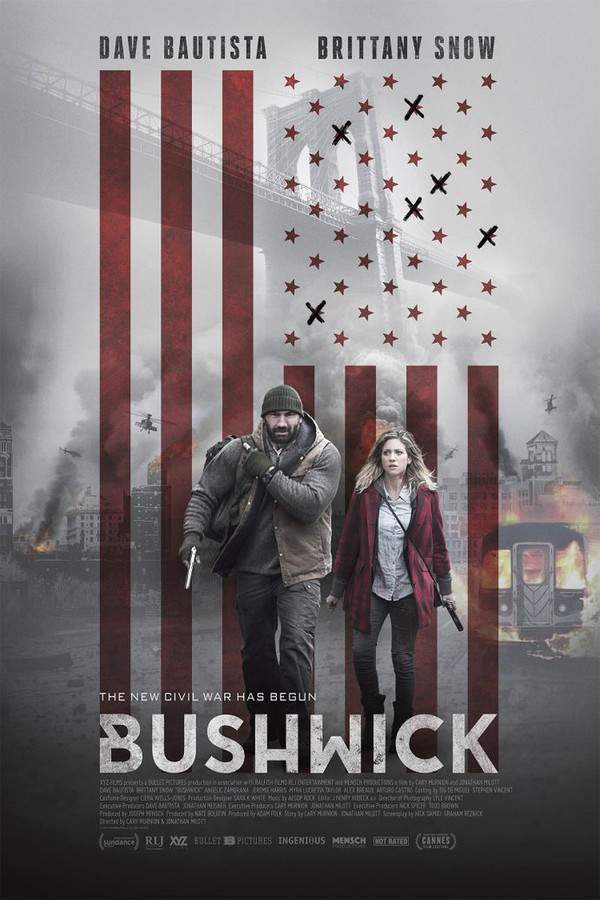
Echo Score: 56In the Bushwick neighborhood of Brooklyn, a sudden crisis unfolds as Texas secessionists invade New York City. As chaos grips the area, Lucy seeks shelter in the basement of Stupe, a former soldier. Together, they must brave the dangerous streets, dodging gunfire and destruction, in a desperate attempt to reach Lucy's intended destination.
Find where to stream, rent, or buy Bushwick (2017) in the US with current JustWatch availability, up-to-date pricing, and platform listings for subscription, rental, and digital purchase options.
Warning: spoilers below!
Haven’t seen Bushwick yet? This summary contains major spoilers. Bookmark the page, watch the movie, and come back for the full breakdown. If you're ready, scroll on and relive the story!
Read the complete plot breakdown of Bushwick (2017), including all key story events, major twists, and the ending explained in detail. Discover what really happened, and what it all means.
In the Bushwick neighborhood of Brooklyn, a tense morning unfolds as Lucy, a determined second-year civil engineering grad student, and her boyfriend Jose stumble out of a subway car into an eerily quiet station. A man bursts in, engulfed in flames, sending panic rippling through the platform. Jose darts to investigate, but an explosion abruptly ends his life, leaving Lucy stranded and searching for any sign of help amid the sudden chaos. The city’s usual rhythm collapses around them as sirens wail in the distance and fires blaze in unexpected corners of the city.
Lucy’s attempt to seek shelter quickly pulls her into a dangerous chase. She is pushed through rooms and alleyways, narrowly avoiding violence, until she is cornered in a house owned by Stupe, a former U.S. Navy hospital corpsman who knows how to move quickly in a crisis. In a brutal, decisive moment, Stupe dispatches the attackers and reveals a startling, hard-edged truth: martial law has been declared, and the country is unraveling under a surge of insurgency and fear. With danger looming around every corner, Lucy makes a bold choice—she decides to join Stupe as he sets his sights on Hoboken, New Jersey, where he believes his family may still be waiting. The practical, survivalist instincts that have kept Lucy’s life orderly are suddenly redirected toward a treacherous journey, and she embraces the possibility of safety by sticking close to a man who has seen far more of the world’s cruelty than she has.
As they move through a city that seems to be tearing itself apart, Stupe sustains injuries but doesn’t slow down. He becomes a hard-edged mentor and guide, training Lucy in essential first aid techniques and the art of handling a firearm, should they encounter armed men again. The relationship between them—built on necessity, respect, and the harsh lessons of violence—starts to form a fragile bond in the crucible of crisis. Their voyage leads them to a pivotal moment: Lucy’s grandmother’s house, a place that might offer refuge or reveal more losses. The grim news arrives in the form of a heart-wrenching truth—the grandmother has died of heart failure. This revelation compounds the sense that every step toward safety is now shadowed by grief and a sense of responsibility.
With no safe haven left behind, Lucy and Stupe press on and seek shelter with Belinda, Lucy’s sister, only to find themselves pulled into an even larger struggle. A mercenary infiltration exposes the volatile truth about who controls the city—and who plans to use it as a staging ground for a broader conflict. The mercenary’s confession reveals that a coalition of seceded states, including Texas, has formed the New American Coalition (NAC), and their aim is to suppress uprisings in major urban centers by targeting neighborhoods with minorities deemed vulnerable. The revelation shifts the stakes from personal survival to collective resistance, and Stupe insists on a gambit that might turn the tide: the DMZ, where the U.S. Army is allegedly extracting non-combatants, at Grover Cleveland Park in Queens. A swift set‑piece of action follows, as the trio rifles through danger toward what they hope will be a lifeline.
On the road to the park, the group witnesses raw scenes of urban dissent—citizens rising up in makeshift militias, small skirmishes erupting in the streets, and the hard faces of people who refuse to be erased by an occupying force. They cross paths with James and his mother, who seize Belinda and press Stupe and Lucy to organize a defense for evacuees and rival factions alike. The plan centers on a public rally at a laundromat, a practical yet symbolic gathering point where disparate groups can come together in the face of overwhelming force. The church, expected to serve as a beacon of organized resistance, becomes a crucible: the priest who would lead the effort tragically takes his own life, but the surviving group agrees to fight nonetheless, drawing lines of solidarity between civilians, exiles, and disaffected members of the city’s underbelly.
As the clock ticks toward a coda of combat and survival, Stupe opens up about a long-buried trauma—the September 11 attacks—and his earlier instinct to abandon Lucy on the way to Hoboken. He confesses that fate gave them a second chance by choosing to stay together, a confession that adds a bitter weight to every decision they make from that point forward. The moment of human frailty arrives in the form of a frightened teenage girl hiding in a bathroom, who, in a panic, fires a shot that strikes Stupe. The loss of their guide is a heavy blow, but Lucy, Belinda, and the rest of the evacuees keep moving, driven by a stubborn belief that they can reach safety and preserve what remains of their community.
The journey culminates at the DMZ, where the U.S. Army is already pinned down by NAC forces. The final confrontation unfolds amid helicopter resupply and spiraling gunfire as resistance fighters converge on the extraction zone. Lucy and Belinda remain side by side through the worst of the firefight, but tragedy seals their fate. Belinda is struck in the leg, and Lucy—ever the pragmatist and the one who refused to abandon others—attempts to save her, only to fall herself to a fatal shot. The scene closes on Belinda’s anguished cry as evacuees carry her away, while the city of New York blazes in the distance, a stark, lasting image of a metropolis tested to its limits by division, violence, and resilience.
Last updated: October 09, 2025 at 16:17
Explore frequently asked questions about Bushwick (2017) with spoiler-rich answers covering the full plot summary, major story beats, character motivations, hidden details, and ending meaning. This movie summary FAQ helps explain confusing scenes, plot twists, and narrative decisions in clear, searchable detail.
José runs toward the burning man because he's instinctively trying to help someone in distress. As a civilian unaccustomed to crisis situations, he doesn't recognize the danger signals, a man running onto a subway platform engulfed in flames is a clear warning that something far more dangerous is unfolding. His curiosity and desire to assist cost him his life when an explosion occurs shortly after, killing him instantly while Lucy barely escapes.
The NAC (New American Coalition) is a coalition of seceded states, primarily led by Texas, that has declared martial law across the country. According to the captured mercenary, their strategy involves seizing major urban centers by targeting neighborhoods with minority populations they deem vulnerable. The invasion of New York City is part of a broader campaign to suppress uprisings in major cities and establish control through military force.
Earlier scenes of martial law and armed attackers roaming the streets hint at a coordinated military occupation.
Stupe helps Lucy initially because she's a frightened civilian who literally runs into his home seeking shelter, and as a former Navy hospital corpsman, he has both the skills and the moral compulsion to protect someone in immediate danger. His decision to let her accompany him to Hoboken stems from practical survival logic, two people moving together are harder to intercept than one person alone, though his attitude shifts into genuine mentorship as he trains her in combat and first aid.
Lucy's grandmother dies of natural causes, heart failure, before Lucy and Stupe can reach her. This tragic timing means Lucy not only loses her grandmother but also loses the safe haven she was hoping to find. The grandmother's death represents another personal loss stacked on top of José's death, reinforcing the film's theme that safety and family are constantly out of reach during the crisis.
The priest who was meant to lead the resistance at the church chooses to take his own life rather than participate in the fight against the NAC forces. His suicide is shown as a moment of despair and psychological collapse under the overwhelming pressure of the invasion. Rather than face the violence and likely death in combat, he ends his own life, leaving the survivors to organize their defense without spiritual leadership.
The teenage girl shoots Stupe accidentally while hiding in panic. She's a frightened civilian who has been traumatized by the violence surrounding her, and when Stupe approaches during the chaotic confrontation at the laundromat, she reacts out of sheer terror. In her panic, she fires a shot that strikes Stupe, killing the group's mentor and guide in a tragic accident that underscores how fear and chaos claim lives even among those trying to help each other.
The DMZ (Demilitarized Zone) at Grover Cleveland Park in Queens is portrayed in the film as a U.S. Army extraction point where non-combatants are being evacuated from the city. In reality, there is no such military zone in Queens, Queens is a residential borough of New York City, not a border territory. The film uses the concept of a DMZ to represent a temporary safe zone created by the U.S. military within the city during the NAC occupation, where survivors might escape the conflict.
Stupe reveals that his family died in the September 11 attacks and that he nearly abandoned Lucy on the way to Hoboken because he's facing the likelihood of death in the upcoming battle and wants to be honest about who he really is. This confession serves as his emotional reckoning, a man who has survived incredible tragedy and initially planned to leave Lucy to save himself now chooses to stay and fight alongside her. It's a moment of vulnerability that humanizes the hardened survivor.
Lucy dies because the DMZ extraction turns into a deadly firefight. After Belinda is shot in the leg, Lucy, whose defining trait is refusing to abandon others, attempts to save her sister and is herself shot and killed. Her death is the culmination of the film's brutal narrative logic: no one is guaranteed survival, and the protagonist's selflessness ultimately costs her life. The bleak ending rejects the typical action movie victory, instead showing that heroism doesn't guarantee safety.
The resistance forms after James and his mother take Belinda hostage, forcing Stupe and Lucy to organize a defense for the evacuees. The planned rally at the laundromat becomes a symbolic gathering point where disparate groups, civilians, exiles, and disaffected residents, attempt to unite against the NAC. The church was meant to serve as the resistance headquarters, but when the priest commits suicide, the survivors decide to fight anyway, drawing lines of solidarity despite having no formal leadership.
Belinda survives the final assault at the DMZ despite being shot in the leg. After Lucy is killed trying to save her, Belinda is carried away by evacuees as the resistance continues fighting. She represents the continuation of the fight and the community that persists even after losing its leaders. The film ends with Belinda and the remaining survivors pressing on while New York City burns in the distance, leaving her fate uncertain but alive.
Discover curated groups of movies connected by mood, themes, and story style. Browse collections built around emotion, atmosphere, and narrative focus to easily find films that match what you feel like watching right now.
Civilians fighting for their lives in a city turned battlefield.If you liked the relentless danger and desperate struggle for survival in Bushwick, this thread gathers movies featuring civilians caught in urban warfare. These films share a tense, fast-paced, and high-intensity survival experience in a collapsed city environment.
These narratives typically begin with a sudden, catastrophic event that fractures society, often an invasion or disaster. The plot is a linear, straightforward journey focused on immediate survival, moving protagonists from one perilous encounter to the next with little room for subplots or rest.
They are grouped by their shared high-intensity, fast-paced vibe and the core theme of civilian resilience in the face of overwhelming urban danger. The experience is defined by a consistently tense tone, grim mood, and a focus on the raw, physical struggle to stay alive.
Hopeless struggles where survival comes at a tragic cost.For viewers seeking movies with a similar heavy emotional weight and bleak ending to Bushwick. This thread features stories of political or societal collapse where the struggle is heroic but ultimately futile, leaving characters with profound loss.
The narrative follows a downward spiral where initial chaos gives way to the grim realization that the old world is gone. Character arcs are defined by loss and sacrifice, and the journey, while showcasing resilience, leads to an ending that offers no solace or triumph, reinforcing the futility of the struggle.
This thread connects films through their shared emotional trajectory and thematic focus. The key unifying elements are a heavy emotional weight, a bleak ending feel, and the central theme of navigating a world that has fundamentally broken down, often with a tragic outcome for the protagonists.
Don't stop at just watching - explore Bushwick in full detail. From the complete plot summary and scene-by-scene timeline to character breakdowns, thematic analysis, and a deep dive into the ending - every page helps you truly understand what Bushwick is all about. Plus, discover what's next after the movie.
Track the full timeline of Bushwick with every major event arranged chronologically. Perfect for decoding non-linear storytelling, flashbacks, or parallel narratives with a clear scene-by-scene breakdown.
Discover the characters, locations, and core themes that shape Bushwick. Get insights into symbolic elements, setting significance, and deeper narrative meaning - ideal for thematic analysis and movie breakdowns.
Discover movies like Bushwick that share similar genres, themes, and storytelling elements. Whether you’re drawn to the atmosphere, character arcs, or plot structure, these curated recommendations will help you explore more films you’ll love.
Bushwick (2017) Scene-by-Scene Movie Timeline
Bushwick (2017) Movie Characters, Themes & Settings
Bushwick (2017) Spoiler-Free Summary & Key Flow
Movies Like Bushwick – Similar Titles You’ll Enjoy
Daylight (1996) Ending Explained & Film Insights
21 Bridges (2019) Full Summary & Key Details
The Baytown Outlaws (2013) Plot Summary & Ending Explained
Aftermath (2024) Full Movie Breakdown
The Bayou (2025) Story Summary & Characters
Guns Up (2025) Movie Recap & Themes
Mulberry Street (2006) Full Movie Breakdown
Hazard (2005) Ending Explained & Film Insights
1990: The Bronx Warriors (1982) Film Overview & Timeline
Escape from the Bronx (1983) Complete Plot Breakdown
New York Ninja (2021) Ending Explained & Film Insights
NYC: Tornado Terror (2008) Film Overview & Timeline
Aftershock: Earthquake in New York (1000) Spoiler-Packed Plot Recap
Bushwhacked (1995) Detailed Story Recap
City on Fire (1979) Plot Summary & Ending Explained