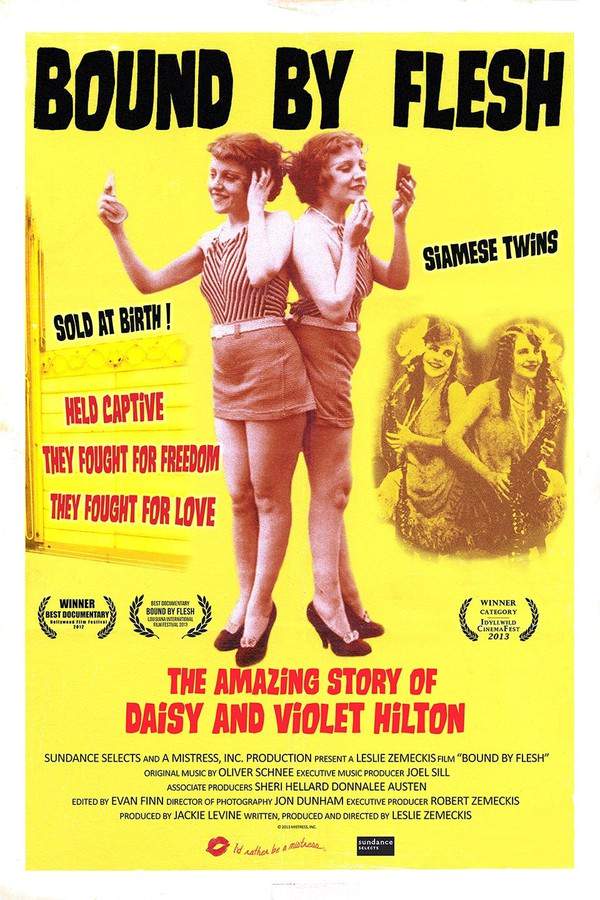
This documentary explores the extraordinary lives of conjoined twins Daisy and Violet Hilton, who captivated audiences as celebrated performers in the 20th century, even sharing the stage with Bob Hope and Charlie Chaplin. Despite their fame, the twins faced relentless exploitation by their managers, a harsh reality that ultimately led to a hard-won freedom, achieved at a deeply emotional cost.
Find where to stream, rent, or buy Bound by Flesh (2014) in the US with current JustWatch availability, up-to-date pricing, and platform listings for subscription, rental, and digital purchase options.
Warning: spoilers below!
Haven’t seen Bound by Flesh yet? This summary contains major spoilers. Bookmark the page, watch the movie, and come back for the full breakdown. If you're ready, scroll on and relive the story!
Read the complete plot breakdown of Bound by Flesh (2014), including all key story events, major twists, and the ending explained in detail. Discover what really happened, and what it all means.
They were as inseparable as any two sisters could be, sharing their passions for singing, dancing, and playing musical instruments. They rose to fame as the highest-paid act in vaudeville during the 30s and 40s, capturing the hearts of America as the biggest celebrities of their time. This remarkable duo was known as Siamese twins and were alternatively called The Brighton United Twins, The San Antonio Twins, or simply Daisy and Violet Hilton.
Their extraordinary journey began in 1908 in Brighton, England, when their mother, overwhelmed by the realization that she had given birth to "freaks," sold them to her midwife. What ensued was a Dickensian childhood filled with exploitation, as they were put on display in pubs and wax museums, zigzagging across the world through carnivals and fairs. While they earned substantial money for their performances, they never had the chance to enjoy it.
A turning point came when they fought for their freedom from their legal guardians in a sensational trial held in San Antonio. Once liberated, the sisters finally had the opportunity to explore romance. However, Violet faced numerous obstacles in her quest for love, as her attempts to obtain a marriage license were thwarted by laws that deemed her status as a Siamese twin an unmanageable liability. Devastated by the disappearance of her fiancé, she found herself alone. In a strange twist of fate, her manager orchestrated a publicity marriage during the 1936 Texas Centennial, intending to capitalize on their uniqueness for an audience willing to pay for the spectacle.
The sisters made their mark in film, starring in Freaks, which has since been recognized and preserved by the U.S. National Film Registry, and in the 1950s exploitation feature Chained for Life. For the first time, their story unfolds, revealing a rich tapestry of carnival and circus life that shaped early American entertainment, from vaudeville to burlesque, sideshows to Hollywood glamour.
Last updated: November 16, 2024 at 12:01
Explore frequently asked questions about Bound by Flesh (2014) with spoiler-rich answers covering the full plot summary, major story beats, character motivations, hidden details, and ending meaning. This movie summary FAQ helps explain confusing scenes, plot twists, and narrative decisions in clear, searchable detail.
Their mother sold them to her midwife immediately after birth because she was overwhelmed by the realization she had given birth to conjoined twins, whom she viewed as "freaks." This sale set in motion a lifetime of exploitation, as the twins were then passed to handlers who profited from displaying them in pubs, wax museums, and traveling carnivals.
The documentary establishes early that their birth in 1908 Brighton initiated a pattern of being treated as commodities rather than children.
The sisters fought for their independence through a sensational legal trial held in San Antonio. The trial drew significant public attention and represented a major turning point, allowing them to break free from the guardians who had controlled their lives and earnings since childhood.
The documentary builds toward this moment as the culmination of years of exploitation, positioning the trial as their first real opportunity for autonomy.
Violet faced legal obstacles when trying to obtain a marriage license because laws at the time deemed her status as a Siamese twin an unmanageable liability. These discriminatory regulations prevented her from legally marrying her fiancé, who subsequently disappeared, leaving her devastated and alone.
Earlier scenes establishing the twins' desire for normal romantic relationships set up this heartbreaking legal barrier.
After Violet's fiancé disappeared due to marriage law barriers, her manager orchestrated a publicity marriage for her during the 1936 Texas Centennial. This was not a genuine romantic union but rather a calculated spectacle designed to exploit the twins' uniqueness for profit, capitalizing on audience fascination with their unusual circumstances.
The documentary frames this as a cynical manipulation, contrasting Violet's genuine desire for love with the commercial exploitation of her emotional vulnerability.
The twins were viewed by their guardians and managers as lucrative attractions rather than individuals. While Daisy and Violet earned substantial money performing as the highest-paid vaudeville act of their era, they were never allowed to enjoy their earnings. Their conjoined status made them a novelty sensation that drew crowds, creating strong financial incentive for their handlers to maintain control over them.
The documentary establishes early that despite their fame and income, the sisters lived in conditions that prioritized profit over their wellbeing.
The Hilton sisters starred in two notable films: Tod Browning's "Freaks" (1932), which has since been preserved in the U.S. National Film Registry for its cultural significance, and the 1950s exploitation feature "Chained for Life." These films represented their transition from vaudeville and sideshow performances to Hollywood cinema.
The documentary positions their film careers as an evolution of their entertainment journey, moving from live performance to the silver screen.
The twins rose to fame as performers in the 1930s and 1940s, becoming the highest-paid act in vaudeville. Their captivating singing, dancing, and musical instrument performances captured American audiences, making them beloved celebrities and the biggest stars of their time.
The documentary shows how their talents transformed them from exploited children into celebrated entertainers who headlined across America.
"Freaks" (1932) is significant because it has been recognized and preserved by the U.S. National Film Registry, indicating its cultural, historical, and aesthetic importance. The film starred actual sideshow performers, including Daisy and Violet Hilton, and has become a cult classic despite the controversy it generated upon release.
The documentary frames their involvement in "Freaks" as a landmark moment that cemented their place in film history.
Violet Hilton's fiancé disappeared after she was legally blocked from marrying him due to discriminatory laws regarding conjoined twins. The documentary presents his disappearance as a devastating blow, leaving Violet heartbroken and her dreams of love and companionship unfulfilled.
Earlier scenes showing the twins' hope for romantic fulfillment after gaining their freedom make this loss particularly poignant.
The San Antonio trial was significant because it represented the sisters' first major act of resistance against decades of exploitation. By legally fighting for their independence from their guardians, they reclaimed agency over their own lives and earnings, marking a pivotal turning point from being controlled by others to becoming self-determined.
The documentary builds dramatic tension around this trial, presenting it as the moment the twins took control of their destinies.
Discover curated groups of movies connected by mood, themes, and story style. Browse collections built around emotion, atmosphere, and narrative focus to easily find films that match what you feel like watching right now.
Tales of extraordinary individuals fighting for freedom against a system that profits from them.For viewers who appreciated the bittersweet true story in Bound by Flesh, this list features similar documentary and biographical films. These movies explore the lives of remarkable individuals who battled exploitation in show business, the arts, or other public spheres, showcasing their talent while exposing the emotional cost of their struggle for freedom.
Narratives in this thread typically follow a chronological arc, beginning with the discovery of a unique talent or circumstance that leads to fame or public fascination. This is followed by a period of exploitation by managers, families, or institutions, creating a central conflict between personal autonomy and external control. The story builds towards a legal, emotional, or physical struggle for independence, resulting in a bittersweet conclusion where freedom is achieved but at a significant personal loss.
Movies are grouped here based on their shared focus on the exploitation of unique individuals, their predominantly bittersweet or melancholic tone, and the central theme of a difficult quest for personal freedom against oppressive systems. They resonate with a similar emotional weight, blending admiration for human spirit with sadness over injustice.
Historical documentaries that explore fascinating but somber lives with a steady, reflective pace.If you liked the reflective and melancholic tone of Bound by Flesh, explore these similar historical documentaries. These films uncover fascinating true stories from the past, often about vaudeville, circus life, or unique individuals, presented with a steady pace and a bittersweet emotional undercurrent that acknowledges the sadness within the spectacle.
These documentaries typically use a linear, chronological structure to present a biographical or historical account. They blend archival footage, interviews, and narration to build a comprehensive picture. The narrative pattern often involves unveiling a hidden or forgotten story, celebrating its unique aspects while gradually revealing the underlying tensions, struggles, and societal prejudices that defined the era and the subjects' lives.
These films are grouped by their shared documentary format, historical subject matter, and a specific tonal blend of fascination and melancholy. They share a steady, contemplative pacing that encourages reflection on the past, and they often focus on themes of celebrity, otherness, and the passage of time, resulting in a similarly resonant and thoughtful viewing experience.
Don't stop at just watching - explore Bound by Flesh in full detail. From the complete plot summary and scene-by-scene timeline to character breakdowns, thematic analysis, and a deep dive into the ending - every page helps you truly understand what Bound by Flesh is all about. Plus, discover what's next after the movie.
Track the full timeline of Bound by Flesh with every major event arranged chronologically. Perfect for decoding non-linear storytelling, flashbacks, or parallel narratives with a clear scene-by-scene breakdown.
Discover the characters, locations, and core themes that shape Bound by Flesh. Get insights into symbolic elements, setting significance, and deeper narrative meaning - ideal for thematic analysis and movie breakdowns.
Discover movies like Bound by Flesh that share similar genres, themes, and storytelling elements. Whether you’re drawn to the atmosphere, character arcs, or plot structure, these curated recommendations will help you explore more films you’ll love.
Bound by Flesh (2014) Scene-by-Scene Movie Timeline
Bound by Flesh (2014) Movie Characters, Themes & Settings
Bound by Flesh (2014) Spoiler-Free Summary & Key Flow
Movies Like Bound by Flesh – Similar Titles You’ll Enjoy
Twinsters (2015) Ending Explained & Film Insights
Tickled (2016) Movie Recap & Themes
My Flesh and Blood (2003) Film Overview & Timeline
Double Dare (2005) Plot Summary & Ending Explained
Meet the Fokkens (2012) Detailed Story Recap
Body Parts (2023) Full Movie Breakdown
Bound for Pleasure (2004) Plot Summary & Ending Explained
The Celluloid Bordello (2019) Movie Recap & Themes
My Body (2002) Complete Plot Breakdown
The Skin Horse (1983) Detailed Story Recap
Being Different (1981) Spoiler-Packed Plot Recap
The Forbidden (1966) Movie Recap & Themes
Hollywood’s World of Flesh (1963) Story Summary & Characters
Fetishes (1996) Spoiler-Packed Plot Recap
The Art Star and the Sudanese Twins (2008) Ending Explained & Film Insights