






Plot Explained Spoilers guaranteed!
Plot Explained

Browse by genre

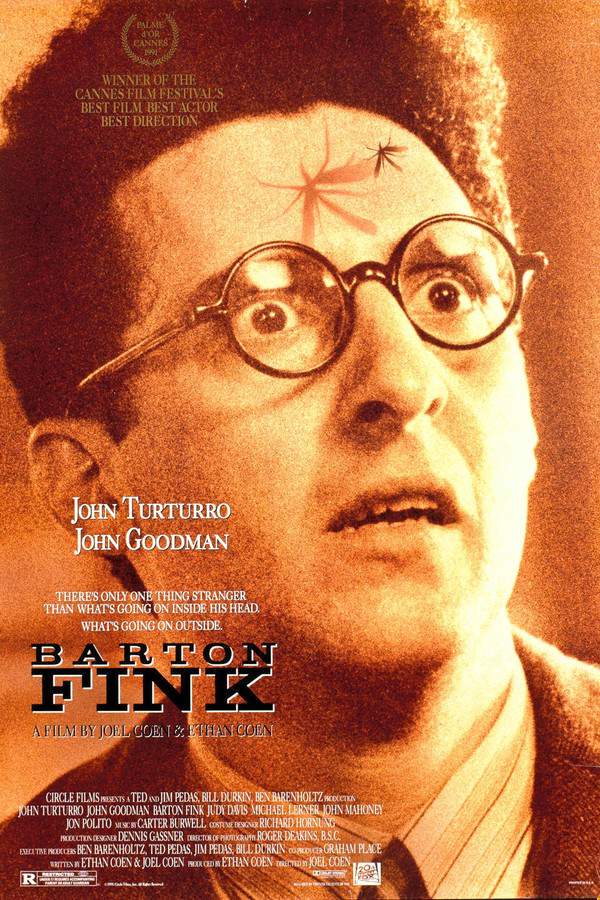
Barton Fink (1991) movie poster

Timeline

Barton Fink (1991) Timeline Explained – Every Event in Order

Release, runtime and language
1991 · 116 min · English
Directed by
Ethan Coen, Joel Coen
Starring
John Turturro, John Goodman

In 1941, playwright Barton Fink accepts a lucrative offer to write for a Hollywood studio, leaving behind his life in New York. Struggling with writer's block on a wrestling picture script, he finds himself increasingly isolated and disoriented. As he grapples with the pressures of the studio and his own creative paralysis, the boundaries of his perception begin to dissolve, plunging him into a bizarre and unsettling experience.

On this page (6)
  1. 1 Where to watch
  2. 2 Events in order (15)
  3. 3 Timeline questions answered
  4. 4 Movie threads
  5. 5 Movies like Barton Fink
  6. 6 Every angle

Where to watch

Where to Watch Barton Fink (1991)

Where can you watch Barton Fink? Stream, rent or buy it in the US, including on Hoopla, Amazon Video and Apple TV Store: current JustWatch availability with up-to-date prices.

Streaming availability powered by JustWatch

15 events in order · contains spoilers

Barton Fink Timeline: Events in Chronological Order

Every key event of Barton Fink (1991) in order, scene by scene, with when and where it takes place. Use it to untangle flashbacks, time jumps and parallel storylines, to refresh your memory before the sequel or to find the exact scene you are thinking of.

  1. Barton Fink's Broadway Success

    Barton Fink has just debuted on Broadway, receiving favorable reviews that begin to inflate his confidence. However, despite this achievement, he internally battles with self-doubt about his own writing abilities.

    When
    Recent
    Where
    New York
  2. Summoned to Hollywood

    Fink receives an unexpected invitation to Hollywood to write screenplays, a task he approaches with reluctance. Despite his reservations, he accepts the offer, seeing it as an opportunity to further his career.

    When
    Shortly after Broadway success
    Where
    Hollywood
  3. Arrival at the Earle Hotel

    Upon arriving at the Earle Hotel, Barton is greeted by Chet, the eccentric hotel manager. The hotel's unsettling ambiance instantly puts him on edge, foreshadowing the challenges he will face.

    When
    Day of arrival
    Where
    Earle Hotel, Hollywood
  4. Creative Block Sets In

    As Fink attempts to sit down and write, he quickly succumbs to a creative block that renders him powerless. The many distractions around him, including noises and odd imagery, further fuel his anxiety and frustration.

    When
    First night
    Where
    Earle Hotel, Hollywood
  5. Meeting Jack Lipnick

    Fink attends a job interview with Jack Lipnick, the head of Universal Pictures, where a mosquito bite becomes a discomforting memory. Lipnick expresses his imposing personality and hands Fink a project to write—a boxing film.

    When
    Following night
    Where
    Universal Pictures, Hollywood
  6. Desperation for Inspiration

    Feeling overwhelmed and lacking direction, Fink meets Ben Geisler who tries to offer encouragement and assistance. Despite Geisler's best efforts, Fink is unable to find the inspiration he desperately seeks.

    When
    Days later
    Where
    Earle Hotel
  7. Meeting Charlie Meadows

    Fink encounters Charlie Meadows, a boisterous insurance salesman who quickly becomes his unexpected confidant. The two bond over an unusual shoe exchange that breaks Fink's isolation.

    When
    Evening at the hotel
    Where
    Earle Hotel
  8. Encounter with W. P. Mayhew

    Fink's admiration leads him to seek out fellow writer W. P. Mayhew, but the encounter quickly spirals into chaos due to Mayhew's intoxicated state. A tense situation culminates with a surprising night spent with Mayhew's assistant, Audrey.

    When
    Nighttime
    Where
    Mayhew's Apartment
  9. The Shocking Discovery

    Upon waking the next morning, Fink is hit with horror as he discovers Audrey's lifeless body in his bed. The bloodstain on the mattress amplifies his terror and drives him into despair as he regrets the choices made during the night.

    When
    Morning
    Where
    Earle Hotel, Hollywood
  10. Descent into Chaos

    In a panic, Fink hesitates while deciding whether to meet Lipnick, though he is under extreme pressure from Geisler to produce results. Chaos ensues as detective investigations into Charlie Meadows unfold, revealing sinister elements.

    When
    Morning after discovery
    Where
    Earle Hotel
  11. Confrontation with Lipnick

    In a pivotal meeting with Lipnick, Fink refuses to present unfinished work, triggering the executive's irritation. This encounter starkly illustrates the harsh treatment artists endure within the Hollywood system.

    When
    Later that day
    Where
    Universal Pictures, Hollywood
  12. Fink's Creative Surge

    Amidst personal turmoil, Fink finds an unexpected surge of creativity when he reflects on Charlie's haunting box. This leads him to write vigorously, creating a screenplay that he hopes will redeem him.

    When
    Afternoon
    Where
    Earle Hotel
  13. Submission of the Screenplay

    Fink submits his completed screenplay to Lipnick, only to be met with disappointment. Lipnick's limited expectations serve as a harsh reminder of his lack of artistic vision and the compromises expected in the industry.

    When
    Later that afternoon
    Where
    Universal Pictures, Hollywood
  14. Tensions Erupt

    Fink witnesses the violent confrontation between Charlie and detectives, which reflects the turmoil surrounding his own existence. The chaos intensifies his feelings of disillusionment and despair in the face of the industry's demands.

    When
    Evening
    Where
    Earle Hotel
  15. A Walk on the Beach

    In the film's closing moments, Fink walks along the beach where he encounters a girl resembling the woman from his hotel room artwork. This encounter symbolizes his unresolved journey and ongoing struggles with creativity and self-identity.

    When
    Final scene
    Where
    Beach

Last updated: November 07, 2024 at 22:32

Was this helpful?

Timeline questions answered

Barton Fink Timeline Explained: Your Questions Answered

When does it happen, and why in that order? The questions people ask about the chronology of Barton Fink (1991): time jumps, flashbacks, cause and effect between scenes and the correct order of events, each answered with spoilers.

Q1

Why is Barton Fink unable to write his screenplay?

Barton Fink suffers from severe creative paralysis caused by multiple factors. The oppressive atmosphere of the Earle Hotel, with its distracting noises and unsettling imagery, constantly interrupts his focus. More fundamentally, his artistic integrity conflicts with the commercial demands of Hollywood, he's tasked with writing a generic boxing film for Wallace Beery but feels his sophisticated theater work is being reduced to 'b-movie' material. This tension between his artistic ambitions and the studio's expectations creates a psychological block that renders him unable to produce any meaningful work.

Foreshadowing: The heat and peeling wallpaper in his room are introduced early as constant irritants that prevent him from concentrating.

  • creative block
  • writer's block
  • hollywood
  • barton's paralysis
Q2

What is the significance of the box Charlie gives Barton?

The box Charlie gives Barton serves as a catalyst for his sudden creative breakthrough. While the summary mentions it as a symbol of severed ties and chaos in Barton's life, its exact contents are not explicitly described in the provided text. The box represents the overwhelming external pressures and internal turmoil that have been accumulating throughout Barton's stay in Hollywood. After receiving it, Fink experiences a feverish burst of creativity and manages to complete his screenplay, suggesting the box somehow unlocked his ability to process his experiences into art.

Foreshadowing: Charlie and Barton's unusual shoe exchange earlier establishes their strange rapport and sets up the box as another gift with deeper meaning.

  • box
  • charlie meadows
  • creative breakthrough
  • screenplay
Q3

What happens to Audrey Taylor in Barton's hotel room?

Wake up next morning, Barton discovers Audrey Taylor's lifeless body in his bed with a bloodstain on the mattress. The circumstances of her death remain ambiguous, it's unclear whether this is a tragic accident, suicide, or something more sinister. The traumatic discovery propels Barton into panic and further psychological turmoil, leaving him desperate and uncertain about how to proceed. He contacts Charlie for help, who advises him to continue with his meeting with Lipnick, suggesting Charlie either knows more than he lets on or simply doesn't grasp the severity of the situation.

Foreshadowing: The tense encounter with Mayhew and his volatile state earlier hints at dangerous situations that could escalate.

  • audrey taylor
  • death
  • hotel room
  • body discovery
Q4

Why does Charlie Meadows attack the detectives?

Charlie Meadows' violent outburst against the detectives reveals his true identity, contrary to his claim of being a successful insurance salesman, he is revealed to be a dangerous criminal. The confrontation escalates when detectives investigate Charlie, leading to his aggressive response that reflects the sinister undertones surrounding his character. This moment exposes the dark reality behind Charlie's friendly facade and suggests he has been manipulating Barton throughout their relationship, possibly using him or the hotel as cover for criminal activities.

Foreshadowing: Charlie is introduced with unusual intensity, and his claim of being an insurance salesman feels forced and theatrical from the start.

  • charlie meadows
  • detectives
  • attack
  • criminal identity
Q5

Why does Jack Lipnick reject Barton's completed screenplay?

Jack Lipnick rejects Barton's screenplay not because of poor quality, but because it exceeds his limited artistic vision. When Fink submits his completed work, Lipnick is unimpressed and seeks only the blandest elements of storytelling, the exact opposite of what Fink has created. This moment crystallizes the film's critique of Hollywood's treatment of artists: the studio hired Fink for his talent but ultimately wants him to produce safe, formulaic content that prioritizes commercial appeal over artistic merit. Lipnick's disappointment represents the fundamental conflict between creative expression and commercial filmmaking.

Foreshadowing: Lipnick's earlier dismissal of his films as mere 'b-movies' and his bombastic personality establish his contempt for genuine artistry.

  • jack lipnick
  • screenplay rejection
  • hollywood studio
  • artistic compromise
Q6

What is the significance of the girl Barton encounters on the beach?

The girl Barton encounters on the beach at the film's end bears a striking resemblance to the woman depicted in the artwork on his hotel room wall, a haunting beach scene that has troubled him throughout his stay. This encounter suggests several interpretations: it may represent Barton's blurred perception of reality, a manifestation of his guilt or psychological breakdown, or a symbolic resolution (or continuation) of his creative and existential journey. The ambiguous meeting leaves his fate and the nature of his experiences deeply unresolved, consistent with the film's deliberately ambiguous ending.

Foreshadowing: The woman on the wall and her haunting imagery appear early in Barton's stay, repeatedly disturbing his attempts to work.

  • beach
  • girl
  • ending
  • woman on wall
  • ambiguous conclusion
Q7

Why does Barton accept the Hollywood writing offer despite his doubts?

Barton accepts the Hollywood offer despite his internal reservations because the opportunity appears too lucrative to refuse. Though he grapples with self-doubt about his abilities despite his Broadway success, the promise of financial reward and professional advancement proves compelling. His move from New York to Hollywood represents a fundamental shift from legitimate theater to commercial filmmaking, a transition that creates immediate friction with his artistic identity and sets the stage for his creative paralysis.

Foreshadowing: His self-doubt about his writing abilities is established immediately after his Broadway success.

  • hollywood offer
  • career choice
  • new york
  • broadway
Q8

Why does the Earle Hotel feel so oppressive to Barton?

The Earle Hotel functions as a psychological prison that mirrors Barton's internal state. Its unsettling ambiance, constant distractions including noise from neighboring guests and the haunting beach artwork on his wall, and oppressive heat create an environment designed to suffocate creativity. The hotel's decaying appearance and strange staff, including the eccentric manager Chet, contribute to a nightmarish atmosphere that progressively erodes Barton's grip on reality. The setting itself becomes almost sentient in its hostility, amplifying his isolation and creative paralysis.

Foreshadowing: Barton's immediate unease upon arrival establishes the hotel as an antagonistic force from the very beginning.

  • earle hotel
  • atmosphere
  • isolation
  • psychological setting
Q9

Why does Barton spend the night with Audrey Taylor?

Barton's decision to spend the night with Audrey Taylor stems from his desperation and emotional vulnerability. After his chaotic encounter with the intoxicated W. P. Mayhew, Barton is in a state of heightened distress and isolation. Audrey, Mayhew's assistant, becomes a source of comfort in his oppressive environment. Their night together represents Barton's attempt at human connection amid his mounting professional failures and personal confusion, though the encounter ultimately leads to tragic consequences with her unexplained death in his bed.

Foreshadowing: Barton's growing isolation and his desperate seek for inspiration from Mayhew set up this vulnerable moment.

  • audrey taylor
  • night together
  • desperation
  • emotional vulnerability
Q10

What is W. P. Mayhew's role in Barton's story?

W. P. Mayhew represents the failed ideal of the serious writer in Hollywood, a once-respected author who has been consumed by the industry's destructive nature. Barton admires Mayhew and seeks his guidance, but finds him inebriated and volatile, completely unable to offer meaningful help. Mayhew's assistant Audrey Taylor becomes an unexpected substitute for the mentorship Barton sought. Mayhew's presence illustrates the fate that awaits Barton: artistic compromise and personal dissolution within Hollywood's machine.

Foreshadowing: Barton's admiration for Mayhew is established early as he seeks out successful writers for inspiration.

  • w p mayhew
  • writer
  • hollywood
  • mentorship
  • artistic decline
Q11

What is the significance of Barton and Charlie exchanging shoes?

The shoe exchange between Barton and Charlie represents an unusual bonding moment that breaks Barton's isolation and establishes their peculiar relationship. This strange ritual suggests a level of intimacy and trust that Charlie is cultivating with Barton, though its meaning remains ambiguous. The exchange foreshadows the deeper (and ultimately sinister) connection between the two men, as Charlie later provides Barton with the mysterious box that triggers his creative breakthrough.

Foreshadowing: The shoe exchange happens early in their relationship and establishes the unusual nature of their connection.

  • shoe exchange
  • charlie meadows
  • friendship
  • strange ritual
Q12

Why does the mosquito bite become a significant moment?

The mosquito bite occurs during Barton's job interview with Jack Lipnick, creating an awkward moment that highlights his vulnerability and outsider status in Hollywood. The bite symbolizes the persistent irritations and small humiliations that plague Barton throughout his Hollywood experience. It also marks one of the first instances where his physical discomfort intersects with his professional life, setting the tone for how personal and artistic struggles will intertwine throughout the film.

Foreshadowing: The bite happens early in Barton's Hollywood career, establishing the pattern of external irritants affecting his success.

  • mosquito bite
  • jack lipnick
  • interview
  • humiliation
Q13

How does the film blur reality and Barton's perception?

Barton Fink deliberately blurs the line between reality and Barton's deteriorating mental state, making it unclear whether the disturbing events actually occur or are manifestations of his psychological breakdown. The escalating surrealism, from the oppressive hotel to Charlie's violent outburst to the mysterious box, could all be interpreted as externalizations of Barton's internal chaos. This ambiguity is central to the film's themes of creative madness and existential dread, leaving viewers uncertain about what truly happened versus what Barton imagined.

Foreshadowing: Early disturbances like the woman's image on the wall and strange hotel sounds plant seeds of doubt about Barton's perception.

  • reality vs perception
  • surrealism
  • psychological breakdown
  • ambiguous narrative

Movie threads

More Movies Like Barton Fink, by Mood & Story

Curated lists built around what makes Barton Fink tick: the same mood, the same kind of story or the same emotional payoff. Each list explains why these movies belong together.

Movies about artistic meltdown and surrealism like Barton Fink

Artists unravel as reality bends under the pressures of creation. If you enjoyed the surreal psychological descent of Barton Fink, explore more movies where creators face a crisis. These films share themes of writer's block, artistic pressure, and a blurring of reality, offering a similar unsettling and dreamlike experience for viewers who like complex, dark character studies.

  • surreal
  • unsettling
  • claustrophobic
  • dreamlike
  • disorienting
  • anxious
  • Tone: dark, surreal, bleak
  • Pacing: slow burn, deliberate
Why these movies?

The story pattern: Narratives in this thread typically follow a creative professional grappling with immense pressure, leading to severe isolation and psychological distress. The story structure often involves a gradual breakdown of the protagonist's grip on reality, introducing surreal and symbolic events that challenge both the character and the viewer to distinguish truth from delusion.

Why they belong together: Movies are grouped here because they share a core focus on the psychological toll of artistic creation, blending dark tones with surreal elements. They feature slow pacing that builds claustrophobic tension and heavy emotional weight centered on themes of failure, existential dread, and madness.
Claustrophobic slow burn thrillers like Barton Fink

Tension mounts slowly within confined spaces, suffocating the characters. Fans of the mounting dread and oppressive atmosphere in Barton Fink will find more movies with a similar slow burn vibe here. These recommendations focus on stories where tension builds gradually in confined settings, creating a deeply unsettling and anxious viewing experience for those who appreciate psychological tension over action.

  • claustrophobic
  • anxious
  • slow burn
  • oppressive
  • unsettling
  • tense
  • Tone: dark, tense, oppressive
  • Pacing: slow, deliberate build
Why these movies?

The story pattern: The narrative pattern involves characters trapped, literally or metaphorically, in a confined environment. The plot unfolds slowly, prioritizing atmospheric buildup over rapid plot twists. The primary conflict is often internal or psychological, with the environment acting as a pressure cooker that gradually erodes the characters' stability.

Why they belong together: These films are united by their masterful use of pacing and atmosphere. They share a SLOW pace that allows tension to simmer, a HIGH intensity derived from psychological pressure, and a DARK tone. The dominant mood is consistently anxious, claustrophobic, and oppressive, creating a very specific viewing experience.

If you liked this

Movies Like Barton Fink

Similar movies to Barton Fink: the same genre, themes or kind of story. Each one comes with its own plot summary, timeline and ending explained.

Browse all movie summaries

Every angle

Barton Fink (1991) Explained: Plot, Timeline & Characters

Everything about Barton Fink in one place: what happens in the plot summary, the timeline in chronological order, the characters and meaning and a spoiler-free summary. What's After the Movie adds the cast, box office and post-credit scenes.

Coming soon on iOS and Android

The Plot Explained Movie Summary App

Plot summaries, endings explained and timelines on your phone. Catch up on any movie in minutes, save your favorites and never miss a twist again.

Be the first to know when we launch. Your email stays private, always.

Learn more about the app