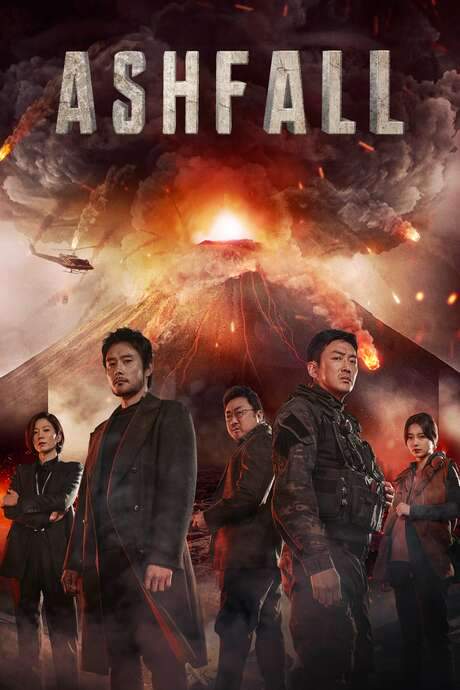
Paektu Mountain, a volatile volcano perched on the China–North Korea border, suddenly erupts and triggers a cascade of severe earthquakes that ripple across the Korean peninsula. The crisis sparks a race against time as officials fear further eruptions, threatening countless lives. In response, a plan emerges rooted in a controversial theory about predicting and preventing a larger catastrophe: detonate a nuclear device near a mine close to Paektu’s caldera to relieve the built-up pressure and avert catastrophic activity.
At the heart of this mission is Jo In-chang, a capable captain who leads a dedicated special-forces team into hostile airspace and perilous terrain. From the outset, In-chang must navigate not only the physical dangers of the mission but also the murky lines between loyalty and survival. He reaches out to Lee Joon-pyeong, a man living a double life as a North Korean intelligence operative, who becomes a pivotal, if morally complex, ally. Joon-pyeong’s knowledge proves essential, but it comes with a heavy personal cost: his dying wife becomes a leverage point used by adversaries who threaten his daughter’s safety, forcing him to reveal difficult truths to help the mission move forward.
Meanwhile, in Seoul, Choi Ji-young—a pregnant wife and mother enduring the chaos of the disaster—faces a different kind of stress: the struggle to protect her family while the city buckles under seismic shocks and collapsing infrastructure. Her resilience under pressure highlights the human toll of the crisis beyond strategic calculations and battlefield maneuvers.
As In-chang’s team plunges deeper into danger, they parachute into compromised skies when their aircraft malfunctions, a harrowing dawn that leaves them to improvise and push ahead. Their search leads them toward the critical lead: a power station connected to the supply of an essential material—the uranium needed for the extraction of the perilous device. The mission intensifies as American forces react, attempting to intercept the team and prevent the delivery from falling into the wrong hands. The tension rises with every heartbeat as the international stakes grow higher and the clock ticks louder.
Back at the center of the storm, Jeon Yoo-kyung plays a crucial, if perilous, role. In the chaos of the base, she purloins military documents and slips away to meet with Kang and Ji-young, initiating a clandestine line of contact that could tilt the balance of the operation. The scramble to keep information secure while fleeing their pursuers underscores a world where trust is scarce and every choice carries consequence.
As the North’s forces converge near Paektu, In-chang and Lee Joon-pyeong push through dangerous terrain toward Bocheon, the town closest to the looming mountain. The reunion with Joon-pyeong’s family is fraught with danger, and when the time comes, In-chang provides the uranium but orchestrates a precise countdown, aligning the device’s detonation with the moment Paektu’s eruption strikes again. The resulting eruption triggers a fresh wave of quakes that scatter the pursuing soldiers and criminals, forcing retreat and reconfiguration of the battle lines.
In parallel, Professor Kang—whose scientific insight frames the entire operation—continues to guide the South Korean military with his deep understanding of the volcano’s behavior. As the team closes in on the final objective, Kang updates In-chang on the eruption’s likely sequence and the best place to strike to quell the threat without sacrificing more lives. This alliance between pragmatic military action and scientific expertise proves essential to timing and precision.
The climax unfolds in an abandoned mine that becomes the crucible for the operation’s ultimate act. Joon-pyeong volunteers to take the critical device into the depths, while In-chang stays with Soon-ok, the little girl who embodies the fragile future they are all fighting to protect. The countdown ends in a dramatic, earth-shaking moment: the device explodes, sacrificing Joon-pyeong but successfully halting the seismic onslaught. The peninsula steadies, and the immediate danger recedes, sparing countless lives from the catastrophic chain reactions that threatened to reshape the region.
In the aftermath, North and South Korea begin the long work of reconstruction, uniting in a shared resolve to rebuild a fractured land. In-chang and Ji-young welcome a newborn son into their family, and Soon-ok finds a place in their lives as they commit to a future defined by cooperation rather than conflict. The story closes on a note of cautious optimism, with a divided peninsula choosing to move forward together, honoring the sacrifices that kept the eruption at bay and the people who stood up to protect one another.
The film’s texture—grounded in urgent technical detail, human vulnerability, and a persistent sense of moral ambiguity—keeps the reader engaged from the first tremor to the final, hard-won moment of peace. It marries high-stakes action with intimate emotional stakes, reminding audiences that even in the face of planetary-scale danger, the choices of individuals can carve a path toward recovery and renewal.