Plot Explained Spoilers guaranteed!
Plot Explained

Browse by genre

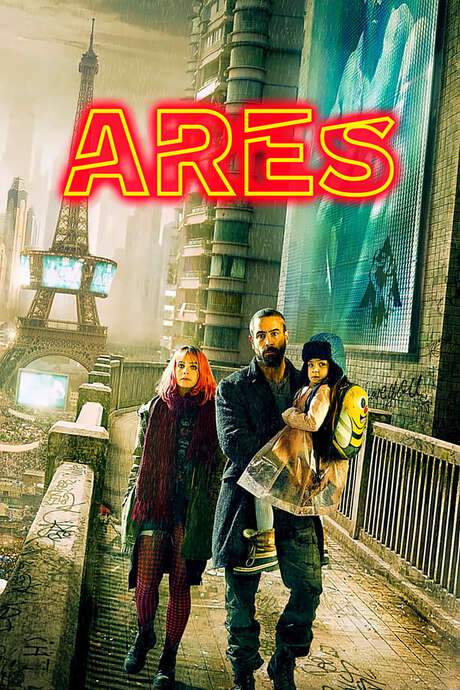
Ares (2016) movie poster

Plot Summary

Ares (2016) Plot Summary Explained

Release, runtime and language
2016 · 80 mins · French
Loading streaming availability…
Directed by
Jean-Patrick Benes
Starring
Vincent Deniard, Thierry Hancisse, Micha Lescot, Hélène Fillières, Jo Prestia, Ruth Vega Fernandez

In a dystopian near future, France struggles with widespread unemployment and poverty, leading its citizens to seek solace in televised, ultra-violent fights. These contests feature legally-doped fighters, reflecting a society on the brink of rebellion and despair. The fights provide a disturbing outlet for the frustrations of a nation facing economic collapse and social unrest.

On this page (5)
  1. 1 Where to watch
  2. 2 What happens: full plot
  3. 3 Plot questions answered
  4. 4 Movie threads
  5. 5 Every angle
Loading streaming availability…

Full plot summary · contains spoilers

What Happens in Ares: Full Plot Summary

The whole story of Ares (2016) explained, from the opening scene to the final frame: every key event, every twist and what it all adds up to. Read it as a quick recap before the sequel, to check a scene you missed, or to finally understand what really happened.

In a near-future France, the economy has collapsed and corporate power eclipses the old republic. Banks and mega-companies buy up national debt, leaving more than 15% of the population unemployed and sheltering in squalid encampments, the largest sprawling under the Eiffel Tower. In this world, the government is nominally a republic, but the corporations run everything, passing sweeping reforms that deregulate industries and bend the rule of law to their advantage. Among these changes, doping and human experimentation become legalized, and violent new spectator sports emerge as big sponsors push pharmaceutical drugs on athletes. Reda, Vincent Deniard fights under the nickname Arès, earning a living in brutal cage matches while being sponsored by powerful corporate interests.

Reda’s life is tangled with Altman, a female corporate agent who exercises leverage over him, and with a corrupt system that trades in human risk for profit. As the state’s riot police are replaced by unemployed temporary workers serviceable to the corporations, Reda finds himself on the front lines during civil unrest, acting as part of the security apparatus but also as someone who cares for those around him. During one riot, his niece—a vocal anti-corporate advocate—gets swept into a police van, and Reda manages to secure her release, a moment that underscores the personal stakes behind the political theater.

Carla, Reda’s sister, is framed for possession of a pistol and branded a terrorist. Altman delivers the grim news: Carla will stand trial, unless Reda can find a €100,000 bribe to secure her release. The only feasible route is consent to participate in HSX, a drug trial whose track record is catastrophic. Reda is told that the drug could maximize his biochemistry enough to survive, but it will trigger a five-minute blackout that could erase the memory of what follows. To safeguard Carla’s children, Reda leaves them with Myosotis, a neighbor who supports them and who—despite a rocky history with Reda—agrees to help him for the kids’ sake. Myosotis, Micha Lescot, is a complex ally: protective yet wary of Reda’s judgments, and their shared concern for the children drives the action forward.

The boardroom push to sell HSX pushes Reda toward a dramatic test. To demonstrate the drug’s power and generate sales, the CEO arranges for Reda to fight a top-tier fighter whose nervous system has been enhanced to feel no pain. The match is viewed as a near-impossible challenge, and even Reda’s coach—who doubts him—won’t place bets on a victory. Yet HSX performs as advertised, and Reda secures a stunning win against odds of twelve to one. The victory sends HSX into the mainstream, and with the money Reda ascends to freedom for Carla, using Myosotis as the broker. But tragedy strikes when Carla dies in prison while trying to defend another inmate, revealing the human cost at the heart of corporate experiments.

Anna, Ruth Vega Fernandez, a security figure within the corporation, tries to salvage their project and frames a different narrative around Reda’s motives. She informs Reda that Altman can be persuaded to return his funds if he helps with the broader scheme—yet Reda asks that the money instead be used to uncover who framed Carla. The resistance is further energized when Anouk, Éva Lallier, Anouk’s boyfriend Boris—a hacker who supports anti-corporate actions—provides critical evidence that implicates Reda’s coach in some of the machinations.

With Carla’s children in peril, Reda again has to rely on Myosotis and Boris to keep him in their orbit. Reda’s next fight ends in a brutal 17-second defeat, crushing public confidence that HSX is a reliable path to wealth for the lower ranks. The corporate machine quietly writes off the earlier victory as a fluke, and Reda’s coach is financially ruined as a consequence. When Reda confronts his own choices, he reveals that he did not take HSX and instead threw the fight to preserve the drug for a more consequential use. He saves the drug for his coach, who dies quickly after being injected, a moment that intensifies the moral calculus of every player in the drama.

Anna confronts Reda with the chilling reality that Altman intends to kidnap Carla’s children, arguing that Altman’s loyalty to money eclipses any personal care. Reda agrees to stage a dramatic demonstration for the corporate board, hoping to expose the truth. At home, Altman orders Anouk to phone Myosotis, insinuating a gesture of gratitude from Reda that Myosotis finds suspicious. Myosotis recruits Boris’s hacking talents to uncover what’s really going on, recognizing that a misdirection has been laid out for them all.

In a climactic rescue, Boris and Myosotis save the children and kill Altman, a brutal end to one strand of corporate influence. Reda’s bodyguards—a pair of genetically engineered arena-fighter clones— initially gain an advantage but are ordered to spare Reda; the board’s calculus about killing him collapses. As the five-minute window of the HSX drug nears expiration, Reda contemplates eliminating Anna, but instead helps Boris remotely hack the corporation’s mainframe. The breakthrough reveals shocking numbers: more than 30,000 people died in HSX drug trials, a catastrophe that dwarfs the personal losses already suffered.

Knowing that his nieces will remain unsafe as long as he is alive as “patient zero,” Reda makes the ultimate sacrifice and takes his own life. Anna protests, and the corporation attempts to bury the scandal, but Boris hijacks the advertising and media displays to broadcast the truth, exposing the full extent of HSX’s failed trials and Reda’s death. The revelation becomes a catalyst for a mass movement against the corporate leadership, triggering widespread riots and a new energy behind the resistance—the moment when the fight against corporate domination begins to reshape France.
Last updated: October 09, 2025 at 16:00

Was this helpful?

Plot questions answered

Ares Plot Explained: Your Questions Answered

The questions people ask most about Ares (2016): what happens in the confusing scenes, why the characters do what they do, the twists, hidden details and what the ending means. Each answer contains spoilers.

Q1

Why did Reda agree to take the HSX drug?

Reda agreed to take the HSX drug because his sister Carla was framed for terrorism and faced imprisonment. Altman offered to secure Carla's release in exchange for €100,000, a sum Reda could only earn by participating in the dangerous HSX drug trial. The drug promised to enhance his fighting abilities enough to survive the trials, though it would trigger a five-minute blackout that could erase his memory of what followed.

Foreshadowing: Earlier scenes establish that Altman has leverage over Reda through his employment in the corporate security apparatus, making refusal difficult.

  • hsx drug
  • reda
  • carla
  • altman
  • trial
  • prison
Q2

How was Carla framed for terrorism?

Carla was framed for illegal pistol possession and branded a terrorist. While the specific details of who orchestrated the framing aren't fully explained in the film, Boris later provides evidence implicating Reda's coach in the machinations, suggesting the framing was part of a larger corporate scheme to pressure Reda into compliance with the HSX program.

Foreshadowing: The film's early establishment of Altman's control over Reda hints that her arrest serves a calculated purpose.

  • carla
  • framed
  • terrorist
  • altman
  • coach
Q3

Why did Reda throw his second fight?

Reda deliberately lost his second fight to preserve the HSX drug for a more significant purpose. Rather than taking the drug himself, he saved it to give to his coach, who had been financially ruined by the fallout from Reda's earlier victory being dismissed as a fluke. This act revealed Reda's strategic thinking, he used the loss to manipulate the drug's availability while maintaining his moral reasoning.

Foreshadowing: The film hints at Reda's resourcefulness earlier when he navigates corporate pressure and manages to secure his niece's release from police custody.

  • reda
  • fight
  • hsx
  • coach
  • thrown
  • defeat
Q4

Why did Reda commit suicide at the end?

Reda committed suicide because he knew his nieces would never be safe as long as he lived as the test subject who could expose the corporation. With the five-minute HSX window about to expire and his bodyguards dead, he chose to sacrifice himself to ensure the children's protection and to prevent Altman or the corporation from using them as leverage. His death also became a catalyst for exposing the HSX scandal to the public.

Foreshadowing: Earlier scenes establish that Altman values money over personal relationships, making the threat to the children credible and immediate.

  • reda
  • suicide
  • children
  • nieces
  • altman
  • sacrifice
Q5

What was the HSX drug and why was it dangerous?

HSX was an experimental pharmaceutical drug designed to maximize a fighter's biochemistry, enhancing strength and endurance to superhuman levels. It was dangerous because the trials had catastrophic results, over 30,000 people died during the testing phase. The drug also caused a five-minute blackout, erasing the user's memory of actions taken while under its influence, effectively making users unaware participants in potentially violent events.

Foreshadowing: The early scenes establish that doping and human experimentation have been legalized in this dystopian France, setting the stage for corporate abuse.

  • hsx
  • drug
  • trials
  • dangerous
  • death
  • experimentation
Q6

Why did Carla die in prison?

Carla died in prison while attempting to defend another inmate. Despite Reda winning his fight and earning enough money to potentially secure her release, she did not survive long enough to benefit from his efforts. Her death highlights the brutal reality of the prison system in this world and underscores the human cost of corporate experimentation.

Foreshadowing: The timeline shows Carla dies shortly after Reda's victory, preventing her liberation despite his sacrifice.

  • carla
  • prison
  • death
  • inmate
Q7

How did Boris and Myosotis rescue Carla's children?

Boris and Myosotis rescued Carla's children by working together after Myosotis grew suspicious of Altman's intentions. When Anna warned Reda that Altman planned to kidnap the children, Myosotis recruited Boris's hacking talents to uncover the threat. They then staged a climactic intervention that resulted in Altman's death and the children's safe extraction from corporate control.

Foreshadowing: Myosotis's initial suspicion of Reda's 'gratitude' phone call triggers the investigation that reveals Altman's true plans.

  • boris
  • myosotis
  • children
  • kidnap
  • rescue
  • altman
Q8

What triggered the nationwide riots at the end?

The nationwide riots were triggered when Boris hijacked advertising and media displays to broadcast the truth about HSX drug trials, revealing that over 30,000 people had died and exposing Reda's death in the process. The revelation of corporate crimes against the population ignited mass outrage, transforming individual tragedy into a public uprising against corporate domination.

Foreshadowing: The film's meta notes establish that resistance against corporate power is a central theme, with the ending serving as the catalyst for change.

  • riots
  • boris
  • exposed
  • corporate
  • hsx
  • death
Q9

Why did Reda give the HSX drug to his coach?

Reda gave the HSX drug to his coach because the coach had been financially ruined when the corporation dismissed Reda's earlier victory as a fluke, causing HSX sales to tumble. Rather than using the drug himself in the second fight, Reda chose to administer it to his coach, who died quickly after the injection, a tragic outcome that demonstrates the drug's lethal nature outside of controlled conditions.

Foreshadowing: The coach's earlier refusal to bet on Reda hints at their complicated relationship and the coach's precarious financial position.

  • reda
  • coach
  • hsx
  • drug
  • injection
  • death
Q10

Why did the corporate bodyguards spare Reda?

The corporate bodyguards, genetically engineered arena-fighter clones, initially gained an advantage over Reda but were ordered to spare him. The board calculated that killing Reda would eliminate their valuable test subject and hinder ongoing drug trials. This hesitation allowed Reda the window he needed to help Boris hack the mainframe and expose the corporation's crimes.

Foreshadowing: The bodyguards' initial orders from Anna establish that Reda was meant to remain alive for the demonstration.

  • bodyguards
  • clones
  • spared
  • reda
  • board
  • experiment
Q11

What was Myosotis's role in the resistance?

Myosotis served as a crucial ally by caring for Carla's children and later joining the resistance against the corporation. Despite a rocky history with Reda, who she believed to be a fascist, she agreed to help for the children's sake. Her suspicion of Altman's intentions led her to recruit Boris, and together they executed the rescue of the children and the elimination of Altman.

Foreshadowing: Myosotis's initial refusal to trust Reda establishes her as a cautious but ultimately loyal character driven by concern for the children.

  • myosotis
  • children
  • resistance
  • boris
  • ally
Q12

Why did Altman want to kidnap Carla's children?

Altman planned to kidnap Carla's children as leverage against Reda, demonstrating that her loyalty to money eclipsed any personal care. Anna explained to Reda that Altman would use the children to ensure his continued compliance with the corporate agenda, treating them as assets rather than innocent lives.

Foreshadowing: Altman's earlier actions establish her as a ruthless corporate agent who instrumentalizes people for profit.

  • altman
  • kidnap
  • children
  • leverage
  • money

Movie threads

More Movies Like Ares, by Mood & Story

Curated lists built around what makes Ares tick: the same mood, the same kind of story or the same emotional payoff. Each list explains why these movies belong together.

Dystopian Fight Arenas and Systemic Rebellion like in Ares

Brutal, high-stakes fights become the catalyst for exposing a corrupt system. If you liked the brutal fight-for-survival premise of Ares, you'll find similar themes in these movies. This thread groups gritty sci-fi and action thrillers where televised combat or gladiatorial systems mask deeper corruption, leading to a protagonist's sacrifice that ignites rebellion. Explore more movies like Ares with oppressive worlds and desperate heroes.

  • dystopian
  • brutal
  • oppressive
  • desperate
  • gritty
  • rebellious
  • Tone: dark, desperate, cautionary
  • Pacing: fast, relentless
Why these movies?

The story pattern: These stories typically follow a skilled but oppressed individual whose participation in a violent, systemic spectacle is initially for survival or to protect loved ones. As they uncover the true depth of the corruption behind the spectacle, their personal fight transforms into a symbolic act of resistance, often culminating in a sacrifice that exposes the truth to the masses.

Why they belong together: Movies are grouped here for their shared setting of a corporatized or authoritarian dystopia, the central motif of orchestrated combat, and the narrative arc where personal sacrifice within the system becomes a public catalyst for change. They share a dark, intense tone and a focus on systemic critique.

Heavy Sci-Fi Thrillers with Bittersweet Sacrifice like in Ares

Gripping stories where a protagonist's ultimate sacrifice delivers a costly victory. For viewers who appreciated the emotional weight and bittersweet resolution of Ares, this thread features similar sci-fi thrillers. These films share a dark tone, high stakes, and a narrative where the hero's tragic sacrifice is necessary for a larger victory. Discover more movies like Ares with heavy themes and impactful endings.

  • somber
  • desperate
  • tragic
  • hopeful
  • tense
  • weighty
  • Tone: dark, heavy, bittersweet
  • Pacing: fast, gripping
Why these movies?

The story pattern: The narrative pattern involves a protagonist facing an overwhelming, systemic evil. Conventional solutions fail, forcing them to make a choice that costs them everything—their life, their future, or their peace. Their sacrifice is not in vain; it achieves a crucial objective (exposing truth, saving others, sparking change), but the ending is tinged with the sorrow of their loss.

Why they belong together: These films are united by their intense, dark mood, fast pacing, and a very specific emotional arc: the journey towards a bittersweet ending achieved through sacrifice. The focus is on the emotional impact of the protagonist's choice and the complex feelings of a victory paid for with a great personal cost.

Every angle

Ares (2016) Explained: Plot, Timeline & Characters

Everything about Ares in one place: what happens in the plot summary, the timeline in chronological order, the characters and meaning and a spoiler-free summary. What's After the Movie adds the cast, box office and post-credit scenes.

Coming soon on iOS and Android

The Plot Explained Movie Summary App

Plot summaries, endings explained and timelines on your phone. Catch up on any movie in minutes, save your favorites and never miss a twist again.

Be the first to know when we launch. Your email stays private, always.

Learn more about the app