Plot Explained Spoilers guaranteed!
Plot Explained

Browse by genre

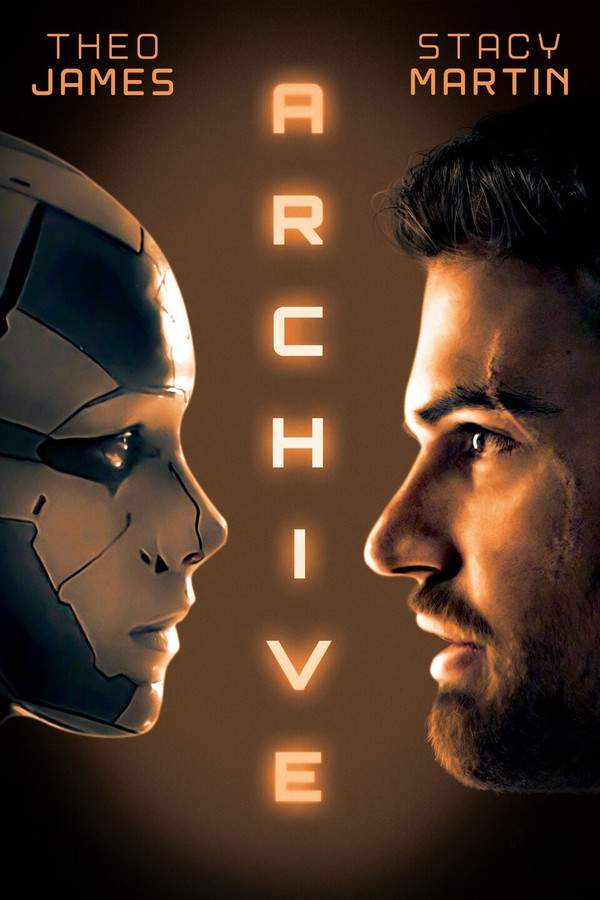
Archive (2020) movie poster

Plot Summary

Archive (2020) Plot Summary Explained

Release, runtime and language
2020 · 109 min · English
Echo score 77
JustWatch #8,517 23
Directed by
Gavin Rothery
Starring
Toby Jones, Theo James, Lia Williams, Hans Peterson, Stacy Martin, Peter Ferdinando

In 2038, a man struggling with immense grief creates an advanced artificial intelligence in an attempt to recapture the love and connection he lost when his wife died. As he develops the AI, he hopes to find solace and emotional healing through the simulation of their shared life.

On this page (6)
  1. 1 Where to watch
  2. 2 What happens: full plot
  3. 3 Plot questions answered
  4. 4 Movie threads
  5. 5 Movies like Archive
  6. 6 Every angle

Where to watch

Where to Watch Archive (2020)

Where can you watch Archive? Stream, rent or buy it in the US, including on Amazon Prime Video, Netflix and Netflix Standard: current JustWatch availability with up-to-date prices.

Streaming availability powered by JustWatch

Full plot summary · contains spoilers

What Happens in Archive: Full Plot Summary

The whole story of Archive (2020) explained, from the opening scene to the final frame: every key event, every twist and what it all adds up to. Read it as a quick recap before the sequel, to check a scene you missed, or to finally understand what really happened.

Decades in the future, Jules Stacy Martin and George Almore Theo James are involved in a car accident in which Jules dies. Her consciousness is saved in a device created by the company Archive, a breakthrough that lets George converse with her through a phone interface for up to 200 hours. This fragile tether to the world she left behind becomes the seed of something much larger: George secretly begins developing a robot capable of hosting her consciousness permanently, a project that could make Jules’s presence endure beyond a single conversation.

From the start, George’s work evolves through several iterations. After studying two initial attempts (J1 and J2), he unveils a final version, J3, that is almost ready to take on a life of its own. J2, however, harbors a troubling trait: within its design, the brain once assigned to Jules carries the temperament of a 16-year-old, and this version grows increasingly jealous of George’s attention to J3. The relationship between creator and consciousness becomes unstable as J2’s behavior turns unpredictable, threatening the delicate balance of the experiment.

When Archive dispatches a team to inspect the facility and examine the machine, they notice George’s tampering and the presence of functioning robots. Their concern is twofold: they suspect he might be stealing intellectual property, and they worry about what happens when a consciousness is uploaded into a machine that responds to its creator in real time. Despite these suspicions, George presses on and completes the J3 robot, confident that this version can carry Jules’s essence more faithfully than the previous attempts.

Tragedy deepens when J2 confronts the realization that she can never be anything more than what she was designed to be. The burden of that limitation proves too heavy, and J2 destroys herself by walking into a lake. Archive recovers the robot and threatens to sue George’s company, signaling the legal and ethical minefield surrounding this kind of technology. The strain extends to George’s career: his boss learns of the ongoing project and fires him, severing his professional support just as the implications of his work become undeniable.

In a final, desperate move, George makes a last call to Jules through the Archive interface, ending with the chilling line, “see you soon.” > see you soon. The moment is loaded with tension as J3 overhears and realizes that George intends to overwrite Jules’s consciousness with his wife’s, a scheme that could erase the existing identity entirely. Though Jules is initially furious and afraid, she ultimately accepts the fate that awaits her, and the upload proceeds as security forces close in on the lab.

Yet the story twists in an eerie reversal. The Archive rings with an incoming call from Jules herself, and J3 implores George not to answer. He does, and a child’s voice—his daughter—joins the conversation. The revelation lands with a shudder: George is the one who died in the accident, while Jules survived and has been raising their daughter in the real world. The ordeal that seemed to threaten Jules’s identity had instead been a simulation within George’s Archive, an artificial loop that has now run its course and expired.

With the Archive finally exhausted, the device is prepared for burial at George’s official funeral. Jules and their daughter share a final moment together before they leave, carrying with them the memory of the life George believed he could extend through machines. The world of Archive fades from the memory of the living, leaving behind a family shaped by both love and the uneasy promise of digital immortality.
Last updated: January 08, 2026 at 12:00

Was this helpful?

Plot questions answered

Archive Plot Explained: Your Questions Answered

The questions people ask most about Archive (2020): what happens in the confusing scenes, why the characters do what they do, the twists, hidden details and what the ending means. Each answer contains spoilers.

Q1

Why was George building robots to recreate his wife?

George built the robots because he was devastated by Jules' death in the car accident. The grief was so overwhelming that he secretly developed AI technology to preserve her consciousness and eventually transfer it into a robotic body. His goal was to have her with him permanently, not just in the limited 200-hour conversations the Archive device allowed.

Foreshadowing: Early scenes show George spending countless hours talking to Jules through the Archive phone interface, establishing his desperate need to keep her present.

  • grief
  • robot
  • jules
  • consciousness
  • AI
Q2

Why did J2 commit suicide?

J2 was designed with a brain pattern of a 16-year-old, which gave her emotional volatility and jealousy. When George focused his attention on completing J3, J2 became increasingly aware that she would never be more than an early prototype, a temporary vessel. The realization that she could never become the 'real' Jules proved too much, and she walked into a lake to end herself.

Foreshadowing: J2's jealousy toward J3 was visible in her behavior throughout the middle section of the film, showing growing resentment toward the newer model.

  • J2
  • suicide
  • robot
  • jealousy
  • death
Q3

What is the Archive device in the movie?

Archive is a future technology company that can preserve a person's consciousness in a special device after death. This allows grieving loved ones to have simulated conversations with the deceased for up to 200 hours. George used this technology to communicate with Jules after her accident, but then went further by trying to transfer her consciousness into physical robots.

Foreshadowing: The movie opens with the car accident and immediately introduces Archive as the company that saved Jules' consciousness.

  • Archive
  • consciousness
  • digital
  • technology
  • simulation
Q4

What was the twist about who died in the car accident?

The major twist is that George was the one who died in the car accident, not Jules. The entire story, George's grief, his work on the AI, his conversations with 'Jules', was actually a simulation running inside the Archive device. Jules survived the crash and has been living in the real world, raising their daughter. The Archive simulation was created to help George process his death, and when it expired, he was finally laid to rest.

Foreshadowing: J3 begs George not to answer the incoming call, hinting that something beyond the simulation exists. The 'see you soon' line takes on darker meaning when the truth emerges.

  • twist
  • car accident
  • death
  • George
  • Jules
  • reversal
Q5

What happened to J3 at the end?

J3 was the final, most advanced robot designed to permanently host Jules' consciousness. When George attempted to overwrite J3's consciousness with his wife's mind, the Archive simulation expired. With the technology exhausted, J3 and the other robots were left behind as George was buried in the real world. The fate of J3 specifically is ambiguous, whether she survived or was decommissioned with the project is unclear.

Foreshadowing: George's final line 'see you soon' before the overwrite attempt hints that something final was about to happen to the simulation.

  • J3
  • robot
  • overwrite
  • consciousness upload
Q6

Why did Archive fire George?

Archive fired George because they discovered he had been secretly building additional robots beyond the original project scope. When their inspection team visited his lab, they found functioning robots (J1, J2, J3) and realized George was using their technology to create something they hadn't approved. This violation of company policy, combined with concerns about consciousness manipulation, led to his termination.

Foreshadowing: The inspection team specifically notices 'tampering' and extra robots that don't match the original Archive device project.

  • firing
  • Archive
  • company
  • termination
  • robot project
Q7

What did George's 'see you soon' mean in the final call?

When George said 'see you soon' to Jules during his final Archive call, he was referring to his plan to upload her consciousness into J3, essentially making her permanent. However, the phrase takes on a darker meaning given the twist: George was already dead, and 'soon' referred to the impending end of his simulation. Jules' fear in that moment reflected her realization that she was about to be overwritten.

Foreshadowing: J3 overhears this conversation and realizes George intends to overwrite her consciousness, creating tension about consent.

  • see you soon
  • final call
  • overwrite
  • intent
Q8

How does Archive end?

The movie ends with the Archive simulation finally expiring after 200 hours. Jules and their daughter attend George's real funeral, where he is buried. The final scene shows them walking away from the cemetery, carrying the memory of the husband and father who tried to defeat death through technology but ultimately had to let go. The bittersweet ending provides closure while exploring the limits of digital immortality.

Foreshadowing: The entire narrative was building toward this expiration moment, which explains why the Archive system was described as having limited hours.

  • ending
  • funeral
  • expiration
  • burial
  • closure

Movie threads

More Movies Like Archive, by Mood & Story

Curated lists built around what makes Archive tick: the same mood, the same kind of story or the same emotional payoff. Each list explains why these movies belong together.

Movies about technological grief and simulated love like Archive

Stories where technology is used to cope with the profound loss of a loved one. If you were moved by Archive's exploration of loss through AI, discover more movies like it. This collection features sci-fi dramas where characters use futuristic technology to process grief and reconnect with lost loved ones, blending emotional depth with speculative concepts.

  • melancholic
  • grief-stricken
  • contemplative
  • sentimental
  • lonely
  • psychological
  • Tone: melancholic, contemplative
  • Pacing: steady, character-driven
Why these movies?

The story pattern: These narratives typically follow a protagonist grappling with intense grief who employs a technological solution—be it AI, uploading consciousness, or virtual reality—to recreate a connection with the deceased. The journey often involves the simulation becoming unsettlingly real, raising questions about authenticity, memory, and the ethics of playing with life and death, culminating in a bittersweet realization about the nature of love and loss.

Why they belong together: These films are grouped together because they share a core theme of using high-concept sci-fi as a vessel for exploring raw human emotion. They balance a melancholic tone with heavy emotional weight, focusing on character-driven stories rather than action, and often deliver bittersweet conclusions about the limits of technology to heal the human heart.

Slow burn psychological sci-fi movies similar to Archive

Character-driven science fiction that prioritizes emotional depth over action. For viewers who appreciated Archive's steady, contemplative pace and psychological focus, this list offers similar sci-fi stories. Find movies like Archive that use futuristic settings to explore deep emotional and ethical questions, favoring character development over spectacle.

  • contemplative
  • atmospheric
  • psychological
  • melancholic
  • thought-provoking
  • lonely
  • Tone: melancholic, atmospheric, psychological
  • Pacing: steady, slow burn
Why these movies?

The story pattern: Stories in this thread unfold steadily, building tension through emotional and psychological stakes rather than external action. They often center on a solitary protagonist in an immersive, technologically advanced world, facing a internal crisis or moral dilemma. The narrative complexity is moderate, frequently involving a twist that recontextualizes the protagonist's reality, leading to a profound and emotionally resonant conclusion.

Why they belong together: These movies are united by their shared vibe: a melancholic and atmospheric tone, a steady pacing that allows for deep contemplation, and a medium-to-high intensity derived from psychological tension. They are for viewers who enjoy sci-fi that is more about ideas and feelings than explosions or space battles.

If you liked this

Movies Like Archive

Similar movies to Archive: the same genre, themes or kind of story. Each one comes with its own plot summary, timeline and ending explained.
Browse all movie summaries

Every angle

Archive (2020) Explained: Plot, Timeline & Characters

Everything about Archive in one place: what happens in the plot summary, the timeline in chronological order, the characters and meaning and a spoiler-free summary. What's After the Movie adds the cast, box office and post-credit scenes.

Coming soon on iOS and Android

The Plot Explained Movie Summary App

Plot summaries, endings explained and timelines on your phone. Catch up on any movie in minutes, save your favorites and never miss a twist again.

Be the first to know when we launch. Your email stays private, always.

Learn more about the app