Plot Explained Spoilers guaranteed!
Plot Explained

Browse by genre

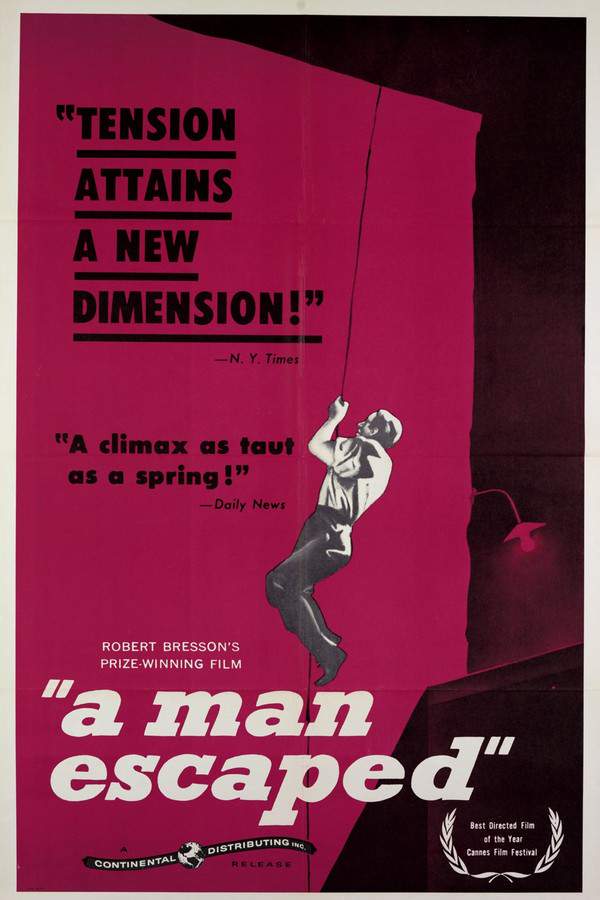
A Man Escaped (1956) (2012) movie poster

Timeline

A Man Escaped (1956) (2012) Timeline Explained – Every Event in Order

Release, runtime and language
2012 · 99 min · French
Directed by
Robert Bresson

Confined within the walls of Fort Montluc, prisoner-of-war André Fontaine meticulously plans a daring escape, spurred by the looming threat of execution. The arrival of a new cellmate initially disrupts his focus, but ultimately provides an unexpected opportunity to execute a more ambitious breakout. He methodically prepares, studying the fort’s layout and routines to overcome the seemingly insurmountable challenge.

On this page (5)
  1. 1 Events in order (14)
  2. 2 Timeline questions answered
  3. 3 Movie threads
  4. 4 Movies like A Man Escaped (1956)
  5. 5 Every angle

14 events in order · contains spoilers

A Man Escaped (1956) Timeline: Events in Chronological Order

Every key event of A Man Escaped (1956) (2012) in order, scene by scene, with when and where it takes place. Use it to untangle flashbacks, time jumps and parallel storylines, to refresh your memory before the sequel or to find the exact scene you are thinking of.

  1. Capture and Imprisonment

    In 1943, during a daring attempt to escape, Fontaine leaps from the vehicle transporting him to Montluc prison. Unfortunately, he is quickly apprehended by German soldiers, who subject him to a brutal beating before locking him away in a cell.

    When
    1943
    Where
    Montluc prison
  2. Life in Prison

    Fontaine endures the harsh realities of confinement, as the echoes of gunfire signify the executions of his fellow inmates. This grim backdrop haunts Fontaine as he desperately tries to survive and remain hopeful.

    Where
    Montluc prison
  3. Communication with Inmates

    While initially isolated in his cell, Fontaine cleverly communicates with his neighbor by tapping on the wall. He also engages with Terry, a fellow inmate, who is allowed to exercise in the courtyard, creating a lifeline by delivering messages to the outside world.

    Where
    Montluc prison
  4. Transfer to Isolated Cell

    After fifteen days in a ground-floor cell, Fontaine is transferred to a more isolated cell on the top floor. This new environment brings him relief as he is no longer handcuffed, allowing him to engage with another inmate, Blanchet.

    Where
    Montluc prison
  5. Bonding with Blanchet

    In his new cell, Fontaine forms a bond with Blanchet, who initially does not respond to his attempts to communicate. As they work together on daily chores, Blanchet starts to engage with Fontaine, providing much-needed companionship during their grim imprisonment.

    Where
    Montluc prison
  6. Planning an Escape

    Fontaine begins to analyze the wooden door separating him from freedom and notices its structural weaknesses. Using a sharpened spoon, he sets out to chisel away at the joints of the door, meticulously ensuring he does not raise any suspicion.

    Where
    Montluc prison
  7. Creating Tools for Escape

    As Fontaine works on his escape plan, he gathers various makeshift materials found in his cell to craft ropes. His resourcefulness in creating these tools is vital for facilitating a successful escape from his confines.

    Where
    Montluc prison
  8. Orsini’s Impulsive Action

    Orsini, another inmate who has been signaling guard movements for Fontaine, expresses a desire to join the escape plan. However, his impulsiveness leads to his capture during a reckless moment, resulting in a death sentence that shocks Fontaine.

    Where
    Montluc prison
  9. Support from Fellow Inmates

    Despite growing doubts among some inmates regarding Fontaine's escape plan, he receives unexpected support from Blanchet, who donates a blanket to aid in his rope-making efforts. This solidarity strengthens Fontaine’s resolve.

    Where
    Montluc prison
  10. New Cellmate François Jost

    Fontaine’s situation becomes more complex with the arrival of new cellmate François Jost, who claims to have been charged with desertion. Suspicious that Jost might be a Nazi informant, Fontaine cautiously decides to build a rapport for survival.

    Where
    Montluc prison
  11. Collaboration with Jost

    Realizing the urgency of their predicament, Fontaine reveals his escape plan to Jost, who agrees to assist him. Together, they strategize further, crafting additional ropes necessary for their escape under the dire circumstances they face.

    Where
    Montluc prison
  12. The Night of the Escape

    Under the cover of darkness, Fontaine and Jost execute their well-planned escape attempt. They ascend into the hallway, reaching the roof through a skylight while the sounds of trains below provide a helpful distraction.

    Where
    Montluc prison
  13. Crossing to Freedom

    Upon reaching the rooftop, Fontaine faces a pivotal moment of hesitation before he finally musters the courage to shimmy across a rope he made. With a deep breath, he descends into the vibrant streets of Lyon, leaving Montluc prison behind.

    Where
    Lyon
  14. The Taste of Freedom

    After months of harrowing imprisonment and meticulous planning, Fontaine finally experiences the exhilarating sensation of freedom. The bustling atmosphere of Lyon welcomes him as he steps into a new life, far from the confines of his past.

    Where
    Lyon

Last updated: November 15, 2024 at 19:05

Was this helpful?

Timeline questions answered

A Man Escaped (1956) Timeline Explained: Your Questions Answered

When does it happen, and why in that order? The questions people ask about the chronology of A Man Escaped (1956) (2012): time jumps, flashbacks, cause and effect between scenes and the correct order of events, each answered with spoilers.

Q1

Why does Fontaine leap from the vehicle transporting him to Montluc?

Fontaine, a member of the French Resistance, attempts to escape during transport because he knows that being delivered to Montluc prison means almost certain execution under Nazi occupation. His leap is a desperate gambit to avoid imprisonment, though he is quickly caught and beaten by German soldiers.

Foreshadowing: Earlier, the film establishes that Fontaine is a resistance fighter, explaining why he would risk such a dangerous escape attempt.

  • fontaine
  • escape attempt
  • transport
  • french resistance
  • capture
Q2

Why is Fontaine transferred to a top-floor cell after 15 days?

The transfer to a more isolated top-floor cell actually benefits Fontaine because he is no longer required to wear handcuffs. This gives him the freedom of movement necessary to work on his escape plan using a sharpened spoon.

Foreshadowing: The transfer appears punitive but becomes instrumental to his escape capabilities.

  • fontaine
  • top floor cell
  • handcuffs
  • transfer
  • isolation
Q3

How does Fontaine escape his cell using only a spoon?

Fontaine observes that the wooden door is made of thick boards joined by softer wood. Using a sharpened spoon, he patiently chisels away at the joints over time, meticulously disposing of the wood shavings to avoid detection. This slow, methodical work allows him to create an opening large enough to slip through into the corridor.

Foreshadowing: Fontaine's careful observation of the door's construction early in his imprisonment sets up this method of escape.

  • fontaine
  • spoon
  • chisel
  • wooden door
  • escape method
Q4

Why does Fontaine decide to trust François Jost with his escape plan?

Although Fontaine suspects Jost might be a Nazi informant (Jost claims to be charged with desertion), Fontaine realizes that refusing to collaborate would be more dangerous. If Jost is an informant, refusing him could lead to betrayal, while involving him ensures at least one ally. With Fontaine facing a death sentence, the risk of trusting Jost is outweighed by the need for help.

Foreshadowing: Fontaine's survival instinct and the pressure of his impending execution force this difficult decision.

  • francois jost
  • fontaine
  • trust
  • escape plan
  • desertion
Q5

What happens to Orsini after his failed escape attempt?

Orsini, who has been helping Fontaine by signaling guard movements, becomes impulsive and attempts to escape during a slop bucket run. He is quickly captured and sentenced to execution. Before his death, Orsini urges Fontaine to fashion hooks to scale the prison walls, showing his continued belief in the escape plan despite his own failure.

Foreshadowing: Orsini's earlier signaling of guard movements had helped Fontaine, making his capture particularly impactful.

  • orsini
  • capture
  • execution
  • escape attempt
  • death sentence
Q6

Why does Blanchet initially ignore Fontaine's wall taps?

Blanchet, an elderly inmate in the top-floor cell, initially remains unresponsive to Fontaine's attempts at communication through wall taps. He only begins to engage after they bond during daily chores together, gradually opening up and eventually providing companionship and even donating a blanket for rope-making.

Foreshadowing: This initial resistance establishes the gradual trust-building that becomes important later.

  • blanchet
  • wall taps
  • communication
  • elderly inmate
  • relationship
Q7

How do the train sounds help Fontaine and Jost escape?

The noise from passing trains below provides essential cover for Fontaine and Jost as they ascend through a skylight and cross the roof. This ambient sound masks the noise of their movement, allowing them to traverse the rooftop without being heard by guards.

Foreshadowing: This detail was not foreshadowed earlier but becomes crucial in the escape sequence.

  • trains
  • noise
  • skylight
  • roof
  • escape timing
Q8

Why does Fontaine hesitate before crossing the rope to freedom?

At the critical moment on the rooftop, Fontaine hesitates as his nerves nearly get the better of him. After what feels like an eternity, he musters the courage to shimmy across the rope he fashioned, dropping down into the streets of Lyon. This moment represents the psychological toll of months of imprisonment and the fear of failure so close to freedom.

Foreshadowing: The buildup of tension throughout the slow escape process culminates in this moment of fear.

  • fontaine
  • hesitation
  • rooftop
  • rope
  • courage
  • freedom
Q9

What does Orsini's execution mean for Fontaine's escape?

Orsini's capture and execution serves as a grim reminder of the stakes involved. His death motivates Fontaine to continue planning while also showing the consequences of recklessness. Orsini's final request for hooks demonstrates his commitment to the escape cause even as he faces his fate.

Foreshadowing: The executions heard throughout the film create the constant backdrop of mortality that drives Fontaine's urgency.

  • orsini
  • execution
  • consequences
  • motivation
  • stakes
Q10

Why does Orsini ask Fontaine to make hooks before his execution?

In his final moments, Orsini urges Fontaine to fashion hooks specifically to scale the prison walls. This suggests Orsini believed the escape route required climbing equipment, possibly as an alternative method if the door-chiseling approach failed or as a backup plan for reaching higher points in the prison structure.

Foreshadowing: This request hints at alternative escape strategies Fontaine had considered.

  • orsini
  • hooks
  • prison walls
  • scaling
  • escape tools
Q11

What role does the safety pin from Terry play in Fontaine's escape?

Terry, a fellow inmate allowed to exercise in the courtyard, provides Fontaine with a safety pin. While the summary doesn't detail its specific use, such a pin could have served as a makeshift lock-picking tool, a writing implement for notes, or another small but crucial tool in his escape preparations.

Foreshadowing: This early assistance from Terry establishes the network of inmate collaboration.

  • safety pin
  • terry
  • tools
  • inmate help
  • courtyard
Q12

Why does Blanchet donate a blanket to Fontaine's escape effort?

Despite growing doubts among some inmates about the feasibility of Fontaine's escape plan, Blanchet shows solidarity by donating a blanket. This blanket likely contributes to the rope-making effort, as textile materials would be valuable for creating the strong rope needed to scale the prison walls.

Foreshadowing: Blanchet's gradual warming to Fontaine after initially ignoring him culminates in this act of support.

  • blanchet
  • blanket
  • rope making
  • inmate support
  • solidarity
Q13

Why are the sounds of executions important throughout the film?

The echoes of gunfire signifying the executions of fellow inmates create a constant atmosphere of terror and urgency. This grim soundtrack reminds viewers and Fontaine himself that failure means death, heightening the stakes of every decision and making the successful escape feel genuinely hard-won.

Foreshadowing: This ongoing sound establishes the life-or-death stakes that drive the entire narrative.

  • executions
  • gunfire
  • tension
  • fear
  • montluc prison
  • stakes

Movie threads

More Movies Like A Man Escaped (1956), by Mood & Story

Curated lists built around what makes A Man Escaped (1956) tick: the same mood, the same kind of story or the same emotional payoff. Each list explains why these movies belong together.

Methodical Escape Thrillers like A Man Escaped (1956)

Stories where meticulous planning and quiet tension lead to a desperate breakout. If you enjoyed the step-by-step, realistic escape plan in A Man Escaped, explore more movies like it. This list features similar thrillers and dramas where characters use intelligence and determination to overcome imprisonment, focusing on the painstaking process of breakout attempts.

  • claustrophobic
  • methodical
  • anxious
  • desperate
  • hopeful
  • tense
  • Tone: tense, grim, hopeful
  • Pacing: slow burn, methodical
Why these movies?

The story pattern: The narrative pattern follows a protagonist in confinement who devises a detailed, often improvised, escape plan. The plot is driven by the acquisition of tools, the study of guard patterns, and the overcoming of sequential obstacles. The journey is one of quiet rebellion, where intellect and willpower are the main weapons against a formidable system.

Why they belong together: Movies are grouped here based on their shared focus on a realistic, process-driven escape narrative. They share a tense, claustrophobic mood, a slow-burn pacing that builds suspense through detail, and a heavy emotional weight due to the life-or-death stakes of the situation.


Claustrophobic Survival Narratives like A Man Escaped (1956)

Intense stories of individuals surviving against oppressive, confined environments. For viewers who appreciated the claustrophobic tension of A Man Escaped, this section collects movies with a similar feel. Discover similar war dramas and thrillers where characters fight for survival in confined, high-pressure settings, emphasizing psychological endurance and the grim reality of imprisonment.

  • claustrophobic
  • anxious
  • grim
  • desperate
  • survival
  • tense
  • Tone: tense, grim, desperate
  • Pacing: slow, deliberate
Why these movies?

The story pattern: These narratives typically feature a protagonist isolated in a hostile, confined space—be it a prison cell, a bunker, or a trapped vehicle. The story is a character study in endurance, focusing on their internal struggle, their strategies to maintain sanity and hope, and their meticulous efforts to outlast or overcome their captors or circumstances.

Why they belong together: These films are united by their oppressive, confined settings and the intense psychological experience they create. They share a high level of tension, a heavy emotional weight, a slow or steady pacing that allows dread to build, and a central theme of human survival against overwhelming physical and psychological constraints.

If you liked this

Movies Like A Man Escaped (1956)

Similar movies to A Man Escaped (1956): the same genre, themes or kind of story. Each one comes with its own plot summary, timeline and ending explained.

Browse all movie summaries

Every angle

A Man Escaped (1956) (2012) Explained: Plot, Timeline & Characters

Everything about A Man Escaped (1956) in one place: what happens in the plot summary, the timeline in chronological order, the characters and meaning and a spoiler-free summary. What's After the Movie adds the cast, box office and post-credit scenes.

Coming soon on iOS and Android

The Plot Explained Movie Summary App

Plot summaries, endings explained and timelines on your phone. Catch up on any movie in minutes, save your favorites and never miss a twist again.

Be the first to know when we launch. Your email stays private, always.

Learn more about the app