Year: 2012
Runtime: 87 min
Language: English
Directors: Dinesh D'Souza, John Sullivan
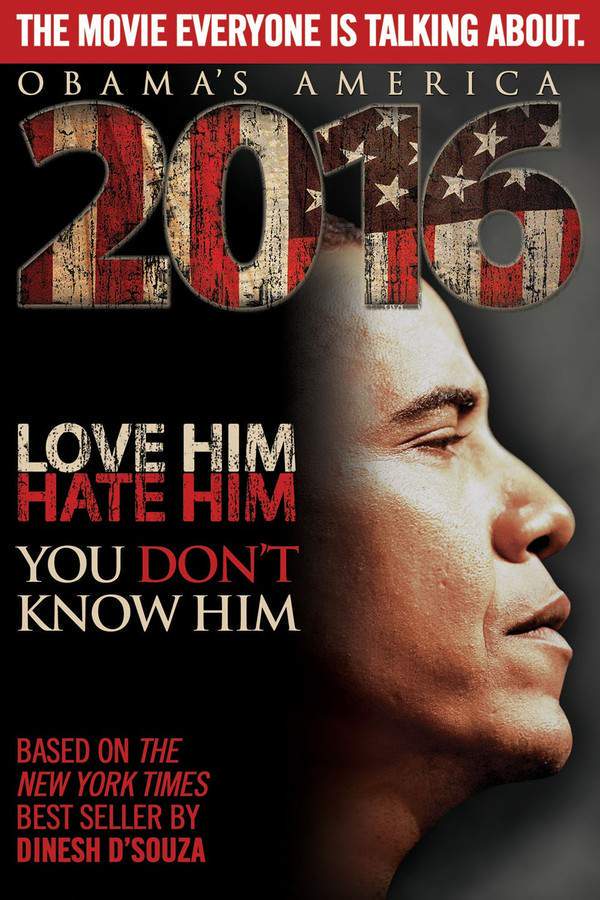
As the 2016 election approaches, this documentary follows best-selling author Dinesh D’Souza as he investigates Barack Obama's past and its potential influence on America's future. The film takes viewers on a journey across four continents, exploring Obama’s upbringing and connections, and examining the impact of his policies on a global scale. The documentary aims to uncover hidden aspects of Obama’s background and their possible ramifications for the nation.
Find where to stream, rent, or buy 2016: Obama's America (2012) in the US with current JustWatch availability, up-to-date pricing, and platform listings for subscription, rental, and digital purchase options.
Warning: spoilers below!
Haven’t seen 2016: Obama's America yet? This summary contains major spoilers. Bookmark the page, watch the movie, and come back for the full breakdown. If you're ready, scroll on and relive the story!
Trace every key event in 2016: Obama's America (2012) with our detailed, chronological timeline. Perfect for unpacking nonlinear stories, spotting hidden connections, and understanding how each scene builds toward the film’s climax. Whether you're revisiting or decoding for the first time, this timeline gives you the full picture.
Last updated: October 25, 2024 at 11:44
Find frequently asked questions about the 2016: Obama's America (2012) timeline, including chronological order, nonlinear jumps, cause-and-effect links, and scene sequence clarifications. This timeline FAQ helps explain when key events happen, how moments connect, and why the story unfolds in that specific order.
D'Souza draws parallels between himself and Obama because they share similar demographics, both are mixed-race men of similar age who attended Ivy League schools and immigrated to America. D'Souza argues this connection gives him unique insight into Obama's mindset, suggesting that understanding his own immigrant experience helps explain how Obama's background shaped his worldview.
Earlier, D'Souza mentions his own journey from India to Dartmouth College in 1978, establishing the personal stakes of his investigation.
D'Souza argues that Obama's father, Barack Obama Sr., significantly influenced his son's ideology despite minimal direct contact. The documentary traces Obama's lineage to Kenya's colonial past and independence struggle, claiming this connection explains Obama's views on colonialism, wealth redistribution, and anti-American sentiment. The journey to Kenya is presented as uncovering the 'roots of Obama's rage.'
The film establishes early that 'we are all shaped by our past' as a central thesis.
D'Souza argues that Obama's childhood experiences, including his absent father, life in Indonesia during the revolution, and exposure to anti-colonial sentiments through mentors, shaped his adult worldview. The documentary suggests these experiences explain his support for Argentina over America, hesitation on the Keystone Pipeline, and approach to conflicts in Libya and Syria, framing these as rooted in his critical view of American power.
Dr. Alice Dewey reflects on young Obama's kindness, but Ann Obama's emphasis on resilience is shown steering him toward his father's influence.
The documentary identifies Frank Marshall Davis as an anti-American journalist and Bill Ayers as a former Weather Underground member who advocated violent liberation. D'Souza investigates their relationships with Obama, claiming these figures significantly influenced Obama's radical worldview during his formative years in Chicago and Hawaii.
The film mentions these figures while exploring Obama's ideological development and early associations.
D'Souza draws parallels between his own upbringing in British India and Obama's connection to Kenya's colonial past. The documentary argues that Obama's critical view of America stems from his identification with colonized nations and anti-colonial independence movements. This framing is used to explain Obama's perceived 'anti-American' diplomatic approach.
D'Souza explicitly compares his experiences in British India to Obama's father's experiences in colonial Kenya.
D'Souza criticizes what he sees as inconsistent foreign policy, highlighting Obama's intervention in Libya but perceived passivity regarding Syria. The documentary frames these decisions as evidence of Obama's prioritization of global engagement over America's direct security interests, questioning why the president intervenes selectively in conflicts.
Earlier, the documentary establishes Obama as someone who 'intervenes in conflicts like Libya but remains passive regarding Syria.'
The documentary is based on D'Souza's book 'The Roots of Obama's Rage.' The book and film argue that Obama unconsciously channels his father's unfinished political ambitions, specifically regarding anti-colonialism and redistribution, rather than pursuing traditional American values. D'Souza presents this as the key to understanding Obama's seemingly contradictory policies.
The title of D'Souza's book is introduced early as the conceptual framework for the entire investigation.
D'Souza uses psychologist Paul Vitz's analysis to argue that Obama's deep-rooted need to validate his father's significance shaped his identity. Despite minimal interaction with Obama Sr., the documentary claims Barack Obama sought fulfillment of his father's unfulfilled ambitions. This psychological framework is presented as explaining Obama's political motivations and quest for transformative change.
The documentary reveals that Ann Obama 'often glorified his father,' creating the foundation for Barack's later quest.
The documentary poses the central question: 'If Obama wins a second term, where will we be in 2016?' The film projects Obama's policies and worldview into a potential second term, presenting it as a critical juncture for America, asking whether the nation will embrace Obama's 'democratic dream' or return to 'traditional American principles.'
The opening establishes the 2016 election as the documentary's driving悬念.
D'Souza criticizes Obama's economic approach by highlighting the economic downturn during his presidency, calling it 'the worst since the Great Depression.' The documentary questions Obama's positions on the Keystone Pipeline, oil drilling restrictions, and allocation of funds abroad, framing these as detrimental to American prosperity. The film presents Obama's ideological opposition to capitalism as driving these decisions.
Critics who once championed Obama 'now lament the significant losses in wealth experienced during his presidency.'
Dr. Shelby Steele observes that Obama's historic election carried significant racial undertones, representing America's attempt to transcend racial barriers. However, the documentary frames this progress as potentially blinding voters to what D'Souza considers flawed decision-making. The film presents the election as both a milestone and a complicating factor in evaluating Obama's presidency.
The documentary frames Obama's election as reminiscent of Lincoln's rise, before introducing Steele's analysis of racial dynamics.
Discover curated groups of movies connected by mood, themes, and story style. Browse collections built around emotion, atmosphere, and narrative focus to easily find films that match what you feel like watching right now.
Methodical films that critically examine the past and ideology of a major political figure.For viewers who enjoyed the analytical approach of 2016: Obama's America, this section features movies that critically examine political figures and their legacies. Discover similar documentaries that investigate a leader's past, ideological roots, and the projected future of their policies.
Films in this thread typically follow a researcher or journalist as they piece together a political figure's background, often traveling to key locations and interviewing experts. The narrative builds a case, connecting personal history to public policy, and often concludes with an open-ended question about the long-term ramifications of the leader's actions.
These documentaries are grouped by their shared investigative mood, analytical tone, and focus on political biography and ideology. They appeal to viewers interested in a reasoned, yet critical, exploration of power and its origins.
Stories that trace the roots of a belief system and leave its ultimate impact uncertain.If you liked how 2016: Obama's America explored political roots with an open-ended conclusion, this section is for you. Find films that delve into belief systems, whether political, social, or philosophical, and leave the final consequences for the viewer to contemplate.
The narrative pattern involves tracing the origin and development of an ideology—be it political, corporate, or personal—and examining its real-world effects. The conflict arises from the tension between the ideology's intent and its results, culminating in an ending that suggests possible futures without committing to one, fostering continued debate and reflection.
These films are united by their focus on ideological exploration, a moderate level of complexity in connecting ideas to actions, and an ambiguous ending that prioritizes thoughtful inquiry over neat resolution. They share a serious, steady-paced vibe that is more cerebral than emotional.
Don't stop at just watching - explore 2016: Obama's America in full detail. From the complete plot summary and scene-by-scene timeline to character breakdowns, thematic analysis, and a deep dive into the ending - every page helps you truly understand what 2016: Obama's America is all about. Plus, discover what's next after the movie.
Read a complete plot summary of 2016: Obama's America, including all key story points, character arcs, and turning points. This in-depth recap is ideal for understanding the narrative structure or reviewing what happened in the movie.
Discover the characters, locations, and core themes that shape 2016: Obama's America. Get insights into symbolic elements, setting significance, and deeper narrative meaning - ideal for thematic analysis and movie breakdowns.
Discover movies like 2016: Obama's America that share similar genres, themes, and storytelling elements. Whether you’re drawn to the atmosphere, character arcs, or plot structure, these curated recommendations will help you explore more films you’ll love.
2016: Obama's America (2012) Plot Summary & Movie Recap
2016: Obama's America (2012) Scene-by-Scene Movie Timeline
2016: Obama's America (2012) Spoiler-Free Summary & Key Flow
Movies Like 2016: Obama's America – Similar Titles You’ll Enjoy
The Way I See It (2020) Spoiler-Packed Plot Recap
Year One: A Political Odyssey (2022) Movie Recap & Themes
11/8/16 (2017) Plot Summary & Ending Explained
Hillary's America: The Secret History of the Democratic Party (2016) Full Movie Breakdown
American Chaos (2018) Detailed Story Recap
The American Question (2024) Film Overview & Timeline
The Obama Years: The Power of Words (2017) Full Movie Breakdown
Obamaland Part 1: Rise of the Trumpublikans (2017) Plot Summary & Ending Explained
Frontline: America’s Great Divide (2020) Ending Explained & Film Insights
Obama (1000) Ending Explained & Film Insights
Obama: In Pursuit of a More Perfect Union (1000) Story Summary & Characters
We Are One: The Obama Inaugural Celebration at the Lincoln Memorial (2009) Story Summary & Characters
Right America: Feeling Wronged (2009) Spoiler-Packed Plot Recap
By the People: The Election of Barack Obama (2009) Complete Plot Breakdown
Police State (2023) Plot Summary & Ending Explained