Plot Explained Spoilers guaranteed!
Plot Explained

Browse by genre

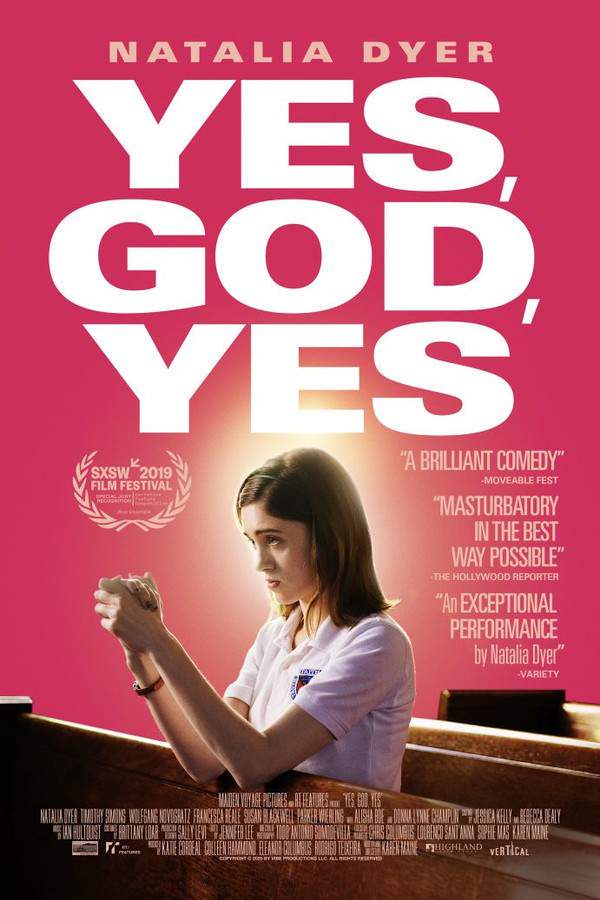
Yes, God, Yes (2017) movie poster

Timeline

Yes, God, Yes (2017) Timeline Explained – Every Event in Order

Release, runtime and language
2017 · 11 mins · English
Loading streaming availability…
Directed by
Karen Maine
Starring
Natalia Dyer, John Doherty, Michael Bonini, Wendy Susan Hammer, Merissa Czyz, Joe Reece

Fifteen-year-old Alice has always been a good Catholic, but when an innocent AOL chat turns unexpectedly racy, she finds herself suddenly obsessed with sex.

On this page (6)
  1. 1 Where to watch
  2. 2 Events in order (14)
  3. 3 Timeline questions answered
  4. 4 Movie threads
  5. 5 Movies like Yes, God, Yes
  6. 6 Every angle
Loading streaming availability…

14 events in order · contains spoilers

Yes, God, Yes Timeline: Events in Chronological Order

Every key event of Yes, God, Yes (2017) in order, scene by scene, with when and where it takes place. Use it to untangle flashbacks, time jumps and parallel storylines, to refresh your memory before the sequel or to find the exact scene you are thinking of.

  1. Morality class sets tone

    In fall 2000, Father Murphy teaches that sex outside procreation within marriage is a sin, with eternal damnation as punishment. Alice feels the clash between rigid rules and her growing curiosity. The lesson plants the seeds of guilt that will haunt her.

    When
    Fall 2000, early term
    Where
    Midwestern Catholic high school – Morality classroom
  2. Rumor about Alice

    The following Monday, the school buzzes with a rumor that Alice engaged in a sexual act at a party. Alice denies knowing the meaning of the phrase, but the rumor sticks and colors how classmates view her. The gossip marks a turning point in how her peers scrutinize her.

    When
    Monday after party
    Where
    School corridors
  3. Consequences at Mass

    The rumor reaches Mrs. Veda, who prevents Alice from serving at Mass, signaling how gossip translates into punishment. Alice feels shamed and policed by adults who control public acts of faith. The episode heightens her sense of isolation within the school community.

    When
    Monday
    Where
    Church / Mass location
  4. Reconciliation and penance

    During the sacrament of reconciliation, Alice confesses venial sins and receives twenty prayers as penance. She dutifully completes the prayers in the school chapel, the issue of sexuality echoing in her conscience. The moment ties her private guilt to formal religious ritual.

    When
    Monday afternoon
    Where
    School chapel / reconciliation room
  5. Decision to attend Kirkos retreat

    Alice and Laura decide to attend the upcoming Kirkos spiritual retreat, hoping to reorient themselves within their faith. The retreat promises distance from rumors and a chance to examine their beliefs more candidly. The decision signals a break from daily school life to test limits.

    When
    Before retreat begins
    Where
    School and Kirkos retreat
  6. Retreat begins; bonds form

    On the first day at the Kirkos retreat, Nina is introduced as a retreat leader and Chris becomes a friendly, enthusiastic presence. Alice is assigned to Chris's group, and the two begin to form a bond that feels charged within the retreat's restrictive atmosphere. The setting heightens the tension between rules and desire.

    When
    Day 1 of retreat
    Where
    Kirkos retreat campgrounds
  7. Night of curiosity

    That night, Alice experiences a moment of sexual curiosity while alone in her room, which she instinctively suppresses after thinking about the crucifix. The scene marks a pivotal moment of inner conflict between curiosity and religious propriety. The crucifix imagery deepens her internal struggle.

    When
    Night 1 of retreat
    Where
    Retreat lodging
  8. Day 2: deception and chores

    On the second day, Alice fakes an injury to get closer to Chris and is assigned to cleaning duties. Nina confiscates her phone, and Father Murphy’s office becomes a place for her to search online terms she doesn’t understand; she is interrupted by footsteps. The day intensifies her sense of being watched and judged.

    When
    Day 2
    Where
    Kirkos retreat grounds and office
  9. Confrontations over rumors

    The looming Wade rumor continues to press on Alice, prompting a tense confrontation where he avoids accountability. The rumor compounds the strain between Alice, Wade, and Laura, who remains skeptical of Alice’s claims. The social web of secrecy tightens around them.

    When
    Day 2
    Where
    Retreat site
  10. Day 3: revelations and tensions

    On the third day, Father Murphy discovers an explicit online chat on his computer and presses Alice to confess. She insists that nothing happened, while the atmosphere grows louder with accusations and distrust. The revelations push Alice toward drastic actions as she seeks to protect herself.

    When
    Day 3
    Where
    Retreat, Father Murphy's office
  11. Break-in accusation and hidden truth

    In a tense sequence, Alice suspects Wade's involvement in a break-in and frames him accordingly, while she also uncovers a troubling secret about Father Murphy. The double-edged discoveries challenge her loyalties and complicate her moral compass. She also shares a moment with Chris, who pulls away afterward.

    When
    Day 3
    Where
    Retreat grounds; Father Murphy's office
  12. Escape to a supportive bar

    Escaping the camp, Alice finds a lesbian bar where the owner Gina offers understanding and practical advice. The encounter provides a counterpoint to the retreat’s fear-based logic and helps Alice glimpse possibilities beyond the church’s strict code. Gina encourages Alice to consider colleges on the West and East Coasts.

    When
    Night of Day 3
    Where
    Lesbian bar
  13. Last day at Kirkos retreat

    On the retreat’s last day, Alice befriends a socially awkward classmate and Wade faces the consequences of the explicit chat incident. Laura reconciles with Alice, and in a group sharing session, Alice reminds everyone that people hide things, urging honesty and respect as Jesus wanted. The moment crystallizes her shift toward openness.

    When
    Last day
    Where
    Kirkos retreat grounds
  14. Return to school and heavier penance

    Back at school, Alice reaffirms the possibility of friendship with Chris, and returns to reconciliation with Father Murphy. He assigns a heavier penance of one hundred prayers for the retreat confession, highlighting the ongoing power struggle between guilt and tolerance. The day ends with Alice deciding to confront her own sexuality more openly rather than suppress it.

    When
    After retreat
    Where
    School; Chapel

Last updated: November 22, 2025 at 15:59

Was this helpful?

Timeline questions answered

Yes, God, Yes Timeline Explained: Your Questions Answered

When does it happen, and why in that order? The questions people ask about the chronology of Yes, God, Yes (2017): time jumps, flashbacks, cause and effect between scenes and the correct order of events, each answered with spoilers.

Q1

Why is Alice so obsessed with finding out what 'tossed salad' means?

Alice has never been sexually active and is genuinely ignorant of the term. However, the rumor has spread throughout the school, costing her a role serving at Mass. Her curiosity is fueled by both the social consequences she faces and her own growing sexual curiosity, which conflicts with the guilt instilled by her Catholic education. The question represents her larger struggle to understand sexuality in an environment that treats it as shameful and forbidden.

Foreshadowing: Father Murphy's morality class lesson about sex being a sin plants the seed of shame that makes Alice afraid to simply ask about the term openly.

  • tossed salad rumor
  • alice
  • sexual curiosity
  • catholic guilt
Q2

Why does Father Murphy single out Alice during confession?

Father Murphy notices Alice's visible discomfort during his morality lessons about sexual sin. When the rumor about Alice spreads, he becomes fixated on her as someone who might be acting on forbidden desires. During confession, he pushes her to admit to sexual acts she didn't commit, suggesting he projecting his own temptations onto her. His obsession reveals his hypocrisy and sets up the later revelation of his own sexual secrets.

Foreshadowing: The morality class scene shows Father Murphy's intense focus on condemning sexual behavior, hinting at his own inner struggle.

  • father murphy
  • confession
  • alice
  • hypocrisy
  • priest
Q3

Why does Alice frame Wade for the computer break-in?

Alice frames Wade because he refused to clear her name about the rumor, leaving her to bear the social and academic consequences alone. She knows he was actually involved in spreading the original rumor about her. Framing him is her way of lashing out at someone she sees as responsible for her problems, though the act also reveals her growing moral compromise as she copes with the retreat's oppressive atmosphere.

Foreshadowing: Wade's earlier refusal to admit his role in the rumor establishes his character as selfish and unconcerned with Alice's wellbeing.

  • wade
  • frame
  • break-in
  • revenge
  • alice
Q4

What does Alice discover Father Murphy doing in his office?

While hiding in Father Murphy's office after framing Wade, Alice sees him masturbating to a pornographic video on his computer. This moment shatters the priest's moral authority and explains his intense focus on Alice's supposed sins, he was struggling with the same desires he preaches against. The discovery marks a turning point for Alice, as she realizes the adults lecturing her about sin are guilty of the same transgressions.

Foreshadowing: Father Murphy's excessive interest in Alice's confession and his accusatory questioning hint at his own hidden struggles with sexuality.

  • father murphy
  • masturbation
  • porn
  • video
  • discovered
Q5

Why does Chris run away after Alice kisses him?

Chris is overwhelmed by the situation, he is a retreat leader responsible for guiding younger students spiritually, and Alice's kiss creates a conflict between his personal feelings and his role as a religious authority figure. The retreat's environment, focused on purity and resisting temptation, makes him feel guilty even though he did nothing wrong. His running away reflects how deeply the retreat's messaging about sexuality has affected all the students, including the leaders.

Foreshadowing: Chris's friendly and enthusiastic demeanor during the retreat shows he's fully embraced the retreat's spiritual ideals, making him unprepared for a genuine romantic moment.

  • chris
  • kiss
  • retreat
  • runs away
  • confused
Q6

Why does Alice go to a lesbian bar after the retreat?

After witnessing Nina's secret sexual encounter, being rejected by Chris, and discovering Father Murphy's hypocrisy, Alice feels completely isolated and desperate for understanding. She escapes the retreat grounds and finds a lesbian bar, seeking someone who might understand her confusion about sexuality without judgment. The owner, Gina, provides the acceptance and perspective Alice desperately needs, helping her see that her desires are natural rather than sinful.

Foreshadowing: Alice's earlier discovery that she can pleasure herself, followed by her guilt and stopping, shows her desperate need for someone to tell her that her feelings are okay.

  • lesbian bar
  • gina
  • escape
  • acceptance
  • sexuality
Q7

What happens at the end of the movie?

After Father Murphy gives Alice an even heavier penance of one hundred prayers, she leaves the chapel and goes home. There, she watches Titanic and deliberately masturbates to the famous sex scene between Jack and Rose. This act represents her final reclamation of her sexuality, she chooses to explore her desires on her own terms rather than submitting to the guilt and shame imposed by the church. The ending is hopeful because Alice finally acts on her own curiosity instead of suppressing it.

Foreshadowing: Earlier in the retreat, Alice discovers her ability to pleasure herself but stops out of guilt while looking at the crucifix. The ending shows her overcoming that guilt.

  • ending
  • titanic
  • masturbation
  • scene
  • sex
Q8

Why does Laura stop being friends with Alice?

Laura refuses to believe Alice when she tells her about seeing Nina with another student, accusing Alice of making up lies and being a "pervy psycho." Laura is desperate to fit in with Nina and the popular crowd at the retreat, so she rejects Alice rather than risk alienating herself from the social hierarchy she craves acceptance into. Their friendship was already strained by the rumor and by Laura's shame about Alice's perceived sexuality.

Foreshadowing: Laura's initial excitement about Nina being a retreat leader shows her priority is social status rather than genuine spiritual growth.

  • laura
  • friendship
  • breakup
  • nina
  • retreat
Q9

What is the Kirkos retreat in the movie?

Kirkos is a fictional Catholic school spiritual retreat designed to strengthen students' faith and help them resist worldly temptations. The retreat takes place over several days at remote campgrounds and involves group activities, confession, and sharing sessions led by older student leaders. For Alice, it becomes an environment where her internal conflict between curiosity and guilt intensifies, rather than the spiritually restorative experience she hoped for.

Foreshadowing: Alice and Laura decide to attend the retreat to get back on the "path of righteousness," setting up the irony that the retreat actually pushes Alice toward self-acceptance.

  • kirkos
  • retreat
  • catholic
  • spiritual
  • school
Q10

Why does Alice tell Father Murphy she saw the explicit video?

Alice confesses to Father Murphy that she saw a video of people having sex as a way to confront him with his own hypocrisy. Both Alice and Father Murphy know what she's referring to, he was watching porn when she caught him. By confessing this, she's testing whether he'll acknowledge his own sin or continue pretending moral superiority. His response is to assign her an even heavier penance, which further confirms his hypocrisy and pushes her toward rejecting the church's control over her sexuality.

Foreshadowing: Alice's discovery of Father Murphy masturbating to the video gives her leverage she uses to expose his hypocrisy.

  • confession
  • video
  • father murphy
  • confrontation
  • hypocrisy
Q11

Why does Alice fake an injury during the retreat hike?

Alice fakes an injury to get closer to Chris, using the excuse of needing help walking to initiate physical contact with him. This shows her growing willingness to act on her desires rather than simply suppress them, even if the method is deceptive. It also demonstrates how the retreat's strict atmosphere has pushed her toward sneakier ways of pursuing what she wants.

Foreshadowing: Alice's attraction to Chris was established when she first noticed him as a friendly, handsome retreat leader on day one.

  • fake injury
  • christ
  • hike
  • retreat
  • crush
Q12

What does the title 'Yes, God, More' mean?

The title reflects Alice's internal struggle between religious obedience and her growing sexual desire. It's a play on the phrase "Yes, God, no", the response expected of a devout Catholic resisting temptation. Instead, Alice finds herself wanting "more" despite what she's been taught. The title captures her journey from suppressing her curiosity to eventually embracing her sexuality on her own terms.

Foreshadowing: Father Murphy's teachings about saying "no" to sexual temptation establish the religious framework that the title subverts.

  • title meaning
  • god
  • more
  • sexuality
  • theme

Movie threads

More Movies Like Yes, God, Yes, by Mood & Story

Curated lists built around what makes Yes, God, Yes tick: the same mood, the same kind of story or the same emotional payoff. Each list explains why these movies belong together.

Movies about awkward sexual awakening like Yes, God, Yes

Stories of teen self-discovery that clash with rigid social or religious rules. If you enjoyed Yes, God, Yes for its honest take on teenage desire and Catholic guilt, you'll find similar stories here. These movies feature protagonists navigating their sexual self-discovery against restrictive social, religious, or familial expectations, often blending humor with genuine emotional conflict.

  • awkward
  • anxious
  • conflicted
  • rebellious
  • cathartic
  • nostalgic
  • Tone: bittersweet, awkward, anxious
  • Pacing: steady, character-focused
Why these movies?

The story pattern: These narratives typically follow a young protagonist as an event triggers their sexual curiosity, creating a secret internal world that contradicts their public persona. The central conflict is between their emerging identity and the repressive systems around them, often culminating in a moment of personal truth that redefines their relationship with those systems.

Why they belong together: Movies in this thread share a core focus on the specific anxiety of discovering one's sexuality in a context that deems it sinful or wrong. They blend a bittersweet tone with a steady, character-driven pace, creating a relatable and often cathartic viewing experience centered on a universal, yet intensely personal, coming-of-age struggle.


Movies with bittersweet self-liberation like Yes, God, Yes

Character-driven stories where small acts of rebellion lead to personal catharsis. Fans of Yes, God, Yes and its hopeful ending will appreciate these movies about characters finding personal freedom. These stories focus on subtle rebellions and internal growth, resulting in a cathartic but bittersweet sense of liberation where happiness is earned through self-acceptance rather than a perfect resolution.

  • cathartic
  • hopeful
  • introspective
  • conflicted
  • rebellious
  • self-discovery
  • Tone: bittersweet, hopeful, cathartic
  • Pacing: steady, introspective
Why these movies?

The story pattern: The narrative pattern involves a character feeling trapped by a specific ideology, community, or expectation. Through a series of personal challenges and revelations, they gradually dismantle their internalized constraints. The climax is often an act of quiet defiance or a moment of profound self-honesty, leading to an ending that is hopeful for the individual but acknowledges the complexity of their changed relationships.

Why they belong together: These films are grouped by their shared emotional arc: a journey from internal conflict to a nuanced, earned liberation. They possess a medium emotional weight and a steady pace, allowing the viewer to fully invest in the character's subtle transformation. The overall vibe is cathartic and resonant, focusing on the power of personal truth.

If you liked this

Movies Like Yes, God, Yes

Similar movies to Yes, God, Yes: the same genre, themes or kind of story. Each one comes with its own plot summary, timeline and ending explained.

Browse all movie summaries

Every angle

Yes, God, Yes (2017) Explained: Plot, Timeline & Characters

Everything about Yes, God, Yes in one place: what happens in the plot summary, the timeline in chronological order, the characters and meaning and a spoiler-free summary. What's After the Movie adds the cast, box office and post-credit scenes.

Coming soon on iOS and Android

The Plot Explained Movie Summary App

Plot summaries, endings explained and timelines on your phone. Catch up on any movie in minutes, save your favorites and never miss a twist again.

Be the first to know when we launch. Your email stays private, always.

Learn more about the app