Year: 1962
Runtime: 134 min
Language: English
Director: Robert Aldrich
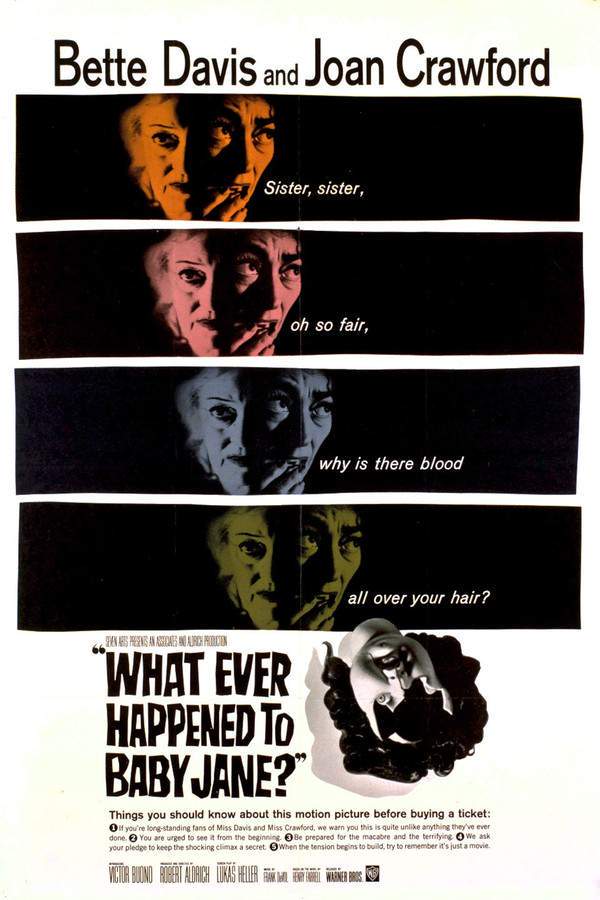
In the fading glamour of Hollywood's past, a dark and disturbing story emerges. Aging actress Jane Hudson, determined to recapture her lost stardom, keeps her sister Blanche, a former child star now paralyzed after a car accident, imprisoned. As Blanche plots her retribution, Jane's increasingly sinister schemes to hide her sister and engineer a comeback lead to a chilling and deadly confrontation.
Find where to stream, rent, or buy What Ever Happened to Baby Jane? (1962) in the US with current JustWatch availability, up-to-date pricing, and platform listings for subscription, rental, and digital purchase options.
Warning: spoilers below!
Haven’t seen What Ever Happened to Baby Jane? yet? This summary contains major spoilers. Bookmark the page, watch the movie, and come back for the full breakdown. If you're ready, scroll on and relive the story!
Read the complete plot breakdown of What Ever Happened to Baby Jane? (1962), including all key story events, major twists, and the ending explained in detail. Discover what really happened, and what it all means.
In 1917, we are introduced to Baby Jane Hudson, played by Julie Allred, a prodigious vaudevillian child star captivating audiences and leading to the creation of a lavish Baby Jane doll. However, while surrounded by admirers, Jane becomes an utterly spoiled individual, indulged by her father, Ray Hudson (Dave Willock), while her disapproving mother and her 11-year-old sister, Blanche Hudson (Gina Gillespie), watch enviously from the periphery.
Fast forward to 1935, the dynamic within the Hudson household has dramatically shifted. Now both sisters are established movie stars, but it is Blanche who has become the celebrated, glamorous figure, while Jane finds herself battling obscurity as her films flop miserably. Desperately attempting to reclaim her past glory, Jane succumbs to alcohol, struggling to cope with her fading dreams. In a pivotal moment after returning home from a party, the sisters' car careens into the mansion's gate, foreshadowing the tumultuous relationship that will follow.
By 1962, the once-dynamic duo now exists in a dilapidated mansion in Los Angeles. Blanche, confined to a wheelchair and portrayed by Joan Crawford, spends her days reliving her cinematic past while Jane, masterfully portrayed by Bette Davis, has grown into a bitter, aging woman whose incessant drinking and gaudy makeup efforts aim to mask her true age. Constantly at odds, Jane's abusive demeanor suffocates Blanche, who remains largely dependent on her sister, save for her bond with Elvira Stitt, their compassionate cleaning lady (played by Maidie Norman). Elvira harbors deep concerns about Jane's erratic behavior, especially given her worrying habit of sifting through Blanche's mail and discarding it.
Deep in her delusions, Jane grapples with the memories of her once-starlit childhood. One day, as she fixes her hair and makeup to venture out and seek a pianist for a comeback, Blanche desperately tries to reach out for help from the outside world. However, Jane intercepts her plea—a response that only escalates their volatile relationship. A grim discovery awaits Blanche as she finds her beloved parakeet cruelly placed under her lunch tray, an act of Jane's malice.
Amidst the sisterly chaos, newly introduced character Edwin Flagg (played by Victor Buono), a struggling yet earnest young man, responds to Jane's call for a piano player. His arrival at the Hudson mansion intensifies the strained atmosphere. Jane nostalgically performs her childhood hit, "I've Written a Letter to Daddy," while Edwin fights to conceal his discomfort. As tensions rise, Jane violently confronts Blanche several times, leading to a shocking climax as she forbids her sister from reaching out for any kind of help.
Further tragedy unfolds when Jane, consumed by paranoia, goes to extreme lengths to silence those who threaten her twisted sanctuary. The drama escalates with Elvira's untimely demise at the hands of Jane, plunging her deeper into a psychological abyss defined by isolation, obscurity, and resentment.
A week passes; rumors of their disappearance begin to circulate when police investigation reveals Elvira's fate. As Jane's mental state spirals out of control, her desperate attempts to escape the consequences of her actions lead to a guilt-ridden confrontation with her sister.
Their final moments on a deserted beach expose the deep-seated truths of their tumultuous lives. In a poignant confession, Blanche reveals the tragic accident that left her incapacitated, forcing Jane to grapple with the reality that her self-inflicted anguish may have clouded her perception of their shared history.
With the police closing in, Jane's fleeting moments of joy disintegrate into madness as she performs for a crowd, blissfully unaware of the heart-wrenching tragedy that surrounds her. The film concludes on a haunting note as Jane dances, lost in her delusions while Blanche lies motionless in the sand, the brutal toll of their intertwined fates finally revealed. THE END
Last updated: November 07, 2024 at 23:04
Explore frequently asked questions about What Ever Happened to Baby Jane? (1962) with spoiler-rich answers covering the full plot summary, major story beats, character motivations, hidden details, and ending meaning. This movie summary FAQ helps explain confusing scenes, plot twists, and narrative decisions in clear, searchable detail.
Jane's cruelty stems from a lifetime of jealousy and resentment. As a child, Jane was the celebrated star while Blanche watched from the sidelines, but by 1935, their roles reversed, Blanche became the famous actress while Jane's career faded. This reversal, combined with her alcoholism and delusion, twisted Jane's feelings into pure hatred, leading her to imprison and torment her sister.
The 1935 car crash into the mansion gate foreshadows the destructive nature of their relationship.
Blanche became paralyzed after a car accident in 1935. However, the full truth only emerges at the end, Blanche reveals that Jane was driving the car when it crashed, not Blanche as Jane had always claimed. This means Jane has been blaming Blanche for an accident Jane herself caused, adding another layer to Jane's guilt and delusion.
The 1935 car crash that destroys the mansion gate is the incident that leaves Blanche in a wheelchair.
Jane killed Elvira because she saw her as a threat to her control over Blanche. Elvira was the only person who showed kindness to Blanche and who might help her escape or call for help. As Jane's paranoia intensified, she viewe Elvira as an obstacle to her twisted plan of keeping Blanche imprisoned and maintaining her delusional grasp on the situation.
Earlier scenes show Jane intercepting Blanche's mail and forbidding her from reaching out for help, establishing her pattern of silencing anyone who might assist Blanche.
Jane's breakdown resulted from a combination of factors: her fading fame, alcoholism, and years of resenting Blanche for overtaking her stardom. Living in the decaying mansion while caring for her paralyzed sister, Jane retreated into delusions of reviving her career, ultimately descending into paranoia and violence as her grip on reality loosened.
Jane's obsessive makeup and costume attempts to recreate her childhood glory hint at her disconnection from reality.
Jane intercepts Blanche's calls because she fears exposure. If authorities or outsiders discovered how Jane has been treating her sister, keeping her imprisoned, abusing her, and preventing her from seeking help, Jane would face serious consequences. Her control over Blanche represents the only power she has left, and losing it would shatter her remaining delusions of importance.
Jane's habit of sifting through and discarding Blanche's mail establishes her need to control all communication.
In the final confrontation on a deserted beach, Blanche reveals the truth about the 1935 car accident, that Jane was driving, not Blanche. This confession shatters Jane's self-deception. When police close in, Jane wanders away to perform for an imaginary crowd, completely lost in her delusions, while Blanche dies alone in the sand, victims of their toxic, intertwined fate.
The beach confrontation is set up by the police investigation that forces Jane to flee the mansion.
The parakeet scene demonstrates the depth of Jane's cruelty and her need to inflict psychological pain on Blanche. By killing Blanche's beloved pet and placing it under her lunch tray, Jane shows she will destroy anything that brings Blanche comfort or joy, revealing her petty, vindictive nature and intensifying the psychological horror of her abuse.
The parakeet represents the final innocent thing Blanche has left, making its destruction a pivotal moment of malice.
Edwin Flagg is a young pianist who responds to Jane's advertisement for musical accompaniment. His presence triggers Jane's nostalgic performance of her childhood hit "I've Written a Letter to Daddy." Edwin serves as an audience for Jane's delusion, briefly making her feel like a star again, while also providing uncomfortable tension as he witnesses the toxic household.
Jane's call for a pianist reveals her delusional attempt to stage a comeback performance.
Baby Jane became spoiled because her father Ray Hudson indulged her every whim while her mother disapproved and her sister Blanche envied her from the sidelines. With no one to set boundaries and everyone catering to her fame, Jane developed an entitled, self-centered personality that persisted into her adulthood and fueled her later breakdown when the world stopped adoring her.
The 1917 introduction establishes Jane's spoiled nature as the foundation for her later psychological unraveling.
The rivalry began in childhood, when Baby Jane received all the attention and adoration while 11-year-old Blanche watched enviously from the margins. This early imbalance created deep-seated resentment in both sisters, Jane expected constant worship, while Blanche grew bitter watching her sister receive everything. By 1935, when Blanche's career eclipsed Jane's, the dynamic fully reversed, exploding the tensions that had simmered for decades.
The opening scene in 1917 establishes the envious dynamic that will define the sisters' entire relationship.
Discover curated groups of movies connected by mood, themes, and story style. Browse collections built around emotion, atmosphere, and narrative focus to easily find films that match what you feel like watching right now.
Psychological terror escalating within the confines of a decaying home.If you liked the oppressive, housebound terror of 'What Ever Happened to Baby Jane?', explore these movies. They feature psychological horror set within decaying mansions or isolated homes, where familial or domestic relationships turn sinister and lead to a bleak confrontation.
These stories typically focus on a small cast of characters, often family members or caretakers, trapped together by circumstance or coercion. The narrative steadily escalates from psychological manipulation to physical threat, using the confined setting to amplify tension and explore themes of madness, abuse, and faded grandeur.
Movies are grouped here for their shared oppressive atmosphere, claustrophobic settings, and focus on intimate, psychologically-driven horror. They prioritize mood and character degradation over supernatural elements, creating a deeply unsettling experience rooted in human darkness.
Character-focused stories of a mind unraveling under the weight of obsession.For viewers who appreciated Jane Hudson's tragic unraveling in 'What Ever Happened to Baby Jane?', this section collects movies about characters descending into madness. These films feature intense, character-driven narratives where obsession and mental illness lead to a bleak and destructive outcome.
The narrative follows a linear but impactful path, charting the protagonist's escalating irrationality. Their actions become increasingly harmful as their delusions deepen, often trapping another character as a victim. The story builds to a climax that reveals the full extent of their madness, typically resulting in a tragic and irreversible conclusion.
These films are united by their focus on a central character's psychological breakdown. They share a high emotional weight, a dark tone, and a steady pacing that allows the audience to witness the chillingly logical (to the character) progression into insanity.
Don't stop at just watching - explore What Ever Happened to Baby Jane? in full detail. From the complete plot summary and scene-by-scene timeline to character breakdowns, thematic analysis, and a deep dive into the ending - every page helps you truly understand what What Ever Happened to Baby Jane? is all about. Plus, discover what's next after the movie.
Track the full timeline of What Ever Happened to Baby Jane? with every major event arranged chronologically. Perfect for decoding non-linear storytelling, flashbacks, or parallel narratives with a clear scene-by-scene breakdown.
Discover the characters, locations, and core themes that shape What Ever Happened to Baby Jane?. Get insights into symbolic elements, setting significance, and deeper narrative meaning - ideal for thematic analysis and movie breakdowns.
Discover movies like What Ever Happened to Baby Jane? that share similar genres, themes, and storytelling elements. Whether you’re drawn to the atmosphere, character arcs, or plot structure, these curated recommendations will help you explore more films you’ll love.
What Ever Happened to Baby Jane? (1962) Scene-by-Scene Movie Timeline
What Ever Happened to Baby Jane? (1962) Movie Characters, Themes & Settings
What Ever Happened to Baby Jane? (1962) Spoiler-Free Summary & Key Flow
Movies Like What Ever Happened to Baby Jane? – Similar Titles You’ll Enjoy
The Haunting of Julia (1981) Film Overview & Timeline
Call Jane (2022) Plot Summary & Ending Explained
Incident In a Ghostland (2018) Full Movie Breakdown
Jane (2022) Movie Recap & Themes
Jane Doe (2001) Film Overview & Timeline
What Ever Happened to Baby Jane? (1991) Movie Recap & Themes
The Haunting of Julia (1977) Ending Explained & Film Insights
Possessed (1947) Plot Summary & Ending Explained
The Bad Sister (1931) Full Summary & Key Details
What Became of Jack and Jill? (1972) Story Summary & Characters
Miss Fane’s Baby Is Stolen (1934) Movie Recap & Themes
Pictures of Baby Jane Doe (1999) Complete Plot Breakdown
Baby (2020) Ending Explained & Film Insights
Lady Jane (2008) Full Summary & Key Details
The Baby (1973) Spoiler-Packed Plot Recap