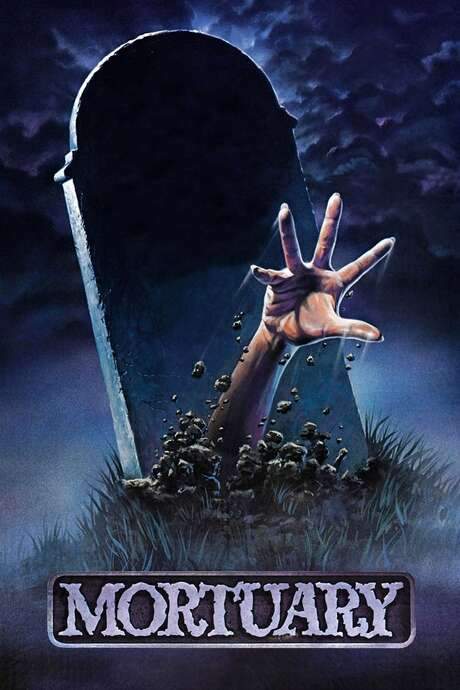
Giorgio Mainardi [Duilio Del Prete] lies in a hospital bed surrounded by his family, his mind already adrift between illness and the impending silence of death. He utters a solitary, penetrating question — "why?" — before slipping away from an internal hemorrhage that guards the secrets of his life. The following day, Rosie [Karina Huff] Mainardi visits the grand estate, having paused her college studies to attend the funeral and the formal reading of the will. She discovers a family divided by inheritance, with Giorgio’s stepmother Hilda [Frances Nacman] blocking any autopsy and Giorgio’s own father, Paolo [Paolo Paoloni], weakened by a recent stroke and unable to speak or move. The household atmosphere crackles with strain: Mario [Pascal Persiano]—Giorgio’s son from a later marriage—is entangled in a painful affair with Lucy [Bettina Giovannini], the much younger wife who shows a rare tenderness toward Rosie’s presence.
Giorgio’s death leaves a spectral trace in the mansion: his spirit lingers, restless and insistent, and from the confines of his buried coffin he reaches out to Rosie. The supernatural connection intensifies as he begins to appear in Rosie’s dreams, urging her to uncover the truth behind his death. Yet time is not on their side—while the corpse decays, so too does Giorgio’s power to communicate, pressing Rosie to hasten her investigation.
At the funeral, the mood of accusation and memory unfolds through the memories of those closest to Giorgio. Lucy recalls his fierce anger and his harsh judgments about her perceived frigidity; Mario remembers the humiliations and rejections he endured after seeking Giorgio’s help for a business opportunity; Hilda rages about the times Giorgio blocked funds from his late father’s accounts; and Rita, Giorgio’s former mistress, recalls how their affair ended when he chose to return to his wife. Each memory winds a tangled skein of motive, opportunity, and resentment, casting doubt on who stood to gain most from Giorgio’s demise.
When the will is read, it becomes clear that Rosie stands to inherit the entire estate, yet Lucy is allowed to remain in the mansion. The tension spirals further as the stipulation about a child named David—whom Giorgio believed could not be his—exposes a hidden axle of jealousy and resentment within the household. An autopsy is conducted, and the pathologist reveals a troubling detail: lacerations inside Giorgio’s intestines. A sample is placed in a jar of formaldehyde for later analysis, but the jar is later smashed, and Gianni [Lorenzo Flaherty], Rosie’s college boyfriend and a medical student with access to the pathology lab, discovers splinters of glass that predate the accident. He urges reporting the matter to the police, yet Rosie proposes that they pursue the truth themselves, wary of making a public scandal.
According to Lucy, Giorgio had just returned from a clandestine visit to Rita [Antonella Tinazzo], and Rosie begins to suspect Rita’s involvement as a possible link to the mysterious chain of events. A conversation with the Maitre’d at a restaurant where Giorgio and Rita met reveals that their relationship escalated into a heated argument—an exchange that preceded Giorgio’s collapse. Rosie returns to the mansion and discovers that her beverages have been poisoned, as a hypodermic needle scar is found atop a soda can. She confides in Dorrie [Sacha Darwin], the housekeeper and David’s nanny, who confirms that only she, David, and Lucy were in the house the night of Giorgio’s death. The sight of David handling a mortar and pestle adds a chilling clue: a child’s play could mask a far darker scheme.
In a late-night dream, Rosie pieces together the puzzle: the glass shards were hidden in Giorgio’s ice cubes, not in his food or drink alone. With this realization, she confronts Lucy and unveils a coordinated plot hatched by Hilda [Frances Nacman] and Mario [Pascal Persiano]. Hilda confesses to the motive—killing Giorgio for his wealth—and admits that Lucy was aware of the plan but did nothing to derail it. The plan, Rosie explains, included David’s “game” with the mortar and pestle, designed to conceal a murder as an accident. Hilda’s strategy rested on hiding the truth until a legal solution could absolve suspicion.
Rosie makes a stark choice: she will leave the conspirators to rot in the mansion instead of presenting them to the police. The haunting presence of Giorgio lingers around the living, a constant reminder that truth can outlive even a carefully arranged crime. As Rosie stands at Giorgio’s grave, she recounts the sequence of events that led to his death, and in a moment that blends fatalism with dark humor, the two share a sense that the dead will haunt the living forever.
- The film’s atmosphere leans on family dynamics strained by wealth, secrecy, and betrayal, with the supernatural thread serving as a quiet, inexorable reminder of the consequences of greed.
- The autopsy scene introduces a medical mystery that threads into the family’s hidden truths, pulling in Gianni’s medical knowledge and Rosie’s determination to uncover the reality behind the alleged accident.
- The underlying tension of the tale rests on a network of relationships: Giorgio’s distant, controlling manner toward those around him; Hilda’s mercenary impatience; Rita’s longing for a past connection she cannot reclaim; Lucy’s protective but morally gray stance; Mario’s resentment and fear of losing status; and the vulnerable David, whose innocent “game” hides a potentially lethal intention.
- The ending leaves the reader with a blend of eerie closure and unsettling doubt: Rosie’s departure from the mansion signals a bittersweet conclusion, while Giorgio’s spirit remains a pervasive force, an omnipresent witness to every act of deceit and every motive that remained buried for too long.
Rosie [Karina Huff] and the others, including Gianni and the rest of the Mainardi clan, endure a web of secrets that only grows more tangled as the truth inches closer to the light. The film’s final cadence — a graveyard scene that mingles laughter with the weight of death — reinforces the idea that the living can be haunted not only by ghosts but by the consequences of the choices they make in life.
> "why?"