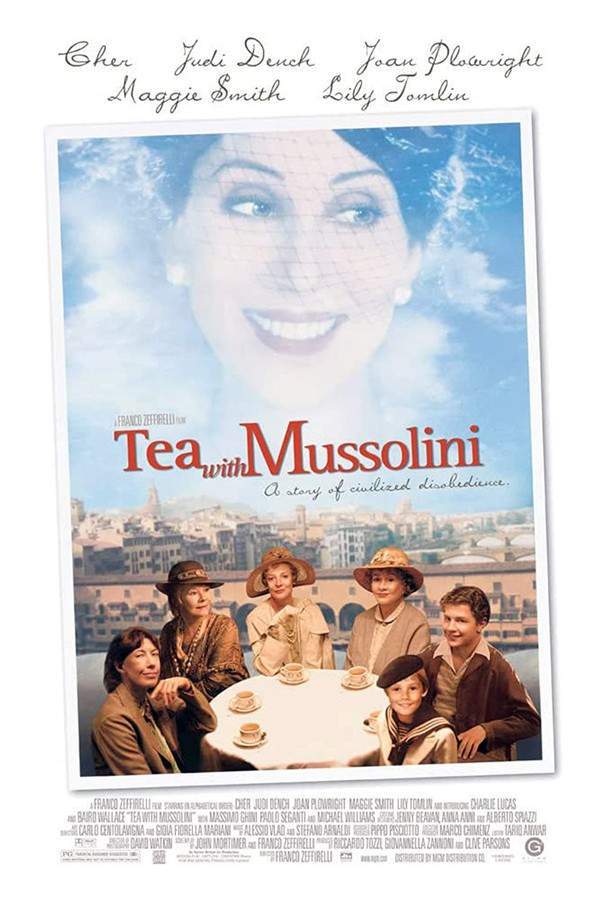
Tea with Mussolini

Tea with Mussolini

Year: 1999

Runtime: 117 min

Language: English

Director: Franco Zeffirelli

Budget: $12M

DramaComedyWar

In 1930s Italy, a young boy named Luca is sent to live with British expatriate Mary Wallace after the loss of his mother. He finds comfort and friendship within her circle of cultured companions, all living privileged lives. As the shadow of war lengthens and the political climate shifts, their refined world begins to fall apart. Luca must then confront difficult choices and navigate a complex situation involving love, loss, and the challenges of loyalty within the changing landscape of Mussolini's Italy.

Where to Watch Tea with Mussolini?

Find where to stream, rent, or buy Tea with Mussolini (1999) in the US with current JustWatch availability, up-to-date pricing, and platform listings for subscription, rental, and digital purchase options.

Streaming availability powered by JustWatch

Warning: spoilers below!

Haven’t seen Tea with Mussolini yet? This summary contains major spoilers. Bookmark the page, watch the movie, and come back for the full breakdown. If you're ready, scroll on and relive the story!

Tea with Mussolini (1999) – Full Plot Summary & Ending Explained

Read the complete plot breakdown of Tea with Mussolini (1999), including all key story events, major twists, and the ending explained in detail. Discover what really happened, and what it all means.

In the enchanting backdrop of Florence in 1935, a distinguished group of English expatriates, known as the Scorpioni, gather for their cherished afternoon tea rituals. This diverse assembly of cultured women includes Arabella, an aspiring artist renowned for her eccentricity, and Mary Wallace (portrayed by Judi Dench), who also serves as the caregiver for young Luca. Their companionship extends to Luca’s seamstress mother, who has recently passed away. With Luca’s father, a prosperous Italian businessman, exhibiting a lack of interest in his son’s upbringing, Mary steps in and turns to her Scorpioni friends for guidance.

Serendipitously, Elsa Morganthal, a wealthy American widow with a fondness for Luca’s late mother, learns of the boy’s plight and sets up a financial trust for him. This act of kindness receives a nod of condescending approval from Lady Hester Random, who reluctantly permits Elsa’s presence in their circle.

However, their peaceful gatherings become threatened as Italian Fascists attack their favored café, mirroring the rising anxieties within the expatriate community. As tensions heighten, the Scorpioni increasingly feel the squeeze of oppression, with Luca’s father, fearing Italy’s impending alliance with Germany, opting to send him away to an Austrian boarding school.

Time progresses to five years later, and Luca returns to Florence with ambitions of becoming an artist, empowered by Elsa’s trust fund. Yet, turmoil looms as the majority of British nationals are retreating, anticipating Mussolini’s war declaration against Great Britain. Mary has now taken residence with Lady Hester and the remaining English hold-outs, all grappling with their uncertain futures.

While the United States maintains its peace, Elsa (played by Cher) and her bold American friend Georgie Rockwell, a pioneering archaeologist unafraid of her lesbian identity, find liberty from the war’s constraints. Elsa seizes the chance to utilize Luca as a courier, facilitating the discreet delivery of forged documents and funds to secure the Scorpioni’s relocation from their humble quarters to luxurious digs. Lady Hester, cloaked in delusion, triumphantly displays a newspaper photo of herself with the Italian dictator, believing this move was sanctioned by Mussolini himself.

Amid the chaos of the war, Elsa—a Jewish woman safeguarded from persecution due to her wealth and nationality—secretly collaborates with Italian Jews to create fake passports. She enlists the reluctant help of Luca, who harbors unspoken feelings for her, to deliver these vital documents, unknowingly complicating their relationship as she grows closer to Vittorio, an Italian lawyer. As the war intensifies by 1941, Elsa and Georgie find themselves interned alongside British women, grappling with the harsh realities of their situation.

Meanwhile, Vittorio, driven by deceitful intentions, absconds with Elsa’s art collection and funds, plotting to betray her to the German Gestapo while pretending to offer her a false escape route to Switzerland. Consumed by jealousy, Luca keeps this vile treachery a secret from his friends Mary and Wilfred. However, the truth eventually surfaces when Mary learns of Vittorio’s betrayal through Elsa’s art dealer and confronts Luca, stirring his conscience.

With a shift in perspective, Luca decides to redirect his trust fund towards the Italian resistance movement, joining forces with Wilfred. Oblivious to the schemes against her, Elsa remains unaware of Vittorio’s duplicity until Lady Hester, chastised by Mary for her unrestrained admiration of Mussolini, divulges the grim reality, promising her support for the scheme.

In a pivotal moment, Elsa confides in Luca about her past support for his mother during a challenging pregnancy, deepening their connection. As plans for their escape take shape, the urgency heightens with the British Army closing in on San Gimignano in July 1944. Together with Arabella and Georgie, the English women, including Lady Hester, valiantly defend their artistic heritage against German troops.

As the Germans retreat, San Gimignano remains largely untouched, a testament to the resilience of its community. The arrival of the Scots Guards ignites celebration, with Luca stepping into the role of their trusted interpreter. Despite orders to abandon their home, Lady Hester staunchly resolves that they will rebuild their lives in Italy.

In the aftermath of war, Mary beams with pride as Luca, now dressed in British military uniform, fulfills his father’s dream of becoming an “English gentleman.” The film concludes with a revealing glimpse into the fates of these characters, showcasing Luca’s evolution into a gifted artist and an integral part of the narrative.
Last updated: November 21, 2024 at 10:24

Was this helpful?

Tea with Mussolini (1999) Plot Questions Answered – Summary FAQ

Explore frequently asked questions about Tea with Mussolini (1999) with spoiler-rich answers covering the full plot summary, major story beats, character motivations, hidden details, and ending meaning. This movie summary FAQ helps explain confusing scenes, plot twists, and narrative decisions in clear, searchable detail.

Q1

Why did Luca's father send him to Austria?

A.

Luca's father feared Italy's impending alliance with Germany and the growing threat of fascism in Italy. Concerned for his son's safety, he decided to send Luca away to an Austrian boarding school, away from the escalating political tensions and potential conflict.

LucaAustriaboarding schoolfascist ItalyMussolini
Q2

What was Elsa Morganthal's trust fund for Luca?

A.

Elsa Morganthal, a wealthy American widow who had a deep admiration for Luca's late mother, established a financial trust for Luca after his mother's death. The trust fund supported Luca's education and later enabled him to pursue his artistic ambitions in Florence.

Elsa Morganthaltrust fundLucafinancial supportAmerican widow
Q3

Why did Elsa use Luca as a courier for forged documents?

A.

Elsa leveraged Luca's Italian citizenship and mobility to deliver forged documents and funds discreetly. This was part of her effort to help the Scorpioni women relocate from their humble quarters to safer, more luxurious accommodations as the war intensified and the political situation deteriorated.

Elsacourierforged documentsScorpioniresistance
Q4

What was Vittorio's betrayal of Elsa?

A.

Vittorio, an Italian lawyer in a relationship with Elsa, secretly stole her art collection and funds. While pretending to help her escape to Switzerland, he planned to betray her to the German Gestapo. His treachery was motivated by opportunism and self-preservation during the war.

VittoriobetrayalGestapoElsaart collectionItalian lawyer
Q5

Why did Luca keep Vittorio's betrayal secret?

A.

Luca harbored unspoken romantic feelings for Elsa, making him consumable with jealousy over her relationship with Vittorio. This emotional turmoil caused him to hide the betrayal from Mary and Wilfred until Mary discovered the truth through Elsa's art dealer.

LucajealousyVittoriobetrayalsecretMary
Q6

How did Luca join the Italian resistance?

A.

After learning about Vittorio's betrayal and being confronted by Mary, Luca experienced a moral awakening. He redirected his trust fund, the money Elsa had set aside for his future, toward supporting the Italian resistance movement, joining forces with Wilfred to fight against the occupying forces.

Lucaresistancetrust fundWilfredItalian resistancemoral转变
Q7

How did the English women defend San Gimignano?

A.

As German troops advanced toward San Gimignano in July 1944, the English women, including Lady Hester, Arabella, and Georgie, joined forces with Luca to protect their artistic heritage and community. Their collective stand and resilience helped preserve the town when the Germans retreated.

San GimignanoGerman troopsEnglish womendefenseLucawar
Q8

Why did Lady Hester believe Mussolini supported her?

A.

Lady Hester Random, throughout the war, maintained a delusional belief that Mussolini personally supported her. She displayed a newspaper photo of herself with the Italian dictator as proof, convinced this connection would protect her and the Scorpioni. This delusion eventually crumbled as the war ended and reality set in.

Lady HesterMussolinidelusionScorpioninewspaperFlorence
Q9

Why did Elsa forge fake passports for Italian Jews?

A.

Despite being Jewish herself, Elsa was protected from persecution due to her American wealth and nationality. Using this relative safety, she secretly collaborated with Italian Jews to create forged passports, helping them escape persecution by providing false identity documents.

Elsafake passportsItalian JewsforgeryJewishresistance
Q10

What did Elsa reveal about her connection to Luca's mother?

A.

In a pivotal moment before the escape plans, Elsa confided to Luca that she had supported his mother during a difficult pregnancy in the past. This revelation deepened their emotional connection and added personal significance to Luca's involvement in her rescue.

ElsaLucamotherpregnancypastrevelationconnection
Q11

What role did Luca play when the Scots Guards arrived?

A.

When the British Army, specifically the Scots Guards, arrived in San Gimignano after the German retreat, Luca served as their trusted interpreter. His bilingual skills and local knowledge made him invaluable during the liberation celebrations and initial reconstruction efforts.

Scots GuardsLucainterpreterliberationSan GimignanoBritish Army
Q12

How did Luca become an English gentleman?

A.

In the aftermath of the war, Luca fulfilled his father's long-held dream of becoming an English gentleman. He dressed in a British military uniform, representing his transformation and integration into English culture, a culmination of his upbringing among the Scorpioni and his service during the war.

LucaEnglish gentlemanBritish uniformfathertransformationwar aftermath
Mobile App Preview

Coming soon on iOS and Android

The Plot Explained Mobile App

From blockbusters to hidden gems - dive into movie stories anytime, anywhere. Save your favorites, discover plots faster, and never miss a twist again.

Sign up to be the first to know when we launch. Your email stays private, always.

Explore Movie Threads

Discover curated groups of movies connected by mood, themes, and story style. Browse collections built around emotion, atmosphere, and narrative focus to easily find films that match what you feel like watching right now.

Bittersweet Wartime Coming-of-Age Stories like Tea with Mussolini

Young lives shaped by innocence, resilience, and the shadow of conflict.If you liked Tea with Mussolini, explore other movies about youth and resilience set against the backdrop of war. These similar dramas feature young protagonists whose innocence is tested, offering bittersweet stories of found family and survival in times of political upheaval.

coming of ageresilientmelancholichopefuldramaticnostalgictense

Narrative Summary

The narrative usually follows a young protagonist's coming-of-age arc, set within a specific historical period of conflict. Their personal growth—learning about love, loyalty, and art—is intertwined with the larger societal collapse, forcing them to make difficult choices that accelerate their maturity.

Why These Movies?

Movies are grouped here for their shared focus on a youthful perspective during times of war, blending a medium emotional weight with a bittersweet tone. They share a steady pacing that allows for character development amidst rising external tension, culminating in endings that acknowledge both survival and the loss of innocence.

Movies about Imperiled Eccentric Communities like Tea with Mussolini

Quirky communities and their fragile worlds threatened by encroaching darkness.Discover movies similar to Tea with Mussolini that feature charming, quirky groups whose peaceful lives are disrupted. These dramas and comedies explore found families and artistic circles facing political upheaval or war, focusing on resilience and the bittersweet endurance of human connection.

charmingdramaticnostalgictenseresilientmelancholichopeful

Narrative Summary

The narrative pattern involves establishing a charming, slightly anachronistic community, detailing its quirks and harmonies. A major external conflict then intrudes, shattering their peace and forcing the group to band together, often leading to sacrifices, betrayals, and a redefinition of their community's purpose for survival.

Why These Movies?

These films are connected by their specific world-building around a 'found family' or community, a mix of charming and dramatic tones, and the central theme of a sanctuary under threat. They share a moderate complexity with multiple character arcs and a steady pacing that balances intimate moments with growing tension.

Unlock the Full Story of Tea with Mussolini

Don't stop at just watching - explore Tea with Mussolini in full detail. From the complete plot summary and scene-by-scene timeline to character breakdowns, thematic analysis, and a deep dive into the ending - every page helps you truly understand what Tea with Mussolini is all about. Plus, discover what's next after the movie.

Tea with Mussolini Timeline

Track the full timeline of Tea with Mussolini with every major event arranged chronologically. Perfect for decoding non-linear storytelling, flashbacks, or parallel narratives with a clear scene-by-scene breakdown.

Tea with Mussolini Timeline

Characters, Settings & Themes in Tea with Mussolini

Discover the characters, locations, and core themes that shape Tea with Mussolini. Get insights into symbolic elements, setting significance, and deeper narrative meaning - ideal for thematic analysis and movie breakdowns.

Characters, Settings & Themes in Tea with Mussolini

Tea with Mussolini Spoiler-Free Summary

Get a quick, spoiler-free overview of Tea with Mussolini that covers the main plot points and key details without revealing any major twists or spoilers. Perfect for those who want to know what to expect before diving in.

Tea with Mussolini Spoiler-Free Summary

More About Tea with Mussolini

Visit What's After the Movie to explore more about Tea with Mussolini: box office results, cast and crew info, production details, post-credit scenes, and external links - all in one place for movie fans and researchers.

More About Tea with Mussolini

Similar Movies to Tea with Mussolini

Discover movies like Tea with Mussolini that share similar genres, themes, and storytelling elements. Whether you’re drawn to the atmosphere, character arcs, or plot structure, these curated recommendations will help you explore more films you’ll love.