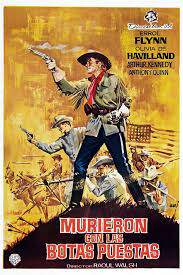
Year: 1942
Runtime: 140 min
Language: Italian
Director: Raoul Walsh
A hardened bounty hunter embarks on a perilous journey to rescue the son of the outlaw who betrayed him years before. Driven by a desire for redemption, he traverses a dangerous landscape filled with shifting allegiances and simmering tensions. Facing both external threats and his own internal struggles, he must grapple with the complexities of vengeance and the brutal consequences of a long-ago conflict.
Find where to stream, rent, or buy They Died with Their Boots On (1942) in the US with current JustWatch availability, up-to-date pricing, and platform listings for subscription, rental, and digital purchase options.
Warning: spoilers below!
Haven’t seen They Died with Their Boots On yet? This summary contains major spoilers. Bookmark the page, watch the movie, and come back for the full breakdown. If you're ready, scroll on and relive the story!
Trace every key event in They Died with Their Boots On (1942) with our detailed, chronological timeline. Perfect for unpacking nonlinear stories, spotting hidden connections, and understanding how each scene builds toward the film’s climax. Whether you're revisiting or decoding for the first time, this timeline gives you the full picture.
Last updated: November 17, 2024 at 21:39
Find frequently asked questions about the They Died with Their Boots On (1942) timeline, including chronological order, nonlinear jumps, cause-and-effect links, and scene sequence clarifications. This timeline FAQ helps explain when key events happen, how moments connect, and why the story unfolds in that specific order.
Custer arrived at West Point wearing a flamboyant uniform meant for a visiting dignitary rather than a new cadet. This caused confusion and attracted more attention than typical for a new student. His showy entrance set the tone for his rebellious behavior throughout his time at the academy.
His flamboyant entrance at West Point foreshadows his characteristic showmanship and disregard for convention that would define his military career.
Custer accumulated excessive demerits due to his mischievous behavior and blatant disregard for regulations. As punishment for these infractions, the academy assigned him to a solitary tour of duty, which ironically led to his first meeting with Libbie Bacon.
This punishment becomes the serendipitous setting for meeting his future wife.
A blunder from the Department of War mistakenly promoted Custer to the rank of brigadier general. This error assigned him to lead the Michigan Brigade during the Battle of Gettysburg, where his tactical skills led to significant Union victories.
The accidental promotion sets the stage for his rise as a celebrated military leader.
Libbie's father rejected Custer because of his troubled past at West Point, including the demerits and mischievous behavior that had placed him at the bottom of his class. Despite Custer's military achievements, the elder Bacon considered his record disgraceful.
This disapproval creates tension that Custer must overcome through further accomplishments before earning the family's acceptance.
The soldiers at Fort Lincoln had become disheveled and unruly largely due to the influence of Ned Sharp, an old rival from West Point who operated a trading post and saloon under government license. Sharp was secretly supplying Native Americans with Winchester repeating rifles, and his illicit activities had corrupted the military discipline.
Sharp's presence foreshadows the central conflict that will destroy Custer's career.
Custer discovered that Sharp was secretly supplying Native Americans with Winchester repeating rifles through his trading post and saloon. Viewing this as a betrayal of his duty and a threat to frontier safety, Custer immediately halted the weapon sales, closed the saloon, and implemented strict discipline to restore order among his men.
This decisive action directly triggers Sharp's scheme to destroy Custer's reputation.
Ned Sharp spread rumors of gold discovery in the Black Hills specifically to ruin Custer's reputation. Sharp's trading posts had suffered financially due to the treaty protecting the Black Hills, so he maliciously spread these rumors to attract settlers and destabilize the treaty Custer was enforcing.
These rumors directly spark the conflict that leads to Custer's final battle.
Sharp's scheme culminated when he offered free liquor to Custer's soldiers just hours before an important inspection by Commissioner Taipe, a politician secretly aligned with Sharp. The resulting embarrassment during the inspection led to Custer's furious confrontation with both Sharp and Taipe, which quickly resulted in his dismissal from command.
This betrayal sets up Custer's downfall and his desperate fight to clear his name.
In his dying letter to Libbie, Custer revealed the bitter truth about the circumstances that engineered the conflict, the corrupt politicians in Washington who manipulated Native American tribes for financial gain, and how the gold rush scheme had created the conditions for war. This document became his testament, laying bare the injustice faced by Native Americans and transforming his defeat into a declaration of integrity.
Custer's last stand at Little Bighorn, while resulting in the destruction of his cavalry, represented a brave final effort to defend U.S. infantrymen besieged by overwhelming Lakota forces. His sacrifice, though tragic, became a symbol of courage and ultimately helped expose the corrupt political manipulations that had sparked the conflict. His letter to Libbie posthumously revealed the truth about Native American injustice, giving his death deeper meaning.
Ned Sharp, operating under government license at his trading post, secretly supplied weapons to Native Americans while also coordinating with Commissioner Taipe, a politician linked to his schemes. When Custer disrupted these operations, Sharp spread gold rumors to destroy the treaty and Custer's reputation. Taipe helped orchestrate the disastrous inspection that led to Custer's dismissal, demonstrating a network of corruption that exploited Native Americans for profit.
Discover curated groups of movies connected by mood, themes, and story style. Browse collections built around emotion, atmosphere, and narrative focus to easily find films that match what you feel like watching right now.
Epic tales of charismatic leaders marching proudly toward an inevitable, tragic fate.Explore movies like 'They Died with Their Boots On' that feature charismatic leaders on a collision course with destiny. These films blend historical grandeur, military campaigns, and personal tragedy, perfect for viewers who appreciate epic stories of flawed heroes and their doomed last stands.
These narratives follow a character's rise to prominence, often fueled by ambition or idealism, which is ultimately challenged by overwhelming external forces. The story structure builds steadily toward a known or inevitable catastrophic event, emphasizing the tragic beauty and futility of the final sacrifice.
Movies in this thread are united by a melancholic tone, a steady pacing that builds fatalistic dread, and a heavy emotional weight derived from the protagonist's noble yet futile struggle. They share a bittersweet ending feel, where honor is found in defeat.
Stories of flawed individuals seeking personal redemption by facing a dangerous, morally complex landscape.Find movies similar to 'They Died with Their Boots On' where a flawed protagonist seeks redemption in a dangerous setting. If you liked the themes of vengeance, duty, and sacrifice set against a historical backdrop, these stories of moral reckoning and hard-won honor are for you.
The narrative follows a protagonist, often hardened by past betrayals or failures, on a perilous quest that serves as a path to personal cleansing. The journey is physically and emotionally demanding, set against a backdrop of political corruption or social upheaval, culminating in a sacrifice that redefines their legacy.
These films share a steady, character-driven pace, a medium to heavy emotional weight, and a consistently melancholic or gritty tone. They are connected by the central theme of a protagonist's moral arc from seeking vengeance to achieving a bittersweet redemption through self-sacrifice.
Don't stop at just watching - explore They Died with Their Boots On in full detail. From the complete plot summary and scene-by-scene timeline to character breakdowns, thematic analysis, and a deep dive into the ending - every page helps you truly understand what They Died with Their Boots On is all about. Plus, discover what's next after the movie.
Read a complete plot summary of They Died with Their Boots On, including all key story points, character arcs, and turning points. This in-depth recap is ideal for understanding the narrative structure or reviewing what happened in the movie.
Discover the characters, locations, and core themes that shape They Died with Their Boots On. Get insights into symbolic elements, setting significance, and deeper narrative meaning - ideal for thematic analysis and movie breakdowns.