Plot Explained Spoilers guaranteed!
Plot Explained

Browse by genre

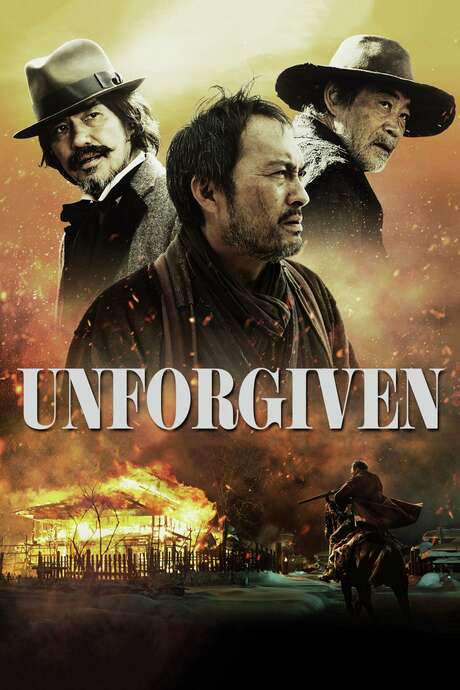
Unforgiven (2013) movie poster

Plot Summary

Unforgiven (2013) Plot Summary Explained

Release, runtime and language
2013 · 135 mins · Japanese
Loading streaming availability…
Directed by
Lee Sang-il
Starring
Ken Watanabe, Akira Emoto, Jun Kunimura, Takahiro Miura, Eiko Koike, Shioli Kutsuna

An old swordsman, his former comrade and a young braggart are hired by prostitutes to track down bandits who mutilated one of the women.

On this page (5)
  1. 1 Where to watch
  2. 2 What happens: full plot
  3. 3 Plot questions answered
  4. 4 Movie threads
  5. 5 Every angle
Loading streaming availability…

Full plot summary · contains spoilers

What Happens in Unforgiven: Full Plot Summary

The whole story of Unforgiven (2013) explained, from the opening scene to the final frame: every key event, every twist and what it all adds up to. Read it as a quick recap before the sequel, to check a scene you missed, or to finally understand what really happened.

Set in the late 19th century American frontier, the story unfolds across two bitterly contrasting landscapes: the rough edges of Big Whiskey, Wyoming, and the dustier plains of Hodgeman County, Kansas. It opens with a brutal act of violence that leaves a young prostitute named Delilah Fitzgerald scarred for life when a cowboy named Quick Mike slashes her face with a knife. The town’s sheriff, known as Little Bill Daggett, responds with a heavy hand, demanding vengeance by punishing Mike and his accomplice, Davey Bunting, by forcing them to surrender some of their ponies to Delilah’s employer Skinny DuBois. The motive behind the punishment is money lost, but the anger it sparks among the town’s prostitutes quickly evolves into a $1,000 bounty placed on the two cowboys, turning the fates of many toward a grim, law-tinged reckoning.

Across the wind-swept plains in Kansas, a boastful young man arrives at a modest hog farm with a bold claim: he is the Schofield Kid, a bounty hunter seeking help to track down the men who hurt Delilah. Will Munny, a once-notorious outlaw now living as a repentant widower with two children, is drawn back into the world he once left behind. His farm’s hard luck and the uncertain future of his children push him toward a looming decision. He initially resists, but the weight of responsibility and the lure of a promised reward pull him toward cooperation with his old ally Ned Logan. The Kid, who is almost blind in one eye, reveals his self-appointed role to pursue the same target, and the trio’s uneasy alliance begins to form under the threat of the looming bounty.

Meanwhile, in Big Whiskey, the aging British gunfighter English Bob rides into town with his biographer, W. W. Beauchamp, hoping to cash in on the bounty under the town’s rigid anti-gun code. Little Bill, determined to uphold his version of frontier order, disarms Bob and gives him a brutal lesson, beating him in front of a crowd to deter others from seeking the reward. The next morning, the townspeople drive Bob away, banished for failing to conform to the sheriff’s code. Beauchamp, watching from the shadows of the saloon, becomes irresistibly drawn to Little Bill’s philosophy of violence, while the sheriff explains that the true skill of a gunslinger lies in composure and in taking out the best opponent first rather than simply drawing first.

When the two groups converge again in a rain-soaked town, the trio—Will, Ned, and the Kid—enter Skinny’s saloon. A tense confrontation ensues as Ned and the Kid mingle with the prostitutes upstairs while Little Bill confronts Will below. After a harrowing confrontation, Bill confiscates Will’s weapon and delivers a savage beating that leaves him battered and feverish. Ned and the Kid escape through the back, returning Will to a makeshift shelter where the women tend to his wounds. In the days that follow, the trio executes a plan that sees them ambush Davey Bunting, but their strike is imperfect: they shoot Davey’s horse, and Ned falters, leading Will to finish Davey off. Ned’s fate darkens further when he is captured and flogged by Little Bill to reveal Will and the Kid’s whereabouts. Ned’s brutal death becomes a grim emblem of the price of revenge, while the Kid’s reluctance to kill deepens the moral weight he carries.

With Ned’s death weighed on them, the three return to the ranch, where the plan to avenge Delilah’s injury takes a sharper, bloodier form. The Kid, who has begun to question the necessity of killing, returns to Kansas with the reward while Will continues alone in pursuit, driven by a stubborn resolve and a thirst for justice that may be more about old loyalties than redemption. Will’s resolve fractures as he learns Ned’s corpse has been displayed in a coffin outside Skinny’s, a grim reminder of the consequences of their vow.

The climax builds to a brutal, decisive gunfight in the heart of the town. Will walks into the public space, facing Little Bill and the posse with a revolver in hand. He shoots Little Bill and several deputies, ordering the rest of the men to leave. The duel ends with Will finally killing Little Bill, the sheriff whose claim to virtue rests on force and fear. Beauchamp is forced to leave with the others, while Skinny meets a fate tied to the displays of Ned’s body. The film closes on the somber note that Will’s world remains haunted and unsettled, even as the violence seems to abate for a moment.

In the final reveal, a quiet epilogue through a title card notes that Will’s farm was abandoned years later, as his mother-in-law wonders why her daughter ever chose a path tied to such notoriety. The ending leaves a lingering sense of ambiguity about Will’s life after the violence, suggesting that the line between justice and vengeance is a difficult one to tread. The narrative keeps its focus on the consequences of choices made in the name of justice, the cost of violence, and the fragile hope for redemption in a land where the past often catches up with the present.

- This retelling preserves the core beats of the tale: the inciting act of violence, the bounty, the uneasy alliance among former outlaws, the brutal enforcement of law in a frontier town, the moments of personal doubt, and the final confrontation that redefines the meaning of justice in the wild West. It stays faithful to the tone and the arc, presenting a coherent, readable, and immersive recounting of events with an emphasis on the emotional and moral weight carried by each character as the story unfolds.
Last updated: October 27, 2025 at 16:47

Was this helpful?

Plot questions answered

Unforgiven Plot Explained: Your Questions Answered

The questions people ask most about Unforgiven (2013): what happens in the confusing scenes, why the characters do what they do, the twists, hidden details and what the ending means. Each answer contains spoilers.

Q1

Why does Will Munny agree to take on the bounty after promising to leave his outlaw past behind?

Will agrees to pursue the bounty because his hog farm is failing and he cannot provide for his two children. While he initially resists the Kid's request, the desperate financial situation and uncertainty about his children's future push him to return to the only life he knows - killing for money. His decision reflects the harsh reality that redemption is difficult when survival is at stake.

Foreshadowing: Earlier scenes show Will struggling to feed his livestock and maintain the farm, establishing the financial desperation that will drive his decision.

  • will munny
  • bounty
  • redemption
  • farm
  • money
  • kids
Q2

Why does Little Bill beat Will Munny when he doesn't even know who he is?

Little Bill beats Will as a warning to any bounty hunter thinking about claiming the reward. The sheriff enforces a strict anti-gun policy in Big Whiskey and wants to deter violence. Since Will arrived in town seeking the bounty, Bill treats him as a potential threat, confiscating his weapon and delivering a brutal beating to make an example of him. Bill's violence is calculated to maintain control, regardless of whether he knows the person's identity.

Foreshadowing: Bill's earlier confrontation with English Bob establishes his pattern of disarming and humiliating gunslingers to enforce his version of order.

  • little bill
  • will munny
  • beating
  • sheriff
  • bounty
Q3

Why does Ned Logan quit the bounty hunt after the failed ambush on Davey Bunting?

Ned quits because he cannot bring himself to kill an unarmed man. When they ambush Davey Bunting, Ned hesitates and fails to fire, forcing Will to kill Davey instead. This moment breaks Ned - he realizes he is not capable of murder for money, unlike his old partner Will. Ned decides to return to Kansas, but his fate is sealed when Little Bill captures and kills him for information.

Foreshadowing: Ned's reluctance to kill is hinted at earlier when he and Will discuss their past killings, with Ned expressing regret over the lives he took.

  • ned logan
  • quits
  • davey bunching
  • ambush
  • regret
Q4

What happens to Ned Logan and why is his death so significant?

Ned is captured by Little Bill's deputies while trying to return to Kansas. Bill brutally flogs Ned to extract information about Will and the Kid's whereabouts. Ned refuses to talk and dies from the torture. His body is displayed in a coffin outside Skinny's saloon as a warning. Ned's death represents the ultimate price of getting involved in the bounty - it transforms Will's mission from money-seeking into personal revenge and hardens his resolve.

Foreshadowing: Bill's conversation with Beauchamp about killing the best shooter first foreshadows his ruthless tactics against anyone who opposes him.

  • ned logan
  • death
  • flogging
  • little bill
  • revenge
Q5

Why does the Schofield Kid refuse to kill Quick Mike at the end?

The Kid refuses to kill because he has realized he cannot live with taking another person's life. When the time comes to ambush Quick Mike in the outhouse, the Kid admits to Will that he is afraid to kill and doesn't want to become a murderer. He hands over his revolver and chooses to return to Kansas with the reward money rather than commit another killing. This represents his moral awakening after witnessing Ned's death and the violence they already committed.

Foreshadowing: The Kid's initial boastfulness about being an experienced bounty hunter is contrasted with his near-sightedness and later his reluctance to actually kill.

  • schofield kid
  • quick mike
  • refuses to kill
  • morality
Q6

Why does Will Munny go on a killing spree in Big Whiskey after Ned's death?

Will's killing spree is driven by revenge and grief after learning Ned was tortured to death. When a prostitute delivers the reward money and tells Will about Ned's fate, he becomes consumed by anger. He storms into town, kills Skinny DuBois, and then hunts down Little Bill and his deputies. What started as a money-making mission has transformed into personal vengeance - Will is no longer hunting for the bounty but exacting justice for his friend's brutal murder.

Foreshadowing: The discovery of Ned's corpse displayed in a coffin outside the saloon is the final trigger that pushes Will over the edge.

  • will munny
  • little bill
  • revenge
  • killing spree
  • ned death
Q7

Why does Little Bill enforce such brutal justice in Big Whiskey?

Little Bill believes his violent methods are necessary to maintain order in a lawless frontier town. He sees himself as a protector who uses fear and force to prevent chaos. Bill justifies his brutality by claiming that a gunslinger's true skill is staying calm and killing the best opponent first. His anti-gun policy and violent punishments are his way of imposing his version of justice - even if that justice is arbitrary and cruel. The film portrays him as a man who confuses tyranny with law enforcement.

Foreshadowing: Bill's explanation to Beauchamp about what makes a good gunslinger reveals his philosophy of using violence strategically to control the town.

  • little bill
  • sheriff
  • brutal justice
  • order
  • frontier
Q8

Why does Beauchamp stay in Big Whiskey with Little Bill after witnessing his violence?

Beauchamp remains fascinated by Little Bill because he represents the romanticized gunfighter archetype that his writing career depends on. After watching Bill disarm and humiliate English Bob, Beauchamp is drawn to the sheriff's ruthless pragmatism. He sees Bill as a living example of the violent frontier mythology he wants to write about. Rather than being repelled by Bill's brutality, Beauchamp is intrigued by it - he wants to understand the sheriff's code of violence up close.

Foreshadowing: Beauchamp's earlier role as English Bob's biographer establishes his interest in documenting famous gunfighters.

  • beauchamp
  • little bill
  • biographer
  • fascination
  • violence
Q9

Why is Will Munny's failing farm important to the story?

Will's failing farm represents the impossibility of escaping his past. Despite wanting to become a respectable farmer and provide for his family, the drought and hard times have made his farm unworkable. This economic desperation is what forces him to accept the bounty offer in the first place. The epilogue confirms his farm is eventually abandoned, suggesting that once you're marked by violence and notoriety, the peaceful life is nearly impossible to maintain.

Foreshadowing: The opening scenes of Will struggling to feed his hogs establish the financial desperation that drives the entire plot.

  • will munny
  • farm
  • failure
  • poverty
  • redemption
Q10

Why does Quick Mike slash Delilah's face and trigger the entire story?

Quick Mike cuts Delilah's face during an argument, permanently disfiguring her. This act of violence is what sets the entire plot in motion - the prostitutes are so enraged that they pool money for a $1,000 bounty on Mike and his companion Davey Bunting. Sheriff Little Bill's inadequate response (merely taking their horses as compensation) fails to satisfy the women, so they take justice into their own hands. Mike's violence creates the chain of events that draws Will back into killing.

Foreshadowing: The opening act establishes that violence against women in this town goes unpunished by law, motivating the prostitutes to offer their own reward.

  • quick mike
  • delilah
  • face slash
  • bounty
  • prostitutes

Movie threads

More Movies Like Unforgiven, by Mood & Story

Curated lists built around what makes Unforgiven tick: the same mood, the same kind of story or the same emotional payoff. Each list explains why these movies belong together.

Stories of reluctant vengeance like Unforgiven

Aging warriors forced back into a violent world they tried to leave. If you liked Unforgiven, you'll appreciate these movies featuring aging or retired warriors pulled back into a life of violence. This thread collects similar dramas and Westerns where protagonists are forced to confront their past for a bittersweet, morally complex form of justice.

  • grim
  • somber
  • tense
  • brutal
  • unsettling
  • moral conflict
  • Tone: dark, melancholic, morally ambiguous
  • Pacing: steady, methodical build
Why these movies?

The story pattern: The narrative follows a protagonist who has abandoned their violent skills, only to be coerced by circumstances into one last mission. The story explores the psychological toll of re-engaging with brutality, questioning whether redemption is possible or if violence simply begets more violence.

Why they belong together: Movies are grouped here for their shared focus on the reluctant anti-hero archetype, a steady pacing that builds towards inevitable confrontation, and a dark tone that questions the very concept of heroic violence, resulting in a heavy emotional weight.

Bleak revenge Westerns similar to Unforgiven

Stories where the quest for vengeance corrupts and the landscape is unforgiving. Find movies like Unforgiven that explore the heavy cost of frontier justice. These similar films feature a dark tone, high intensity, and a steady pace, delivering a somber experience centered on vengeance in a harsh, morally ambiguous world.

  • grim
  • brutal
  • atmospheric
  • tense
  • melancholic
  • unforgiving
  • Tone: dark, bleak, somber
  • Pacing: steady, atmospheric build
Why these movies?

The story pattern: The plot is triggered by a brutal act that demands a violent response. The journey through a stark landscape is linear, steadily escalating towards a final, bloody confrontation that offers little catharsis. The narrative emphasizes that the price of revenge often outweighs the satisfaction.

Why they belong together: These films share a cohesive vibe defined by a dark tone, high intensity from graphic violence, and a steady pacing that creates relentless tension. They are united by themes of moral ambiguity, loss, and the bleak reality of obtaining justice through brutal means.

Every angle

Unforgiven (2013) Explained: Plot, Timeline & Characters

Everything about Unforgiven in one place: what happens in the plot summary, the timeline in chronological order, the characters and meaning and a spoiler-free summary. What's After the Movie adds the cast, box office and post-credit scenes.

Coming soon on iOS and Android

The Plot Explained Movie Summary App

Plot summaries, endings explained and timelines on your phone. Catch up on any movie in minutes, save your favorites and never miss a twist again.

Be the first to know when we launch. Your email stays private, always.

Learn more about the app