Plot Explained Spoilers guaranteed!
Plot Explained

Browse by genre

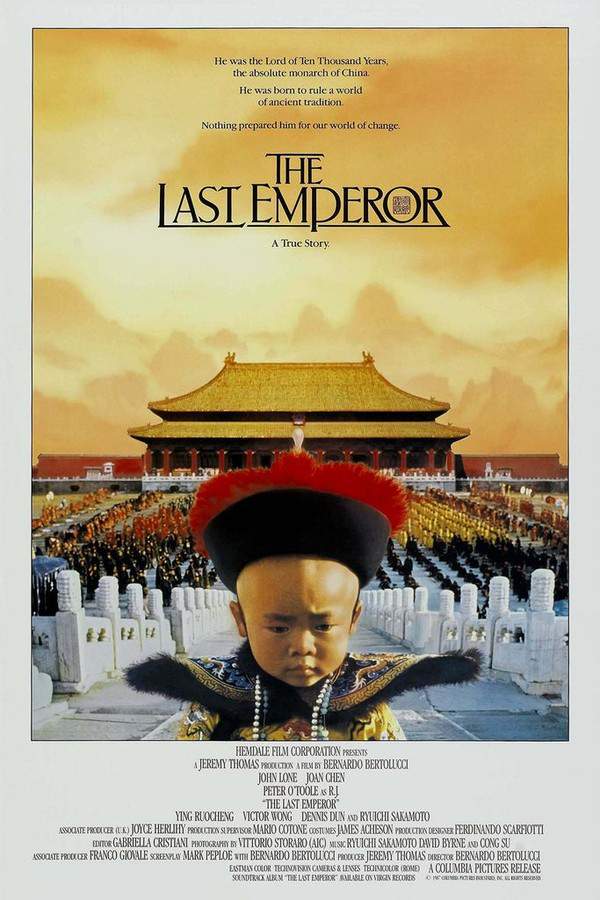
The Last Emperor (1987) movie poster

Plot Summary

The Last Emperor (1987) Plot Summary Explained

Release, runtime and language
1987 · 163 min · English
JustWatch #5,702 4
Directed by
Bernardo Bertolucci
Starring
Peter O'Toole, Joan Chen, John Lone

This epic biographical drama chronicles the life of China's last emperor, Pu Yi, portrayed by John Lone. The film explores his privileged upbringing within the Forbidden City, showcasing the opulence and grandeur of imperial life. It follows his journey through the dramatic changes in China, from the fall of the Qing Dynasty to his imprisonment and subsequent rehabilitation as a war criminal in 1950. Through Pu Yi’s experiences, the film offers a poignant look at the collapse of an empire and the shifting dynamics of power.

On this page (6)
  1. 1 Where to watch
  2. 2 What happens: full plot
  3. 3 Plot questions answered
  4. 4 Movie threads
  5. 5 Movies like The Last Emperor
  6. 6 Every angle

Where to watch

Where to Watch The Last Emperor (1987)

Where can you watch The Last Emperor? Stream, rent or buy it in the US, including on HBO Max, Amazon Video and Apple TV Store: current JustWatch availability with up-to-date prices.

Streaming availability powered by JustWatch

Full plot summary · contains spoilers

What Happens in The Last Emperor: Full Plot Summary

The whole story of The Last Emperor (1987) explained, from the opening scene to the final frame: every key event, every twist and what it all adds up to. Read it as a quick recap before the sequel, to check a scene you missed, or to finally understand what really happened.

A train arrives at a North China station in 1950, where soldiers are seen everywhere. This train is transporting prisoners, all deemed war criminals. As the prisoners wait in the station, an unusual scene unfolds: four of them suddenly rise and reverently bow to a well-dressed man, John Lone. This man, known as Pu Yi, is the last emperor of China. Uncomfortable under this unexpected reverence, he soon retreats to a bathroom, locking the door behind him. In a moment of despair, he fills a sink with hot water and slits his wrists, letting his blood cloud the water.

Outside, the prison governor, played by Ruocheng Ying, insists on entering the locked bathroom, pounding on the door and calling out, "Open the door!" Pu Yi's thoughts drift to a long-ago era—1908, when he was just a child. The Empress Dowager Cixi orders him to the Forbidden City, where he will be anointed as the new emperor. Followed by a procession, the three-year-old Pu Yi, sobbing, is handed over by his mother to his nurse, Ar Mo, who assures her, "My son is your son."

During his investiture, the empress proclaims, "Little Pu Yi, you will be the new Lord of Ten Thousand Years. You will be the Son of Heaven." When silence falls after the endless bows from officials and servants, a cricket chirps, and the High Tutor presents it as a gift, declaring it the emperor's cricket.

As he grows older, Pu Yi is largely isolated, attended to by court eunuchs and servants. He reaches out to Ar Mo, crying, "I want to go home!" but finds himself trapped in a life he never chose. Fast forward to his adulthood, where his failed suicide attempt leads him to the Fushun Detention Center, where he sits in a cell haunted by memories.

His brother, Pu Chieh, visits him, prompting further reflections on their childhood. At just eight years old, Pu Yi viewed the world through the lens of an emperor, largely indifferent to his family. Even the sacred bond with his brother is questioned when Pu Chieh insists that Pu Yi is no longer emperor.

In yet another emotional plunge, the prison governor lays out the expectations for the imprisoned war criminals, demanding autobiographies confessing their crimes while Pu Yi’s mind drifts to 1919, when he met Reginald Johnston, Peter O'Toole, his tutor. Johnston wishes to cultivate a friendship rather than a hierarchical relationship; he sees the naivety hidden beneath Pu Yi's royal facade.

Pu Yi's life continues through turbulent kaleidoscopes of history—his marriage in 1922 to a girl named Wen Hsiu and his political entanglements with Japan, leading to a theatrical yet tragic rise to power as emperor of the puppet state Manchukuo.

As decades pass, his reality unfolds like a scripted play, where every decision he makes is woven intricately into layers of betrayal, identity crisis, and despair. In a heartbreaking moment, Pu Yi is confronted with the fallout of his past decisions during painful interrogations, all while longing for the childhood he left behind, wrapped tightly in the comforts of the Forbidden City.

Yet, by 1959, there's a glimmer of redemption. As a chorus of prisoners, Pu Yi finds release from the chains of his past, walking into freedom at last. 1967 welcomes him to a fresh start, functioning as a gardener, where he smiles genuinely for the first time. In a poignant rediscovery, he visits his past haunts—the Forbidden City, grappling with nostalgia and loss when confronted by the realities of his long-lived tale.

Ultimately, he reflects on a life encased in the weight of meaning and responsibility, where he declares, "I was responsible for everything." His journey culminates in serene acceptance—a blend of power lost and the quiet dignity of an ordinary existence, culminating in a gentle farewell to the vestiges of his imperial past.
Last updated: November 07, 2024 at 23:53

Was this helpful?

Plot questions answered

The Last Emperor Plot Explained: Your Questions Answered

The questions people ask most about The Last Emperor (1987): what happens in the confusing scenes, why the characters do what they do, the twists, hidden details and what the ending means. Each answer contains spoilers.

Q1

Why does Pu Yi attempt suicide at the train station?

In 1950, Pu Yi tries to kill himself in the station bathroom because he cannot bear the weight of his past and the unexpected reverence shown by other prisoners. The sight of four men bowing to him triggers overwhelming despair, reminding him of the imperial status he has lost. He slits his wrists in a locked bathroom, filling the sink with blood, a physical manifestation of his internal turmoil and sense of entrapment.

Foreshadowing: Earlier scenes of the young Pu Yi crying "I want to go home!" in the Forbidden City foreshadow this desperate escape attempt.

  • Pu Yi
  • suicide
  • 1950
  • war criminal
  • train station
Q2

Why do the other prisoners bow to Pu Yi at the station?

The four prisoners bow to Pu Yi out of deep respect for his former status as Emperor of China, despite his current position as a war criminal. This unexpected reverence reflects the lingering aura of imperial authority that still surrounds him. The moment makes Pu Yi deeply uncomfortable, forcing him to confront the gap between his past power and present humiliation.

Foreshadowing: This scene establishes the conflict between Pu Yi's lost imperial status and the way others still perceive him.

  • Pu Yi
  • prisoners
  • bow
  • respect
  • emperor
Q3

Why is the three-year-old Pu Yi chosen as emperor in 1908?

The Empress Dowager Cixi selects three-year-old Pu Yi as emperor in 1908 after the previous emperor dies without an heir. She summons him to the Forbidden City, where he is anointed as the "Lord of Ten Thousand Years," the Son of Heaven. The young child is pulled away from his mother and handed to his nurse Ar Mo, beginning his life of isolation within the palace walls.

Foreshadowing: This moment sets in motion Pu Yi's lifelong entrapment by circumstances he never chose.

  • Pu Yi
  • coronation
  • 1908
  • Empress Dowager Cixi
  • Forbidden City
Q4

Why does Pu Yi grow up isolated in the Forbidden City?

Pu Yi is isolated because imperial tradition requires the emperor to be separated from his family to maintain his divine status as the Son of Heaven. He is attended only by court eunuchs and servants, with his biological mother forbidden from seeing him. The young emperor repeatedly cries "I want to go home!" but is trapped in a life of ceremonial grandeur and emotional emptiness.

Foreshadowing: This childhood isolation directly fuels his desperate suicide attempt decades later.

  • Pu Yi
  • Forbidden City
  • isolation
  • childhood
  • eunuchs
Q5

Who is Reginald Johnston and what role does he play in Pu Yi's life?

Reginald Johnston is a British tutor assigned to teach Pu Yi in 1919. Unlike strict educators, he seeks to build a friendship with the young emperor rather than enforce rigid hierarchy. Johnston recognizes the naivety hidden behind Pu Yi's royal facade and attempts to prepare him for the modern world beyond the palace walls, representing the clash between Eastern tradition and Western modernity.

Foreshadowing: Johnston's mentorship exposes Pu Yi to ideas that will later influence his decisions.

  • Reginald Johnston
  • tutor
  • Pu Yi
  • education
  • Western influence
Q6

Why does Pu Yi become emperor of the puppet state Manchukuo?

After being expelled from the Forbidden City, Pu Yi is installed as emperor of Manchukuo in the 1930s, a puppet state created by Japan in Manchuria. Though he believes this will restore his power, he becomes little more than a figurehead with no real authority. Japan uses his imperial status to legitimize their occupation, and his collaboration leads directly to his classification as a war criminal after World War II.

Foreshadowing: This decision seals his fate as a war criminal and leads to his imprisonment.

  • Pu Yi
  • Manchukuo
  • Japan
  • puppet state
  • emperor
Q7

Why is Pu Yi imprisoned as a war criminal after World War II?

Pu Yi is imprisoned because he served as emperor of Manchukuo, Japan's puppet state in Manchuria. Though he was largely a figurehead with no real power, his imperial title provided legitimacy to Japanese occupation. After the war, the Soviet Union and China classify him as a war criminal, and he is detained in 1950. He remains imprisoned for nearly a decade, undergoing interrogation and forced confession writing.

Foreshadowing: This imprisonment becomes the setting for his psychological transformation.

  • Pu Yi
  • war criminal
  • imprisonment
  • Fushun
  • Manchukuo
Q8

What happens when Pu Yi's brother Pu Chieh visits him in prison?

Pu Yi receives a visit from his brother Pu Chieh at the Fushun Detention Center, prompting reflection on their childhood relationship. As children, Pu Yi, trapped in his imperial role, was largely indifferent to family bonds. During the visit, Pu Chieh challenges Pu Yi by telling him he is "no longer emperor," highlighting how Pu Yi's imperial identity created a profound distance between them.

Foreshadowing: This visit forces Pu Yi to confront the personal relationships his status destroyed.

  • Pu Yi
  • Pu Chieh
  • brother
  • prison visit
  • family
Q9

When and why is Pu Yi finally released from prison?

Pu Yi is released from the Fushun Detention Center in 1959 after years of imprisonment and rehabilitation. His release comes as part of a broader Chinese government policy toward war criminals. By accepting responsibility for his past actions and demonstrating genuine transformation, he earns his freedom, though he remains under surveillance as a citizen of the new China.

Foreshadowing: His release marks the beginning of his journey toward redemption.

  • Pu Yi
  • release
  • 1959
  • Fushun
  • freedom
Q10

How does Pu Yi find peace working as a gardener?

By 1967, Pu Yi works as a gardener in Beijing, finding genuine happiness in simple, ordinary life for the first time. This humble occupation represents a complete reversal of his imperial existence. He smiles authentically, a stark contrast to his earlier tormented self. The simple act of tending gardens allows him to experience freedom and purpose without the burdens of absolute power.

Foreshadowing: This peace is the culmination of his acceptance and transformation.

  • Pu Yi
  • gardener
  • 1967
  • peace
  • ordinary life
Q11

What happens when Pu Yi returns to the Forbidden City?

Pu Yi returns to the Forbidden City as an ordinary citizen, visiting the palace that was once his prison. He walks through the halls where he was crowned as a child, now transformed into a public museum. This visit forces him to confront his past directly, filled with nostalgia for both the splendor and the loneliness of his childhood. He reflects on the weight of meaning and responsibility he carried as emperor.

Foreshadowing: This return represents the final confrontation with his imperial legacy.

  • Pu Yi
  • Forbidden City
  • return
  • museum
  • past
Q12

What does Pu Yi mean when he says "I was responsible for everything"?

When Pu Yi declares "I was responsible for everything," he finally accepts full moral accountability for his actions as emperor, including his collaboration with Japan and the suffering caused by his decisions. This statement represents his complete psychological and spiritual transformation. By acknowledging responsibility rather than blaming circumstances or manipulation, he achieves the self-awareness necessary for true redemption.

Foreshadowing: This acceptance directly enables his freedom and inner peace.

  • Pu Yi
  • responsibility
  • acceptance
  • accountability
  • redemption
Q13

What is the significance of the cricket during Pu Yi's coronation?

During Pu Yi's 1908 coronation, as the child emperor sits overwhelmed by endless ceremonial bows, a cricket chirps in the silence. The High Tutor presents it to the young Pu Yi as a gift, declaring it the emperor's cricket. This moment provides brief, innocent joy amid the overwhelming formality, symbolizing the small comforts that could not mask the isolation and burden of imperial life.

Foreshadowing: The cricket represents the childhood innocence Pu Yi would lose.

  • Pu Yi
  • cricket
  • coronation
  • childhood
  • gift
Q14

Why does the prison governor insist on entering the bathroom?

The prison governor pounds on the bathroom door, repeatedly shouting "Open the door!" as Pu Yi attempts suicide inside. His persistence prevents Pu Yi from completing his suicide, serving as the catalyst that interrupts his desperate act. This moment transforms from a simple rescue into a symbolic interruption of Pu Yi's self-destruction, representing the possibility of transformation through human intervention.

Foreshadowing: This intervention marks the beginning of Pu Yi's rehabilitation.

  • prison governor
  • bathroom
  • door
  • rescue
  • intervention

Movie threads

More Movies Like The Last Emperor, by Mood & Story

Curated lists built around what makes The Last Emperor tick: the same mood, the same kind of story or the same emotional payoff. Each list explains why these movies belong together.

Historical Epics about the Fall of an Empire like The Last Emperor

Epic historical dramas about the personal cost of a dynasty's end. If you were captivated by the grand scale and personal tragedy of The Last Emperor, explore these movies like it. This collection features similar historical dramas and biographical stories about the collapse of empires, the loss of power, and the poignant human stories at the center of world-changing events.

  • epic
  • historical
  • somber
  • reflective
  • opulent
  • tragic
  • Tone: melancholic, somber, reflective
  • Pacing: variable, epic scope
Why these movies?

The story pattern: Stories in this thread typically follow a linear or nonlinear path tracing the zenith and nadir of a powerful figure or institution. The narrative juxtaposes opulent heights with profound loss, often using a character's personal journey to symbolize the fate of an entire nation or era.

Why they belong together: Movies are grouped here for their shared focus on monumental historical change, their epic scope, and their melancholic tone. They all explore the heavy emotional weight of witnessing a world disappear, often through the eyes of someone who once ruled it.

Movies about Imprisonment and Identity like The Last Emperor

Stories of personal transformation and self-discovery through imprisonment. If you liked The Last Emperor's focus on Pu Yi's transformation, discover these movies about imprisonment and identity. This collection features similar stories of characters stripped of power who must rebuild their sense of self, often with a bittersweet ending and a heavy emotional journey.

  • somber
  • reflective
  • lonely
  • hopeful
  • psychological
  • redemptive
  • Tone: somber, reflective, bittersweet
  • Pacing: slow, character-driven
Why these movies?

The story pattern: The narrative arc hinges on a forced isolation that catalyzes a deep identity crisis. The story contrasts a character's life before and during confinement, focusing on their internal struggle and eventual, hard-won acceptance or redefinition of self, rather than a conventional escape.

Why they belong together: These films share a core theme of identity reconstruction amid constraint. They are united by a somber, reflective mood, a focus on internal psychological change over external action, and an ending that acknowledges loss while offering a glimpse of peace or understanding.

If you liked this

Movies Like The Last Emperor

Similar movies to The Last Emperor: the same genre, themes or kind of story. Each one comes with its own plot summary, timeline and ending explained.

Browse all movie summaries

Every angle

The Last Emperor (1987) Explained: Plot, Timeline & Characters

Everything about The Last Emperor in one place: what happens in the plot summary, the timeline in chronological order, the characters and meaning and a spoiler-free summary. What's After the Movie adds the cast, box office and post-credit scenes.

Coming soon on iOS and Android

The Plot Explained Movie Summary App

Plot summaries, endings explained and timelines on your phone. Catch up on any movie in minutes, save your favorites and never miss a twist again.

Be the first to know when we launch. Your email stays private, always.

Learn more about the app