Plot Explained Spoilers guaranteed!
Plot Explained

Browse by genre

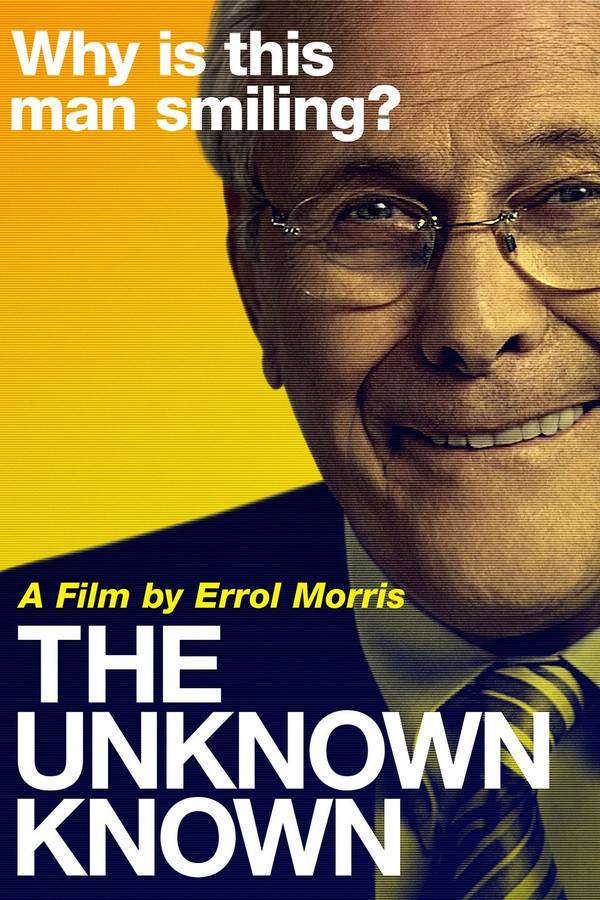
The Unknown Known (2014) movie poster

Timeline

The Unknown Known (2014) Timeline Explained – Every Event in Order

Release, runtime and language
2014 · 103 min · English
Loading streaming availability…
Starring
Donald Rumsfeld

This documentary explores the legacy of Donald Rumsfeld through a collection of his personal handwritten memos, often referred to as "snowflakes." Director Errol Morris presents Rumsfeld performing and interpreting these notes, offering a revealing look into the mind of the architect of the Iraq War. The film examines his worldview and challenges conventional understandings, prompting reflection on truth, historical accounts, and the complexities of leadership in times of conflict.

On this page (5)
  1. 1 Where to watch
  2. 2 Events in order (17)
  3. 3 Movie threads
  4. 4 Movies like The Unknown Known
  5. 5 Every angle
Loading streaming availability…

17 events in order · contains spoilers

The Unknown Known Timeline: Events in Chronological Order

Every key event of The Unknown Known (2014) in order, scene by scene, with when and where it takes place. Use it to untangle flashbacks, time jumps and parallel storylines, to refresh your memory before the sequel or to find the exact scene you are thinking of.

  1. Rumsfeld introduces the concept of 'unknown knowns'

    At the beginning of the documentary, Rumsfeld argues that a major purpose of the Department of Defense is to evaluate 'unknown knowns', which he defines as 'the things you think you know, that it turns out you did not'. He presents this evaluation as a tool to anticipate hostile actions before they take place. The statement establishes the central theme of the film and frames everything that follows.

    When
    Beginning of the documentary
  2. Pearl Harbor as a 'failure of imagination'

    To illustrate his point about blind certainties, Rumsfeld suggests that the failure of the United States to anticipate the attack on Pearl Harbor was a 'failure of imagination'. He uses this historical example to show how overlooking what one believes to be known can have catastrophic consequences.

    Where
    Pearl Harbor, Hawaii
  3. The 'Yellow Perils' memos

    The major portion of the documentary is spent addressing excerpts from the countless memos Rumsfeld wrote during his long career as a congressman and advisor, which his first Pentagon staff nicknamed 'Yellow Perils'. These documents span decades of his service as an advisor to four different presidents. Morris uses them to trace Rumsfeld's thinking across much of modern American foreign policy.

    Where
    The Pentagon
  4. The 'Snowflakes' memos

    Rumsfeld's later memos were nicknamed 'Snowflakes' by his second Pentagon staff, reflecting the way they scattered across the bureaucracy during his two terms as Secretary of Defense. Rumsfeld allowed Morris only limited access to their contents while preparing the film. The sheer volume of these memoranda forms the backbone of the documentary's structure.

    Where
    The Pentagon
  5. The Iraq and WMD news briefing response

    The documentary focuses on a response Rumsfeld gave to a question at a news briefing about the lack of evidence linking the government of Iraq with the supply of weapons of mass destruction to terrorist groups. This exchange exemplifies the gap between the administration's confidence and the available evidence. It becomes one of the key archival moments Morris returns to throughout the film.

    When
    February 12, 2002
    Where
    U.S. Department of Defense news briefing
  6. Memos covering the aftermath of Watergate

    Among the memos Morris and Rumsfeld examine are those covering the aftermath of Watergate. They show how Rumsfeld responded to a constitutional crisis at the highest levels of government. These documents reveal the breadth of his involvement in American political life long before the Iraq War.

  7. Memos on the torture at Abu Ghraib

    The memos also touch on the torture and abuse of prisoners at Abu Ghraib, one of the darkest episodes of the Iraq War. Morris presses on how the man who wrote so many memoranda related to what occurred there. The topic stands as one of the film's most pointed confrontations.

    Where
    Abu Ghraib
  8. Defining the word 'terrorism'

    Other memos grapple with the definition of the word 'terrorism' itself. The documents reveal Rumsfeld's ongoing attempts to pin down terminology that drove national security policy. This linguistic scrutiny mirrors Morris's own questioning style throughout the film.

  9. The swirling snowflake globe motif

    Throughout the documentary, Morris returns to the motif of snowflakes swirling within a globe whenever he discusses the memos with Rumsfeld. The visual serves as a metaphor for the scattered and sometimes chaotic nature of Rumsfeld's written record. It ties the film's aesthetics directly to its subject matter.

  10. Reading memos aloud on camera

    On camera, Rumsfeld agrees to read several of his own memos aloud, offering rare direct engagement with his own words. The readings allow viewers to hear his voice applied to decisions of enormous consequence. Morris uses these moments to prompt unscripted reactions from his subject.

  11. Morris catches Rumsfeld lying on camera

    As the interviews proceed, the director is able to catch his subject lying on camera. When this happens, Rumsfeld does not acknowledge it or instead deflects the conversation. Morris concludes that the politician is unwilling or unable to engage in meaningful self-reflection.

  12. Lessons from the Vietnam War

    When Morris asks Rumsfeld about lessons he learned from the Vietnam War, Rumsfeld dismisses the question with the remark, 'Some things work out, some things don't. That didn't.' The flippant response underscores the film's portrait of a man reluctant to draw conclusions from history.

  13. The approved Guantánamo torture techniques list

    Rumsfeld expresses good-natured surprise at the list of torture techniques, including hooding, stress positions, and nudity, that he personally approved for use on Guantánamo detainees. He exclaims, 'Good grief! That's a pile of stuff!' The moment reveals a startling distance between the author of such approvals and their real-world effects.

    Where
    Guantánamo Bay
  14. The Yoo 'Torture Memos' question

    Morris questions Rumsfeld about the so-called 'Torture Memos' sent by Assistant Attorney General John Yoo to the Department of Defense describing enhanced interrogation techniques. Rumsfeld indicates he never read them despite having been the head of the department. Morris responds in disbelief, 'Really?'

    Where
    U.S. Department of Defense
  15. Was the Iraq War a mistake?

    Asked point-blank if the Iraq War was a mistake, Rumsfeld replies plaintively, 'I guess time will tell.' The answer deflects responsibility onto the verdict of history rather than offering any personal reckoning. It stands as one of the film's most telling evasions.

    Where
    Iraq
  16. The inverted definition of 'unknown knowns'

    In the penultimate scene, Morris questions Rumsfeld again about 'unknown knowns', and the definition has inverted since the beginning of the interview, with Rumsfeld now defining them as 'things that you know, that you don't know you know'. Morris is quick to point out the incongruity. Rumsfeld acknowledges it when shown his memo, but suggests that his earlier definition was instead the one that was wrong.

    When
    Penultimate scene
  17. Why did Rumsfeld agree to the interviews?

    As the documentary closes, Morris asks Rumsfeld why he agreed to the interviews in the first place. Rumsfeld responds, 'That is a vicious question. I'll be darned if I know.' His final answer encapsulates the film's unresolved and unsettling portrait of its subject.

    When
    End of the documentary

Last updated: November 23, 2026 at 21:14

Was this helpful?

Movie threads

More Movies Like The Unknown Known, by Mood & Story

Curated lists built around what makes The Unknown Known tick: the same mood, the same kind of story or the same emotional payoff. Each list explains why these movies belong together.

Political Power and Accountability Movies Like The Unknown Known

Documentary investigations expose contradictions within the machinery of political power. Explore movies like The Unknown Known and similar documentary stories that scrutinize government decisions, official contradictions, and the language of political power. These politically charged films favor evidence, interviews, and moral questioning over spectacle, inviting viewers to reassess accepted histories and the consequences of war and government secrecy.

  • sober
  • probing
  • disquieting
  • oppressive
  • reflective
  • accountability
  • Tone: dark, sober, disquieting
  • Pacing: slow, methodical
Why these movies?

The story pattern: An inquiry begins with a public figure or institution presenting a seemingly coherent explanation, then accumulates evidence exposing gaps, contradictions, and unanswered questions. Instead of providing simple closure, the story widens the moral field and leaves viewers confronting how uncertainty can be used to justify action.

Why they belong together: These films are grouped by their focus on state power and accountability rather than spectacle alone. Their measured interviews, contested official accounts, and references to war or government misconduct create a shared experience of political scrutiny: authoritative language is tested, and the audience must weigh unresolved contradictions.

Dark, Slow-Burn Documentary Movies Like The Unknown Known

Slow, probing documentaries let contradictions and moral discomfort gather without dramatic resolution. Discover movies like The Unknown Known and similar documentary stories with slow pacing, probing interviews, and an ominous sense of withheld truth. These dark, complex narratives build unease through conflicting statements, disturbing political context, and restrained presentation rather than action, leaving questions and moral uncertainty hanging.

  • slow burn
  • uneasy
  • methodical
  • oppressive
  • reflective
  • disquieting
  • Tone: dark, uneasy, reflective
  • Pacing: slow burn, deliberate
Why these movies?

The story pattern: A calm surface gives way to creeping disquiet as a central claim is examined from several angles. Extended conversations and close attention to language reveal inconsistencies, while disturbing realities gradually become impossible to dismiss. The journey ends without a definitive answer, leaving ambiguity and a burden of reflection.

Why they belong together: The connection is primarily experiential: restrained presentation, slow accumulation, pointed exchanges, and disturbing subject matter combine to create sustained unease. These films avoid conventional action and easy moral closure, using repetition, evasion, and unresolved contradictions to make the audience reconsider what has been said and what remains concealed.

If you liked this

Movies Like The Unknown Known

Similar movies to The Unknown Known: the same genre, themes or kind of story. Each one comes with its own plot summary, timeline and ending explained.

Browse all movie summaries

Every angle

The Unknown Known (2014) Explained: Plot, Timeline & Characters

Everything about The Unknown Known in one place: what happens in the plot summary, the timeline in chronological order, the characters and meaning and a spoiler-free summary. What's After the Movie adds the cast, box office and post-credit scenes.

Coming soon on iOS and Android

The Plot Explained Movie Summary App

Plot summaries, endings explained and timelines on your phone. Catch up on any movie in minutes, save your favorites and never miss a twist again.

Be the first to know when we launch. Your email stays private, always.

Learn more about the app