Plot Explained Spoilers guaranteed!
Plot Explained

Browse by genre

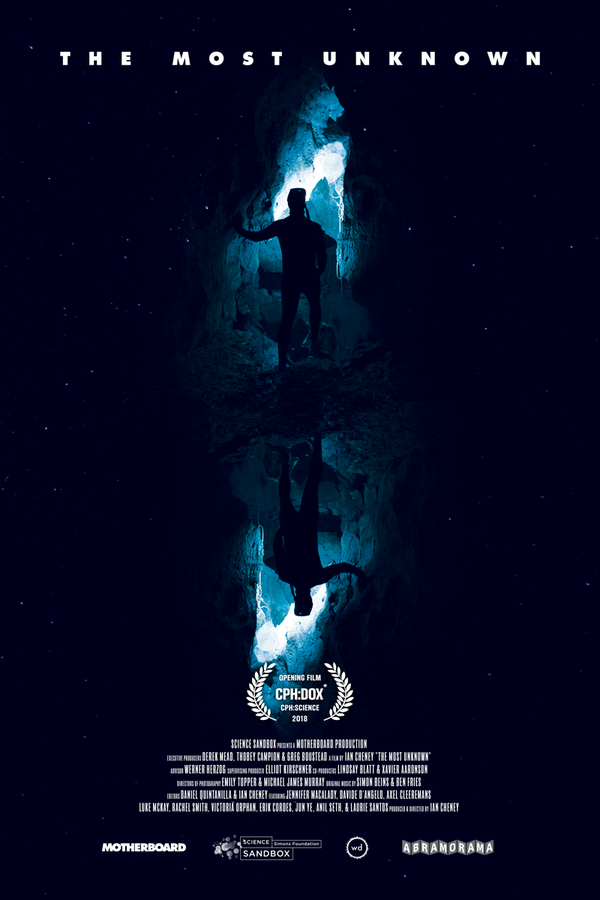
The Most Unknown (2018) movie poster

Plot Summary

The Most Unknown (2018) Plot Summary Explained

Release, runtime and language
2018 · 88 min · English
Echo score 72
Directed by
Ian Cheney
Starring
Jennifer L. Macalady, Rachel L Smith

Nine scientists explore profound mysteries in this documentary. Their quest spans subjects from the beginnings of life to the complexities of time and consciousness, pushing the boundaries of scientific understanding. Through collaboration and exploration, they forge connections across various disciplines, revealing the transformative power of shared discovery and the captivating nature of the unknown.

On this page (6)
  1. 1 What happens: full plot
  2. 2 Plot questions answered
  3. 3 Movie threads
  4. 4 Movies like The Most Unknown
  5. 5 Categories
  6. 6 Every angle

Full plot summary · contains spoilers

What Happens in The Most Unknown: Full Plot Summary

The whole story of The Most Unknown (2018) explained, from the opening scene to the final frame: every key event, every twist and what it all adds up to. Read it as a quick recap before the sequel, to check a scene you missed, or to finally understand what really happened.

The Most Unknown is a compelling documentary that embarks on an exhilarating journey with nine brilliant scientists as they travel to remarkable locations around the globe to seek answers to some of humanity's most profound questions. Their inquiries delve into the origins of life, the concept of time, the nature of consciousness, and the extent of our knowledge about the universe. Key figures in this quest include Jennifer L. Macalady, a microbiologist from Penn State University, and Rachel L. Smith, an astrophysicist at the North California Museum of Natural Sciences, alongside a diverse array of experts such as physicists, cognitive psychologists, and ecologists.

Through this innovative approach, the film emphasizes the importance of interdisciplinary collaboration. It showcases researchers immersing themselves in fields they have never explored before, which ultimately broadens the narrative of scientific storytelling. What unfolds is a deeply human adventure at the core of discovery, serving as a powerful reminder of the significance of posing unanswered questions.

In the Frasassi Caves of Italy, Jennifer L. Macalady](/actor/jennifer-l-macalady) makes a remarkable find—evidence of ancient microbial life dating back millions of years. While she collects samples, she later meets Davide D'Angelo in his lab, where he is focused on the elusive concept of dark matter, which constitutes 85% of the universe yet remains undiscovered. Jennifer highlights a staggering figure: there are 35 billion microbial species in existence, yet humanity has identified merely a million—leaving the vast majority enveloped in mystery.

Moving on, Davide D'Angelo travels to Brussels to collaborate with Axel Cleeremans, a cognitive psychologist probing the origins of consciousness. In a groundbreaking experiment, Davide attempts to control a robotic hand using only his thoughts, contributing to Axel's quest to establish a clearer definition of consciousness, which he feels is progressing too slowly in the field of science.

Axel Cleeremans journeys next to the Black Rock Desert in Nevada, where he meets Luke McKay, an astrobiologist in search of extraterrestrial life. Luke’s exploration of hot springs aims to unravel the origins of life in the cosmos, questioning the potential equivalents of consciousness in alien forms. He comments on the astonishing overlap between microbial diversity on Earth and the vastness of outer space, with DNA sequences resembling cosmic landscapes.

Later, Luke ventures to Hawai’i to meet Rachel L. Smith, who examines star formation from gaseous clouds. With the control center situated in the heart of downtown, the telescope sits at 14,000 feet elevation. Rachel studies carbon monoxide signatures, crucial for understanding star development, while also showcasing live lava flows to Luke, highlighting Earth's dynamic processes.

Following this, Rachel connects with Victoria Orphan, who investigates life on the ocean's floor. She reveals that underwater ecosystems, rich in diverse microbial life, prevent significant amounts of methane gas from entering the atmosphere. Rachel shares her experiences, emphasizing that more knowledge exists about outer space than the unexplored depths of the oceans, while acknowledging the critical role these microbes play in combating global warming.

Victoria's research leads her to Boulder, Colorado, where she meets Jun Ye, a physicist diving into quantum physics and the nature of time. Jun Ye's work with strontium atomic clocks showcases how they can detect variations in time when impacted by massive objects, opening new understandings about the fabric of time itself.

The journey progresses as Jun Ye travels to the UK to meet Anil Seth, a neuroscientist studying brain function. His research focuses on how we perceive time and whether this perception evolves with age. Anil posits that while technology advances, there may always be limitations in our understanding due to the inherent cognitive boundaries of humans.

The narrative culminates in a meeting between Anil and Laurie Santos at Yale, where she studies free-range monkeys in Puerto Rico to glean insights into human cognitive processes. By conducting various cognitive experiments, Laurie offers a glimpse into how these animals respond to different stimuli. In a beautiful full circle, Laurie reunites with Jennifer L. Macalady, intertwining their explorations and discoveries, enriching the film's portrayal of the interconnectedness of science and humanity.

Through its compelling storytelling, The Most Unknown not only ignites curiosity but also emphasizes the importance of asking the right questions that can further our understanding of the universe and our place within it.
Last updated: November 03, 2024 at 23:39

Was this helpful?

Plot questions answered

The Most Unknown Plot Explained: Your Questions Answered

The questions people ask most about The Most Unknown (2018): what happens in the confusing scenes, why the characters do what they do, the twists, hidden details and what the ending means. Each answer contains spoilers.

Q1

What scientific questions does the documentary explore?

The Most Unknown explores nine scientists' journeys to answer profound questions about the origins of life, the nature of consciousness, the concept of time, and the extent of human knowledge about the universe. Each researcher brings a different specialty, from microbiology to astrophysics to cognitive psychology, creating a collaborative quest that spans multiple scientific disciplines.

Foreshadowing: The documentary opens by introducing nine scientists, each representing a different field of inquiry.

  • origins of life
  • consciousness
  • time
  • universe
  • scientific discovery
Q2

Why do the scientists travel to meet researchers in different fields?

The documentary emphasizes interdisciplinary collaboration as essential to modern scientific discovery. By having each scientist visit another researcher in an unfamiliar field, the film shows how breakthroughs often occur at the intersection of different disciplines. This structure reinforces that complex questions about life and the universe require multiple perspectives.

Foreshadowing: The introduction explicitly highlights interdisciplinary collaboration as a core theme.

  • interdisciplinary collaboration
  • scientists
  • research
  • field crossover
Q3

What did Jennifer L. Macalady discover in the Frasassi Caves?

Jennifer L. Macalady discovered evidence of ancient microbial life dating back millions of years in Italy's Frasassi Caves. She highlights that while there are approximately 35 billion microbial species on Earth, humanity has identified only about one million, a tiny fraction of microbial diversity that remains largely unknown.

Foreshadowing: The cave discovery occurs early in the documentary, establishing the theme of unexplored life.

  • microbial life
  • Frasassi Caves
  • bacteria
  • ancient life
Q4

What is dark matter and why is it important to the scientists?

Dark matter constitutes approximately 85% of the universe yet remains undetected by direct observation. Davide D'Angelo explains its significance: understanding dark matter is crucial because it represents the vast majority of what makes up the cosmos, leaving most of the universe's composition unknown to science.

Foreshadowing: Jennifer meets Davide after her cave exploration, linking microbial unknowns to cosmic unknowns.

  • dark matter
  • universe
  • cosmic
  • physics
  • 85 percent
Q5

What robotics experiment did Davide D'Angelo attempt with Axel Cleeremans?

In Brussels, Davide D'Angelo attempted to control a robotic hand using only his thoughts, as part of Axel Cleeremans's research into consciousness. This brain-computer interface experiment aimed to explore how consciousness might be measured and defined, contributing to the broader question of what constitutes conscious experience.

Foreshadowing: The experiment follows their discussion about the difficulty of defining consciousness.

  • robotics
  • consciousness
  • brain computer interface
  • thoughts
Q6

Why does the documentary explore consciousness and its origins?

Cognitive psychologist Axel Cleeremans investigates consciousness because it remains one of science's most elusive concepts. He expresses frustration that the study of consciousness is progressing too slowly, noting that understanding how awareness emerges is fundamental to understanding what it means to be human.

Foreshadowing: This segment follows Davide's work on dark matter, connecting cosmic and cognitive mysteries.

  • consciousness
  • awareness
  • cognitive psychology
  • mind
Q7

Why does Luke McKay study hot springs to search for extraterrestrial life?

Astrobiologist Luke McKay studies hot springs in Nevada's Black Rock Desert because these environments mirror conditions that may exist on other planets. By understanding how life thrives in extreme conditions on Earth, scientists can better identify where to look for life beyond our planet and understand the potential origins of life in the universe.

Foreshadowing: Axel travels to meet Luke after discussing consciousness, shifting from internal to external exploration.

  • astrobiology
  • extraterrestrial life
  • hot springs
  • aliens
  • space
Q8

What does Rachel L. Smith study about star formation?

Astrophysicist Rachel L. Smith studies star formation by examining carbon monoxide signatures in gaseous clouds in Hawai'i. Her work at high-elevation telescopes helps scientists understand how stars develop from cosmic gas, revealing the processes that create the building blocks of planetary systems.

Foreshadowing: Luke travels to Hawai'i to meet Rachel, connecting Earth-based research to cosmic phenomena.

  • star formation
  • astrophysics
  • gas clouds
  • astronomy
  • stars
Q9

What did Victoria Orphan discover about ocean microbes and methane?

Victoria Orphan investigates deep ocean ecosystems rich in microbial life that prevent significant amounts of methane gas from entering the atmosphere. These microbes play a critical role in regulating climate by consuming methane that would otherwise contribute to global warming, revealing how much remains unknown about ocean depths.

Foreshadowing: Rachel meets Victoria in Hawai'i, linking cosmic and environmental research.

  • ocean microbes
  • methane
  • deep sea
  • climate
  • ecosystem
Q10

How do atomic clocks help scientists understand the nature of time?

Physicist Jun Ye works with strontium atomic clocks so precise they can detect variations in time caused by massive objects. His research demonstrates that time is not uniform throughout the universe, it can be stretched or compressed by gravity, revealing that time itself is more complex than everyday experience suggests.

Foreshadowing: Victoria travels to Colorado to meet Jun, shifting from biological to physical concepts.

  • atomic clocks
  • time
  • quantum physics
  • gravity
  • physics
Q11

Why does Anil Seth study how humans perceive time?

Neuroscientist Anil Seth studies time perception because our experience of time does not match objective reality, time can feel slow or fast depending on circumstances. He explores whether perception of time changes with age and argues that cognitive limitations may always prevent humans from fully understanding concepts like time and consciousness.

Foreshadowing: Jun travels to the UK to meet Anil, connecting physics to neuroscience.

  • time perception
  • neuroscience
  • brain
  • aging
  • consciousness
Q12

What does Laurie Santos's research with monkeys reveal about cognition?

Laurie Santos studies free-range monkeys in Puerto Rico to understand the evolutionary roots of human cognition. By conducting experiments on how monkeys respond to various stimuli, she provides insights into which cognitive abilities are uniquely human and which share deeper evolutionary origins with other primates.

Foreshadowing: Anil meets Laurie at Yale, completing the journey from physics back to biology.

  • monkeys
  • cognition
  • evolution
  • primates
  • Yale
  • psychology
Q13

Why does the documentary end with Laurie reuniting with Jennifer Macalady?

The reunion between Laurie Santos and Jennifer L. Macalady creates a full-circle narrative that emphasizes the interconnected nature of scientific exploration. Despite studying vastly different subjects, monkey cognition and ancient microbes, both are driven by the same fundamental quest to understand life's mysteries, reinforcing the documentary's message that all scientific inquiry is connected.

Foreshadowing: The final scene deliberately echoes the opening introduction of scientists.

  • reunion
  • interconnection
  • scientists
  • collaboration
  • narrative

Movie threads

More Movies Like The Most Unknown, by Mood & Story

Curated lists built around what makes The Most Unknown tick: the same mood, the same kind of story or the same emotional payoff. Each list explains why these movies belong together.

Movies about big questions with a hopeful tone like The Most Unknown

Documentaries and stories that tackle life's biggest mysteries with a sense of optimism. If you liked the inspiring, wonder-filled journey of The Most Unknown, you'll find similar films here. These movies explore profound scientific and philosophical mysteries with an optimistic and curious tone, focusing on the collaborative and uplifting nature of human inquiry.

  • inspiring
  • contemplative
  • wonder-filled
  • optimistic
  • curious
  • thoughtful
  • Tone: hopeful, contemplative, inspiring
  • Pacing: steady, thoughtful
Why these movies?

The story pattern: Narratives in this thread often follow a journey of inquiry, where characters or experts collaborate to explore a deep mystery. The conflict is typically intellectual rather than interpersonal, and the resolution reinforces the value of asking questions and the interconnectedness of knowledge.

Why they belong together: These movies are grouped together because they share a unique blend of tackling complex, weighty subjects with a fundamentally hopeful and optimistic tone. They prioritize wonder over worry and celebrate discovery, creating an inspiring and contemplative viewing experience.

Movies about interdisciplinary collaboration like The Most Unknown

Stories where experts from different fields come together to solve a shared puzzle. Fans of The Most Unknown will enjoy these stories about collaborative problem-solving. This collection features films where scientists, thinkers, or experts from different areas join forces, revealing how interconnected knowledge leads to profound discoveries and insights.

  • collaborative
  • inspiring
  • curious
  • educational
  • thought-provoking
  • unifying
  • Tone: inspiring, curious, optimistic
  • Pacing: steady, logical
Why these movies?

The story pattern: The plot structure revolves around bringing together specialists with unique skills or knowledge bases. The story unfolds as these individuals learn to communicate and combine their expertise, often involving travel to distinct locations or labs, culminating in a shared 'Eureka' moment or a deeper understanding.

Why they belong together: These films are united by their focus on the process of interdisciplinary collaboration as a central narrative engine. They share a vibe of intellectual camaraderie and the excitement that comes from connecting dots across traditional boundaries of knowledge.

If you liked this

Movies Like The Most Unknown

Similar movies to The Most Unknown: the same genre, themes or kind of story. Each one comes with its own plot summary, timeline and ending explained.

Browse all movie summaries

Categories

Movie Lists Featuring The Most Unknown

The Most Unknown appears in these hand-built movie categories. Each one groups movies by a specific mood, theme or story type, with their plot summaries and endings explained.

View all movie categories

Every angle

The Most Unknown (2018) Explained: Plot, Timeline & Characters

Everything about The Most Unknown in one place: what happens in the plot summary, the timeline in chronological order, the characters and meaning and a spoiler-free summary. What's After the Movie adds the cast, box office and post-credit scenes.

Coming soon on iOS and Android

The Plot Explained Movie Summary App

Plot summaries, endings explained and timelines on your phone. Catch up on any movie in minutes, save your favorites and never miss a twist again.

Be the first to know when we launch. Your email stays private, always.

Learn more about the app