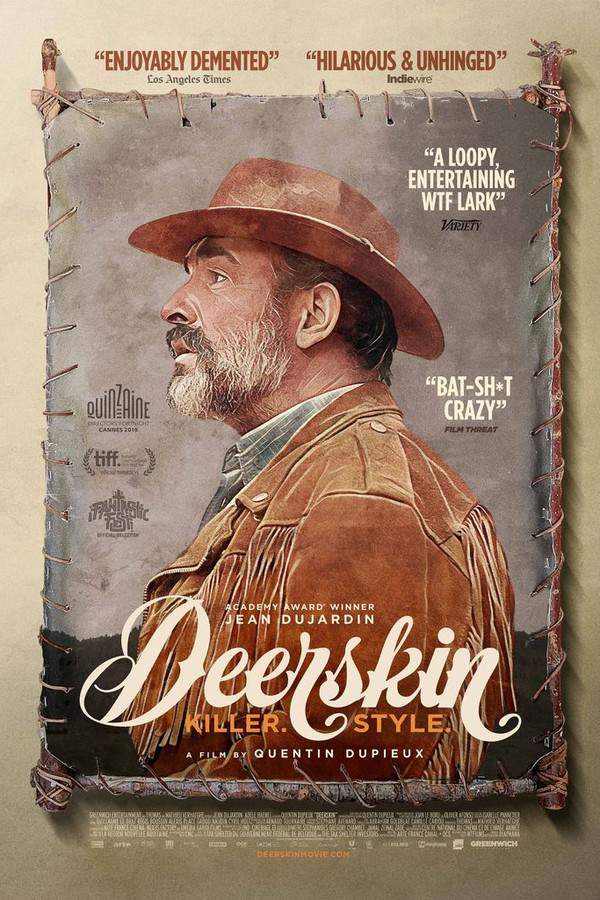
Georges, Jean Dujardin, a 44-year-old man, purchases a vintage fringed deerskin motorcycle jacket for €7,500 from an older countryside seller who also gifts him an almost-new digital camcorder, free of charge and without any prompt from Georges.
After the purchase, he checks into a small hotel in a mountainside village and leaves his wedding ring as collateral with the receptionist. There, he encounters a local bartender, a young woman named Denise, and claims he is in town on a film shoot. Denise, an amateur editor, takes a keen interest and begins to engage with his plan, sensing there might be more to his story than a simple wardrobe purchase.
Georges soon experiments with the camcorder, using it to film the jacket and inventing a fantasy where the jacket itself is a sentient being. The dialogue between Georges and the jacket gradually shifts from benign curiosity to something unsettling. A pivotal exchange appears in the form of an ambiguous line: > Let’s team up. But I am warning you I am in charge. < The phrasing is intentionally murky, leaving it unclear whether the jacket is speaking through Georges or if Georges is projecting the idea onto the camera.
The following day brings a cascade of misfortunes: an ATM refuses to dispense cash, and Georges finds himself rummaging through a trash can for food while a mute boy observes. He then discovers that his estranged wife has frozen his bank account. From there, the jacket begins to speak to him more clearly, claiming a dream of becoming the only jacket in the world. A seemingly simple decision to extend his stay—spurred by a convenient suicide—allows Georges to secure a deerskin hat and to continue assembling a complete deerskin outfit piece by piece.
Desperation pushes him to involve Denise more directly in the project; he persuades her to fund the film, with Denise taking on the editing. He uses the money to pay townspeople to relinquish their jackets, which he then appropriates for his growing wardrobe. A mute observer, the same boy, watches several of these encounters, and in one unsettling moment Georges throws a brick at him.
As the jacket's influence intensifies, Georges keeps filming as he cycles through more garments and the growing costume. When one reluctant participant refuses to surrender his jacket in the cold, it initially seems Georges may have killed him, but a dialogue between Georges and the jacket implies that no one has actually died yet. The jacket shifts from praising the camera work to urging violence after Georges concedes that it might want him to proceed. Spurred by this suggestion, Georges tears a blade from a ceiling fan, sharpens it into a weapon, and embarks on a killing spree that is captured on his camcorder.
In moments of sleep, the jacket seems to speak directly to Georges, repeating his name—Georges—as if trying to wake him or test whether he is truly asleep. The sound design makes Georges’ breathing nearly inaudible beneath the jacket’s voice, underscoring how the voice has come to “own” his mouth. Eventually, Georges buries his victims with the aid of a digger and a digger operator; the operator’s jacket mostly remains out of frame during the recording, preserving a sense of eerie concealment.
Georges’ spree culminates in a chilling realization of the consequences of his project. Denise, excited by the new footage, offers to produce the film and uses a portion of her inheritance to finish it. She reveals that she has known Georges was a fraud since they first met. After gifting him a pair of deerskin gloves, Denise films him as he preens in his full outfit on a roadside hill. From the opposite hillside, the mute boy’s father unexpectedly shoots Georges in the head with a hunting rifle. Denise continues filming as she strips the jacket from Georges’ corpse and dons it herself, completing the metamorphosis that the jacket suggested all along.
In a mid-credits moment, Georges records himself wearing the jacket as he approaches a herd of deer. Although Georges cannot see the image on the camcorder, the device zooms in on the scene twice, hinting at the jacket’s lingering, inescapable influence even after death.