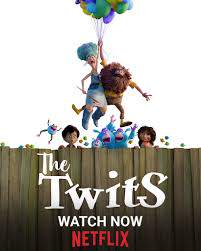
Told through the framing device of a firefly named Pippa [Emilia Clarke] telling a story to her son inside the beard of Mr. Twit [Johnny Vegas], the tale centers on a grumpy pair who share little joy beyond their amusement park, Twitlandia. The opening chapters set a tone of mischief and neglect, painting a couple who despise each other yet cling to their park as a hollow symbol of their power. When Twitlandia is shut down on its grand opening day for a string of violations, the couple vows revenge in a spectacular, chaotic fashion. In a bold and reckless move, they steal a liquid hot dog meat truck and use it to flood the water tower, triggering a massive explosion that dumps Triperot-like floodwater through the town. What follows is a disruption that upends the entire community and introduces a cast of characters who will either be drawn into or pushed away from the Twits’ broken world.
The focus shifts to Beesha Balti [Maitreyi Ramakrishnan], a perceptive 12-year-old Indian-American girl, and her friend Bubsy [Ryan Anderson Lopez], who is waiting to be adopted. The Twits’ meat flood wrecks havoc on the town and has immediate consequences for Bubsy’s adoption prospects, as prospective parents worry about contamination and decide to look elsewhere. Beesha, sensing the stakes and determined to help Bubsy, delivers a pep talk that rekindles Bubsy’s hope and clarifies the path forward. The two children eventually reach Twitlandia and are met with a cold reception: the Twits bluntly confess their crime, exposing a depth of cruelty beneath their showy veneer. This moment is a pivot point that tests the children’s resolve and foreshadows the deeper moral questions the story will explore.
A pivotal encounter introduces the Muggle-Wumps, a family of vibrant, monkey-like creatures from Loompaland, who have been imprisoned by the Twits in a double-decker bus-themed cage. The Muggle-Wumps plead for help, and Beesha and Bubsy quickly grasp their plight through their own powerful sense of empathy. The rescue attempt unfolds with the sense that some wrongs may be too entrenched to fix in a single act of bravery; in a telling turn, the rescue fails, yet Beesha succeeds in capturing the Twits’ confession on tape, a recording that becomes a key piece of evidence. The arrest of the Twits marks a temporary victory for the children and the creatures, even as the town’s ties to the couple remain complicated and fragile.
Back at home, Beesha and Bubsy uncover a key that could unlock the Muggle-Wumps’ cage, and they encounter a Sweet-Toed Toad [Alan Tudyk] who speaks in reverse, a quirky character who deepens the odd, fairy-tale atmosphere of the story. The Twits, meanwhile, manage to secure a kind of bail-out from a family that hopes the notorious couple can still contribute to the town’s recovery, offering them a pathway back into the community if they cooperate. This arrangement creates a tense, uneasy peace, while Beesha and Bubsy press on toward a more meaningful sense of justice.
The search for freedom for the Muggle-Wumps intensifies as the orphans hurry to their orphanage, only to be pursued by the Twits. After a decisive confrontation with the head of the orphanage, Mr. Napkin, the story culminates in a dramatic sequence that takes place in the main bedroom where the children and their friends hide. A carefully orchestrated prank turns the Twits’ world upside down, as the space is rearranged so they appear to be standing on the ceiling. The Twits’ attempts at negotiation crumble when Beesha sets a condition: entry to the orphanage can only come if the Twits can become mayor. The town erupts into a chaotic civic event as the Twits race to the ballot.
The mayoral race introduces a colorful cast of characters and a new sense of civic theater. The Twits and the orphans collide over power and responsibility, culminating in the controversial plan to eliminate their rival, Mayor Wayne John John-John [Jason Mantzoukas], by serving him a Triperot Cake—an intentionally laxative confection that inflates his body in a farcical, over-the-top moment. The outcome shifts town sentiment in Beesha’s favor, as she disrupts the election and positions herself to influence the town’s future.
With the Twits newly installed as co-mayors, their grip tightens on the orphanage and its assorted residents. They unleash a wave of intimidation aided by a wary, complicit citizenry, while the orphans and the Muggle-Wumps respond with a creative counterattack that relies on a cloud of Florbnorbles—the strange, sentient furballs that Marty Muggle-Wump [Timothy Simons] periodically vomits under stress. The creatures’ dramatic presence underscores the emotional stakes and the vulnerability of Beesha as she navigates loyalties, fear, and the desire for belonging. In a moving exchange, Beesha and Mary Muggle-Wump [Natalie Portman], the mother figure who speaks softly but carries a quiet strength, share a heart-to-heart that reinforces Beesha’s sense of family and the hope that her real parents might still be reachable.
As the town recoils from the Twits’ escalating cruelty, Beesha confesses that she longs for a real family to come back, and Mary reassures her that she has a warm, supportive circle to rely on. The next morning, the Twits’ power is tested again as the orphans push back, attracting a wider coalition of townspeople who begin to see the Twits for what they are. The orphans stage a dramatic exodus of the orphanage to Twitlandia, transforming the space into a spectacle for a new kind of entertainment that centers on community and resilience rather than fear and exploitation. Beesha, inspired by the Sweet-Toed Toad [Alan Tudyk], marches toward a goal of saving her makeshift family, and she succeeds in getting the Twits to submit to a more humane, if imperfect, resolution.
Twitlandia reopens, and the crowd’s excitement swells as the town witnesses a partial victory—though the Twits still crave control, the moment is tempered by Beesha’s insistence on accountability. The Muggle-Wumps are freed, the park undergoes a symbolic cleansing, and a rare moment of honesty unfolds when the Twits apologize by destroying their own creation in a blaze of dramatic destruction. In the climactic prank, Beesha and the orphans rearrange the living room and expose the Twits to a gravity-bound downfall, defeating them not with brute force but with cleverness and solidarity. The Twits’ fall is met with a sense of justice, yet the story preserves a final, nuanced reflection on forgiveness and the costs of revenge.
In the epilogue, the orphanage is restored by Mr. Napkin, and the Muggle-Wumps’ tears are commodified into a new source of funding for the children’s home. The town’s reputation as a place of fun and belonging is rekindled with the help of the Florbnorbles, and Beesha finds a sense of belonging within her new family. The bird’s-eye conclusion returns to the frame: Pippa and Jeremy slip away from Mr. Twit’s beard, and the Twits’ post-credits misadventure ends with their inadvertent journey into Loompaland, where they are swallowed by the mouth of a giant Sweet-Toed Toad, closing the tale with a wink of whimsy and consequence.