Year: 1995
Runtime: 106 mins
Language: English
Director: Robert Markowitz
During World II the US Army Air Corps launched a special initiative to integrate African‑American pilots into its Fighter Pilot Program, sending them to the Tuskegee airbase for rigorous training. This effort created the famed Tuskegee Airmen. Though they faced constant harassment, racial prejudice and behind‑the‑scenes politics, the men persevered. When finally deployed overseas they flew escort missions, proved their skill in combat and earned a reputation for remarkable performance.
Warning: spoilers below!
Haven’t seen The Tuskegee Airmen yet? This summary contains major spoilers. Bookmark the page, watch the movie, and come back for the full breakdown. If you're ready, scroll on and relive the story!
Read the complete plot breakdown of The Tuskegee Airmen (1995), including all key story events, major twists, and the ending explained in detail. Discover what really happened—and what it all means.
During World War II, Hannibal “Iowa” Lee, Jr. [Laurence Fishburne] travels by train to Tuskegee, Alabama for the chance to train as a military pilot, joining a determined group of African-American cadet candidates that includes Cuba Gooding Jr. as Billy “A-Train” Roberts, Allen Payne as Walter Peoples III, and Mekhi Phifer as Lewis Johns. They are welcomed by the base’s leadership, including Colonel Noel Rogers [Daniel Hugh Kelly] and Major Sherman Joy [Christopher McDonald], while Second Lieutenant Glenn [Courtney B. Vance] stands as the base’s seasoned Black pilot with real combat experience. Joy’s outward confidence clashes with a pervasive white American belief that African-Americans cannot serve as pilots, a tension that shadows every briefing and training session.
The cadets are ordered to retake the flight exam they used to qualify for the program. Joy’s suspicions about the integrity of their admission are laid bare, but Rogers explains the retesting outcome: no one scored below a 95%. With that hurdle cleared, the trainees begin hands-on flight training in the PT-17 with their instructor pilots. Early tests are brutal; Cadet Johns [Mekhi Phifer] and his instructor are killed when Johns fails to recover from a stall. The tragedy shakes Cadet Leroy Cappy [Malcolm-Jamal Warner], causing several others to leave the program voluntarily. In a pivotal moment, Lee and Peoples persuade Cappy to stay, and the cadets press on toward solo flight. Lee earns the chance to fly solo, while Glenn briefed the class on air combat, sharing his own history in the Battle of Britain with the Royal Canadian Air Force—an experience that makes him the only Army Air Corps officer at the base with real battlefield credentials.
In the skies, [Walter Peoples III] and [Lewis Johns] push their limits, and the pair’s first solo flights in the AT-6 Texan culminate in a friendly, though competitive, mock dogfight where Peoples narrowly defeats Lee. Spirits rise until Peoples treats flight like a showcase, performing unauthorized aerobatics. His defiant display leads to his removal from the program, setting off a painful cycle of forgiveness requests that fail to soften Major Joy’s stance. Facing the risk of public disgrace, Peoples makes a desperate choice and seizes an AT-6 to crash it deliberately, ending his life. The cadets debate Joy’s tactics: Roberts accuses him of attempting to break them, while Cappy sides with Roberts, fearing a broader collapse of their chances. Lee, however, refuses to bow to pressure and remains determined to chase his dream of flying.
Despite the brutal testing and internal strife, the cadets graduate with commissions as second lieutenants in the Army Air Corps. The real-world deployment, however, remains blocked by racist scrutiny from Congress. A turning point comes when First Lady Eleanor Roosevelt [Rosemary Murphy] visits the base, personally inspecting it and flying with Lee. The favorable press that follows helps push the program forward, and the unit is finally deployed to North Africa as the 99th Pursuit Squadron. Initially limited to ground-attack roles, the squadron soon proves its worth during a combat encounter with Messerschmitt Bf 109s, showing that the Black pilots can perform in air-to-air combat. In a dramatic moment, Cappy breaks formation and shoots down a German fighter, but the triumph is tempered by his own death in later actions. Meanwhile, Lee earns the Distinguished Flying Cross for sinking a destroyer and receives a promotion to captain.
As the 99th Pursuit Squadron grows, it earns the explicit trust of a congressional panel to form a new all-Black unit, the 332nd Fighter Group, commanded by Benjamin O. Davis [Andre Braugher]. With this expanded force, the squadron ships out to Ramitelli, Italy, to escort B-17 heavy bombers over dangerous skies. In one memorable mission, Lee and Roberts help save a stricken B-17 by destroying a destroyer out at sea and guiding the crew home; upon their return, a B-17 pilot struggles to trust that Black pilots were the saviors, illustrating the deep-seated racism they must overcome. Later missions continue to stack losses on the crew, but the Tuskegee Airmen persevere, emerging as a respected force. Roberts is shot down on a subsequent operation, but Lee’s leadership and skill continue to redefine what Black aviators could achieve. Lee’s success culminates in the now-believed-to-be-indispensable role of the Tuskegee Airmen as escorts for a planned mission to Berlin, a mission that will finally demonstrate their capability when the record shows that no heavy bombers are lost during their protection.
Colonel Noel Rogers and Major Sherman Joy shape the training and testing that lead to the cadets’ graduation, with Rogers calmly balancing pressure and fairness while Joy pushes the cadets toward a harsh standard.
The 99th Pursuit Squadron, led by Davis, evolves into the all-Black 332nd Fighter Group, but their path remains fraught with political and racial obstacles as they prove their combat effectiveness in North Africa and Italy.
The Tuskegee Airmen’s journey—from hesitant beginnings to proven prowess—culminates in a reputation for reliability in escort duty and a broader, more hopeful future for Black pilots within the Allied air forces.
Last Updated: October 09, 2025 at 14:14
Discover curated groups of movies connected by mood, themes, and story style. Browse collections built around emotion, atmosphere, and narrative focus to easily find films that match what you feel like watching right now.
Stories of marginalized groups fighting prejudice to earn respect through sheer skill.If you liked The Tuskegee Airmen, you'll appreciate these films about characters facing an uphill battle against systemic adversity. This thread features movies where marginalized groups or individuals must overcome discrimination and prove their capability in challenging fields, from the military to sports and beyond.
The narrative follows a clear, often linear path of training, testing, and ultimate validation. Characters face external opposition and internal doubt, but their perseverance and demonstrable skill gradually force a change in perception, leading to a legacy of respect that is deeply meaningful but often bittersweet.
They are grouped by the powerful emotional arc of overcoming institutional barriers. The shared experience combines the frustration of prejudice with the catharsis of hard-earned success, creating a deeply resonant and hopeful yet sobering viewing experience.
War stories that balance the grim reality of combat with the hope of earned respect.Find more war dramas like The Tuskegee Airmen that balance intense combat with a hopeful core. These similar movies capture the heavy cost of war while focusing on uplifting themes like brotherhood, perseverance, and leaving a lasting, positive legacy amidst the tragedy.
These narratives unfold in a steady, grounded pace, moving from training or induction into the heart of conflict. The journey is defined by costly sacrifices and tragic losses, but the central plot arc—proving a unit's valor, achieving a strategic goal, or simply surviving together—provides a resilient thread of hope that endures.
They share a specific tonal balance: the unflinching intensity of war is palpable, but it's leavened by a focus on positive human qualities like honor, perseverance, and brotherhood. This creates a viewing experience that is heavy yet ultimately uplifting, rather than purely bleak.
Don't stop at just watching — explore The Tuskegee Airmen in full detail. From the complete plot summary and scene-by-scene timeline to character breakdowns, thematic analysis, and a deep dive into the ending — every page helps you truly understand what The Tuskegee Airmen is all about. Plus, discover what's next after the movie.
Track the full timeline of The Tuskegee Airmen with every major event arranged chronologically. Perfect for decoding non-linear storytelling, flashbacks, or parallel narratives with a clear scene-by-scene breakdown.
Discover the characters, locations, and core themes that shape The Tuskegee Airmen. Get insights into symbolic elements, setting significance, and deeper narrative meaning — ideal for thematic analysis and movie breakdowns.
Get a quick, spoiler-free overview of The Tuskegee Airmen that covers the main plot points and key details without revealing any major twists or spoilers. Perfect for those who want to know what to expect before diving in.
Visit What's After the Movie to explore more about The Tuskegee Airmen: box office results, cast and crew info, production details, post-credit scenes, and external links — all in one place for movie fans and researchers.
Discover movies like The Tuskegee Airmen that share similar genres, themes, and storytelling elements. Whether you’re drawn to the atmosphere, character arcs, or plot structure, these curated recommendations will help you explore more films you’ll love.
The Tuskegee Airmen (1995) Scene-by-Scene Movie Timeline
The Tuskegee Airmen (1995) Movie Characters, Themes & Settings
The Tuskegee Airmen (1995) Spoiler-Free Summary & Key Flow
Movies Like The Tuskegee Airmen – Similar Titles You’ll Enjoy
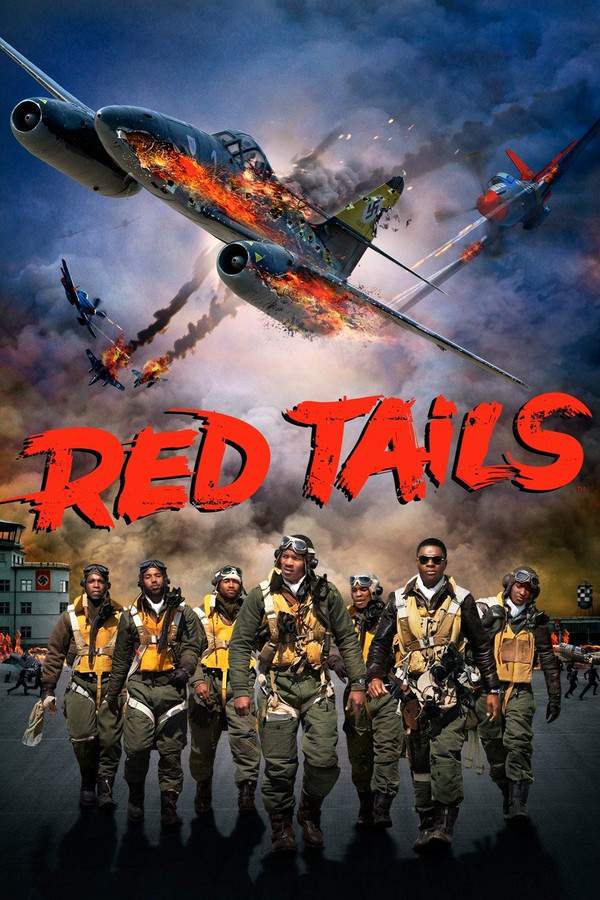
Red Tails (2012) Full Movie Breakdown
Flyboys (2006) Detailed Story Recap
Come Out Fighting (2023) Full Summary & Key Details
The Great War (2019) Plot Summary & Ending Explained
The Bloody Hundredth (2024) Story Summary & Characters
The War Lover (1962) Full Movie Breakdown
Flying Tigers (1942) Story Summary & Characters
Men of the Sky (1942) Movie Recap & Themes
Toward the Unknown (1956) Complete Plot Breakdown
The Eagle and the Hawk (1933) Story Summary & Characters
Air Cadet (1951) Story Summary & Characters
A Gathering of Eagles (1963) Complete Plot Breakdown
The Starfighters (1964) Detailed Story Recap
Masters of the Air (1000) Ending Explained & Film Insights
Fighter Squadron (1948) Spoiler-Packed Plot Recap