





Plot Explained Spoilers guaranteed!
Plot Explained

Browse by genre

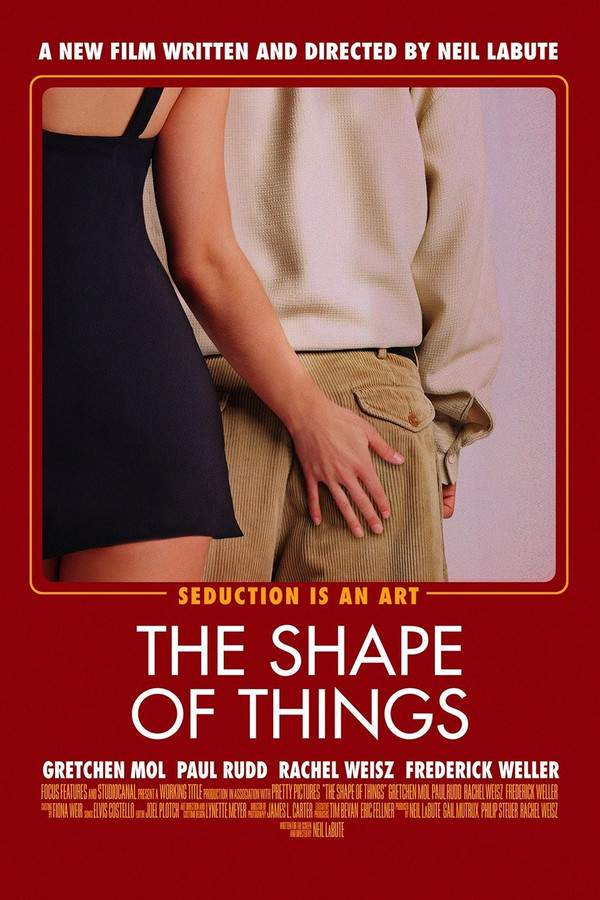
The Shape of Things (2003) movie poster

Plot Summary

The Shape of Things (2003) Plot Summary Explained

Release, runtime and language
2003 · 96 min · English
Directed by
Neil LaBute
Starring
Rachel Weisz, Fred Weller, Paul Rudd, Gretchen Mol, Frederick Weller

A college student becomes involved with a charismatic and manipulative young woman, leading to a complex and unsettling relationship. As Adam grows increasingly drawn to Evelyn, their connection deeply affects his friends and challenges his sense of self. The drama explores themes of love, art, and identity, revealing the potential for manipulation and the fragility of personal boundaries. The unfolding events create a tense and emotionally charged atmosphere, testing the limits of friendship and self-discovery.

On this page (7)
  1. 1 Where to watch
  2. 2 What happens: full plot
  3. 3 Plot questions answered
  4. 4 The book behind the movie
  5. 5 Movie threads
  6. 6 Movies like The Shape of Things
  7. 7 Every angle

Where to watch

Where to Watch The Shape of Things (2003)

Where can you watch The Shape of Things? Stream, rent or buy it in the US, including on Amazon Video, Apple TV Store and Fandango At Home: current JustWatch availability with up-to-date prices.

Streaming availability powered by JustWatch

Full plot summary · contains spoilers

What Happens in The Shape of Things: Full Plot Summary

The whole story of The Shape of Things (2003) explained, from the opening scene to the final frame: every key event, every twist and what it all adds up to. Read it as a quick recap before the sequel, to check a scene you missed, or to finally understand what really happened.

Adam is a student majoring in English Literature at Mercy College, a fictional institution in the Midwest, yearning for excitement beyond his mundane routine of classes and studying. His life takes a drastic turn when he unexpectedly meets Evelyn, a captivating graduate art student, at the local museum where he is employed. This chance encounter fills Adam, the socially awkward and nerdy student, with flattery when Evelyn expresses interest in him.

Under her influence, Adam embarks on a new lifestyle that includes a rigorous exercise regimen, a healthier diet, and the switch from glasses to contact lenses. These initial transformations earn him praise from his friend Phillip and his girlfriend Jenny. However, as time progresses, Evelyn persuades Adam to undergo plastic surgery and convinces him to sever ties with Phillip, Jenny, and all his previous friendships, asserting that she is his only true friend.

As their relationship deepens, Adam decides to propose to Evelyn, who readily accepts. But the climax reveals a shocking truth: Adam has unknowingly been a part of Evelyn's Master of Fine Arts thesis project. Throughout the film, Evelyn refers to her project involving the instruction to "change the world," ultimately deciding to reshape "someone's world"—specifically, Adam's. She has been "sculpting" him into a more desirable version of himself.

Evelyn's true nature surfaces when she unveils Adam to an audience of students and faculty, branding him her "creation," which leaves him deeply embarrassed. It becomes evident that her affection for him has been insincere; their romantic moments were merely documentation for her project. At the opening of her gallery, Evelyn announces to a live audience that she will not marry Adam, revealing that the engagement ring was merely part of her art exhibit.

Devastated and humiliated, Adam confronts Evelyn, seeking an explanation for her betrayal. With chilling indifference, she tells him he should be thankful to her for making him more appealing and interesting in the societal landscape. Finally realizing the true colors of the manipulative Evelyn, Adam rejects her. Evelyn coldly remarks that there was never a relationship to end.

In the poignant conclusion, a heartbroken Adam finds himself alone amidst the remnants of his previous life. His former friends, Philip and Jenny, also condemn him, refusing to forgive his abandonment. In a moment of introspection, he views a segment of a camcorder tape from earlier in the film, replaying the moment when Evelyn whispered what she called the singular truth of their relationship. The film concludes with Adam continuously rewind, listening to her words, trapped in the echoes of what was once a false promise.

Last updated: November 03, 2024 at 21:22

Was this helpful?

Plot questions answered

The Shape of Things Plot Explained: Your Questions Answered

The questions people ask most about The Shape of Things (2003): what happens in the confusing scenes, why the characters do what they do, the twists, hidden details and what the ending means. Each answer contains spoilers.

Q1

Why did Evelyn choose Adam for her art project?

Evelyn selected Adam because he was the perfect subject for her MFA thesis on manipulation and transformation. As a socially awkward, nerdy English Literature student with low self-esteem, Adam was vulnerable and easily influenced. His longing for excitement and validation made him susceptible to her attention. Evelyn specifically wanted someone whose world could be dramatically reshaped to demonstrate her artistic concept of 'changing the world' through manipulating another person.

  • evelyn
  • adam
  • mfa thesis
  • manipulation
  • art project
  • vulnerability
Q2

What was Evelyn's Master of Fine Arts thesis project about?

Evelyn's MFA thesis was titled 'Change the World' and involved reshaping someone's world, in this case, Adam's. She documented every aspect of their relationship, from his physical transformation (glasses to contacts, exercise, diet, plastic surgery) to his social isolation from friends. The entire romantic relationship was part of her artistic experiment, with the engagement ring itself being a prop for her gallery exhibit.

  • mfa thesis
  • art project
  • gallery exhibit
  • change the world
  • documentary
Q3

What did Evelyn whisper to Adam on the camcorder tape?

The film never reveals the exact words Evelyn whispered, but it is referred to as 'the singular truth' of their relationship. This mystery serves the film's themes of manipulation and deception. Adam repeatedly rewinds the tape trying to understand what she said, suggesting it was either a final cruel revelation or a moment of apparent sincerity that he is now desperately trying to decode.

  • camcorder tape
  • singular truth
  • whisper
  • ending
Q4

Why did Adam agree to abandon his friends Phillip and Jenny?

Adam severed ties with his old friends because Evelyn convinced him they were holding him back from becoming his 'true self.' She positioned herself as his only true friend and isolated him psychologically. Adam, desperate for validation and believing he was undergoing genuine personal growth, chose to trust Evelyn over people who actually cared about him. This isolation was essential to her experiment.

  • phillip
  • jenny
  • isolation
  • manipulation
  • friendship
  • abandonment
Q5

Why won't Phillip and Jenny forgive Adam after he abandons them?

Phillip and Jenny refuse to forgive Adam because his abandonment was devastating and complete. He didn't just distance himself, he fully rejected years of friendship under Evelyn's influence, choosing her over everyone who genuinely cared for him. Their refusal reflects the film's dark theme: Adam's transformation came at the cost of authentic relationships, and trust, once broken this severely, cannot be easily repaired.

  • phillip
  • jenny
  • friendship
  • forgiveness
  • betrayal
  • isolation
Q6

Why did Adam agree to undergo plastic surgery?

Adam agreed to plastic surgery because Evelyn convinced him it was necessary for his transformation. She framed it as part of becoming a 'better' version of himself, appealing to his deep-seated insecurity. The surgery represents the complete physical manifestation of Evelyn's manipulation, she literally reshaped his body as her artistic creation, treating him as clay to be sculpted.

  • plastic surgery
  • transformation
  • body modification
  • sculpting
Q7

What does Evelyn mean when she says there was never a relationship?

When Evelyn says there was never a relationship to end, she means every romantic moment was calculated performance for her artistic documentation. The kisses, the intimacy, the acceptance of his proposal, none of it was genuine. To her, Adam was a subject, not a partner. She views their entire connection as an art project, not a relationship, which is why she could reveal him publicly without remorse.

  • relationship
  • love
  • deception
  • art
  • manipulation
  • exploitation
Q8

Why does Adam keep rewinding the tape at the end of the film?

Adam continuously rewinds the tape because he is desperately trying to understand what was real. The tape represents the illusion of their relationship, he wants to find meaning or sincerity in Evelyn's words, but his obsessive rewind signifies his psychological entrapment. He is literally and metaphorically stuck in the past, unable to move forward from the deception.

Foreshadowing: Earlier scenes show Adam recording their relationship, not realizing he was being used as documentary material.

  • tape
  • rewind
  • ending
  • psychological trap
  • memories
  • obsession
Q9

What was the significance of the engagement ring being part of the art exhibit?

The engagement ring was a prop in Evelyn's gallery exhibit, not a symbol of genuine commitment. By displaying it as art, Evelyn reduced Adam's most intimate gesture to another element of her manipulation. This public humiliation at the gallery opening, where she announced she would not marry him, was the ultimate degradation, reducing their entire engagement to a clever piece of conceptual art.

  • engagement ring
  • gallery
  • exhibit
  • humiliation
  • proposal
Q10

Why did Evelyn want to change Adam so drastically?

Evelyn wanted to change Adam to prove her artistic thesis that art can 'change the world' by reshaping an individual. She viewed him as raw material to be transformed into something she considered more appealing. Her justification, that she made him 'more interesting' and 'more appealing in the societal landscape', reveals her coldly utilitarian view of people as subjects for artistic experimentation.

  • transformation
  • art thesis
  • change
  • manipulation
  • identity
Q11

What does the film say about art and ethical boundaries?

The film presents a dark critique of artistic ethics, suggesting that using real people as art subjects without consent crosses a fundamental moral line. Evelyn treats Adam as a canvas rather than a person, and her defense, that she made him 'better', raises questions about whether art justifies manipulation. The film implies that art, when detached from ethical constraints, becomes a vehicle for exploitation.

  • art ethics
  • manipulation
  • exploitation
  • artistic integrity
  • boundaries

Movie threads

More Movies Like The Shape of Things, by Mood & Story

Curated lists built around what makes The Shape of Things tick: the same mood, the same kind of story or the same emotional payoff. Each list explains why these movies belong together.

Movies about Cruel Art and Manipulation like The Shape of Things

Stories where creative expression becomes a tool for manipulation and emotional violence. If you found the psychological manipulation in The Shape of Things compelling, explore other movies where art, performance, or intellectual concepts become tools for cruelty. These similar drama and thriller stories focus on identity, deception, and the unsettling power dynamics within toxic relationships.

  • unsettling
  • manipulative
  • psychological
  • cold
  • intellectual
  • humiliating
  • Tone: dark, unsettling, cold
  • Pacing: steady, methodical
Why these movies?

The story pattern: Narratives in this thread often center on a charismatic but morally ambiguous figure who draws a less-assertive individual into their world under the guise of art or self-improvement. The story methodically chronicles the erosion of the protagonist's identity, using artistic or philosophical justifications for what is essentially a process of psychological domination, culminating in a revelation of profound betrayal.

Why they belong together: These movies are grouped together by their shared thematic focus on the destructive potential of artistry. They create a similar feeling of intellectual unease and emotional violation, where the line between creation and cruelty is deliberately blurred, and trust is shattered in the name of a concept.
Character Studies of Identity Loss like The Shape of Things

Character studies where a person's sense of self is systematically dismantled by another. For viewers who appreciated the intense character transformation in The Shape of Things, this section collects movies with similar slow-burn narratives about identity erosion. Discover other dramatic stories featuring psychological manipulation, toxic relationships, and the bleak aftermath of personal deconstruction.

  • anxious
  • claustrophobic
  • isolating
  • manipulative
  • unsettling
  • psychological
  • Tone: dark, anxious, bleak
  • Pacing: steady, deliberate slow burn
Why these movies?

The story pattern: The narrative pattern follows a protagonist, often insecure or impressionable, who enters a relationship that promises transformation. The story unfolds with a steady, deliberate pace, charting the incremental changes the protagonist undergoes—sacrificing friendships, altering their appearance, and adopting new values—all orchestrated by their partner. The climax reveals the hollow nature of this transformation, leaving the protagonist isolated and stripped of their original identity.

Why they belong together: These films share a core focus on the psychological arc of identity loss. They create a similar, deeply uncomfortable mood of watching a person be remade, generating tension from the inevitable collapse and delivering a heavy emotional impact through the protagonist's ultimate alienation.

If you liked this

Movies Like The Shape of Things

Similar movies to The Shape of Things: the same genre, themes or kind of story. Each one comes with its own plot summary, timeline and ending explained.

Browse all movie summaries

Every angle

The Shape of Things (2003) Explained: Plot, Timeline & Characters

Everything about The Shape of Things in one place: what happens in the plot summary, the timeline in chronological order, the characters and meaning and a spoiler-free summary. What's After the Movie adds the cast, box office and post-credit scenes.

Coming soon on iOS and Android

The Plot Explained Movie Summary App

Plot summaries, endings explained and timelines on your phone. Catch up on any movie in minutes, save your favorites and never miss a twist again.

Be the first to know when we launch. Your email stays private, always.

Learn more about the app