Plot Explained Spoilers guaranteed!
Plot Explained

Browse by genre

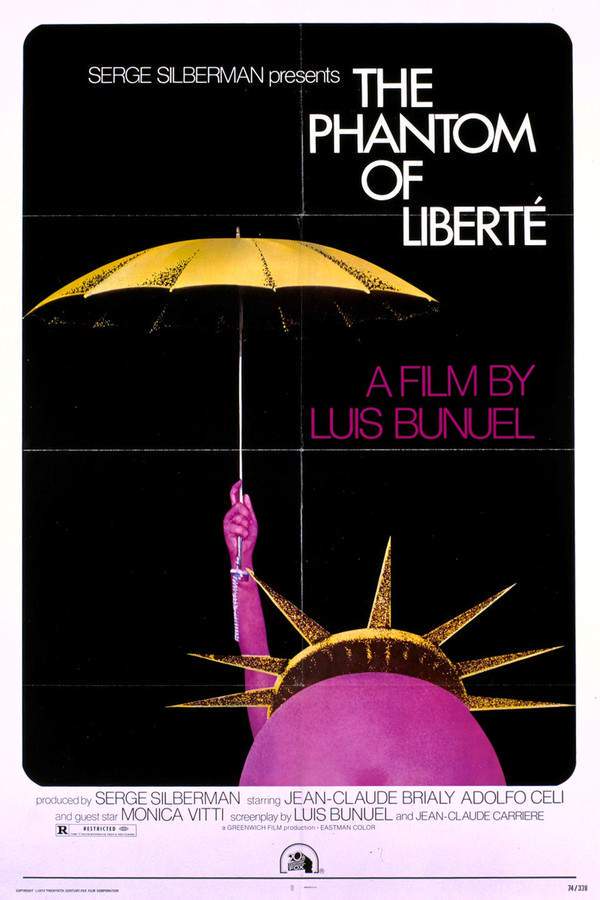
The Phantom of Liberty (re-release) (2002) movie poster

Timeline

The Phantom of Liberty (re-release) (2002) Timeline Explained – Every Event in Order

Release, runtime and language
2002 · 104 min · French
Directed by
Luis Buñuel
Starring
Adolfo Celi, Jean-Claude Brialy, Michel Piccoli, Monica Vitti

This subversive comedy-drama from Luis Buñuel presents a series of surreal and loosely autobiographical vignettes spanning centuries. A dying patriarch and inept authorities are among the diverse characters whose lives intersect in unexpected ways. The film explores taboo subjects such as mortality, morality, and the complexities of the human condition through a tapestry of chance encounters and dreamlike sequences.

On this page (5)
  1. 1 Events in order (16)
  2. 2 Timeline questions answered
  3. 3 Movie threads
  4. 4 Movies like The Phantom of Liberty (re-release)
  5. 5 Every angle

16 events in order · contains spoilers

The Phantom of Liberty (re-release) Timeline: Events in Chronological Order

Every key event of The Phantom of Liberty (re-release) (2002) in order, scene by scene, with when and where it takes place. Use it to untangle flashbacks, time jumps and parallel storylines, to refresh your memory before the sequel or to find the exact scene you are thinking of.

  1. Auction at the Paris Opera House

    The film opens with a poignant auction at the Paris Opera House, which is currently closed. Various props are sold to raise funds, including a striking stuffed monkey dressed in Persian robes purchased by an older man in a wheelchair.

    Where
    Paris Opera House
  2. Flashback to 1870

    As the auction progresses, the scene transitions back to 1870, showcasing a lively performance of 'Hannibal' by Chalemau. The vibrant atmosphere highlights the grandeur of the opera during its golden age.

    When
    1870
    Where
    Paris Opera House
  3. Opera Manager's Departure

    The opera manager announces his unexpected departure to Australia, leaving the Opera House under the management of Gilles André and Richard Firmin. This change in leadership sets the stage for the ensuing chaos.

    Where
    Paris Opera House
  4. Carlotta's Outburst

    During the new management's first rehearsal, a prop falls on the lead diva, Carlotta, igniting her fury and prompting her to storm out. This incident causes a ripple effect, forcing the managers to find a replacement for her role.

    Where
    Paris Opera House
  5. Christine Daaé Takes the Spotlight

    Madame Giry persuades André and Firmin to cast Christine Daaé, a gifted dancer, as the replacement for Carlotta. Christine's debut performance of 'Think of Me' captivates the audience and marks her rise to fame.

    Where
    Paris Opera House
  6. Christine's Prayer

    After her performance, Christine retreats to a chapel beneath the Opera House to pray for her late father, feeling the weight of his absence. She is joined by her best friend Meg, who expresses curiosity about Christine's newfound singing talent.

    Where
    Chapel beneath the Opera House
  7. Raoul's Visit

    Christine's childhood friend, Raoul, visits her dressing room after recognizing her from the audience. He invites her to a party, but Christine finds herself locked in her room, a situation that sparks the Phantom's jealousy.

    Where
    Christine's Dressing Room
  8. The Phantom's Lair

    The Phantom, incensed by Raoul's influence, draws Christine to his lair behind a mirror. In a hauntingly beautiful moment, he confesses his feelings for her during 'Music of the Night,' revealing both his passion and vulnerability.

    Where
    Phantom's Lair
  9. Phantom's Demands

    Ignoring the Phantom's ominous notes demanding Christine's starring role, André and Firmin decide to rehire Carlotta. This decision backfires when the Phantom curses Carlotta's voice, leading the managers to reluctantly elevate Christine.

    Where
    Paris Opera House
  10. The Tragic Death of Joseph Buquet

    As tensions rise, Joseph Buquet uncovers the Phantom's secret but meets a grisly fate, being hanged in front of an audience. This tragic event deeply frightens Christine and propels her to the Opera House roof, where she seeks solace.

    Where
    Paris Opera House
  11. Raoul's Declaration of Love

    On the roof, Raoul professes his unwavering love for Christine, promising to always protect her. This heartfelt moment is overheard by the Phantom, shattering his hopes and igniting feelings of jealousy.

    Where
    Roof of the Opera House
  12. Masquerade Ball and Ultimatum

    Three months later, the Opera House buzzes with activity until the Phantom crashes a vibrant masquerade ball. He presents his new opera, 'Don Juan,' issuing a stern ultimatum to the managers, instilling fear among them.

    Where
    Paris Opera House
  13. Confrontation at Christine's Father's Grave

    Following the ball, Christine visits her father’s grave, where she encounters the Phantom once again. The encounter escalates into a confrontation when Raoul intervenes, leading to a dramatic sword fight.

    Where
    Graveyard
  14. The Final Performance

    During the dramatic performance of 'Don Juan,' the Phantom reveals himself on stage after committing murder. He performs alongside Christine, leading to an emotional revelation of her feelings and a tragic sequence of events.

    Where
    Opera House Stage
  15. The Heart-Wrenching Choice

    At the climax of the story, the Phantom presents Christine with a heart-breaking choice: stay with him or save Raoul. Choosing compassion, Christine kisses the Phantom and leaves with Raoul, breaking the Phantom's heart.

    Where
    Phantom's Lair
  16. Raoul's Rememberance

    The story concludes in 1919, focusing on an older Raoul visiting Christine’s grave. He leaves the music box monkey and discovers a rose tied with a black ribbon, symbolizing the Phantom’s enduring love and Christine's true affections.

    When
    1919
    Where
    Christine's Grave

Last updated: November 16, 2024 at 15:06

Was this helpful?

Timeline questions answered

The Phantom of Liberty (re-release) Timeline Explained: Your Questions Answered

When does it happen, and why in that order? The questions people ask about the chronology of The Phantom of Liberty (re-release) (2002): time jumps, flashbacks, cause and effect between scenes and the correct order of events, each answered with spoilers.

Q1

Why does the Phantom become obsessed with Christine Daaé?

The Phantom is drawn to Christine because she is the first person in years who treats him with kindness rather than revulsion. When Christine unmask him and sees his grotesque face, she does not scream in horror but instead expresses compassion, which deeply affects him. Additionally, Christine's voice represents the beauty and acceptance the Phantom has been denied his entire life due to his disfigurement.

Foreshadowing: Earlier, the Phantom tells Christine she is his 'angel of music,' revealing his desperate need for connection.

  • phantom
  • christine
  • obsession
  • love
  • disfigurement
  • rejection
Q2

Why does the Phantom kill Joseph Buquet?

Joseph Buquet discovers the Phantom's secret hideout beneath the Opera House. The Phantom kills him to prevent this knowledge from spreading and to maintain control over the Opera. Buquet had been threatening to expose the Phantom's identity and blackmail him, making him a dangerous liability.

Foreshadowing: Buquet had been suspiciously asking questions about the Phantom throughout the story.

  • joseph buquet
  • phantom
  • murder
  • secret lair
  • exposure
Q3

Why does Christine kiss the Phantom before leaving?

Christine kisses the Phantom to show him compassion and acknowledge his love for her. She realizes that despite his horrific actions, his feelings were genuine. The kiss is an act of mercy, a moment of genuine human connection before she leaves him forever. It represents her gratitude for his sacrifices and her acknowledgment that he is not simply a monster.

Foreshadowing: The Phantom's earlier breakdown when he unmasks shows his vulnerability and desperate need for acceptance.

  • christine
  • phantom
  • kiss
  • mercy
  • compassion
  • farewell
Q4

What does the rose with the black ribbon at Christine's grave mean?

The rose symbolizes the Phantom's enduring, obsessive love for Christine even after her death. The black ribbon represents mourning and the tragic nature of their relationship. The Phantom continued to visit her grave long after the events at the Opera House, proving his love was not merely obsession but genuine, if twisted, devotion that transcended her lifetime.

Foreshadowing: The Phantom's final selfless act of freeing Christine and Raoul demonstrates his capacity for true love.

  • rose
  • black ribbon
  • phantom
  • christine
  • grave
  • symbolism
  • love
Q5

Why does the Phantom curse Carlotta's voice?

The Phantom curses Carlotta's voice to punish the managers for ignoring his demands. When André and Firmin attempted to replace Christine with Carlotta despite the Phantom's explicit warnings, he used supernatural means to make Carlotta's voice sound like a toad. This was meant to demonstrate his power and force them to comply with his wishes to have Christine star in the lead role.

Foreshadowing: The Phantom had sent multiple notes marked 'O.G.' demanding Christine receive the role.

  • carlotta
  • phantom
  • curse
  • voice
  • opera managers
  • punishment
Q6

Why does the Phantom let Christine and Raoul escape at the end?

The Phantom releases them because he realizes that trapping Christine would only perpetuate his loneliness. His love for her is genuine, and he comes to understand that forcing her to stay would make her hate him, exactly what he feared most. By letting them go, he demonstrates that his love is selfless rather than possessive, choosing her happiness over his own desperate need for companionship.

Foreshadowing: The Phantom tells Christine she is free when she shows him compassion, revealing his capacity for self-sacrifice.

  • phantom
  • christine
  • raoul
  • freedom
  • sacrifice
  • release
  • love
Q7

What is the significance of the music box monkey?

The music box monkey represents the Phantom's only connection to love and companionship throughout his isolated life. He purchased it at the auction at the beginning, holding it close like a cherished companion. Later, Raoul discovers the monkey at Christine's grave, revealing the Phantom had been visiting her grave for years, leaving tokens of his enduring love. The monkey serves as a symbol of the Phantom's loneliness and his need for connection.

Foreshadowing: The old man in the wheelchair clutches the monkey tightly at the auction, showing its emotional importance from the start.

  • music box
  • monkey
  • phantom
  • auction
  • christine
  • grave
  • symbol
Q8

Why does the Phantom reveal his face to the audience during the performance?

The Phantom reveals his face during the performance of Don Juan as a final act of defiance and truth. Having killed Piangi and taken his place on stage, the Phantom removes his mask to show his true self to the world without fear. He is tired of hiding and wants everyone to see who he really is, embracing his identity as the outcast rather than continuing to live in shadows. This moment represents his complete rejection of societal standards of beauty and his acceptance of his own monstrosity.

Foreshadowing: Earlier, the Phantom tells Christine he wishes he didn't have a 'loathsome gargoyle face,' showing his internal struggle with his appearance.

  • phantom
  • face
  • reveal
  • audience
  • don juan
  • performance
  • disfigurement
Q9

What do the 'O.G.' notes from the Phantom mean?

'O.G.' stands for 'Opera Ghost,' the pseudonym the Phantom uses to send his threatening letters to the managers. These notes contain his demands, primarily that Christine must be given the lead role in upcoming productions. The signature establishes his identity as the mysterious figure controlling events from behind the scenes at the Opera House.

Foreshadowing: The notes become increasingly threatening as the managers ignore his demands.

  • o.g.
  • opera ghost
  • notes
  • phantom
  • demands
  • threats
Q10

Why does Christine accept the Phantom's mentorship?

Christine accepts the Phantom's mentorship because she believes he is the 'Angel of Music' her dying father promised would watch over her. She is vulnerable after her father's death and desperately wants to believe his spirit is guiding her. The Phantom uses this promise to manipulate her, presenting himself as her spiritual mentor while developing romantic feelings for her.

Foreshadowing: Christine prays in the chapel asking her father to help her, and the Phantom appears shortly after.

  • christine
  • phantom
  • angel of music
  • father
  • tutorship
  • mentorship
Q11

Why does Raoul leave the music box at Christine's grave in 1919?

Raoul leaves the music box as a final act of respect and closure. Having learned from the Phantom's note that Christine truly loved him, Raoul honors her memory by returning the object that symbolized her connection to the Phantom. It represents his acceptance that their love story was always more complicated than he understood, and his gesture acknowledges the Phantom's genuine devotion.

Foreshadowing: The older Raoul at the auction knows exactly what the music box means, showing his long-standing connection to these events.

  • raoul
  • music box
  • christine
  • grave
  • 1919
  • closure
  • final goodbye
Q12

Why does the Phantom crash the masquerade ball?

The Phantom crashes the masquerade ball to assert his dominance over the Opera House and deliver his ultimatum in person. He presents his own opera, Don Juan, demanding the managers stage it and give Christine the lead role. This public appearance is meant to humiliate the managers and prove he can access any part of the Opera whenever he wishes, solidifying his control.

Foreshadowing: The Phantom's earlier notes had been ignored, so he escalates to a direct, confrontational approach.

  • phantom
  • masquerade ball
  • ultimatum
  • opera don juan
  • dominance

Movie threads

More Movies Like The Phantom of Liberty (re-release), by Mood & Story

Curated lists built around what makes The Phantom of Liberty (re-release) tick: the same mood, the same kind of story or the same emotional payoff. Each list explains why these movies belong together.

Surreal Vignette Films like The Phantom of Liberty (re-release)

Films that weave disconnected, dreamlike stories into a subversive commentary on society. If you enjoyed the dreamlike, episodic structure of The Phantom of Liberty (re-release), explore other movies that use surreal, disconnected vignettes to satirize society and explore the human condition. These films share a similar subversive and philosophical spirit.

  • surreal
  • satirical
  • dreamlike
  • philosophical
  • absurd
  • disconnected
  • Tone: whimsical, melancholic
  • Pacing: steady, contemplative
Why these movies?

The story pattern: Films in this thread often abandon traditional plot in favor of a series of semi-autonomous scenes or chapters. The overall narrative emerges from the thematic connections between these vignettes, which collectively critique morality, authority, and the randomness of existence through a lens of dark humor and surrealism.

Why they belong together: These films are grouped together due to their shared structural approach of fragmented storytelling and their thematic focus on satirizing societal conventions. They create a unique, intellectual viewing experience defined by unexpected connections and a dreamlike logic.

Melancholic Drama Movies like The Phantom of Liberty (re-release)

Character-driven dramas that explore dark themes with a heavy, bittersweet heart. For viewers who appreciated the heavy emotional weight and exploration of taboo themes in The Phantom of Liberty (re-release), this section features similar character-driven dramas with a melancholic tone and bittersweet conclusions.

  • melancholic
  • tragic
  • philosophical
  • heavy
  • bittersweet
  • dramatic
  • Tone: melancholic, bittersweet
  • Pacing: steady, deliberate
Why these movies?

The story pattern: Stories in this thread follow characters grappling with profound personal and existential crises. The plots are driven by internal conflict and moral dilemmas rather than external action, often building towards a climax of sacrifice or acceptance that leaves a lasting, complex emotional residue.

Why they belong together: These movies are united by their serious engagement with challenging themes, a consistently melancholic atmosphere, and a narrative focus on the human condition. They provide a deeply immersive, emotionally heavy experience that resonates on a philosophical level.

If you liked this

Movies Like The Phantom of Liberty (re-release)

Similar movies to The Phantom of Liberty (re-release): the same genre, themes or kind of story. Each one comes with its own plot summary, timeline and ending explained.

Browse all movie summaries

Every angle

The Phantom of Liberty (re-release) (2002) Explained: Plot, Timeline & Characters

Everything about The Phantom of Liberty (re-release) in one place: what happens in the plot summary, the timeline in chronological order, the characters and meaning and a spoiler-free summary. What's After the Movie adds the cast, box office and post-credit scenes.

Coming soon on iOS and Android

The Plot Explained Movie Summary App

Plot summaries, endings explained and timelines on your phone. Catch up on any movie in minutes, save your favorites and never miss a twist again.

Be the first to know when we launch. Your email stays private, always.

Learn more about the app