Plot Explained Spoilers guaranteed!
Plot Explained

Browse by genre

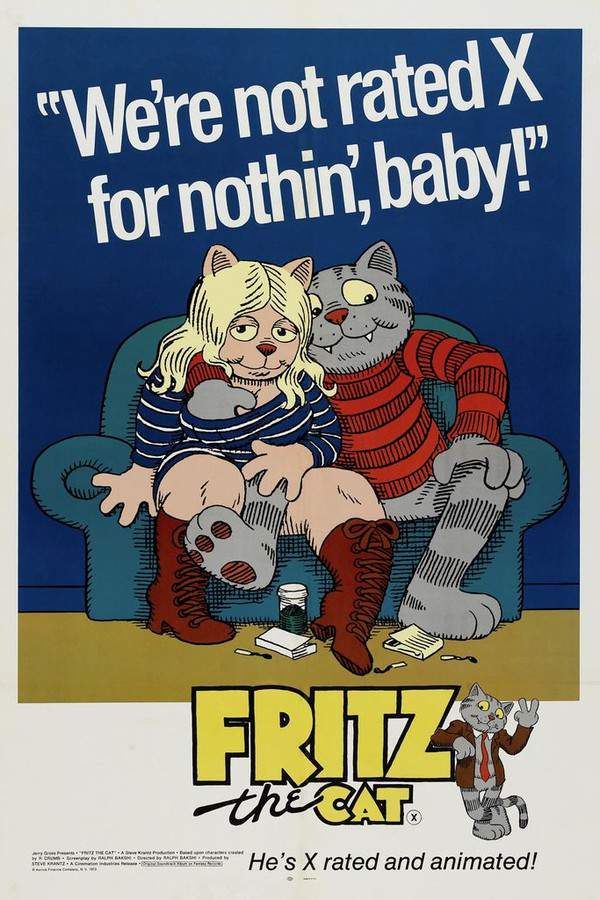
The Nine Lives of Fritz the Cat (1974) movie poster

Plot Summary

The Nine Lives of Fritz the Cat (1974) Plot Summary Explained

Release, runtime and language
1974 · 77 mins · English
JustWatch #5,952 10
Directed by
Robert Taylor
Starring
Glynn Turman, Peter Hobbs, Stanley Adams, Felton Perry, Louisa Moritz, Skip Hinnant

“I’ve Come a Long Way, Baby!” Fritz, now married and with a son, feels trapped in a domestic hell. He lights a joint, and the smoke carries him through vivid recollections of the eight other lives he’s lived, each a different adventure that might offer a welcome distraction from his current routine.

On this page (6)
  1. 1 Where to watch
  2. 2 What happens: full plot
  3. 3 Plot questions answered
  4. 4 Movie threads
  5. 5 Movies like The Nine Lives of Fritz the Cat
  6. 6 Every angle

Where to watch

Where to Watch The Nine Lives of Fritz the Cat (1974)

Where can you watch The Nine Lives of Fritz the Cat? Stream, rent or buy it in the US, including on ScreenPix Amazon Channel , Amazon Video and Apple TV Store: current JustWatch availability with up-to-date prices.

Streaming availability powered by JustWatch

Full plot summary · contains spoilers

What Happens in The Nine Lives of Fritz the Cat: Full Plot Summary

The whole story of The Nine Lives of Fritz the Cat (1974) explained, from the opening scene to the final frame: every key event, every twist and what it all adds up to. Read it as a quick recap before the sequel, to check a scene you missed, or to finally understand what really happened.

In the 1970s, Fritz has just graduated from college, but life after school isn’t what he hoped for: he’s married, hovering on unemployment, and father to a son named Ralphie who is learning to navigate his own curious distractions. His wife, Gabrielle, calls him out on his irresponsibility, and in response, [Fritz] slips into cannabis-fueled reveries that launch a sequence of wild, incongruent lives. What begins as a private escape spirals into a sprawling, mosaic vision of choices and consequences that test the boundaries between dream and reality.

First life. In this opening thread, [Fritz] meets his Puerto Rican friend Juan, a man who lives with his sister, Chita, in a cramped house. Their conversation about Juan’s sister quickly turns personal, and Chita muses aloud about the cannabis odor. Despite the tension, she capitulates and lights up, drawn in by the same escape hatch Fritz has chosen. The moment deepens as the drug heightens sensation, and the two share a charged encounter under the gaze of a pair of crows perched outside the window, who are poised to rob the house but choose to watch the scene unfold instead. The intimacy is abruptly interrupted when Chita’s father bursts in and shoots Fritz, a violent turn that sends the crows fleeing and marks the first brutal note in this kaleidoscopic journey.

Second life. The next frame follows Fritz into a surreal encounter with a drunken bum who proclaims himself to be God, a jarring contrast to the ordinary grievances of his first life and hinting at the grander, more cynical scale of the visions to come.

Third life. The mood shifts again as Fritz becomes a soldier in Nazi Germany. Captured during a ménage à trois with a commanding officer’s wife and daughter, he escapes and ends up serving as an orderly to Adolf Hitler. In a startling turn, Fritz adopts the guise of a therapist and begins to analyze Hitler, suggesting that his world-dominating ambitions were driven by a desperate need for attention. In the showers, a dangerous moment escalates, and Hitler attempts to rape him, only for Fritz to survive a brutal confrontation that ends when a single testicle is blown off. Fritz is ultimately killed by an American tanker, a grim pivot in his sprawling odyssey.

Fourth life. The fourth chapter finds Fritz attempting to hawk a used condom to a liquor-store owner named Niki. Their conversation reveals that Fritz’s sexual history has left a mark on Niki’s life as well, as Niki’s wife has contracted gonorrhea from Fritz in a past encounter. The scene shifts quickly, and Fritz remarks, with a rueful bravado, about his glory days as a sexual “stud” in the 1930s, a memory that underscores the debauchery threading through these episodes.

Fifth life. A rapid, psychedelic montage follows—old stock footage and animation collide to illustrate Fritz’s fall from grace in the 1930s, a period of excess and dissolution that seems to erase boundaries between history and his own deteriorating self.

Sixth life. Fritz’s gambit with welfare cash takes an absurd turn when he visits Morris, a Jewish pawnshop owner who is literally a toad. Fritz proposes a deal: if Morris will cash the welfare check, Fritz will trade him a toilet seat. Morris initially refuses, but a sudden diarrhea attack (triggered by pickle-induced stomach upset) pushes him to accept a trade. The payoff is not cash but a space helmet, and Fritz’ dream of conquest survives only as a fantasy.

Seventh life. The space-age fantasy then unfolds: Fritz envisions himself as a NASA astronaut preparing for a mission to Mars. An interview with journalists leads to an odd choice—Fritz invites a crow reporter into the space shuttle to share a private moment, and the mission lifts off far earlier than planned, only to fracture and explode in space.

Eighth life. In a bleak, far-future turn, Fritz encounters the ghost of his deceased friend Duke. The world he navigates grows stranger still as Henry Kissinger appears as a rat and becomes president, granting independence to New Jersey, which is renamed "New Africa." Fritz works as a courier and is tasked with delivering a letter to the president of this imagined nation. In the Black House, the vice president assassinates the president and frames Fritz for the crime, triggering a war between America and New Africa. Kissinger surrenders unconditionally, and Fritz is executed, another brutal reminder of how this multilayered dream critiques power and fate.

Final life. The last sequence sinks Fritz into the sewers of New York, where he meets an Indian guru and Lucifer himself—a purple cat with wings, horns, and a devilish tail—an emblem of the deepest temptations and fears that haunt his psyche. It’s only when Gabrielle interrupts this vision that Fritz is pulled back to reality. She shouts him back to the present, ultimately tossing him out of the apartment to begin repairing their fractured family. After a rapid survey of all the lives he has lived, Fritz recognizes that this final, ordinary life may be the hardest to salvage—yet it is the one that offers a chance to rethink his responsibilities as a father and husband.

Reflections through all these vignettes reveal a single throughline: a man oscillating between escape and accountability, between the memory of his better days and the consequences of his choices. The film uses a mosaic of eras, styles, and bodies to question how much our imagined selves shape the paths we actually walk, and whether a single life of restraint can outshine a dozen lives spent chasing desire, power, and illusion. And through Fritz’s ordeal, the narrative invites viewers to contemplate what it means to grow up, to own one’s mistakes, and to seek redemption within the pressures of family life.

Last updated: October 07, 2025 at 08:54

Was this helpful?

Plot questions answered

The Nine Lives of Fritz the Cat Plot Explained: Your Questions Answered

The questions people ask most about The Nine Lives of Fritz the Cat (1974): what happens in the confusing scenes, why the characters do what they do, the twists, hidden details and what the ending means. Each answer contains spoilers.

Q1

Why does Fritz experience nine different lives in the movie?

Fritz retreats into cannabis-fueled fantasies to escape his stagnant 1970s reality, being unemployed, married to Gabrielle, and feeling trapped as a father. Each of the nine lives represents a different imagined scenario his mind conjures while high, ranging from his encounters at Juan's house to surreal visions of Nazi Germany and a dystopian future. The mosaic structure shows Fritz cycling through wild escapist fantasies before being forced back to his real life.

Foreshadowing: The film opens with Fritz smoking cannabis while Gabrielle criticizes his irresponsibility, immediately establishing his pattern of escape.

  • nine lives
  • fritz
  • fantasies
  • cannabis
  • escape
Q2

Why is Fritz killed in the first life at Juan's house?

In the first life, Fritz persuades Chita to smoke cannabis with him and they have sex while a pair of crows watches from outside. The intimate moment is violently interrupted when Chita's father suddenly bursts in and shoots Fritz dead. The killing appears sudden and random, reflecting the chaotic, unpredictable nature of Fritz's fantasies, he experiences vivid scenarios that often end abruptly with brutal consequences.

Foreshadowing: The watching crows suggest impending violence, positioning them as observers of destructive outcomes.

  • chita
  • father
  • shooting
  • crows
  • juan
Q3

Why does Fritz become Hitler's orderly in the third life?

After being captured during a ménage à trois with a commanding officer's wife and daughter, Fritz escapes and finds himself serving as an orderly in Hitler's circle. He adopts the role of a therapist and analyzes Hitler, suggesting the dictator's world domination ambitions were driven by a desperate need for attention. This surreal sequence allows the film to critique power and examine how Fritz imagines himself in positions of significance, even when confronting historical monsters.

Foreshadowing: The shift to Nazi Germany early in the fantasy sequence signals the film's willingness to tackle dark historical satire.

  • hitler
  • nazi
  • germany
  • therapist
  • power
Q4

What happens between Fritz and Hitler in the shower?

In a tense shower scene, Hitler attempts to coerce Fritz into sexual assault by grabbing the soap provocatively. The confrontation escalates violently, ending with Hitler being maimed, his testicle is blown off. Fritz survives this shocking encounter but is later killed by an American tanker during the war. This scene uses dark humor to strip Hitler of his mythic power, portraying him as a desperate, degenerate figure.

Foreshadowing: The earlier analysis scene establishes Fritz as someone who believes he can understand and psychologically dissect powerful men.

  • hitler
  • shower
  • maiming
  • confrontation
Q5

What is the significance of the crows throughout Fritz's lives?

The crows appear in multiple lives as observers of Fritz's escapist fantasies, at Juan's house watching the intimate scene, and in the seventh life as a crow reporter Fritz invites into the space shuttle. They function as a recurring motif representing voyeurism, judgment, and the consequences Fritz cannot see while lost in his fantasies. Their presence connects disparate visions, suggesting Fritz is always being watched as he acts out his desires.

Foreshadowing: The crows first appear at Juan's house, establishing their role as constant observers of Fritz's destructive behavior.

  • crows
  • motif
  • observation
  • watchers
Q6

Why is Morris the pawnshop owner depicted as a toad?

Morris is a Jewish toad who runs a pawnshop in Fritz's sixth life. When Fritz tries to cash a welfare check by trading a toilet seat, Morris initially refuses. Only after suffering a diarrhea attack from eating pickles does Morris accept the absurd trade, giving Fritz a space helmet instead of cash. This surreal character embodies the film's wild tonal shifts and uses absurdist humor to critique economic desperation and Fritz's delusional schemes.

Foreshadowing: The transition from the 1930s downfall montage to this surreal scenario shows how Fritz's fantasies escalate from realistic to absurd.

  • morris
  • toad
  • pawnshop
  • space helmet
  • trade
Q7

What happens in the eighth life with New Africa?

In a dystopian future, Fritz witnesses Henry Kissinger depicted as a rat become president of New Africa, an independent New Jersey. Working as a courier, Fritz is framed for assassinating the president when the vice president kills the leader and blames Fritz. This triggers a war between America and New Africa, ending with Kissinger's unconditional surrender and Fritz's execution. The sequence satirizes political power, race, and American imperialism through absurdist speculation.

Foreshadowing: The film gradually escalates toward extreme political satire, with earlier lives building toward this dystopian critique.

  • new africa
  • kissinger
  • rat
  • president
  • war
Q8

Who is the purple cat in the final life?

In the sewers of New York, Fritz encounters Lucifer personified as a purple cat with wings, horns, and a devil-like tail, representing the deepest temptations and fears haunting his psyche. This figure embodies Fritz's darkest impulses and the consequences of his escapist fantasies. The meeting represents Fritz's descent into his own subconscious before being pulled back to reality by Gabrielle.

Foreshadowing: The sewer sequence follows the brutal execution in the eighth life, showing Fritz at his lowest psychological point.

  • lucifer
  • cat
  • sewers
  • temptation
  • fear
Q9

What brings Fritz back to reality at the end?

After experiencing all nine lives, including the surreal sewer encounter with Lucifer, Gabrielle snaps Fritz out of his cannabis-induced vision by shouting at him. She then throws him out of the apartment, forcing him to confront his real responsibilities as a husband and father. This moment breaks the fantasy cycle, returning Fritz to his difficult but fixable domestic reality.

Foreshadowing: The entire film builds toward this confrontation, with each fantasy serving as a prolonged avoidance of exactly this moment.

  • gabrielle
  • reality
  • awakening
  • family
  • responsibility
Q10

Does Fritz actually change by the end of the movie?

After experiencing all eight alternative lives, each ending in death, failure, or absurdity, Fritz returns to his real 1970s life and declares it the worst of all his lives. However, he vows to become a responsible father and husband. The ending is bittersweet: Fritz is forced to confront his responsibilities rather than escape into fantasy, though whether he'll genuinely change remains ambiguous. The film suggests redemption is possible but requires active effort, not just introspection.

Foreshadowing: The repeated pattern of violent or absurd deaths in every fantasy life demonstrates that escape never leads to fulfillment.

  • fritz
  • redemption
  • change
  • responsibility
  • growth
Q11

What is the fifth life montage about?

The fifth life is a rapid, psychedelic montage using old stock footage and animation to depict Fritz's downfall in the 1930s, a period of excess, drinking, and dissolution that erases boundaries between historical events and his deteriorating self. The sequence illustrates how Fritz lost everything through partying and bad decisions, establishing the pattern of self-destruction that informs his later fantasies about escaping his current life.

Foreshadowing: This montage connects the fourth life (where Fritz boasts about his 1930s prowess as a stud) to his actual historical decline.

  • 1930s
  • montage
  • stock footage
  • downfall
  • excess
Q12

Why does the space mission fail in the seventh life?

Fritz envisions himself as a NASA astronaut preparing for the first mission to Mars. During a pre-launch interview, he makes the absurd choice to invite a crow reporter into the space shuttle for a sexual encounter. The shuttle then launches prematurely and explodes in space, killing Fritz. This sequence parodies American optimism about space exploration while showing how Fritz's impulses and poor decisions sabotage even his grandest fantasies.

Foreshadowing: The space helmet trade from the previous life foreshadows this astronaut fantasy, showing Fritz's escalation from small schemes to cosmic ambitions.

  • space
  • mission
  • mars
  • crow
  • explosion

Movie threads

More Movies Like The Nine Lives of Fritz the Cat, by Mood & Story

Curated lists built around what makes The Nine Lives of Fritz the Cat tick: the same mood, the same kind of story or the same emotional payoff. Each list explains why these movies belong together.

Trippy Escapism Movies like The Nine Lives of Fritz the Cat

Characters use drugs or fantasy to flee from crushing domestic or social disillusionment. If you liked the psychedelic, disillusioned journey in The Nine Lives of Fritz the Cat, explore more movies about characters escaping mundane reality. These films often blend dark humor, surreal animation or visuals, and heavy themes of marital discontent and existential crisis through a drug-fueled or fantastical lens.

  • psychedelic
  • escapist
  • cynical
  • dreamlike
  • unsettling
  • jaded
  • Tone: dark, cynical, satirical
  • Pacing: variable, episodic
Why these movies?

The story pattern: The narrative pattern involves a discontented protagonist triggering a non-linear, often fragmented journey into their own mind or an alternate reality. This escape provides temporary freedom but frequently leads to confrontations with even darker truths or a bittersweet return to the problems they sought to evade.

Why they belong together: These films are grouped by their shared focus on escapism as a direct response to existential or domestic dread. They mix a dark, satirical tone with psychedelic or dreamlike visuals and a heavy emotional weight, creating a cohesive vibe of jaded cynicism and surreal release.

Movies with Anthology Life Structures like The Nine Lives of Fritz the Cat

Non-linear stories exploring a character's many possible lives or past selves. Find movies similar to The Nine Lives of Fritz the Cat that use a non-linear, anthology-like structure. These films feature a character exploring different versions of their life across time or fantasy, often resulting in a very complex narrative, bittersweet ending, and heavy thematic weight about choices and identity.

  • non-linear
  • existential
  • vignette
  • unsettling
  • historical
  • satirical
  • Tone: dark, bittersweet, existential
  • Pacing: variable, vignette-based
Why these movies?

The story pattern: The narrative is built around a framing device—like memory, fantasy, or a metaphysical premise—that allows the story to jump between self-contained vignettes. Each segment explores a different genre, era, or aspect of the protagonist's psyche, ultimately contributing to a larger meditation on fate, regret, or the burden of responsibility.

Why they belong together: These films are united by their very complex, non-linear structure that prioritizes thematic exploration over a straightforward plot. They share a variable pacing, a dark or bittersweet tone, and use their fragmented nature to delve into heavy subjects like existential crisis and historical satire.

If you liked this

Movies Like The Nine Lives of Fritz the Cat

Similar movies to The Nine Lives of Fritz the Cat: the same genre, themes or kind of story. Each one comes with its own plot summary, timeline and ending explained.

Browse all movie summaries

Every angle

The Nine Lives of Fritz the Cat (1974) Explained: Plot, Timeline & Characters

Everything about The Nine Lives of Fritz the Cat in one place: what happens in the plot summary, the timeline in chronological order, the characters and meaning and a spoiler-free summary. What's After the Movie adds the cast, box office and post-credit scenes.

Coming soon on iOS and Android

The Plot Explained Movie Summary App

Plot summaries, endings explained and timelines on your phone. Catch up on any movie in minutes, save your favorites and never miss a twist again.

Be the first to know when we launch. Your email stays private, always.

Learn more about the app