Plot Explained Spoilers guaranteed!
Plot Explained

Browse by genre

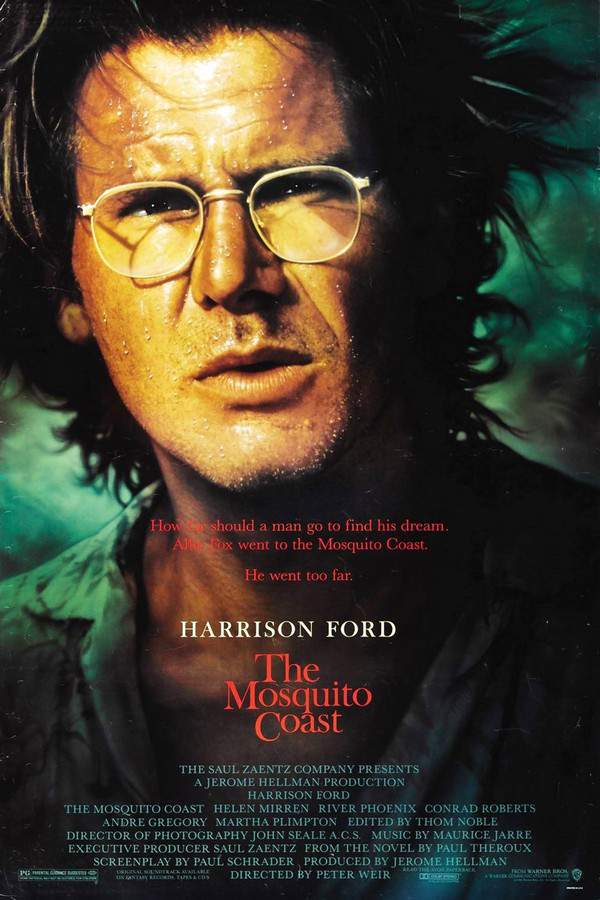
The Mosquito Coast (1986) movie poster

Plot Summary

The Mosquito Coast (1986) Plot Summary Explained

Release, runtime and language
1986 · 117 min · English
Loading streaming availability…
Directed by
Peter Weir
Starring
Helen Mirren, Harrison Ford

A brilliant inventor, disillusioned with American consumerism, leads his family to a remote jungle location to construct a self-sufficient paradise. As they build their new world, tensions rise, and the inventor’s increasingly eccentric behavior puts a strain on his relationships and challenges the family’s survival in a harsh and unforgiving environment. The quest for utopia becomes a dangerous and unsettling journey.

On this page (7)
  1. 1 Where to watch
  2. 2 What happens: full plot
  3. 3 Plot questions answered
  4. 4 The book behind the movie
  5. 5 Movie threads
  6. 6 Movies like The Mosquito Coast
  7. 7 Every angle
Loading streaming availability…

Full plot summary · contains spoilers

What Happens in The Mosquito Coast: Full Plot Summary

The whole story of The Mosquito Coast (1986) explained, from the opening scene to the final frame: every key event, every twist and what it all adds up to. Read it as a quick recap before the sequel, to check a scene you missed, or to finally understand what really happened.

Allie Fox is an exceptionally talented yet headstrong inventor, deeply frustrated with the American Dream and rampant consumerism. He is convinced that impending nuclear disaster is a consequence of the greed and wrongdoing prevalent in American society. After salvaging parts from a local dump alongside his eldest son, Charlie, he completes his latest innovation—an ice machine he affectionately names Fat Boy. However, when Allie's boss, Mr. Polski, a farmer in the asparagus business, expresses concern about failing crops due to Allie's obsession with his invention, the tension grows. During a meeting, Allie showcases the ice machine, but Mr. Polski remains unimpressed. Allie reflects on the immigrant workers harvesting asparagus, contemplating that to them, ice might be viewed as a true luxury.

The very next day, in a surprising turn of events, Allie hosts a celebration for the immigrant laborers before breaking the news to his family that they are leaving the United States behind. They board a Panamanian barge and encounter several fellow passengers, including Reverend Spellgood, his wife, and their daughter, Emily. Allie soon finds himself in conflict with the Reverend due to their starkly opposing beliefs. Once in Belize City, the families separate, and, in a bold move, Allie buys a small village named Jeronimo from a drunken German.

With the help of Mr. Haddy, their boatman, Allie and his family travel upriver to their new home. There, Allie meets the village's inhabitants and sets to work on creating a new and advanced civilization, inventing various tools and methods along the way. The local residents, including Mr. Haddy, initially welcome Allie and his family, yet Allie's relentless pursuit of his vision pushes them to their limits, provoking discontent. Shortly after, Reverend Spellgood appears again, intent on converting the villagers, resulting in a heated confrontation between him and Allie. This clash cements their ideological divide: Allie sees Spellgood as a fanatic, while the Reverend views Allie as a communist threat.

As Allie's dream of an ice-dependent society progresses, he constructs a more massive version of Fat Boy, which he believes will benefit the town. Inspired by stories of a native tribe that has never experienced ice, Allie gathers his sons to transport the precious resource into the jungle. However, he arrives only to find that their cargo has melted, and the tribe has already been introduced to the concept by missionaries.

Returning to Jeronimo, Allie discovers that the Reverend has successfully frightened away most of the villagers with tales of divine retribution, leaving the settlement nearly deserted. When three rebels arrive demanding refuge, Allie, in a moment of desperation, agrees, intending to devise a way to eliminate them. He locks the rebels in the massive ice machine, hoping to freeze them out, but the plan goes horrifically awry when a gunshot ignites the machine, causing a catastrophic explosion. By dawn, the once-thriving machine and their home lie in ruins, with toxic chemicals contaminating the river.

Drifting downstream, the surviving family members arrive at the shore, with the children and their mother hopeful about a return to the United States. In contrast, Allie clings to the belief that their aspirations are still viable and declares that the U.S. has fallen to nuclear war. He attempts to establish a new life on a houseboat he has constructed, dismissing help from Mr. Haddy, convinced that they’ve achieved a utopian existence. However, a violent storm threatens to sweep them away until Charlie reveals a stash of motor parts given to him in secret, allowing them to power the boat.

As they travel upstream once more, tension builds among the family, stirring resentment toward Allie's unyielding demeanor. Upon discovering Spellgood’s fortified settlement, Allie derides it as a Christian concentration camp. In the dead of night, Charlie and Jerry sneak over to Spellgood's home, uncovering shocking truths: the United States is intact, and Emily will aid them in escaping their father. Just as Charlie makes a desperate pitch to their mother and sisters, Allie reacts by igniting Spellgood's church, leading to a violent confrontation where the Reverend shoots Allie, rendering him paralyzed.

As the family embarks on another journey downriver, with Allie slipping in and out of awareness, he inquires whether they are heading upstream. For the first time, his wife lies to him. The narrative concludes with Charlie's somber reflection on Allie's death, intertwined with a glimmer of hope that the remaining family members may finally embrace their freedom.
Last updated: November 15, 2024 at 20:28

Was this helpful?

Plot questions answered

The Mosquito Coast Plot Explained: Your Questions Answered

The questions people ask most about The Mosquito Coast (1986): what happens in the confusing scenes, why the characters do what they do, the twists, hidden details and what the ending means. Each answer contains spoilers.

Q1

Why did Allie Fox decide to leave the United States?

Allie Fox was deeply disillusioned with American consumerism and the greedy values he saw in society. He believed that an impending nuclear disaster was inevitable due to the wrongdoing and excess of American culture. Rather than wait for catastrophe, he chose to remove his family from what he considered a corrupt system and build a self-sufficient utopia elsewhere.

Foreshadowing: Earlier scenes show Allie salvaging parts from dumps and expressing contempt for consumerist culture, foreshadowing his radical decision.

  • Allie Fox
  • United States
  • nuclear war
  • consumerism
  • family departure
  • motivation
Q2

What happens to Allie Fox at the end?

Allie Fox is shot by Reverend Spellgood during a violent confrontation after burning down the church, leaving him paralyzed. He dies while the family travels downriver, with his wife lying to him about whether they're going upstream or downstream. His death marks the collapse of his utopian dream but also frees his family from his increasingly dangerous control.

Foreshadowing: Throughout the film, Allie's fanatical behavior escalates, pushing his family to the brink of survival and making the final confrontation inevitable.

  • Allie Fox death
  • Reverend Spellgood
  • ending
  • paralysis
  • family freedom
Q3

Why did the ice machine explode?

Allie locked three rebels inside the massive ice machine, planning to freeze them to death. However, a gunshot inside the machine ignited the refrigerant gases, causing a catastrophic explosion that destroyed their home and contaminated the river with toxic chemicals.

Foreshadowing: Allie's desperation to maintain control over Jeronimo escalates after the villagers abandon him, leading to increasingly dangerous decisions.

  • ice machine explosion
  • rebels
  • toxic chemicals
  • Jeronimo
  • Fat Boy
Q4

Why did Allie burn down Spellgood's church?

Allie burned the church in a fit of rage after discovering that Charlie and Jerry had gone to Spellgood's settlement and learned the truth, that the United States was still intact. The revelation that his family had been planning to escape shattered his control, leading him to destroy what he saw as a 'Christian concentration camp.'

Foreshadowing: The ongoing ideological battle between Allie and Spellgood escalates throughout the film, with each trying to undermine the other's influence.

  • Allie Fox
  • Reverend Spellgood
  • church burning
  • Charlie
  • confrontation
Q5

Why did Charlie and Jerry go to Spellgood's settlement?

Charlie and Jerry secretly visited Spellgood's fortified settlement hoping to find a way to escape their father. There they discovered shocking truths: the United States was still intact and had not suffered nuclear war. Emily, the Reverend's daughter, agreed to help them escape Allie's control.

Foreshadowing: Earlier tensions between Allie and his children, especially Charlie, foreshadow the children's growing resentment and desire to leave.

  • Charlie Fox
  • Jerry Fox
  • Spellgood settlement
  • Emily
  • escape plan
  • United States intact
Q6

Why did Allie Fox lie about nuclear war?

Allie convinced his family that the United States had been destroyed by nuclear war to prevent them from wanting to return home. This lie maintained his control over the family and justified his decision to build a new civilization in Belize. The truth only emerges when Charlie and Jerry discover the US is still intact during their visit to Spellgood's camp.

Foreshadowing: Allie's preachy anti-American rhetoric and paranoid predictions about impending disaster set the foundation for this deception.

  • Allie Fox
  • nuclear war lie
  • deception
  • family control
  • United States
Q7

Why did the villagers abandon Jeronimo?

Reverend Spellgood successfully frightened most villagers into leaving by preaching about divine retribution and positioning Allie as a communist threat. When Allie returned from his failed ice delivery mission, he found the settlement nearly deserted, with only a handful of residents remaining.

Foreshadowing: The ideological battle between Allie and Spellgood was established early, with each competing for the villagers' allegiance.

  • Jeronomo villagers
  • Reverend Spellgood
  • village abandonment
  • religious fear
  • Allie Fox
Q8

Why was Allie Fox so obsessed with ice?

Allie viewed ice as a symbol of technological progress and a way to demonstrate the superiority of his vision for civilization. He believed that providing ice, which he saw as a true luxury, to people who had never experienced it would prove the value of his self-sufficient society. His larger 'Fat Boy' machine was meant to serve the entire town.

Foreshadowing: Allie's earlier reflections on how immigrant workers might view ice as a luxury hint at his fixation on this goal.

  • Allie Fox
  • ice
  • Fat Boy
  • technology
  • civilization
  • native tribe
Q9

What was Allie Fox's conflict with Mr. Polski about?

Mr. Polski, Allie's boss in the asparagus business, confronted him about neglecting work responsibilities due to his obsessive invention projects. When Allie demonstrated the ice machine 'Fat Boy' at a meeting, Polski remained unimpressed, dismissing it as irrelevant to their failing crops. This clash represented the fundamental conflict between Allie's innovative ideals and societal expectations.

Foreshadowing: The tension with Polski establishes Allie's pattern of prioritizing his vision over practical obligations, foreshadowing his eventual abandonment of conventional life.

  • Mr. Polski
  • asparagus farm
  • ice machine
  • work conflict
  • boss
Q10

Why did Allie Fox buy the village of Jeronimo?

After arriving in Belize City, Allie made the impulsive decision to purchase a small village named Jeronimo from a drunken German. He saw it as the perfect location to establish his utopian society, far from the American values he despised. The purchase represented his commitment to creating a self-sufficient civilization built on his own terms.

Foreshadowing: Allie's earlier statement about providing ice to those who would truly value it reflects his desire to build something meaningful away from consumerist society.

  • Jeronimo village
  • Belize
  • purchase
  • German seller
  • utopian society
  • Allie Fox

Movie threads

More Movies Like The Mosquito Coast, by Mood & Story

Curated lists built around what makes The Mosquito Coast tick: the same mood, the same kind of story or the same emotional payoff. Each list explains why these movies belong together.

Dysfunctional Family Crucibles like in The Mosquito Coast

Families tested to the breaking point by a parent's obsession or delusion. Explore movies like The Mosquito Coast where a family is pushed to the edge by a parent's dangerous ideals. This thread gathers tense dramas and thrillers about survival, parental hubris, and the fracturing of family bonds in isolated or high-pressure environments.

  • dysfunctional family
  • claustrophobic
  • psychological abuse
  • desperate
  • tense
  • unsettling
  • Tone: tense, unsettling, melancholic
  • Pacing: variable, building to crisis
Why these movies?

The story pattern: The narrative follows a family whose life is upended by the radical vision or deteriorating mental state of a dominant figure, usually a father. The story unfolds as their constructed reality collapses, forcing other members to question their loyalty and fight for their own survival against the very person meant to protect them.

Why they belong together: Movies are grouped here for their shared focus on intense family dynamics under psychological pressure, a claustrophobic atmosphere, and the heavy emotional weight of watching a family unit disintegrate from within.

Utopian Dreams Turned Sour like in The Mosquito Coast

A grand vision of a perfect society collapses under the weight of human nature. If you liked The Mosquito Coast, discover other movies about the dangerous pursuit of utopia. These films explore the collapse of idealistic communities, the clash between ideology and reality, and the bittersweet aftermath of failed dreams.

  • utopia
  • quest
  • ideological conflict
  • hubris
  • desperate
  • melancholic
  • Tone: tense, bleak, bittersweet
  • Pacing: variable, from steady build to chaotic collapse
Why these movies?

The story pattern: The narrative pattern begins with a charismatic leader convincing others to follow a radical plan for a better life. The central conflict arises from the gap between the dream and reality, often escalating into a struggle for survival as the project fails, revealing the hubris and unsustainability of the vision.

Why they belong together: These films share a common arc from idealism to disillusionment, a tense and unsettling mood, and a thematic focus on the dangers of extreme ideology. They deliver a heavy emotional experience with often bittersweet or bleak endings.

If you liked this

Movies Like The Mosquito Coast

Similar movies to The Mosquito Coast: the same genre, themes or kind of story. Each one comes with its own plot summary, timeline and ending explained.

Browse all movie summaries

Every angle

The Mosquito Coast (1986) Explained: Plot, Timeline & Characters

Everything about The Mosquito Coast in one place: what happens in the plot summary, the timeline in chronological order, the characters and meaning and a spoiler-free summary. What's After the Movie adds the cast, box office and post-credit scenes.

Coming soon on iOS and Android

The Plot Explained Movie Summary App

Plot summaries, endings explained and timelines on your phone. Catch up on any movie in minutes, save your favorites and never miss a twist again.

Be the first to know when we launch. Your email stays private, always.

Learn more about the app