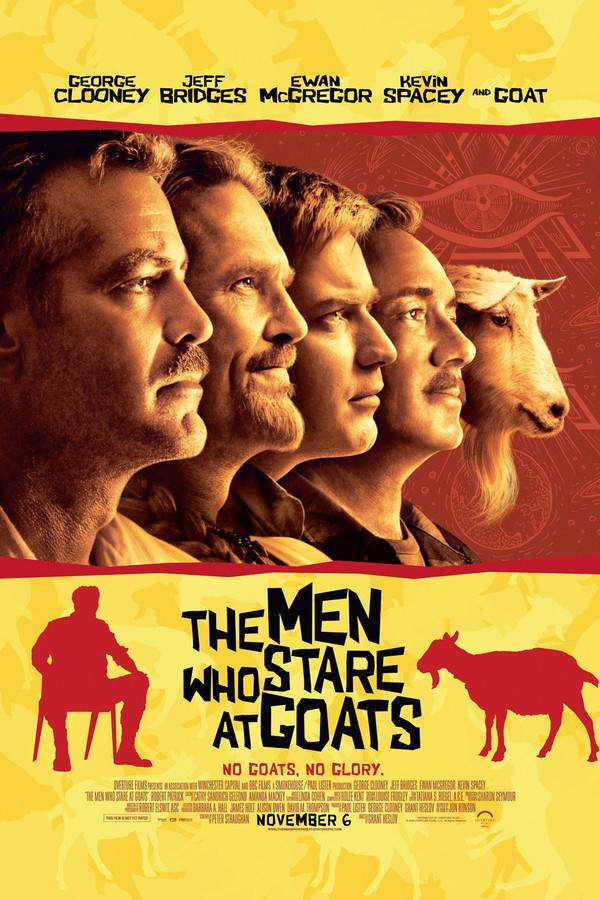
An ambitious reporter, Bob Wilton, investigates a clandestine US military program called the New Earth Army while teaming up with the enigmatic operative Lyn Cassady. Cassady claims the unit trains psychic soldiers with extraordinary abilities, including the power to incapacitate or even kill goats with focused stares. Their mission leads them on a bizarre journey to locate the program's elusive founder, Bill Django, uncovering unconventional training methods and unexpected consequences along the way.
Find where to stream, rent, or buy The Men Who Stare at Goats (2009) in the US with current JustWatch availability, up-to-date pricing, and platform listings for subscription, rental, and digital purchase options.
Warning: spoilers below!
Haven’t seen The Men Who Stare at Goats yet? This summary contains major spoilers. Bookmark the page, watch the movie, and come back for the full breakdown. If you're ready, scroll on and relive the story!
Trace every key event in The Men Who Stare at Goats (2009) with our detailed, chronological timeline. Perfect for unpacking nonlinear stories, spotting hidden connections, and understanding how each scene builds toward the film’s climax. Whether you're revisiting or decoding for the first time, this timeline gives you the full picture.
Last updated: November 03, 2024 at 20:31
Find frequently asked questions about the The Men Who Stare at Goats (2009) timeline, including chronological order, nonlinear jumps, cause-and-effect links, and scene sequence clarifications. This timeline FAQ helps explain when key events happen, how moments connect, and why the story unfolds in that specific order.
The New Earth Army is a secret US military program created by Bill Django, a former Vietnam veteran who had an epiphany that love would triumph over hatred. The unit explores unconventional warfare methods, specifically training soldiers with psychic abilities to use in combat. The program represents the film's satirical take on military bureaucracy and explores whether unconventional tactics could change warfare.
Earlier scenes establish the surreal tone when General Hopgood attempts to phase through his office wall, hinting at the New Earth Army's unconventional methods.
Lyn Cassady is presented as the most formidable Psi-warrior in the New Earth Army unit. He possesses remote viewing skills, allowing him to see distant locations psychically, and demonstrates other psychic abilities throughout the film. He becomes Bob Wilton's guide into the world of the New Earth Army, leading him on a journey to uncover the program. His troubled past with the Army stems from his powerful psychic abilities, which he struggles to control.
Gus Lacey mentions Lyn Cassady as the most formidable Psi-warrior in their unit before Bob actually meets him.
Bob travels to Iraq after experiencing personal tragedy in 2003. When he tries to reconnect with his ex-wife Helen, he discovers she has moved on with her life, leaving him heartbroken. Seeking purpose and escape from his despair, Bob decides to pursue the ultimate story by covering the war in Iraq, where he hopes to find the mysterious New Earth Army and uncover its secrets.
Bob's narrations earlier establish his dissatisfaction with his life's direction and his search for something meaningful.
Larry Hooper is another psychic soldier in the New Earth Army who operates as a rival to Lyn Cassady. While Lyn uses his abilities for what appears to be more noble purposes, Larry employs malevolent tactics and competes against Lyn throughout their mission. His antagonistic presence creates conflict within the New Earth Army and poses a threat to Bob and Lyn during their journey.
Bob Wilton was previously married to his college sweetheart Helen, but their relationship ended before the events of the film. Bob reflects that his life didn't turn out as he expected, with the marriage to Helen being one of the paths not taken. By 2003, when Bob tries to reconnect with her, Helen has moved on with her life, which devastates Bob and contributes to his decision to travel to Iraq seeking purpose.
Bob opens the film by narrating that his saga began with an odd encounter rather than the marriage he envisioned with Helen.
At the film's conclusion, Bob attempts to phase through a wall as a symbolic representation of his personal transformation. Through his journey with Lyn Cassady and Bill Django, Bob learns important lessons about truth and the simplicity of existence. The attempt mirrors the opening scene with General Hopgood and symbolizes Bob's embrace of the whimsical worldview he has adopted, showing he has internalized the New Earth Army's unconventional philosophy.
The film opens with General Hopgood's failed attempt to leap through his office wall, establishing the symbolic significance of wall-phasing.
Remote viewing is the psychic ability Lyn Cassady demonstrates throughout the film, allowing him to perceive distant locations and events without physically being present. This ability is part of what makes Lyn valuable to the New Earth Army and creates tension when Larry Hooper competes with similar but more malicious psychic skills. The film presents remote viewing as one of the key psychic abilities being developed within the secret military program.
Bob learns about Lyn's remote viewing skills as they navigate their challenges in Iraq, which attracts attention from other psychics.
Bill Django, a former Vietnam veteran, created the New Earth Army after experiencing an epiphany that love would triumph over hatred. This realization drove him to explore unconventional methods of warfare, leading to the establishment of the psychic soldier program. His philosophy forms the foundation of the New Earth Army's approach, emphasizing alternative tactics over traditional military methods.
The psychedelic experiences Bob undergoes in Iraq represent his journey of self-discovery and his growing understanding of the New Earth Army's unconventional world. These surreal moments blur the lines between reality and illusion, challenging Bob's previous worldview and guiding him toward personal transformation. Through these experiences, Bob learns to embrace the absurdity of his encounters rather than simply recount battle narratives.
The film establishes early on that the New Earth Army operates with unconventional methods, setting up the surreal nature of Bob's experiences.
Lyn Cassady reveals during his journey with Bob that he has a troubled history with the Army, stemming from his powerful psychic abilities. His psychic prowess created internal demons he grapples with throughout the film. The curse he mentions is connected to his psychic abilities, suggesting that using such powers took a psychological toll on him and affected his military career.
Gus Lacey hints at Lyn's formidable but complicated status within the unit before their full history is revealed.
The New Earth Army is a fictional premise in the film, though it plays on real rumors and conspiracy theories about secret military programs. The film uses the concept as satire, poking fun at military bureaucracy and the idea of unconventional warfare. The story presents the program through Bob Wilton's investigative lens, blending real military settings with absurd supernatural elements for comedic effect.
The opening scene with General Hopgood establishes early that the film operates in a surreal reality rather than strict realism.
Discover curated groups of movies connected by mood, themes, and story style. Browse collections built around emotion, atmosphere, and narrative focus to easily find films that match what you feel like watching right now.
Satirical tales that find the bizarre humor lurking within serious organizations.If you enjoyed the satirical take on the military in The Men Who Stare at Goats, you'll like these movies that find quirky humor within serious organizations. This thread groups comedies where bizarre characters or ideas collide with rigid systems, creating a uniquely offbeat and playful viewing experience.
Stories in this thread often follow an outsider or a true believer as they navigate a powerful, serious institution that harbors a deeply eccentric or illogical core. The plot unfolds through a series of increasingly absurd encounters, revealing the gap between the institution's official purpose and its bizarre reality, often leading to a sense of wry disillusionment or personal revelation.
These films are grouped by their shared tone of whimsical satire, using absurdist comedy to critique or explore serious establishments. They balance a light emotional weight with a medium intensity, creating an experience that is more playful than cynical, and feature steady pacing that allows the absurdity to unfold naturally.
A skeptic and an eccentric partner uncover strange truths on a journey.Fans of the odd-couple dynamic between Bob and Lyn in The Men Who Stare at Goats will enjoy these investigative road trip movies. This collection features films where a pragmatic and a eccentric character team up for a journey that is both a physical adventure and a journey of personal growth, often with a bittersweet ending.
The narrative pattern follows a linear journey, moving from one eccentric location or character to the next. The central conflict is often internal for the skeptical protagonist, who must grapple with their own disbelief and personal baggage as they are led deeper into a world that challenges their reality. The resolution tends to be bittersweet, focusing more on the protagonist's growth than a conventional victory.
Movies in this thread share a specific character dynamic and plot structure. They combine a steady pacing suitable for a journey of discovery with a moderate complexity that weaves character development into the investigation. The tone is typically a mix of whimsical humor and light melancholy, resulting in a bittersweet ending feel.
Don't stop at just watching - explore The Men Who Stare at Goats in full detail. From the complete plot summary and scene-by-scene timeline to character breakdowns, thematic analysis, and a deep dive into the ending - every page helps you truly understand what The Men Who Stare at Goats is all about. Plus, discover what's next after the movie.
Read a complete plot summary of The Men Who Stare at Goats, including all key story points, character arcs, and turning points. This in-depth recap is ideal for understanding the narrative structure or reviewing what happened in the movie.
Discover the characters, locations, and core themes that shape The Men Who Stare at Goats. Get insights into symbolic elements, setting significance, and deeper narrative meaning - ideal for thematic analysis and movie breakdowns.
Discover movies like The Men Who Stare at Goats that share similar genres, themes, and storytelling elements. Whether you’re drawn to the atmosphere, character arcs, or plot structure, these curated recommendations will help you explore more films you’ll love.
The Men Who Stare at Goats (2009) Plot Summary & Movie Recap
The Men Who Stare at Goats (2009) Scene-by-Scene Movie Timeline
The Men Who Stare at Goats (2009) Spoiler-Free Summary & Key Flow
Movies Like The Men Who Stare at Goats – Similar Titles You’ll Enjoy
Three Kings (1999) Movie Recap & Themes
Operation Avalanche (2016) Ending Explained & Film Insights
Korengal (2014) Film Overview & Timeline
Army of One (2016) Complete Plot Breakdown
War, Inc. (2008) Spoiler-Packed Plot Recap
Boys of Abu Ghraib (2014) Complete Plot Breakdown
The Eagle Has Landed (1977) Film Overview & Timeline
Manticore (2005) Ending Explained & Film Insights
A Man Called Sarge (1990) Plot Summary & Ending Explained
Commandos (1968) Detailed Story Recap
The Goat (1921) Movie Recap & Themes
The Wild Geese (1978) Full Summary & Key Details
Men with Guns (1997) Plot Summary & Ending Explained
The Green Berets (1968) Story Summary & Characters
Men in War (1957) Complete Plot Breakdown