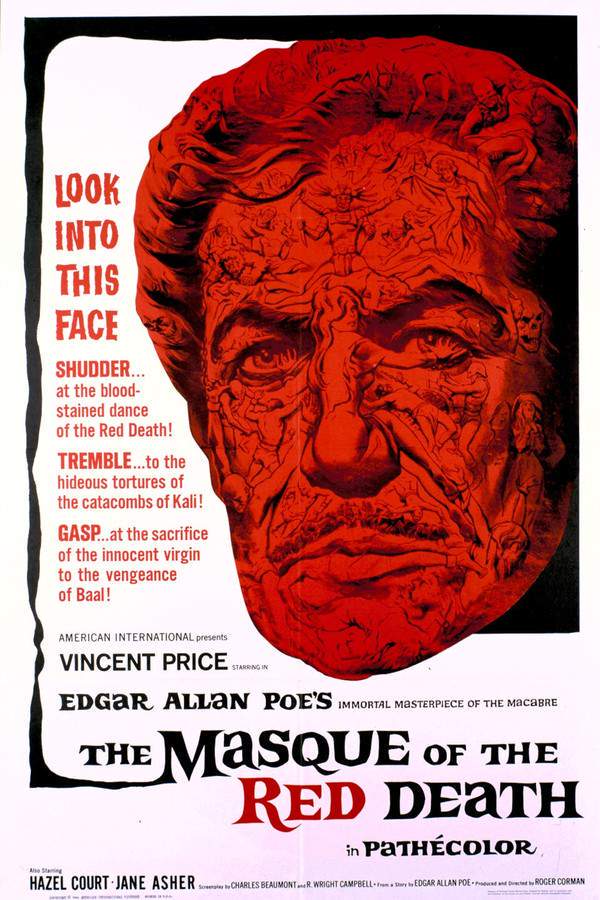
During a dark period in the Middle Ages, Prince Prospero indulges in a lavish and corrupt lifestyle within his imposing castle. His obsession with a mysterious woman leads him down a path of despair, drawing her into the castle's dark vortex. Surrounded by luxury and shadowed by the threat of a deadly plague, Prospero’s reign and the lives of those within the castle walls are about to face an unforeseen reckoning.
Find where to stream, rent, or buy The Masque of the Red Death (1964) in the US with current JustWatch availability, up-to-date pricing, and platform listings for subscription, rental, and digital purchase options.
Warning: spoilers below!
Haven’t seen The Masque of the Red Death yet? This summary contains major spoilers. Bookmark the page, watch the movie, and come back for the full breakdown. If you're ready, scroll on and relive the story!
Trace every key event in The Masque of the Red Death (1964) with our detailed, chronological timeline. Perfect for unpacking nonlinear stories, spotting hidden connections, and understanding how each scene builds toward the film’s climax. Whether you're revisiting or decoding for the first time, this timeline gives you the full picture.
Last updated: November 03, 2024 at 23:59
Find frequently asked questions about the The Masque of the Red Death (1964) timeline, including chronological order, nonlinear jumps, cause-and-effect links, and scene sequence clarifications. This timeline FAQ helps explain when key events happen, how moments connect, and why the story unfolds in that specific order.
Prospero destroys the village in retaliation for Gino's defiance and open mockery of the prince's extravagant offers. When Gino saves an infant from being trampled and challenges Prospero's authority by claiming an old prophecy promises the village's salvation, Prospero retaliates by forcing Gino and his father-in-law Ludovico to kneel as a show of dominance. The arrival of the Red Death plague provides the opportunity for Prospero to take violent action, destroying the village as he takes Francesca to his castle.
Earlier, Prospero's cruel nature is established through his demand that villagers kneel before him and his willingness to punish anyone who questions his power.
The Man in Red appears to be either a manifestation or agent of the Red Death plague itself. He gives Sarah Brackett a blood-red rose, proclaiming that deliverance is near for the village. Later, he confronts Prospero directly, revealing that the prince's pact with dark forces does not guarantee survival. The Man in Red survives the entire ordeal, observing the aftermath as the only remaining figure, suggesting he represents death itself or the inevitable fate that claims everyone regardless of their attempts to escape it.
The Man in Red's first appearance at the very beginning establishes him as an supernatural entity connected to the rose that symbolizes both the plague and fate.
Francesca is forced to make this impossible choice when Prospero confronts Gino and Ludovico after Gino's defiance. Prospero uses this moment to assert his absolute power over Francesca, forcing her to kneel before him and choose between her father Ludovico and her beloved Gino. This cruel test is designed to break her spirit and demonstrate that her loyalty to the prince must override all other relationships. The moment establishes Prospero's manipulative cruelty and Francesca's trapped position between submission to tyranny and her personal bonds.
Francesca's plea for mercy earlier shows her compassionate nature and highlights how precious her loved ones are to her, making this forced choice particularly devastating.
Juliana, Prospero's companion, has made a pact with the devil that Francesca discovers during her time in the castle. This revelation comes as a twist of treachery, exposing the depth of corruption within Prospero's inner circle. The pact suggests Juliana has traded her soul for some form of power or protection, and it is this knowledge that ultimately compels Juliana to help Francesca escape. The discovery galvanizes Francesca to act against Prospero's tyranny, using this betrayal as leverage to further her own escape attempt.
Juliana's role in stripping Francesca of her modesty and helping Prospero corrupt her suggests a deeper malevolent purpose beyond mere loyalty to the prince.
The Red Death enters the castle during the masquerade ball, disguised among the festivities. The plague sweeps through the revelers, killing everyone within the castle walls. Prospero believed his isolation and his pact with dark forces would protect him, but the Red Death proves inescapable. TheMasquerade Ball becomes the setting for the plague's deadly harvest, as chaos ensues and the guests fall victim to the horrific disease.
The constant presence of the Red Death threat throughout the film, combined with Prospero's false confidence in his protective measures, builds to this inevitable confrontation.
Prospero believes he is exempt from death because he has made a pact with dark forces, serving the darkness that the Man in Red represents. His motto, "If God exists, He must have died long ago", reflects his rejection of divine authority and his belief that his power and cruelty grant him immortality. This hubristic conviction drives his reckless behavior throughout the film, leading him to host lavish feasts and games of terror while the plague rages outside. His eventual confrontation with the Man in Red shatters this illusion, revealing that his pact offers no protection.
Prospero's repeated challenges to divine authority and his cruel experiments with death and suffering establish his belief that he operates outside moral and natural law.
During the chaotic climax at the masquerade ball, Gino, cloaked in determination, attempts to liberate Francesca from Prospero's grip. The film shows Gino facing the symbols of death and betrayal in his heroic attempt to save her. However, the Red Death sweeps through the castle, leading to the demise of virtually all the revelers. The film ends with the Man in Red observing the last remnants of life within the castle walls, suggesting that Francesca and Gino both succumb to the plague alongside everyone else.
Gino's earlier defiance and his determination to save Francesca establish his heroic arc, but the film's consistently bleak tone foreshadows the ultimate failure of any attempt to escape death.
The blood-red rose given to Sarah Brackett by the Man in Red serves as a symbol of the Red Death itself, a harbinger of the plague's arrival. When the Man in Red presents the rose and proclaims that deliverance is near, he is foreshadowing the catastrophic fate awaiting the village. The rose represents both death and the false promise of salvation; it is red as blood, connecting it to the violence and mortality that follows. The symbol recurs as the plague descends upon Prospero's castle.
The rose appears at the very beginning of the film, establishing the supernatural element that drives the entire narrative.
Prospero hosts lavish feasts and parties as a demonstration of his power and defiance against both the plague and divine authority. He believes his wealth and his pact with dark forces make him invincible. The feasts serve as venues for his cruel games, where terror becomes entertainment and guests are forced to witness or participate in atrocities. These events showcase his moral corruption and his belief that he can escape the consequences that affect ordinary people.
Prospero's arrival in his royal carriage, offering extravagance to villagers while the threat of death looms, establishes his disconnected and defiant character.
The masquerade ball serves as the climax of the film where the Red Death finally reaches the castle. The ball represents the ultimate hubris, Prospero's attempt to celebrate his supposed immortality through revelry while death approaches. The masks the guests wear become ironic as they cannot hide them from the plague. During this event, all the film's tensions converge: Francesca's attempted escape, Gino's rescue attempt, Prospero's confrontation with his fate, and the arrival of the Red Death itself.
The gradual build-up to the ball, with increasing terror and cruelty in previous scenes, prepares for this deadly convergence.
Juliana helps Francesca escape after Francesca discovers her pact with the devil. This revelation creates a moment of shared vulnerability, Francesca now knows Juliana's dark secret and could expose her. Rather than risk betrayal, Juliana assists Francesca in her escape attempt. However, this help comes too late to prevent the ultimate tragedy, as the Red Death descends upon the castle shortly after. Juliana's assistance is thus motivated by self-preservation rather than genuine compassion.
Juliana's earlier role in corrupting Francesca suggests she is not inherently evil but rather motivated by her own survival needs.
Prospero's downfall is caused by his own hubris and mistaken belief that his pact with dark forces grants him immunity from death. When he confronts the Man in Red during the climax, he learns that his allegiance to darkness does not guarantee survival. The Red Death claims him just as it claims everyone else in the castle. His downfall represents the film's central theme: that no one can escape death, regardless of their power, wealth, or alliances with evil. He dies alone amid the fallen, faced with the horror of recognizing himself as merely an instrument of death.
Prospero's motto rejecting God's existence and his cruel experiments with death throughout the film establish his fatal overconfidence.
Discover curated groups of movies connected by mood, themes, and story style. Browse collections built around emotion, atmosphere, and narrative focus to easily find films that match what you feel like watching right now.
Stories of corrupt and lavish societies facing imminent, unstoppable destruction.If you enjoyed the theme of a corrupt prince's castle threatened by the plague in The Masque of the Red Death, you'll find similar stories here. Explore movies like this that feature opulent, decaying societies and leaders whose hubris is challenged by an existential threat, resulting in bleak and fatalistic conclusions.
Narratives in this thread typically follow a similar arc: establishing a self-contained, opulent society ruled by a corrupt figure, introducing an external or internal force of collapse, and building tension through the characters' denial or engagement with the threat, culminating in the complete downfall of their world.
Movies are grouped here for their shared focus on themes of hubris, moral corruption, and the fragility of civilization. They share a dark, ominous tone and a steady pacing that builds towards an unstoppable, often bleak, finale. The emotional experience is heavy, centered on fatalism and the futility of resisting fate.
Tales where an abstract force like death or fate takes physical form to deliver justice.Fans of The Masque of the Red Death, where the Red Death plague appears as a mysterious figure, will appreciate these similar films. Discover movies like this one that feature a physical embodiment of an unstoppable force, often delivering grim justice to characters who believe they are above moral or natural law.
The narrative pattern involves characters, often flawed or tyrannical, who are confronted by a mysterious figure representing an inescapable truth. The story builds around this confrontation, exploring themes of mortality, morality, and hubris, typically concluding with the unequivocal victory of the personified force over the protagonists.
These films are united by their central narrative device of personification and their exploration of existential themes. They share a high intensity, a dark and philosophical tone, and a steady pacing that leads to a bleak ending affirming the power of the cosmic force. The mood is consistently macabre, diabolical, and fatalistic.
Don't stop at just watching - explore The Masque of the Red Death in full detail. From the complete plot summary and scene-by-scene timeline to character breakdowns, thematic analysis, and a deep dive into the ending - every page helps you truly understand what The Masque of the Red Death is all about. Plus, discover what's next after the movie.
Read a complete plot summary of The Masque of the Red Death, including all key story points, character arcs, and turning points. This in-depth recap is ideal for understanding the narrative structure or reviewing what happened in the movie.
Discover the characters, locations, and core themes that shape The Masque of the Red Death. Get insights into symbolic elements, setting significance, and deeper narrative meaning - ideal for thematic analysis and movie breakdowns.
Discover movies like The Masque of the Red Death that share similar genres, themes, and storytelling elements. Whether you’re drawn to the atmosphere, character arcs, or plot structure, these curated recommendations will help you explore more films you’ll love.
The Masque of the Red Death (1964) Plot Summary & Movie Recap
The Masque of the Red Death (1964) Scene-by-Scene Movie Timeline
The Masque of the Red Death (1964) Spoiler-Free Summary & Key Flow
Movies Like The Masque of the Red Death – Similar Titles You’ll Enjoy
Black Death (2011) Full Movie Breakdown
The Raven (2012) Spoiler-Packed Plot Recap
Masquerade (1988) Film Overview & Timeline
The Mask (1988) Movie Recap & Themes
Masque of the Red Death (1989) Ending Explained & Film Insights
Masques (1987) Complete Plot Breakdown
The Masque of the Red Death (1989) Story Summary & Characters
The Haunted Palace (1963) Plot Summary & Ending Explained
Nightmare Castle (1965) Spoiler-Packed Plot Recap
Castle of Blood (1964) Ending Explained & Film Insights
Masque of the Red Death (1989) Full Movie Breakdown
The Black Torment (1964) Spoiler-Packed Plot Recap
The Castle of the Living Dead (1964) Detailed Story Recap
The Raven (1935) Story Summary & Characters
Macabre Serenade (1968) Story Summary & Characters