Plot Explained Spoilers guaranteed!
Plot Explained

Browse by genre

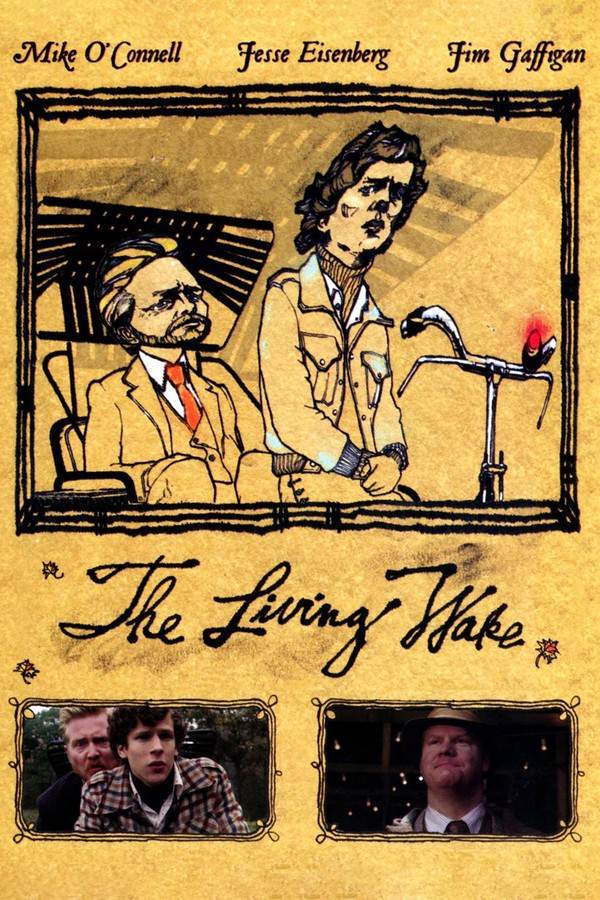
The Living Wake (2007) movie poster

Timeline

The Living Wake (2007) Timeline Explained – Every Event in Order

Release, runtime and language
2007 · 91 mins · English
Loading streaming availability…
Directed by
Sol Tryon
Starring
Jesse Eisenberg, Jim Gaffigan, Bryan Brown, Ann Dowd, Stuart Rudin, Jill Larson

In a story‑book world, artist K. Roth Binew learns he has only one day left. He enlists his sole friend, Mills Joquin, to ferry him around in a bicycle‑powered rickshaw. Throughout the day Binew endures absurd trials in search of meaning, culminating in a “living wake” on a makeshift stage where friends and foes gather for his final performance.

On this page (7)
  1. 1 Where to watch
  2. 2 Events in order (15)
  3. 3 Timeline questions answered
  4. 4 Movie threads
  5. 5 Movies like The Living Wake
  6. 6 Categories
  7. 7 Every angle
Loading streaming availability…

15 events in order · contains spoilers

The Living Wake Timeline: Events in Chronological Order

Every key event of The Living Wake (2007) in order, scene by scene, with when and where it takes place. Use it to untangle flashbacks, time jumps and parallel storylines, to refresh your memory before the sequel or to find the exact scene you are thinking of.

  1. Diagnosis and vow to spend a final day

    He discovers he has a terminal illness and resolves to spend his last day with his friend Mills Joaquin. He hopes to uncover the meaning of life through a promised monologue from his late father. Time is short, and he decides to live fully in these final hours.

    When
    morning
    Where
    K. Roth's home
  2. Confrontation with Reginald and invitation to wake

    K. Roth confronts Reginald, his neighbor and rival, and invites him to attend his living wake. The moment Establishes a defiant, performative tone for the day. It marks the early, confrontational start of his final plan.

    When
    early morning
    Where
    K. Roth's residence
  3. Funeral planning and a ritual at the liquorsmith

    He and Mills attempt to arrange his funeral and even visit a liquorsmith for guidance. They perform a goat sacrifice to appease Greek gods, an eccentric act born from his desperate search for meaning. The scene underscores the performative length he is willing to go to for closure.

    When
    late morning
    Where
    Liquorsmith
  4. Picnic with Marla, the nanny

    K. Roth believes love is the meaning of life and shares a picnic with his former nanny Marla. The outing foregrounds his yearning for genuine connection on his last day. It also foreshadows the hollow nature of such fleeting moments.

    When
    afternoon
    Where
    Park
  5. Romantic interlude with Colombe Jacobsen

    After a brief encounter, K. Roth has a sexual encounter with Colombe Jacobsen and invites her to his wake. The episode highlights his craving for affection and affirmation in his final hours. The moment leaves him unsettled rather than fulfilled.

    When
    afternoon
    Where
    Various city locations
  6. Donating his works at the public library

    K. Roth and Mills go to the public library to donate his entire body of work. The librarians deem his books unfit for reading, rejecting his life’s work. The scene probes whether art can survive in a world that resists it.

    When
    afternoon
    Where
    Public Library
  7. Visit to a psychic

    In another bid to uncover meaning, he visits a psychic. The session offers cryptic guidance but no definitive answer. It underscores the elusiveness of a simple solution to life’s questions.

    When
    afternoon
    Where
    Psychic's shop
  8. Revelation at a church and call to reconnect

    Chance leads him to a church, where members encourage him to reconnect with his family. The community presents life as something shared and communal rather than solitary. This encounter rekindles a faint sense of responsibility toward kin.

    When
    evening
    Where
    Church
  9. Family reluctance and medical doubt

    His brother Karl and their mother are reluctant to reconcile and doubt that K. Roth is dying. Karl questions his legitimacy and seeks the family doctor for confirmation. The tension makes any reconciliation seem increasingly unlikely.

    When
    evening
    Where
    Family home
  10. Last drink and wake preparations

    After a final drink at a bar, K. Roth and Mills prepare for the wake. The bar scene underscores his fragility and resolve to see the day through to its end. The mood shifts toward the impending culmination of his plan.

    When
    late evening
    Where
    Bar
  11. Wake begins with performances

    The wake unfolds with the entire cast in attendance, featuring K. Roth’s dance, Mills’s song, and a one-woman play called Remembrance of Dawn. The performances blur the line between ritual and performance as the dying man is the focal point of the spectacle. The audience becomes part of his last stage.

    When
    evening
    Where
    Wake venue
  12. Wake interrupted by family demands

    The wake is interrupted by K. Roth’s mother, Karl, and the family doctor, who plead with him to stop, calling it another episode. He refuses, and the wake continues as he ties up loose ends and distributes his possessions. The confrontation heightens the sense of an ending approaching.

    When
    mid-evening
    Where
    Wake venue
  13. The ghost of Lampert Binew appears

    The ghost of Lampert Binew, K. Roth’s father, appears to him though only he can see him. They have a direct confrontation about abandonment and the nature of life itself. Lampert explains there is no universal equation for life and that the meaning is to live to one’s full potential.

    When
    near end
    Where
    Wake venue
  14. Self-awareness and final realization

    K. Roth acknowledges his life’s emptiness but then shifts toward a broader sense of purpose inspired by his father’s guidance. He concludes the wake with a final song and dance, embracing the moment rather than clinging to ego or fear. As his time runs out, a quiet resolve settles in.

    When
    end
    Where
    Wake venue
  15. Death and burning of the body

    With the last words of the song, his disease takes hold and he collapses into an upright coffin. The wake attendees pay their final respects as Mills carries his body to a pond. He sets the coffin ablaze, bringing the last day to a ritualful close.

    When
    aftermath
    Where
    Pond

Last updated: October 09, 2025 at 16:31

Was this helpful?

Timeline questions answered

The Living Wake Timeline Explained: Your Questions Answered

When does it happen, and why in that order? The questions people ask about the chronology of The Living Wake (2007): time jumps, flashbacks, cause and effect between scenes and the correct order of events, each answered with spoilers.

Q1

Why does K. Roth want his father's promised monologue so badly?

K. Roth believes his eccentric father Lampert Binew left him a profound, final monologue that would explain the meaning of life. Throughout his life, Lampert was a grandiose figure who never delivered on this promise, dying without ever providing the guidance K. Roth desperately seeks. The monologue represents the validation and purpose K. Roth has been waiting for his entire life, making it the centerpiece of his final day quest.

Foreshadowing: Early in the film, K. Roth repeatedly references his father's unfinished promise, establishing it as the driving force behind his desperate search for meaning.

  • k roth binew
  • lampert binew
  • father
  • monologue
  • meaning of life
  • promise
Q2

What is the living wake that K. Roth throws?

A living wake is a funeral ritual held while the person is still alive. K. Roth decides to host this event because he wants to witness his own farewell and control how he's remembered. Unlike a traditional funeral, the dying person attends their own celebration of life, performing for friends and foes alike. For K. Roth, it's both a theatrical act and a genuine attempt to find meaning before death arrives.

Foreshadowing: The film establishes early that K. Roth is a self-proclaimed genius who loves performance, making the living wake a natural extension of his personality.

  • living wake
  • funeral
  • performance
  • ritual
  • k roth binew
Q3

Why does K. Roth invite his rival Reginald to the wake?

K. Roth confronts Reginald, his neighbor and longtime rival, in the morning and explicitly invites him to the living wake. This act serves multiple purposes: it shows K. Roth's defiance in the face of death, allows him to seek closure with someone who represents conflict in his life, and sets up the revenge he later enacts during the wake by dispersing his possessions in a way that humiliates Reginald.

Foreshadowing: The confrontation establishes Reginald as an antagonist early, and the film later pays off this tension when K. Roth seeks revenge during the wake.

  • reginald
  • rival
  • invitation
  • wake
  • k roth binew
Q4

What is the purpose of the goat sacrifice scene?

K. Roth and Mills visit a peculiar "liquorsmith" and perform a goat sacrifice to appease the Greek gods. This eccentric ritual represents K. Roth's desperate, performative search for meaning, he's willing to try any ritual or grand gesture to find purpose. The scene underscores the absurdity of his quest while also highlighting his genuine desperation to find something meaningful before dying.

Foreshadowing: The goat sacrifice occurs early in the day, establishing the pattern of elaborate rituals K. Roth undertakes in his search for meaning.

  • goat sacrifice
  • greek gods
  • liquorsmith
  • ritual
  • meaning
Q5

Why does K. Roth call Marla his true love?

Marla was K. Roth's former nanny, and he describes her as his true love during their bittersweet picnic. While he claims love is the ultimate meaning of life, the picnic reveals the gap between his grand declarations and reality, Marla represents an idealized, nostalgic love rather than a present connection. The moment is tinged with longing but also highlights how K. Roth romanticizes the past to avoid confronting his present emptiness.

Foreshadowing: The picnic scene foreshadows the hollow nature of K. Roth's romantic quests, as his subsequent encounter with Colombe leaves him feeling more unsettled than fulfilled.

  • marla
  • nanny
  • true love
  • picnic
  • k roth binew
  • love
Q6

Why are K. Roth's books rejected at the library?

K. Roth attempts to donate his entire body of work to the public library, viewing it as his legacy. However, the librarians deem his books unfit for reading and reject the donation. This scene probes whether art can survive in a world that resists it, and it devastates K. Roth by suggesting his life's work has no value or meaning to others.

Foreshadowing: The rejection sets up K. Roth's continued search for meaning, as he turns to a psychic afterward seeking answers the library couldn't provide.

  • library
  • books
  • donation
  • rejection
  • k roth binew
  • legacy
  • writer
Q7

What does the psychic tell K. Roth?

The psychic offers K. Roth cryptic guidance but no definitive answer about the meaning of life. The session underscores the elusiveness of simple solutions to life's biggest questions, K. Roth is searching for clear answers, but the universe provides only ambiguity, reflecting the film's themes about meaning being something one must create rather than discover.

Foreshadowing: The psychic's vague response drives K. Roth toward other attempts at meaning, including his visit to the church and eventual family reconciliation.

  • psychic
  • meaning
  • future
  • answers
  • k roth binew
Q8

Why doesn't K. Roth's family believe he's dying?

When K. Roth attempts to reconcile with his family, his brother Karl and mother Alma are reluctant to believe his terminal diagnosis. Karl bluntly declares that K. Roth is not a real writer or inventor, suggesting he's prone to elaborate episodes and attention-seeking behavior. They call the family doctor for another opinion, treating his announcement as another performance rather than reality.

Foreshadowing: The family's skepticism creates tension during the wake when they arrive to intervene, pleading for an end to what they perceive as another elaborate episode.

  • family
  • karl binew
  • alma binew
  • brother
  • mother
  • doubt
  • dying
Q9

What does K. Roth's father's ghost reveal?

The ghost of Lampert Binew appears to K. Roth during the wake, visible only to him, and explains that he never abandoned his son; he simply died without leaving a trace. Most importantly, Lampert dispels the notion of any universal "equation for life" or blueprint for meaning. He insists that the meaning of life is simply to live to one's full potential, delivering the revelation K. Roth has been searching for all day.

Foreshadowing: This moment is the culmination of the entire film, K. Roth's search for his father's wisdom finally comes to fruition, but in a supernatural form he didn't expect.

  • lampert binew
  • father
  • ghost
  • death
  • meaning of life
  • revelation
Q10

What does Lampert mean when he says there's no equation for life?

Lampert tells K. Roth that there is no universal formula or blueprint for life, no secret answer that will explain everything. Rather than providing the monologue K. Roth expected, Lampert reveals that meaning isn't something to be discovered in a father's words or any external source. Instead, the meaning of life is simply to live fully and to one's full potential. This frees K. Roth from his obsession with finding a definitive answer.

Foreshadowing: This revelation directly leads to K. Roth's moment of self-awareness, where he admits his life has been meaningless but then finds purpose in the act of living itself.

  • meaning of life
  • equation
  • lampert binew
  • potential
  • life
  • purpose
Q11

What is K. Roth's final realization?

After his father's ghost reveals there is no equation for life, K. Roth has a cathartic breakthrough. He admits that his life, in many ways, has been meaningless, he was a "stupid, drunk, scared, dying man." However, rather than despair, he finds direction and peace. Inspired by his father's words, he embraces the moment and concludes the wake with a final song and dance, accepting that meaning is found in living fully rather than in grand achievements or external validation.

Foreshadowing: This self-awareness marks the turning point from K. Roth's earlier grandiosity to genuine acceptance, allowing him to face death with clarity rather than denial.

  • k roth binew
  • realization
  • acceptance
  • meaning
  • self-awareness
  • death
Q12

How does the film end?

The film ends with K. Roth completing his living wake. As he sings his final song, his disease takes hold and he collapses into an upright coffin. His friend Mills carries his body to a pond and performs a quiet, ceremonial cremation. The closing image shows a life fully lived, with Mills carrying on the memory of a day that began with bravado and ended with hard-won meaning. The ending is bittersweet, sad yet peaceful, suggesting K. Roth found what he was searching for.

Foreshadowing: The ending fulfills the film's setup: K. Roth wanted to live fully in his final hours and be remembered through his wake, both of which he achieves.

  • ending
  • death
  • cremation
  • mills joaquin
  • k roth binew
  • wake
  • pond

Movie threads

More Movies Like The Living Wake, by Mood & Story

Curated lists built around what makes The Living Wake tick: the same mood, the same kind of story or the same emotional payoff. Each list explains why these movies belong together.

Movies Like The Living Wake | Quirky Bittersweet Journeys

Stories where eccentric characters and absurd humor explore profound, emotional themes. If you liked The Living Wake, explore movies that blend whimsical humor with melancholic reflection. These films feature eccentric characters on unique personal journeys, using absurdity and wit to explore themes of life, death, and legacy, all while maintaining a bittersweet emotional core.

  • quirky
  • melancholic
  • bittersweet
  • reflective
  • absurd
  • introspective
  • Tone: whimsical, melancholic
  • Pacing: steady, character-focused
Why these movies?

The story pattern: Narratives in this thread often follow an eccentric protagonist on a specific quest or through a series of unusual events. The plot structure provides a framework for exploring deeper emotional truths, with comedic moments often preceding or undercutting poignant revelations. The journey typically leads to a bittersweet resolution that acknowledges both the absurdity and beauty of existence.

Why they belong together: Movies are grouped here for their distinctive tone, which masterfully blends whimsy and melancholy. They share a similar emotional mix, where medium-intensity humor is balanced with a reflective, sometimes sad, core. The pacing is steady, allowing for both quirky antics and quiet contemplation, resulting in a consistently bittersweet feel.
Movies Similar to The Living Wake | Absurdist Takes on a Final Day

Characters facing their own end with humor, ritual, and a search for meaning. Find movies similar to The Living Wake that explore a character's last day through an absurdist and comedic lens. These films focus on the search for meaning and the creation of personal rituals in the face of mortality, blending dark humor with poignant character reflection.

  • absurd
  • reflective
  • introspective
  • existential
  • darkly comedic
  • melancholic
  • Tone: absurd, reflective
  • Pacing: steady, day-in-the-life
Why these movies?

The story pattern: The narrative pattern involves a protagonist receiving a terminal diagnosis or facing an imminent end, prompting a series of planned or spontaneous events throughout a single day. The plot is structured around these rituals or quests, which are often grand, illogical, or deeply personal. The conflict arises from the gap between the character's idealized finale and the messy reality, leading to a climax that is a performance or presentation of their life's meaning.

Why they belong together: These films are connected by a highly specific plot premise—a curated final day—and a shared thematic focus on grappling with mortality through absurdity. They possess a similar mood blend of existential dread met with defiant humor and a moderate complexity that often includes subplots about legacy and relationships.

If you liked this

Movies Like The Living Wake

Similar movies to The Living Wake: the same genre, themes or kind of story. Each one comes with its own plot summary, timeline and ending explained.

Browse all movie summaries

Categories

Movie Lists Featuring The Living Wake

The Living Wake appears in these hand-built movie categories. Each one groups movies by a specific mood, theme or story type, with their plot summaries and endings explained.

View all movie categories

Every angle

The Living Wake (2007) Explained: Plot, Timeline & Characters

Everything about The Living Wake in one place: what happens in the plot summary, the timeline in chronological order, the characters and meaning and a spoiler-free summary. What's After the Movie adds the cast, box office and post-credit scenes.

Coming soon on iOS and Android

The Plot Explained Movie Summary App

Plot summaries, endings explained and timelines on your phone. Catch up on any movie in minutes, save your favorites and never miss a twist again.

Be the first to know when we launch. Your email stays private, always.

Learn more about the app