Plot Explained Spoilers guaranteed!
Plot Explained

Browse by genre

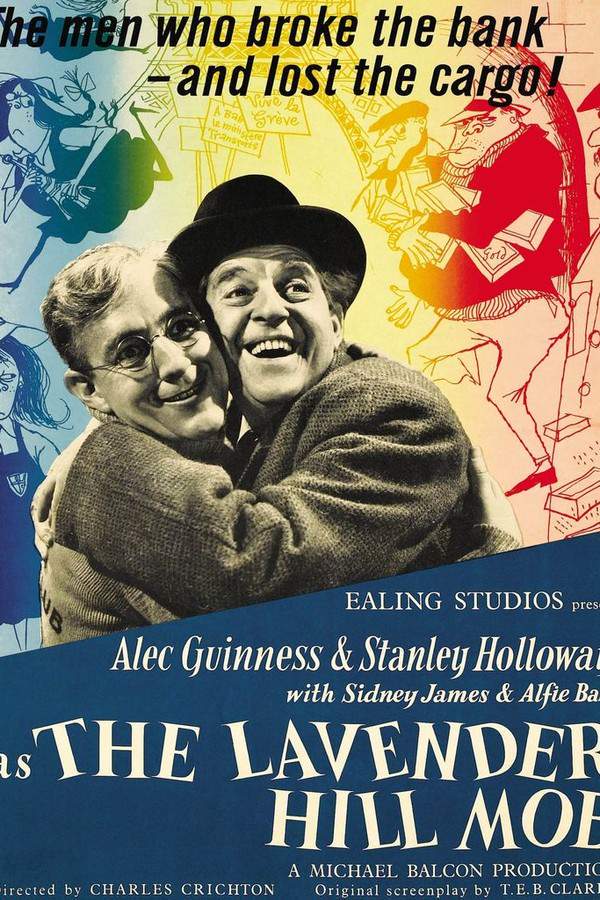
The Lavender Hill Mob (1951) movie poster

Plot Summary

The Lavender Hill Mob (1951) Plot Summary Explained

Release, runtime and language
1951 · 78 min · English
Loading streaming availability…
Directed by
Charles Crichton
Starring
Alec Guinness, Alfie Bass, Stanley Holloway, Ronald Adam, Sidney James, Arthur Hambling

A shy bank clerk and a charming con man devise an elaborate scheme to steal gold bullion from the Bank of England. They plan to melt the gold down and transform it into miniature Eiffel Towers, hoping to sell them as souvenirs. The pair must then outwit a series of inept police investigators and navigate unexpected complications as they try to execute their audacious plan.

On this page (5)
  1. 1 Where to watch
  2. 2 What happens: full plot
  3. 3 Plot questions answered
  4. 4 Movie threads
  5. 5 Every angle
Loading streaming availability…

Full plot summary · contains spoilers

What Happens in The Lavender Hill Mob: Full Plot Summary

The whole story of The Lavender Hill Mob (1951) explained, from the opening scene to the final frame: every key event, every twist and what it all adds up to. Read it as a quick recap before the sequel, to check a scene you missed, or to finally understand what really happened.

In the lively backdrop of Rio de Janeiro, a wealthy man, Henry Holland (Alec Guinness), finds himself recounting a thrilling chapter of his life to a guest. He reflects on how his previous mundane days as a bank clerk in London evolved into an exhilarating escapade. After twenty years of monotony overseeing gold bullion deliveries, Holland becomes increasingly restless and devises a plan to escape his dull routine while exploiting the value of the precious metal.

The turning point comes with the arrival of Alfred Pendlebury (Alfie Bass), an imaginative artist residing at Holland's boarding house. It soon emerges that Pendlebury owns a foundry known for creating distinctive gifts, many of which are sent to Paris. Seeing an opportunity, Holland shares his idea with the eager artist, who is quick to support him.

As Holland faces a departmental transfer, the duo springs into action, enlisting the help of petty criminals Lackery Wood and Shorty Fisher. On the day of their audacious heist, the two criminals hijack the gold bullion van, cunningly swapping its valuable load with items transported in one of Pendlebury's work vans. Holland then assumes the role of an innocent bystander, garnering praise for his swift alerting of the authorities.

While their partners ship the melted gold, recast into Eiffel Tower paperweights for foreign markets, Holland concocts a web of misleading information to misdirect Inspector Farrow’s investigation. Although Wood and Fisher are hesitant to travel to Paris to claim their share, they trust Holland and Pendlebury with the task of distributing their rewards.

The celebration of their triumph quickly takes a chaotic turn as they realize they must reclaim the gold sent to Paris. Their adventure leads them to the iconic Eiffel Tower, where they discover that one box of their gold paperweights has been compromised, and six of them have ended up in the hands of a group of unwitting English schoolgirls. The ensuing chase for the mischievous girls spirals into a comical pursuit as they strive to recover their precious loot.

In the mayhem, Holland and Pendlebury successfully recover five paperweights but find themselves in a bind for the last one. Their quest intensifies upon learning that the final paperweight has been gifted to a policeman at an exhibition illustrating police history at Hendon Police College. As Inspector Farrow closes in on the truth, their anxiety amplifies.

With their ruse unveiled, Holland and Pendlebury hastily flee in a stolen police vehicle, triggering a wild chase through London. To further complicate their predicament, Holland uses the police radio to disseminate false information, aiming to mislead their pursuers. Their escapade takes a turn for the worse when they unknowingly offer a lift to an officer, resulting in their capture.

As Pendlebury gets caught, Holland makes a narrow escape with the remaining six golden paperweights, securing his financial future. However, back in Rio, the visitor has keenly listened to the entire saga, and it soon becomes apparent that the stolen money has vanished. As they part ways, it is unveiled that Holland is, in fact, handcuffed to his companion – a disheartening indication that his criminal misadventures have ultimately ensnared him.
Last updated: November 17, 2024 at 20:51

Was this helpful?

Plot questions answered

The Lavender Hill Mob Plot Explained: Your Questions Answered

The questions people ask most about The Lavender Hill Mob (1951): what happens in the confusing scenes, why the characters do what they do, the twists, hidden details and what the ending means. Each answer contains spoilers.

Q1

Why does Henry Holland decide to rob the gold bullion after twenty years as a bank clerk?

After spending twenty years overseeing gold bullion deliveries at the Bank of England, Holland grows increasingly restless and desires excitement beyond his monotonous routine. The arrival of Alfred Pendlebury, an artist who owns a foundry that ships items to Paris, gives Holland the idea to exploit the gold's value and escape his dull life. His boredom and longing for adventure become the catalyst for the entire heist.

Foreshadowing: The film establishes Holland's restless nature early, showing him yearning for something more than his repetitive bank clerk existence.

  • henry holland motivation
  • bank clerk
  • gold robbery
  • twenty years
  • boredom
Q2

How does the heist actually work? How do they steal the gold from the bank?

On the day of the heist, Wood and Fisher hijack the gold bullion van while it's in transit. They swap the valuable gold load with ordinary items being transported in one of Pendlebury's work vans, which are headed to the foundry. Holland then plays the innocent bystander, alerting authorities to the apparent crime while the real gold is hidden in plain sight among Pendlebury's artistic supplies.

  • heist method
  • gold swap
  • pendlebury foundry
  • wood fisher
  • bank robbery
Q3

Why do they melt the gold down into Eiffel Tower paperweights?

They recast the stolen gold into miniature Eiffel Tower paperweights to disguise the gold as artistic souvenirs. These are then shipped in Pendlebury's work vans to Paris under the guise of legitimate gift items being sent to foreign markets. The Eiffel Tower design serves as the perfect cover since Pendlebury's foundry already creates distinctive gifts for Paris.

Foreshadowing: Pendlebury's foundry, which creates gifts sent to Paris, is introduced as a key detail before the heist plan is revealed.

  • eiffel tower paperweights
  • gold melting
  • paris shipment
  • disguise gold
Q4

Why do Holland and Pendlebury have to go to Paris to recover the gold?

After the heist, they discover that several Eiffel Tower paperweights containing the gold have ended up in the hands of English schoolgirls who purchased them as souvenirs near the Eiffel Tower. They must travel to Paris to track down and recover these paperweights before the gold is lost forever, as the girls have no idea what they've actually bought.

  • paris
  • schoolgirls
  • recover gold
  • eiffel tower
  • paperweights
Q5

How does Inspector Farrow begin to uncover the crime?

Inspector Farrow grows suspicious of Holland because his story about the robbery contains inconsistencies and holes. Holland claims to be an innocent bystander who alerted the authorities, but his detailed knowledge of the crime and unusual behavior raise red flags. Additionally, Holland's fabricated misinformation campaign to misdirect the investigation actually draws more attention to the inconsistencies in his account.

  • inspector farrow
  • investigation
  • suspicion
  • police
  • holland suspicion
Q6

How does one paperweight end up at Hendon Police College?

One of the Eiffel Tower paperweights containing gold is gifted to a policeman at an exhibition illustrating police history at Hendon Police College. This makes recovering the final piece much more difficult for Holland and Pendlebury, as they must attempt to retrieve it from a police facility while Inspector Farrow is closing in on their operation.

  • hendon police college
  • paperweight
  • policeman
  • exhibition
  • final piece
Q7

What is the significance of Holland being handcuffed at the end?

The ending reveals that despite escaping with six gold paperweights and securing his financial future, Holland was ultimately captured. The handcuffs symbolize how his criminal escapades have ensnared him, providing a classic comedic consequence. His elaborate plan and brief freedom were not enough to avoid the inevitable result of his actions.

  • ending
  • handcuffed
  • capture
  • consequence
  • prison
Q8

Why don't Wood and Fisher travel to Paris to claim their share of the gold?

Although Wood and Fisher participated in the heist, they are reluctant to travel to Paris to collect their share of the proceeds. They trust Holland and Pendlebury to handle the distribution, allowing the pair to travel to Paris instead. This decision proves significant as Holland and Pendlebury must then deal with the complications of recovering the paperweights from the schoolgirls.

  • wood fisher
  • paris
  • trust
  • share gold
  • criminals
Q9

Why is Holland telling his story in Rio de Janeiro?

The film uses a framing device where Holland recounts his adventure to a visitor in Rio de Janeiro. This setting establishes that Holland has fled London after the heist. The Rio de Janeiro location emphasizes the international nature of his escape, though the ending reveals he has since been captured and is still handcuffed to his companion.

  • rio de janeiro
  • framing device
  • holland narrator
  • flashback
Q10

What happens to the stolen money by the end of the film?

Back in Rio de Janeiro, Holland discovers that the stolen money has mysteriously disappeared. This twist adds an ironic conclusion to his criminal venture, not only does he face capture, but the fortune he risked everything for is also gone. The vanished money underscores the futility of his elaborate scheme.

  • stolen money
  • vanishes
  • irony
  • fortune
  • lost

Movie threads

More Movies Like The Lavender Hill Mob, by Mood & Story

Curated lists built around what makes The Lavender Hill Mob tick: the same mood, the same kind of story or the same emotional payoff. Each list explains why these movies belong together.

Clever Capers and Witty Heists Like The Lavender Hill Mob

Stories where brilliant plans unravel with hilarious and unforeseen consequences. If you loved the ingenious plot and charming mishaps of The Lavender Hill Mob, this collection is for you. Discover more movies featuring brilliant but flawed heist plans, comedic chases, and the delightful spectacle of a well-laid scheme going charmingly wrong. Perfect for fans of lighthearted crime comedies.

  • clever
  • comical
  • mischievous
  • chase-filled
  • whimsical
  • lighthearted
  • Tone: lighthearted, whimsical, mischievous
  • Pacing: fast, energetic
Why these movies?

The story pattern: The narrative follows a group of underdogs who devise an audacious, seemingly foolproof plan to achieve a goal, typically a theft. The execution is smooth, but a small, unexpected complication—often involving a minor character or a stroke of bad luck—snowballs into a chaotic and humorous finale, forcing the protagonists to improvise wildly.

Why they belong together: Movies in this thread share a focus on intellectual cleverness undermined by farcical reality. They blend a light tone with fast pacing, ensuring the comedy stems from the situation rather than meanness. The emotional journey is one of exhilarating ambition followed by a comedic, often bittersweet, dose of reality.

Movies About Escaping Mundanity Like The Lavender Hill Mob

Ordinary characters breaking free from routine through one audacious, risky act. Fans of The Lavender Hill Mob's theme of a quiet man seeking adventure will enjoy these films. Explore stories where ordinary people break free from their dull routines through one daring scheme. These movies capture the thrill of transformation and the bittersweet price of chasing excitement.

  • escape
  • transformation
  • whimsical
  • bittersweet
  • adventure
  • ordinary hero
  • Tone: bittersweet, liberating, whimsical
  • Pacing: steady build, fast execution
Why these movies?

The story pattern: The narrative begins by establishing the protagonist's stifling, predictable existence. A catalyst presents an opportunity for a radical change, usually involving a secret plan. The core of the story is the execution of this plan, which serves as a thrilling escape, but often concludes with a poignant reminder that such radical freedom is temporary or comes with a cost.

Why they belong together: These films are grouped by their central theme of liberation from banality. They share a bittersweet tone, balancing the exhilaration of the adventure with the inevitable consequences. The pacing is often fast once the plan is in motion, reflecting the protagonist's rush into a new life, and the emotional weight is medium, acknowledging the stakes without being overly heavy.

Every angle

The Lavender Hill Mob (1951) Explained: Plot, Timeline & Characters

Everything about The Lavender Hill Mob in one place: what happens in the plot summary, the timeline in chronological order, the characters and meaning and a spoiler-free summary. What's After the Movie adds the cast, box office and post-credit scenes.

Coming soon on iOS and Android

The Plot Explained Movie Summary App

Plot summaries, endings explained and timelines on your phone. Catch up on any movie in minutes, save your favorites and never miss a twist again.

Be the first to know when we launch. Your email stays private, always.

Learn more about the app