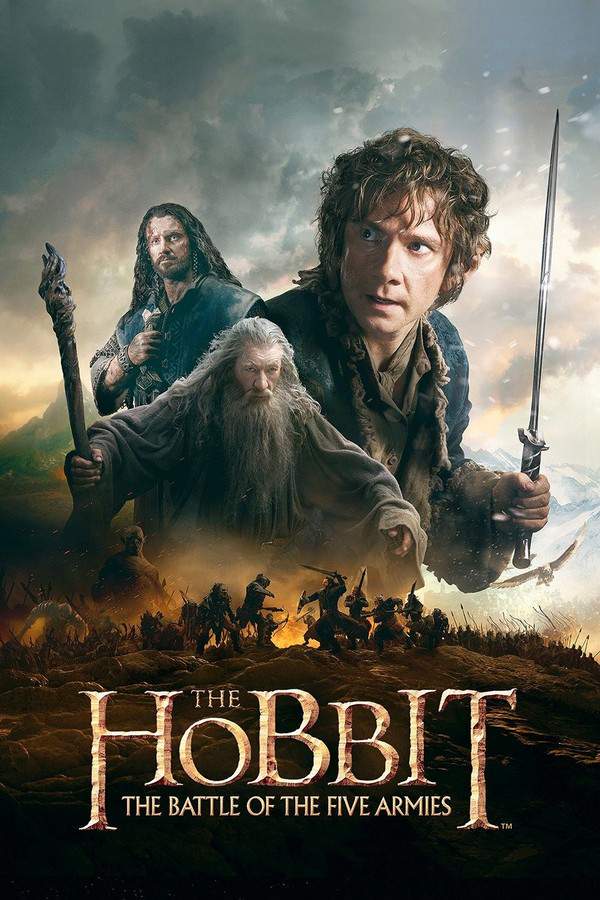
Following the destruction of Lake-town by Smaug, Thorin's relentless pursuit of treasure leads him to make devastating choices. Bilbo Baggins desperately tries to reason with him, but his warnings are ignored. As Thorin’s obsession deepens, unseen dangers arise, with Sauron’s forces mobilizing and heading toward the Lonely Mountain. Now, Dwarves, Elves, and Men must set aside their differences and join forces to confront the looming threat and determine the fate of Middle-earth.
Find where to stream, rent, or buy The Hobbit: The Battle of the Five Armies (2014) in the US with current JustWatch availability, up-to-date pricing, and platform listings for subscription, rental, and digital purchase options.
Warning: spoilers below!
Haven’t seen The Hobbit: The Battle of the Five Armies yet? This summary contains major spoilers. Bookmark the page, watch the movie, and come back for the full breakdown. If you're ready, scroll on and relive the story!
Trace every key event in The Hobbit: The Battle of the Five Armies (2014) with our detailed, chronological timeline. Perfect for unpacking nonlinear stories, spotting hidden connections, and understanding how each scene builds toward the film’s climax. Whether you're revisiting or decoding for the first time, this timeline gives you the full picture.
Last updated: November 08, 2024 at 03:50
Find frequently asked questions about the The Hobbit: The Battle of the Five Armies (2014) timeline, including chronological order, nonlinear jumps, cause-and-effect links, and scene sequence clarifications. This timeline FAQ helps explain when key events happen, how moments connect, and why the story unfolds in that specific order.
Bard kills Smaug using a special black arrow that his son Bain had kept hidden. While imprisoned by the Master of Laketown, Bard escapes and returns to the town to confront the dragon. He climbs to the bell tower and spots a gap in Smaug's armor, his exposed chest from years of lying on gold. Bard fires the black arrow directly into that weak spot, killing the dragon instantly.
Earlier scenes establish that Bard's son Bain had saved the black arrow, a heirloom that had been passed down through generations specifically for this purpose.
Thorin becomes consumed by dragon sickness, a growing obsession with the treasure hoarded by Smaug. After reclaiming Erebor, he fixates on the Arkenstone as his birthright and refuses to part with any gold, viewing it as his duty to restore his people. His pride blinds him to the desperate needs of Laketown's survivors and the political reality that refusing could lead to war.
Thorin's obsession with gold begins subtly after entering the mountain and intensifies as the treasure is revealed.
Bilbo steals the Arkenstone hoping to use it as leverage to prevent war. He secretly offers it to Bard and Thranduil, believing that having the sacred jewel in their possession would force Thorin to negotiate fairly over sharing the treasure to help the people of Laketown who lost their homes. It is an attempt to fulfill his promise to help the townspeople while avoiding bloodshed.
Bilbo's earlier unease about Thorin's growing greed and his role as the mediator foreshadow his desperate secret action.
Inside Erebor, Thorin experiences vivid hallucinations of being buried alive in gold, representing how dragon sickness has consumed him. This terrifying moment of madness brings him to his senses, he realizes his obsession has blinded him to what truly matters. He recognizes his selfishness and chooses to abandon the treasure to join his nephews and allies in battle against Azog's forces.
The gold Thorin bathes in literally and figuratively foreshadows his entanglement with the treasure's corrupting influence.
Azog kills Fíli as a tactical and personal vendetta against Thorin's line. During the battle, Azog specifically targets Fíli because he is Thorin's nephew and heir. Azog murders Fíli right in front of Bilbo and the other Dwarves, attempting to break Thorin's spirit and claim revenge for past defeats.
Azog's longstanding grudge against Thrór and his lineage, established in earlier films, sets the context for this targeted killing.
The Great Eagles are summoned by Radagast the Brown, who convinces them that the free peoples of Middle-earth face annihilation. Beorn, the skin-changer, also arrives in bear form to aid the fight. Their sudden arrival turns the tide of the battle, allowing the allied forces to gain the upper hand against Azog's Orc army.
Gandalf's earlier interactions with the Eagles and Radagast's connection to nature establish that they can be called upon in times of great need.
Kíli dies when Bolg attacks Tauriel during the battle. Kíli rushes to protect her but is struck down by Bolg's mace. His death is a tragic moment that shows his love for Tauriel, as he sacrifices himself trying to save her from the Orc berserker. Tauriel is then left to mourn his loss.
The romantic tension between Kíli and Tauriel throughout the film builds toward this heartbreaking payoff.
Thorin reconciles with Bilbo in his final moments after seeing the error of his ways. During the battle, he realizes that friendship and loyalty matter more than treasure. He apologizes to Bilbo for his behavior and thanks him for being a true friend. This moment provides emotional closure between them before Thorin succumbs to his wounds.
Thorin's earlier moment of clarity during his gold hallucinations foreshadows his ability to recognize what truly matters.
Bilbo lies to Gandalf about losing the ring because he has become powerfully attached to it. When Gandalf asks if Bilbo still has the ring, Bilbo claims he lost it and then pockets it instead of admitting the truth. This lie marks the ring's corrupting influence beginning to take hold, setting up the central conflict of The Lord of the Rings.
Bilbo's discovery of the ring's invisibility powers and his growing secrecy throughout the journey foreshadow this moment.
Thranduil advises Legolas to seek out a ranger in the northern lands known as Strider. This is a direct setup for The Lord of the Rings, as Strider is actually Aragorn, son of Arathorn. Thranduil's advice plants the seed for Legolas's future friendship and alliance with Aragorn in the War of the Ring.
The inclusion of Strider's name is a deliberate Easter egg connecting this film to the later trilogy.
Discover curated groups of movies connected by mood, themes, and story style. Browse collections built around emotion, atmosphere, and narrative focus to easily find films that match what you feel like watching right now.
Large-scale battles where victory is achieved but comes with profound personal loss.For viewers who enjoyed the massive battle and heavy emotional cost in The Hobbit: The Battle of the Five Armies. This section features movies with similar epic final confrontations and bittersweet endings, where triumph is tempered by loss. Find other fantasy and historical films that capture this poignant mix of heroic action and somber consequence.
These narratives build towards an inevitable, large-scale battle that serves as the story's climax. The journey involves uniting disparate factions against a common foe. The central conflict resolves the external threat, but the resolution is emotionally complex, often focusing on the personal toll and sacrifices required for the greater good.
Movies are grouped here for their shared structure of a culminating epic war, their high emotional weight stemming from character deaths, and their consistently bittersweet endings. The tone balances grand, action-packed spectacle with a somber, reflective aftermath, creating a specific and powerful viewing experience.
Stories where a heroic figure succumbs to corruption before a fatal redemption.If you were captivated by Thorin's descent into greed and his final redemption in The Hobbit: The Battle of the Five Armies, explore this thread. Discover similar movies about tragic heroes, their moral collapse under pressure, and their poignant, often costly, paths to redemption. Find powerful stories of flawed leadership and sacrifice.
The narrative pattern follows a central character's internal struggle. A personal weakness is exploited, leading to a moral decline that threatens allies and the mission. The story's tension arises from this internal conflict, culminating in a moment of clarity and a redemptive act that often requires the character's ultimate sacrifice, bringing a tragic but resolved conclusion.
These films are connected by a powerful, tragic character arc focused on a fall and redemption. They share a heavy emotional weight, a tense tone driven by internal conflict, and a bittersweet ending where personal salvation is achieved but at a great cost. The pacing is often fast, reflecting the character's rapid descent.
Don't stop at just watching - explore The Hobbit: The Battle of the Five Armies in full detail. From the complete plot summary and scene-by-scene timeline to character breakdowns, thematic analysis, and a deep dive into the ending - every page helps you truly understand what The Hobbit: The Battle of the Five Armies is all about. Plus, discover what's next after the movie.
Read a complete plot summary of The Hobbit: The Battle of the Five Armies, including all key story points, character arcs, and turning points. This in-depth recap is ideal for understanding the narrative structure or reviewing what happened in the movie.
Discover the characters, locations, and core themes that shape The Hobbit: The Battle of the Five Armies. Get insights into symbolic elements, setting significance, and deeper narrative meaning - ideal for thematic analysis and movie breakdowns.
Get a quick, spoiler-free overview of The Hobbit: The Battle of the Five Armies that covers the main plot points and key details without revealing any major twists or spoilers. Perfect for those who want to know what to expect before diving in.