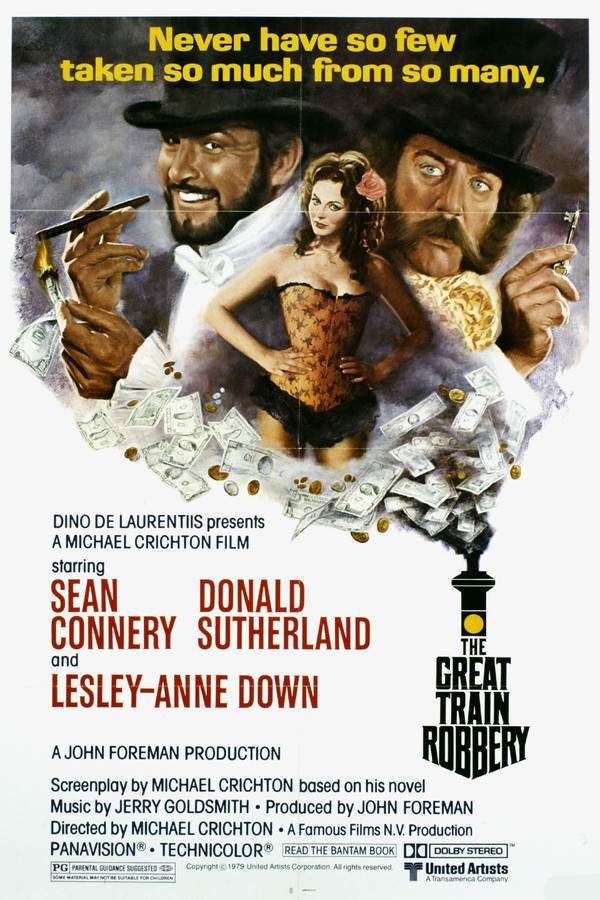
In 1855, Edward Pierce, a member of London's high society, is secretly a master thief. He hatches a bold plan to steal a monthly shipment of gold from the London-to-Folkestone train, money that is meant to pay British troops fighting in the Crimean War. The haul is guarded by two heavy safes in the baggage car, each secured by two locks, meaning four keys must be found and manipulated if the heist is to succeed.
To pull it off, Pierce assembles a small, capable team. He recruits pickpocket and screwsman Robert Agar, and he draws in his mistress Miriam and his chauffeur Barlow to participate, with train guard Burgess bribed into aiding the plot. To keep their true intentions hidden, the plan calls for wax impressions of every key, a meticulous and high-stakes ruse that could unravel at any moment.
Pierce begins by ingratiating himself with Edgar Trent, the bank's president, feigning a shared interest in “rattling” crooks. He also courts Trent's daughter, Elizabeth, hoping to learn the location of her father's key. In a daring night operation, Pierce and Agar break into Trent's house, locate the key, and craft a wax impression before slipping away into the darkness.
Next, the target shifts to Henry Fowler, the bank manager, exploiting his weakness for prostitutes. Miriam disguises herself as "Madame Lucienne," a courtesan in an exclusive bordello, and meets Fowler, prompting him to undress so that Agar can take an impression of the key worn around his neck. A staged police raid is then used to rescue Miriam, driving Fowler into a panic and a possible scandal.
With two keys secured, the remaining two are locked away in a cabinet at the offices of the South Eastern Railway in the London Bridge station. After a daytime diversionary tactic using a street child fails, Pierce bets on a night-time approach. The single guard on duty briefly leaves his post to use the toilet, offering a narrow window to strike. Pierce plans to recruit the cat burglar Clean Willy, who would scale the station walls, slip in through a skylight, and unlock the cabinet from inside. The plan requires Willy to break out of Newgate Prison, using the spectacle of a public execution as cover.
Willy does break free and helps the team obtain the final key impressions, but trouble follows when he is arrested for pickpocketing and betrays Pierce to the police. The authorities use Willy to lure Pierce into a trap, yet the mastermind remains a step ahead. Willy escapes, but is killed on Pierce’s orders by Barlow. Security around the shipment tightens: the baggage car is padlocked from the outside, and every container large enough to hold a person must be opened and checked before loading.
Pierce executes an audacious subterfuge, smuggling Agar into the baggage car disguised as a coffin. He plans to cross the coach roofs while the train roars toward Folkestone, then slip inside the van to reach the loot. A near-miss with Fowler—who is aboard to oversee the shipment—forces Miriam to ride in the same compartment to distract him, while Pierce traverses the roof and unlocks the baggage van from the outside.
Inside the van, the plan unfolds: the thieves replace the gold with lead and hurl the real bars from the moving train at a prearranged point. But a cloud of soot from the locomotive mars Pierce’s disguise, staining his skin and clothing. He borrows Agar’s suit, only to discover it is too small; the jacket tears as he disembarks at Folkestone, drawing the gaze of the surrounding authorities.
Back in custody, Pierce is put on trial for the crime. Yet the crowd adores him as a folk hero for the sheer audacity of his gambit. In the courthouse commotion, a disguised Miriam kisses him and slips a key to his handcuffs from her mouth, while Agar, masquerading as a police van driver, observes from the crowd. Before he can be hauled away, Pierce fights free and escapes with Agar, amid the roar of jubilant supporters and the silent frustration of the police. The legend of the daring thief endures, tempered by the costs paid and the lives touched along the way.