Plot Explained Spoilers guaranteed!
Plot Explained

Browse by genre

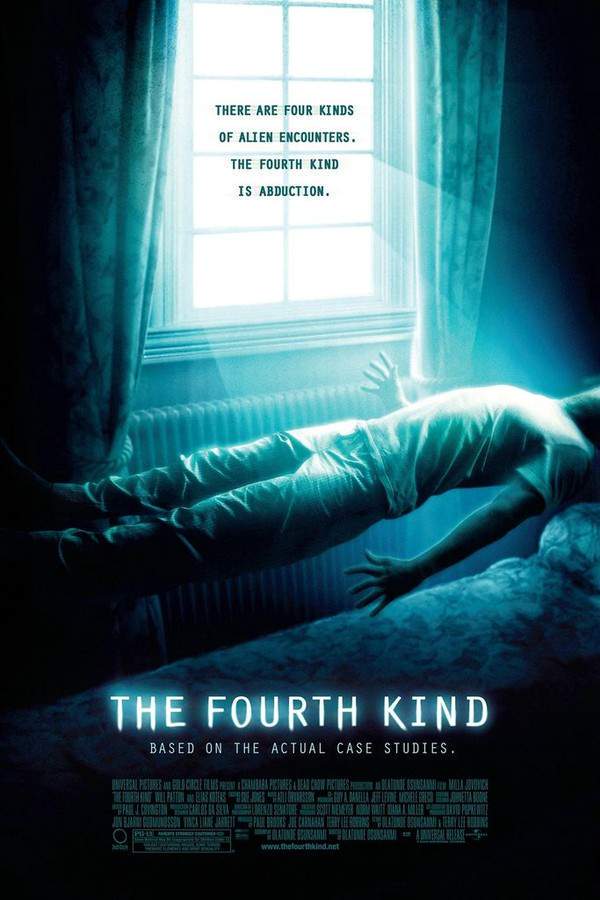
The Fourth Kind (2009) movie poster

Plot Summary

The Fourth Kind (2009) Plot Summary Explained

Release, runtime and language
2009 · 98 min · English
Directed by
Olatunde Osunsanmi
Starring
Will Patton, Elias Koteas, Milla Jovovich

A new scale is proposed to categorize unexplained phenomena: UFO sightings, collected evidence, extraterrestrial contact, and finally, alien abductions. This film explores a particularly unsettling case that challenges conventional understanding and delves into the disturbing reality of abduction experiences. Scientists and skeptics attempt to make sense of the events, revealing a complex and uncharted territory of the unknown.

On this page (6)
  1. 1 Where to watch
  2. 2 What happens: full plot
  3. 3 Plot questions answered
  4. 4 Movie threads
  5. 5 Movies like The Fourth Kind
  6. 6 Every angle

Where to watch

Where to Watch The Fourth Kind (2009)

Where can you watch The Fourth Kind? Stream, rent or buy it in the US, including on Amazon Video, Apple TV Store and Fandango At Home: current JustWatch availability with up-to-date prices.

Streaming availability powered by JustWatch

Full plot summary · contains spoilers

What Happens in The Fourth Kind: Full Plot Summary

The whole story of The Fourth Kind (2009) explained, from the opening scene to the final frame: every key event, every twist and what it all adds up to. Read it as a quick recap before the sequel, to check a scene you missed, or to finally understand what really happened.

In a gripping televised interview, psychologist Dr. Abigail "Abbey" Tyler reflects on mysterious occurrences in Nome, Alaska, leading to a harrowing alleged alien abduction in October 2000. The re-enactment unfolds back in August 2000, where Abbey's life is turned upside down when her husband, Will, is brutally murdered, leaving her to care for their two children, Ashley and Ronnie.

As part of her practice, Abbey records hypnotherapy sessions with patients who have eerie tales of a white owl watching them during sleep, followed by otherworldly creatures making attempts to enter their homes. The tension escalates one night when Abbey receives a distressing call — a patient holds his family at gunpoint, recalling a cryptic phrase, “Zimabu Eter.” In a tragic turn of events, he ends up murdering his family and takes his own life, sending shockwaves through Abbey.

Driven by suspicion that these patients may have experienced alien abductions, Abbey stumbles upon unsettling evidence regarding her own possible abduction. An assistant hands her a tape recorder that reveals haunting sounds of something sinister entering her home. When an unknown voice—speaking in a bizarre language—emanates from the recording, Abbey finds herself engulfed in disbelief and horror, especially when her colleague, Abel Campos from Anchorage, expresses skepticism about her claims. She reaches out to Dr. Awolowa Odusami, a specialist in ancient languages who knew her late husband, to decode the voice. After analysis, Odusami reveals the language to be Sumerian.

Another patient named Scott yearns to uncover the truth but reveals his fragmented memory of "them," mentioning that the owl he initially spoke of was merely a guise. Under hypnosis, mystical occurrences escalate, as Scott levitates and a voice urgently commands Abbey to end her investigation in the ancient language. That alarming incident catches the attention of Sheriff August, who believes Abbey is to blame when Scott ends up paralyzed from the neck down after their session. Despite August's efforts to arrest her, Campos vouches for Abbey's integrity.

As tensions rise, an ominous black triangular object hovers over Abbey's home, and a terrified police officer witnesses surreal events where people are pulled from the house. As chaos ensues, Abbey desperately claims that Ashley has been abducted. Sheriff August, doubting her intentions, separates Ronnie from her custody, heightening the desperation of the situation.

Determined to communicate with the alien presence responsible for her daughter’s disappearance, Abbey undergoes another round of hypnosis. In a disturbing revelation, she recalls witnessing Ashley’s abduction alongside her own. When Abbey pleads for Ashley's return, the alien entity chillingly states that Ashley will never come back and declares itself as "God." Following that harrowing encounter, Abbey loses consciousness, only to awaken in a hospital, confronted by August, who claims Will’s death was a suicide, shattering Abbey's belief that he was murdered.

As the re-enactment concludes, Abbey admits that she, along with Campos and Odusami, have no memories of their abduction experience. Questions arise regarding the validity of her claims of alien encounters, especially with her delusions about her husband's fate. Nevertheless, Abbey stands resolute, hoping beyond hope that Ashley still lives, breaking down emotionally as she grapples with this painful reality.

Freed from legal ramifications, Abbey relocates to the East Coast, where her well-being dramatically declines, requiring extensive care. Meanwhile, Campos continues his practice as a psychologist while Odusami transitions into a teaching role at a Canadian university. Both men, along with August, distance themselves from the haunting events, and Ronnie remains estranged from Abbey, still harboring resentment over Ashley’s mysterious disappearance.

Last updated: November 16, 2024 at 14:09

Was this helpful?

Plot questions answered

The Fourth Kind Plot Explained: Your Questions Answered

The questions people ask most about The Fourth Kind (2009): what happens in the confusing scenes, why the characters do what they do, the twists, hidden details and what the ending means. Each answer contains spoilers.

Q1

Why does the alien entity declare "I am God" to Abbey?

During her final hypnosis session, Abbey encounters the alien entity responsible for taking Ashley. When she pleads for her daughter's return, the entity chillingly states that Ashley will never come back and declares itself as "God." This statement appears to be the entity asserting absolute authority over human life, presenting itself as a supreme being with the power to take and keep anyone it chooses. The declaration serves as a final demonstration of its perceived omnipotence over the humans it abducts.

Foreshadowing: Earlier in the film, the voice that commands Abbey to stop her investigation speaks with the tone of an all-powerful being, hinting at this later assertion of divine status.

  • alien entity
  • god
  • ashley
  • abduction
  • hypnosis session
Q2

What happens to Ashley at the end of the movie?

Ashley is abducted by the alien entity during the chaotic events at Abbey's home. In Abbey's hypnosis session, she witnesses both herself and Ashley being taken. The entity explicitly tells Abbey that Ashley will never come back, making clear that the child is not returning to her mother. The film ends with Abbey still hoping Ashley is alive, but the entity's statement suggests she has been permanently taken.

Foreshadowing: The recurring pattern of the white owl watching over victims, followed by their abduction, establishes that those observed by the entity are eventually taken.

  • ashley
  • abduction
  • daughter
  • alien entity
  • missing child
Q3

Was Will actually murdered or did he commit suicide?

The film presents conflicting accounts of Abbey's husband Will's death. Abbey firmly believes he was brutally murdered, which sets the tragic events of the film in motion. However, at the end, Sheriff August tells Abbey in the hospital that Will's death was officially ruled a suicide. This contradiction leaves ambiguity about whether Will was killed by the aliens, murdered by someone else, or actually took his own life. The film never definitively resolves this question.

Foreshadowing: The opening scenes establish Abbey's conviction that Will was murdered, and the investigation into alien activity appears to be partly driven by her need to understand why he was killed.

  • will
  • murder
  • suicide
  • husband
  • sheriff august
Q4

What does the phrase "Zimabu Eter" mean?

The phrase "Zimabu Eter" is spoken by a patient who takes his family hostage before killing them and himself. When Dr. Awolowa Odusami analyzes the strange voice on Abbey's tape recorder, he identifies the language as Sumerian, one of the oldest known human languages. While the exact translation of "Zimabu Eter" is not explicitly stated in the film, the Sumerian connection suggests the aliens have been interacting with humans for thousands of years, using an ancient language to communicate.

Foreshadowing: The use of Sumerian hints at the aliens' long-standing presence on Earth, with ancient civilizations potentially having encounters similar to those in modern-day Nome.

  • zimu abu eter
  • sumerian
  • language
  • ancient
  • Dr. Odusami
Q5

Why does Scott become paralyzed after levitating during hypnosis?

During his hypnotherapy session with Abbey, Scott begins to levitate as mysterious phenomena occur around him. A voice urgently commands Abbey to end her investigation. Shortly after this session, Scott becomes paralyzed from the neck down. The film implies the aliens punished Scott for revealing information during hypnosis, causing his paralysis as a consequence for interfering with their activities.

Foreshadowing: Earlier patients' stories of being watched by the white owl foreshadow the dangerous consequences of investigating the alien presence.

  • scott
  • levitation
  • paralysis
  • hypnosis
  • punishment
Q6

Why does the patient kill his family after mentioning "Zimabu Eter"?

One of Abbey's patients calls her in a distressed state, holding his family at gunpoint and speaking about being tormented by his memories. He repeats the phrase "Zimabu Eter" before tragically killing his entire family and then himself. This event suggests that the aliens can manipulate or influence individuals through the knowledge they implant, driving certain people to extreme violence. The phrase appears to trigger something in the patient, possibly opening his mind to memories or voices that became unbearable.

Foreshadowing: This tragic event follows the pattern of other patients who report being watched and contacted by the white owl entity, showing the psychological toll of alien contact.

  • patient
  • family
  • hostage
  • zimu abu eter
  • violence
Q7

What is the black triangular object that hovers over Abbey's house?

A mysterious black triangular object appears and hovers over Abbey's home, marking a major escalation in the alien activity. During the chaos that follows, people are pulled from the house by unseen forces. This object represents the physical manifestation of the alien presence in Nome. It coincides with the abduction of Ashley and represents the point of no return for Abbey's family.

Foreshadowing: The triangular shape mirrors reports of UFO sightings and aligns with common depictions of alien spacecraft, connecting to the film's premise about categorizing unexplained phenomena.

  • black triangle
  • ufo
  • spacecraft
  • hovering
  • abduction
Q8

Does Abbey experience her own alien abduction?

The film presents ambiguous evidence about Abbey's own abduction. Through her hypnosis sessions, she appears to recover memories of being abducted alongside her daughter Ashley. However, at the end of the film, Abbey admits that she, along with Campos and Odusami, have no distinct memories of their alleged abduction experiences. The final scenes show her uncertain about what was real, suggesting her memories may have been false memories planted during therapy or that the aliens chose to erase their experiences.

Foreshadowing: The tape recorder capturing strange sounds entering her home and the mysterious voice speaking Sumerian hint at Abbey's direct contact with the alien presence.

  • abbey
  • abduction
  • memory
  • hypnosis
  • false memory
Q9

Why do the aliens take Ashley?

The film never explicitly explains why the aliens choose to abduct Ashley specifically. During Abbey's final hypnosis session, when she pleads for Ashley's return, the entity simply states that Ashley will never come back. The aliens appear to operate according to their own incomprehensible logic, selecting victims seemingly at random. Ashley's abduction seems to follow the pattern established with other victims in Nome, those who have been "watched" by the white owl are eventually taken.

Foreshadowing: The pattern of patients reporting being watched by the white owl before experiencing abductions establishes that observation precedes selection.

  • alien
  • ashley
  • reason
  • abduction
  • selection
Q10

Is The Fourth Kind based on a true story?

The Fourth Kind presents itself as based on "true events" by showing "actual" footage alongside re-enactments, but this is a cinematic technique. The film uses a fictional narrative set in Nome, Alaska, combining elements from various alleged abduction stories and ancient astronaut theories. The "real" footage shown is actors portraying the "re-enactments" as part of the film's fictional frame. While alien abduction claims are real phenomena reported by individuals, this specific story is not a documented case.

Foreshadowing: The film's dual format of documentary-style interviews and dramatic reenactments creates deliberate ambiguity about what is real versus performed.

  • true story
  • based on
  • real events
  • fictional
  • alleged abduction
Q11

Why does Sheriff August try to arrest Abbey?

Sheriff August becomes increasingly suspicious of Abbey as the events in Nome escalate. After Scott becomes paralyzed following his hypnosis session, August holds Abbey responsible, believing her therapy sessions are causing real harm to patients. He attempts to arrest her for her alleged role in Scott's condition. August represents the skeptical, law-enforcement perspective that views Abbey's investigation as dangerous and potentially harmful to the community.

Foreshadowing: Earlier tension between Abbey and August establishes their conflicting views, she seeks the truth about alien activity, while he sees her work as destabilizing.

  • sheriff august
  • arrest
  • suspicion
  • scott
  • paralysis
Q12

Why does Ronnie become estranged from Abbey?

After Ashley's abduction and the subsequent legal troubles, Abbey's son Ronnie becomes estranged from her. The film indicates Ronnie harbors resentment toward his mother over the situation, specifically, her inability to protect Ashley and her involvement in the events that led to their family's destruction. When Abbey moves to the East Coast and her mental health deteriorates, the distance between mother and son only increases, leaving Abbey isolated in her grief and hope that Ashley might still be alive.

Foreshadowing: The traumatic events, including losing his sister and watching his mother's psychological collapse, create an irrepairable rift in their relationship.

  • ronnie
  • estranged
  • son
  • family
  • resentment
Q13

What does the tape recorder reveal about the alien presence?

An assistant gives Abbey a tape recorder that captures sounds from her home. The recording reveals haunting evidence of something sinister entering her residence. Most disturbingly, an unknown voice speaks in a bizarre language from the recording, confirming Abbey's suspicions that something supernatural is targeting her family. This evidence drives her to seek help from Dr. Odusami, who identifies the language as Sumerian, providing concrete proof of the alien communication.

Foreshadowing: The mysterious sounds foreshadow the eventual direct contact Abbey experiences during her hypnosis sessions.

  • tape recorder
  • evidence
  • sounds
  • sumerian
  • voice recording

Movie threads

More Movies Like The Fourth Kind, by Mood & Story

Curated lists built around what makes The Fourth Kind tick: the same mood, the same kind of story or the same emotional payoff. Each list explains why these movies belong together.

Documentary-Style Psychological Horror Movies like The Fourth Kind

Horrifying truths unveiled through clinical evidence and shaky cameras. If you liked the chilling, evidence-based approach of The Fourth Kind, explore these movies that use documentary techniques, found footage, and clinical detachment to deliver psychological horror. These films create a sense of unsettling realism that makes the terror feel plausible and profoundly disturbing.

  • unsettling
  • paranoid
  • clinical
  • investigative
  • claustrophobic
  • anxious
  • Tone: tense, clinical, paranoid
  • Pacing: steady, investigative
Why these movies?

The story pattern: The narrative unfolds through a framing device, such as an investigation, interview, or the discovery of recorded evidence. The story is often presented as a puzzle to be solved, with a steady pacing that builds dread through the methodical accumulation of disturbing details rather than overt jump scares.

Why they belong together: These films are grouped by their unique presentation style, which amplifies the horror through a sense of authenticity. The shared commitment to a realistic, often clinical, viewpoint creates a specific kind of tension and paranoia that distinguishes them from more traditional horror.

Movies About Psychological Collapse and Trauma like The Fourth Kind

Protagonists pushed to the brink by unbearable personal loss and inexplicable events. For viewers who appreciated the gut-wrenching emotional weight and psychological unraveling in The Fourth Kind, this list features films where characters grapple with profound grief and trauma. These stories explore the fragile line between sanity and madness when faced with the unbearable.

  • grieving
  • traumatic
  • paranoid
  • despair
  • heavy
  • unraveling
  • Tone: bleak, tense, grieving
  • Pacing: steady, character-driven
Why these movies?

The story pattern: The plot follows a protagonist grappling with a devastating personal loss—often of a family member—while simultaneously confronting a larger, inexplicable mystery. Their pursuit of the truth becomes intertwined with their grief, causing their sanity and reality to fracture, typically culminating in a tragic or bleak resolution.

Why they belong together: This thread connects movies where the core experience is the visceral depiction of a character's mental and emotional breakdown. The shared focus on heavy emotional weight, themes of grief, and a descent into paranoia or despair creates a coherent, intensely cathartic viewing experience.

If you liked this

Movies Like The Fourth Kind

Similar movies to The Fourth Kind: the same genre, themes or kind of story. Each one comes with its own plot summary, timeline and ending explained.

Browse all movie summaries

Every angle

The Fourth Kind (2009) Explained: Plot, Timeline & Characters

Everything about The Fourth Kind in one place: what happens in the plot summary, the timeline in chronological order, the characters and meaning and a spoiler-free summary. What's After the Movie adds the cast, box office and post-credit scenes.

Coming soon on iOS and Android

The Plot Explained Movie Summary App

Plot summaries, endings explained and timelines on your phone. Catch up on any movie in minutes, save your favorites and never miss a twist again.

Be the first to know when we launch. Your email stays private, always.

Learn more about the app