Plot Explained Spoilers guaranteed!
Plot Explained

Browse by genre

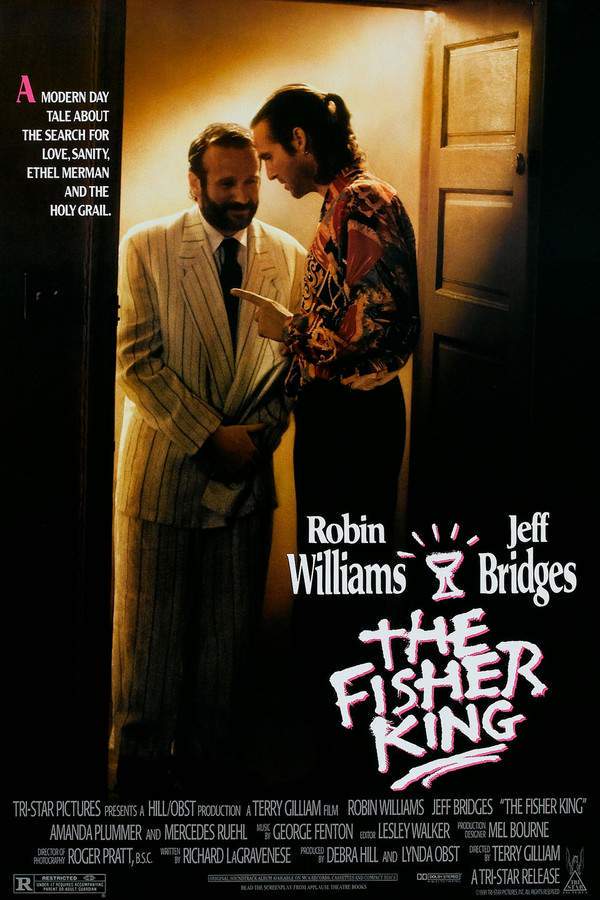
The Fisher King (1991) movie poster

Plot Summary

The Fisher King (1991) Plot Summary Explained

Release, runtime and language
1991 · 137 min · English
Starring
Jeff Bridges, Robin Williams

Following a personal tragedy, abrasive radio personality Jack Lucas finds himself consumed by despair. Simultaneously, a homeless man named Parry seeks comfort by searching for the Holy Grail. Their lives intersect, and Lucas unexpectedly joins Parry on his quest. Through this journey, Lucas is forced to confront his inner demons while both men embark on a path toward redemption and self-discovery.

On this page (6)
  1. 1 Where to watch
  2. 2 What happens: full plot
  3. 3 Plot questions answered
  4. 4 Movie threads
  5. 5 Movies like The Fisher King
  6. 6 Every angle

Where to watch

Where to Watch The Fisher King (1991)

Where can you watch The Fisher King? Stream, rent or buy it in the US, including on Xumo Play, Amazon Video and Apple TV Store: current JustWatch availability with up-to-date prices.

Streaming availability powered by JustWatch

Full plot summary · contains spoilers

What Happens in The Fisher King: Full Plot Summary

The whole story of The Fisher King (1991) explained, from the opening scene to the final frame: every key event, every twist and what it all adds up to. Read it as a quick recap before the sequel, to check a scene you missed, or to finally understand what really happened.

The film commences inside a bustling radio broadcast studio, featuring the arrogant and cynical "shock jock" Jack Lucas (played by Jeff Bridges). During a call with a listener, Edwin Malnick (Christian Clemenson), Jack dismisses Edwin's woes over a recent disastrous date, asserting that his social standing prevents any chance of success in the romantic sphere. As Jack's radio show concludes, he returns to his lavish penthouse, where he engages in a brief argument with his girlfriend, who then leaves him. Amid self-reflection punctuated by his catchphrase, “FORGIVE me!!”, Jack is shattered when he learns that Edwin, in despair, went on a shooting spree at a Manhattan restaurant, claiming several lives before taking his own.

Fast forward three years, Jack finds himself off the radio and entrenched in a profound depression. He is now living with Anne Napolitano (Mercedes Ruehl), the owner of a local video store. Jack spends much of his time drowning his sorrows in alcohol and insults a customer, prompting Anne to suggest he rest. That night, an emotionally charged altercation occurs between them as Jack, watching a TV show inspired by his radio days, disparages Anne. With a bottle in hand, he steps outside, only to be mistaken for a homeless man by a child who compassionately offers him a wooden Pinocchio doll.

As he teeters on the edge of despair by the East River, intending to end his life, he finds himself attacked by two men who regard him as a bum. Just as they are about to set him aflame, another homeless man, who introduces himself as Parry (portrayed by Robin Williams), intervenes. With a medieval flair, Parry leads a legion of fellow homeless individuals to save Jack, overwhelming his assailants.

That night, in an astonishing hallucinatory experience, Jack finds himself among Parry’s new companions under a bridge. Parry claims to be on a sacred quest for the Holy Grail, which he believes is hidden within the home of a prominent architect. Parry hints at being tormented by visions of the “little people,” who guide him on his journey, yet he is also haunted by the terrifying figure of the Red Knight, a product of his own mind. The next morning reveals more about Parry's tragic past — after losing his wife during the same incident Jack feels responsible for, he descended into madness.

Motivated by guilt, Jack pledges to support Parry. He concocts a plan to introduce Parry to a woman named Lydia (Amanda Plummer), whom Parry adores. Parry's self-doubt keeps him from approaching her, even as Jack attempts to orchestrate their meeting. The duo embarks on lively adventures across the city, sharing experiences that uplift both men.

The narrative takes a darker turn as Parry's paranoia resurfaces, and he becomes subjected to violence at the hands of the same men who previously targeted Jack. Jack learns of Parry's catatonia following this trauma, and feeling an overwhelming sense of responsibility, he returns to his previous life as a radio host while grappling with his morality and the choices he must face.

Eventually, Jack decides to fulfill Parry’s quest for the Grail, risking everything as he confronts the man's tragic past and the demons that have long shadowed them both. In a poignant climax, Jack presents the Grail to Parry, a symbolic gesture that facilitates Parry’s emotional revival. Jack’s journey culminates in reconciliation with Anne, as they explore the depths of love and forgiveness, culminating in a serene moment where Jack and Parry bask in the warmth of friendship and light-heartedness beneath the vast sky of Central Park, filled with laughter and a sense of renewal.

Last updated: October 27, 2024 at 21:33

Was this helpful?

Plot questions answered

The Fisher King Plot Explained: Your Questions Answered

The questions people ask most about The Fisher King (1991): what happens in the confusing scenes, why the characters do what they do, the twists, hidden details and what the ending means. Each answer contains spoilers.

Q1

Why did Edwin go on a shooting spree after calling Jack's radio show?

Edwin called Jack's radio show seeking advice about a disastrous date. Jack cruelly dismissed him, telling him his social standing made any romantic success impossible. This brutal dismissal, combined with Edwin's apparent mental instability, drove him to commit the shooting spree at a Manhattan restaurant. Jack's careless words became the catalyst for a tragedy that would haunt him for years.

Foreshadowing: Earlier in the film, Jack's arrogance and cruelty toward callers foreshadow the devastating consequences of his reckless on-air behavior.

  • edwin malnick
  • shooting spree
  • radio show
  • jack's fault
  • guilt
Q2

How did Parry lose his wife?

Parry's wife was killed during the same shooting spree at the Manhattan restaurant that Jack feels responsible for. She was one of the innocent victims in Edwin's mass shooting. This tragedy broke Parry mentally, causing him to descend into homelessness and madness, ultimately leading him to embark on his mystical quest for the Holy Grail as a way to cope with his grief and trauma.

Foreshadowing: The film reveals early that the traumatic incident affects multiple lives, connecting Jack and Parry through this shared tragedy.

  • parry's wife
  • shooting
  • manhattan restaurant
  • death
  • trauma
Q3

What is the significance of the Holy Grail in the story?

The Holy Grail represents Parry's psychological coping mechanism, a magical quest to restore meaning after losing his wife. He believes finding it will bring her back and cleanse his traumatized mind. For Jack, helping Parry find the Grail becomes a path to redemption for his role in the original tragedy. The Grail ultimately serves as a symbolic vehicle for both men's healing and reconciliation.

Foreshadowing: Parry mentions the Grail early in his introduction, framing it as a sacred mission that gives his life direction.

  • holy grail
  • quest
  • symbolism
  • redemption
  • parry's mission
Q4

Who are the "little people" and the Red Knight that Parry sees?

The "little people" and the Red Knight are manifestations of Parry's schizophrenia and PTSD from witnessing his wife's death. The little people appear as guiding visions that direct him on his quest, while the Red Knight represents the traumatic memory of the shooting, the terrifying figure from that night. These hallucinations are products of his broken mind trying to process unimaginable grief and survivor's guilt.

Foreshadowing: Parry's first appearance under the bridge reveals his hallucinatory state, establishing the mental fragility that defines his character.

  • little people
  • red knight
  • hallucination
  • schizophrenia
  • parry's visions
Q5

Why does Jack decide to help Parry after being saved by him?

Jack feels overwhelming guilt over the shooting spree he indirectly caused. When he learns that Parry's wife was killed in that same incident, his guilt intensifies. Seeing Parry's vulnerable state and learning his tragic backstory motivates Jack to help him find the Grail, not just as redemption, but as concrete action to make amends for the lives destroyed by his careless words.

Foreshadowing: Jack's attempt at suicide by the East River shows his desperate state before Parry saves him, establishing the guilt that drives his later actions.

  • jack's guilt
  • helping parry
  • redemption
  • responsibility
  • friendship
Q6

What does the wooden Pinocchio doll represent?

A child mistakes Jack for a homeless man and offers him a wooden Pinocchio doll. The doll symbolizes innocence, compassion, and the possibility of transformation, just as Pinocchio becomes a real boy, Jack may transform from his corrupted self. This act of kindness from a child marks a turning point, reminding Jack that goodness exists even in his darkest moment, and it occurs just before his attackers arrive.

Foreshadowing: This moment occurs right before Jack is attacked, representing the brief flicker of hope before his lowest point.

  • pinocchio doll
  • innocence
  • kindness
  • child
  • symbolism
Q7

Why does Jack return to being a radio host?

Jack returns to radio hosting to fund and support Parry's quest for the Grail, as well as to confront his past. After Parry is beaten and left in a catatonic state, Jack feels responsible and needs a source of income and platform to help his friend. Returning to radio represents Jack grappling with his past career, facing the very tool that caused the tragedy and repurposing it for something positive.

Foreshadowing: The film cycles between Jack's radio persona and his new life, making his return a significant character arc moment.

  • radio host
  • returning to radio
  • parry's care
  • redemption
Q8

How does Jack fulfill Parry's quest for the Holy Grail?

Jack presents Parry with a golden cup he has obtained, symbolically giving him the Holy Grail. This act represents Jack finally taking responsibility for the tragedy and offering Parry the redemption and meaning he has been searching for. The Grail itself is less important than what it symbolizes, the possibility of healing, forgiveness, and closure for both men.

Foreshadowing: Parry's quest has been built up throughout the film, making Jack's gesture the payoff for this central storyline.

  • grail presentation
  • parry's revival
  • symbolic act
  • healing
Q9

Why does the film end on a hopeful note despite its dark subject matter?

The film balances darkness with hope through Jack and Parry's friendship. Both men transform: Jack learns empathy and takes responsibility, while Parry finds closure and emotional revival. Their connection demonstrates that healing is possible even after profound trauma. The bittersweet ending acknowledges that scars remain but suggests renewal is achievable through human connection and forgiveness.

Foreshadowing: Throughout the film, moments of levity and connection foreshadow the ultimate healing both characters achieve.

  • hopeful ending
  • redemption
  • healing
  • friendship
  • bittersweet
  • forgiveness
Q10

Why does Jack try to set Parry up with Lydia?

Jack orchestrates a meeting between Parry and Lydia, a woman Parry admires from afar but feels too unworthy to approach. Jack's motivation stems from guilt and a desire to make things right, he wants to give Parry happiness as a form of redemption. The failed or complicated meeting highlights Parry's struggles with self-worth following his trauma, and it deepens Jack's commitment to helping his new friend.

Foreshadowing: Parry's admiration for Lydia is introduced early, making this subplot a consistent thread in their friendship.

  • lydia
  • parry's love interest
  • jack's plan
  • self-worth

Movie threads

More Movies Like The Fisher King, by Mood & Story

Curated lists built around what makes The Fisher King tick: the same mood, the same kind of story or the same emotional payoff. Each list explains why these movies belong together.

Quirky urban dramas like The Fisher King

Stories where the grimy city hides moments of magic and unlikely connection. If you liked the blend of gritty city life and fantastical hope in The Fisher King, explore more movies like it. This list features bittersweet stories where unlikely friendships and a touch of magic bring healing amidst urban melancholy and themes of mental health.

  • quirky
  • melancholic
  • urban-fantasy
  • hopeful
  • introspective
  • redemptive
  • Tone: bittersweet, quirky, melancholic
  • Pacing: steady, character driven
Why these movies?

The story pattern: Stories in this thread typically follow damaged characters navigating a realistic, often gritty urban landscape. Their journey is punctuated by surreal, quirky, or fantastical elements that provide an escape or a new perspective, leading to a character-driven quest for meaning and redemption.

Why they belong together: These movies are grouped by their distinctive tone: a blend of melancholic realism with hopeful, quirky, or even magical elements. They share a STEADY, character-focused pacing and a MEDIUM intensity that balances heavy emotional themes with levity, creating a uniquely bittersweet urban experience.

Movies about redemption through friendship like The Fisher King

Damaged souls find healing and purpose by helping someone else. Discover movies with themes similar to The Fisher King, where a profound journey of redemption is sparked by an unlikely friendship. These stories explore how helping another person can lead to healing from grief, guilt, and trauma, often through a symbolic quest.

  • redemptive
  • guilt-ridden
  • hopeful
  • introspective
  • quest-narrative
  • emotional
  • Tone: bittersweet, heavy, hopeful
  • Pacing: steady, journey-based
Why these movies?

The story pattern: The narrative pattern involves a guilt-ridden or traumatized protagonist whose life intersects with another broken soul. The second character's unique worldview or obsessive quest becomes the catalyst for the protagonist's journey. As they work towards a common, often symbolic goal, they shoulder each other's burdens and find a way forward together.

Why they belong together: These films share a core narrative structure of dual character arcs intertwined by a central quest. They are united by a HEAVY emotional weight centered on themes like grief and guilt, a BITTERSWEET tone that acknowledges pain while offering hope, and a focus on the transformative power of human connection.

If you liked this

Movies Like The Fisher King

Similar movies to The Fisher King: the same genre, themes or kind of story. Each one comes with its own plot summary, timeline and ending explained.

Browse all movie summaries

Every angle

The Fisher King (1991) Explained: Plot, Timeline & Characters

Everything about The Fisher King in one place: what happens in the plot summary, the timeline in chronological order, the characters and meaning and a spoiler-free summary. What's After the Movie adds the cast, box office and post-credit scenes.

Coming soon on iOS and Android

The Plot Explained Movie Summary App

Plot summaries, endings explained and timelines on your phone. Catch up on any movie in minutes, save your favorites and never miss a twist again.

Be the first to know when we launch. Your email stays private, always.

Learn more about the app