


















Plot Explained Spoilers guaranteed!
Plot Explained

Browse by genre

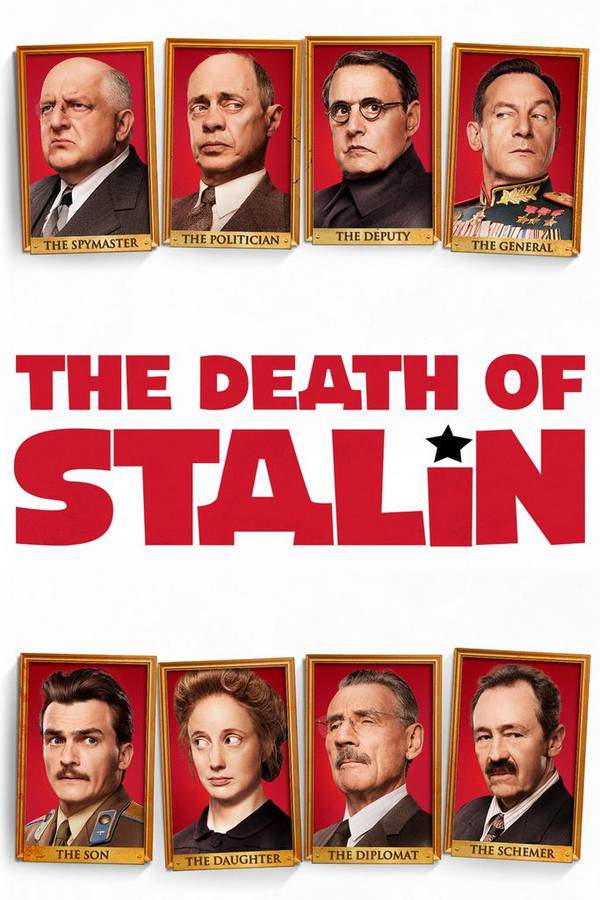
The Death of Stalin (2018) movie poster

Timeline

The Death of Stalin (2018) Timeline Explained – Every Event in Order

Release, runtime and language
2018 · 107 min · English
Echo score 85
JustWatch #1,027 65
Directed by
Armando Iannucci
Starring
Olga Kurylenko, Steve Buscemi, Jason Isaacs, Michael Palin, Andrea Riseborough, Paddy Considine
Budget
$13M

Following the sudden death of Joseph Stalin, a power vacuum erupts in Moscow. A collection of ruthless and ambitious officials, including Georgy Malenkov, Nikita Khrushchev, and Lavrentiy Beria, begin a darkly comedic and chaotic battle for control of the Soviet Union. As they maneuver for position, the nation faces a period of uncertainty and potential anarchy, leading to unexpected and often absurd consequences.

On this page (6)
  1. 1 Where to watch
  2. 2 Events in order (15)
  3. 3 Timeline questions answered
  4. 4 The book behind the movie
  5. 5 Movie threads
  6. 6 Every angle

Where to watch

Where to Watch The Death of Stalin (2018)

Where can you watch The Death of Stalin? Stream, rent or buy it in the US, including on AMC+, fuboTV and Paramount Plus Premium: current JustWatch availability with up-to-date prices.

Streaming availability powered by JustWatch

15 events in order · contains spoilers

The Death of Stalin Timeline: Events in Chronological Order

Every key event of The Death of Stalin (2018) in order, scene by scene, with when and where it takes place. Use it to untangle flashbacks, time jumps and parallel storylines, to refresh your memory before the sequel or to find the exact scene you are thinking of.

  1. Stalin's Demand

    On March 1, 1953, Joseph Stalin issues an urgent demand for a recording of Mozart's Piano Concerto No. 23. The director of Radio Moscow is given the task to secure this performance, which will prove to be a monumental challenge.

    When
    March 1, 1953
    Where
    Moscow
  2. Failure to Capture Performance

    To the director's dismay, the live performance of the concerto was not captured. Faced with the impending wrath of Stalin, the director scrambles to remedy the situation by refilling the audience and finding a new conductor.

    Where
    Moscow
  3. Maria Yudina's Resistance

    Maria Yudina, the pianist, initially resists taking part in the dictator's demand to perform. However, under pressure and bribery, she reluctantly agrees to play for the anxious gathering.

    Where
    Moscow
  4. Central Committee Meeting

    While chaos unfolds in the music world, key members of the Central Committee gather at Kuntsevo Dacha. Lavrentiy Beria reveals to Nikita Khrushchev and Deputy Chairman Georgy Malenkov that Vyacheslav Molotov is targeted for purge.

    Where
    Kuntsevo Dacha
  5. Stalin Receives the Recording

    Stalin finally receives the concert recording but discovers a scathing note penned by Yudina criticizing him. Initially amused, his mood shifts dramatically as he suffers a cerebral hemorrhage.

    Where
    Stalin's Office
  6. Discovery of Stalin's Condition

    The following morning, Stalin is found unconscious by a housemaid. The news sends shockwaves through the Central Committee, who quickly convene to take action despite lacking competent medical personnel.

    Where
    Kuntsevo Dacha
  7. Stalin's Death

    After experiencing a moment of clarity, Stalin dies due to the lack of adequate medical support. The Central Committee must now navigate the ensuing power vacuum left in the aftermath of his death.

    Where
    Kuntsevo Dacha
  8. Beria's Power Play

    With Stalin gone, Beria grabs control and orders the NKVD to eliminate the security positions previously held by the Soviet Army. This consolidates his power while also sowing distrust among the remaining leaders.

    Where
    Moscow
  9. Manipulating the Committee

    Beria begins to manipulate the remaining Central Committee members, particularly by swooping in to gain the favor of Molotov and Stalin’s children, Svetlana and Vasily, to tighten his grip on power.

    Where
    Moscow
  10. Khrushchev's Counter-Move

    Khrushchev spots an opportunity to undermine Beria by allowing transport into Moscow. This decision leads to a tragic incident where 1,500 citizens are killed, intensifying the blame game within the committee.

    Where
    Moscow
  11. Zhukov's Support

    Marshal Georgy Zhukov pledges his loyalty to Khrushchev and agrees to support a coup against Beria, contingent on timing after Stalin's funeral. This alliance sets the stage for a climactic power struggle.

    Where
    Moscow
  12. Beria's Arrest

    After strategically executing their plan, Zhukov leads an armed confrontation during a Committee meeting, resulting in Beria's arrest. This moment marks a critical turning point in the power dynamics within the Soviet leadership.

    Where
    Moscow
  13. Beria's Execution

    In a swift trial, Khrushchev reveals Beria's numerous crimes and sentences him to death. Despite Beria's desperate pleas for leniency, he is executed immediately, illustrating the brutal nature of power struggles.

    Where
    Moscow
  14. Khrushchev's Strategic Moves

    Khrushchev decides to send Svetlana away to Vienna, while keeping close tabs on Vasily. Concurrently, he realizes that Malenkov is too weak to lead effectively, tightening his own rule over the party.

    Where
    Moscow
  15. Resurgence of Maria Yudina

    In 1956, as the new political regime stabilizes, Maria Yudina returns to performing Concerto No. 23. She plays to an audience that includes a now powerful Khrushchev and the attentive future leader, Brezhnev.

    When
    1956
    Where
    Moscow

Last updated: November 08, 2024 at 01:56

Was this helpful?

Timeline questions answered

The Death of Stalin Timeline Explained: Your Questions Answered

When does it happen, and why in that order? The questions people ask about the chronology of The Death of Stalin (2018): time jumps, flashbacks, cause and effect between scenes and the correct order of events, each answered with spoilers.

Q1

Why did Maria Yudina put a note criticizing Stalin inside the record sleeve?

Maria Yudina wrote the note as a private act of defiance against the dictator who had persecuted her and countless others. She likely assumed the record would be filed away without Stalin ever listening to it personally. When Stalin demanded an urgent playback and discovered the note, it triggered his fatal cerebral hemorrhage, a bitter irony that the very act meant to express contempt for him became the instrument of his death.

Foreshadowing: Earlier in the film, Yudina resists performing for Stalin under pressure, showing her deep resentment despite her eventual compliance.

  • maria yudina
  • note
  • stalin
  • record
  • defiance
  • mozart concerto
Q2

Why did Stalin's guards refuse to enter his office when they heard him collapse?

The guards had lived in constant fear of Stalin's paranoia and purges for decades. Entering uninvited could be interpreted as an assassination attempt or espionage, potentially leading to their own execution. Their hesitation reflects the pervasive terror Stalin instilled even in his own inner circle, his cruelty had so conditioned those around him that they prioritized self-preservation over his life.

Foreshadowing: The film establishes early that anyone near Stalin could be purged at any moment, as shown when Molotov's purge is announced.

  • stalin guards
  • hesitation
  • stroke
  • fear
  • purge
Q3

Why was Stalin's medical treatment so poor after his stroke?

Stalin had systematically imprisoned or executed most of the Soviet Union's leading physicians during his purges, leaving only inexperienced or terrified doctors available. The committee frantically summoned whatever medical personnel they could find, but none possessed the expertise to properly treat a cerebral hemorrhage. This medical negligence directly contributed to Stalin's death, showcasing the deadly consequences of his own tyrannical system.

Foreshadowing: When the committee gathers, they acknowledge that most top doctors are in prison, setting up the fatal medical crisis.

  • stalin
  • medical treatment
  • stroke
  • doctors
  • purge
Q4

Why did Beria immediately order the NKVD to take over Soviet Army positions after Stalin's death?

Beria moved swiftly to consolidate power by placing the NKVD (his internal security force) in control of military security, effectively making himself the most powerful figure in the immediate power vacuum. This takeover allowed Beria to control the armed forces' loyalty and prevent any military leader from mounting a coup against him before he could secure his position.

Foreshadowing: Beria is established as the most ruthless and ambitious figure among the committee members, always seeking advantage.

  • beria
  • nkvd
  • soviet army
  • power grab
  • security
Q5

Why did allowing transport into Moscow result in 1,500 deaths?

Khrushchev deliberately countermanded Beria's order blocking transport into Moscow, knowing it would cause a massive influx of mourners grieving Stalin's death. The resulting crowd crush and chaos at the gates killed approximately 1,500 citizens. Khrushchev strategically allowed this tragedy to create a crisis he could later blame on Beria and the NKVD, providing political ammunition for his eventual coup.

Foreshadowing: Khrushchev is shown throughout as the most cunning political operator, always looking for opportunities to outmaneuver Beria.

  • 1500 deaths
  • transport
  • moscow
  • khrushchev
  • beria
  • tragedy
Q6

Why did Marshal Zhukov agree to support Khrushchev against Beria?

Zhukov harbored deep resentment toward Beria because the NKVD had been encroaching on military affairs and threatening the Soviet Army's traditional authority. Additionally, Zhukov had survived Stalin's purges partly by luck and likely feared Beria's secret police would eventually target him. Supporting Khrushchev's coup offered Zhukov protection and a chance to restore military prominence.

Foreshadowing: The film shows Beria ordering the NKVD into military positions, directly challenging the army's power.

  • zhukov
  • khrushchev
  • beria
  • coup
  • military support
Q7

Why was Beria executed so quickly after his arrest?

Beria represented an existential threat to every member of the Central Committee, his control over the NKVD meant he had compiled files on all their potential crimes and weaknesses. Khrushchev hurried the execution to prevent Beria from revealing damaging information or rallying NKVD loyalists to mount a counter-coup. The so-called trial was a theatrical kangaroo court designed purely to legitimize the execution politically.

Foreshadowing: Throughout the film, Beria manipulates and threatens other committee members, making him many powerful enemies.

  • beria
  • execution
  • trial
  • khrushchev
  • power struggle
Q8

Why did Khrushchev send Svetlana to Vienna but keep Vasily under surveillance?

Khrushchev wanted to neutralize Stalin's children as potential political threats. Svetlana, being more politically naive and less threatening, could be safely exiled to Soviet-controlled Vienna where she posed no risk. Vasily, however, was volatile and had the potential to rally support among military figures or old Stalinists, making him too dangerous to release and too valuable to eliminate outright.

Foreshadowing: Beria had previously tried to manipulate both children for his own political gain, showing their potential as pawns.

  • svetlana
  • vasily
  • khrushchev
  • vienna
  • surveillance
  • stalin children
Q9

What is the significance of the Mozart concerto returning at the end of the film?

The return of Mozart's Piano Concerto No. 23 in 1956 mirrors the opening chaos that indirectly caused Stalin's death, creating a cyclical structure. By 1956, Khrushchev has consolidated power just as Stalin once did, and the concert now plays in a stable, controlled environment. The piece represents how art survives and endures through brutal political regimes, while the powerful figures who sought to weaponize it have all been replaced.

Foreshadowing: The original concert recording incident triggered the chain of events leading to Stalin's death and the subsequent power struggle.

  • mozart concerto
  • ending
  • 1956
  • kyrshchev
  • cycle
Q10

Why was Malenkov appointed chairman if he was just Beria's pawn?

Malenkov's weakness was precisely why Beria supported his appointment, Beria believed he could manipulate the indecisive Malenkov while appearing to hold a puppet leader. The other committee members also saw Malenkov as a compromise figure who wouldn't threaten their positions. Khrushchev ultimately exploited this weakness by convincing others that Malenkov was too incompetent to lead, removing him from power once Beria was eliminated.

Foreshadowing: Beria repeatedly manipulates Malenkov throughout the film, making his control over the chairman obvious to attentive viewers.

  • malenkov
  • chairman
  • beria
  • puppet
  • power
Q11

Why did Beria remove Molotov from the purge list?

Beria was strategically recruiting allies to build his power base after Stalin's death. Removing Molotov from the purge list and releasing Molotov's wife from prison was a calculated move to earn Molotov's gratitude and potential support. This manipulation demonstrated Beria's ruthlessness, he would reverse Stalin's decisions if it served his own ambitions, showing how easily the apparatus of terror could be repurposed.

Foreshadowing: The film opens with Beria revealing Molotov's impending purge, establishing Beria as the one who controls who lives and dies.

  • molotov
  • beria
  • purge list
  • manipulation
  • allies
Q12

How did Khrushchev convince the committee that there was unanimous agreement to arrest Beria?

Khrushchev executed a bluff by claiming that Malenkov had already agreed to support the arrest, creating the impression of unanimous committee consensus. When Malenkov attempted to object, Khrushchev interrupted and speaking over him, preventing any actual dissent from being voiced. This deception allowed Zhukov to proceed with the military arrest without resistance, as committee members believed they were acting collectively.

Foreshadowing: Khrushchev's character is established as the most cunning political operator, always looking for strategic advantages.

  • khrushchev
  • unanimous vote
  • malenkov
  • deception
  • coup

Movie threads

More Movies Like The Death of Stalin, by Mood & Story

Curated lists built around what makes The Death of Stalin tick: the same mood, the same kind of story or the same emotional payoff. Each list explains why these movies belong together.

Absurdist political satires like The Death of Stalin

Darkly comedic dramas where ruthless figures battle for control of chaotic systems. If you enjoyed The Death of Stalin, discover more movies about ruthless political power struggles that mix high-stakes tension with darkly comedic absurdity. These films feature chaotic plots, cynical characters, and satirical takes on totalitarianism, providing a similar blend of history, humor, and high-intensity drama.

  • cynical
  • tense
  • absurd
  • ruthless
  • chaotic
  • satirical
  • Tone: dark, cynical, absurd
  • Pacing: fast, chaotic
Why these movies?

The story pattern: These narratives typically begin with a sudden shift in power—a death, a coup, or a crisis—that triggers a frantic and often ridiculous free-for-all among ambitious, morally bankrupt officials. The plot unfolds through a series of strategic maneuvers, betrayals, and escalating absurdities, leading to a conclusion that is seldom a clear victory for good but rather a cynical change in leadership.

Why they belong together: Movies in this thread share a unique tonal blend: the high-intensity dread of a serious political thriller mixed with the farcical humor of watching powerful people act in petty, chaotic, and illogical ways. They are united by a cynical view of power, a fast-paced and chaotic structure, and a darkly comedic sensibility.

Movies with chaotic bureaucracy like The Death of Stalin

Stories where institutional madness creates intense, fast-paced, and absurd consequences. Find more films like The Death of Stalin that depict the intense chaos within powerful bureaucracies. These movies share a fast pace, high tension, and an absurdist tone, exploring what happens when rigid systems fracture and the people inside them engage in a desperate, often darkly humorous struggle for survival and control.

  • chaotic
  • tense
  • oppressive
  • absurd
  • bureaucratic
  • frenetic
  • Tone: tense, absurd, oppressive
  • Pacing: fast, escalating
Why these movies?

The story pattern: The narrative pattern involves a large, rigid system suddenly becoming unstable. A diverse cast of characters, each with their own agenda, must navigate the new chaos, leading to a domino effect of bureaucratic blunders, strategic miscalculations, and frantic attempts to seize control. The journey is less about a single hero and more about the collective, often futile, maneuvering within a broken system.

Why they belong together: These films are grouped by their shared focus on the collapse of order within complex systems. They create a specific vibe of high-intensity confusion, where the pacing is urgent, the tone is bleakly humorous, and the setting feels both oppressive and foolish. The similarity lies in the experience of watching smart people make desperate moves in an absurdly broken world.

Every angle

The Death of Stalin (2018) Explained: Plot, Timeline & Characters

Everything about The Death of Stalin in one place: what happens in the plot summary, the timeline in chronological order, the characters and meaning and a spoiler-free summary. What's After the Movie adds the cast, box office and post-credit scenes.

Coming soon on iOS and Android

The Plot Explained Movie Summary App

Plot summaries, endings explained and timelines on your phone. Catch up on any movie in minutes, save your favorites and never miss a twist again.

Be the first to know when we launch. Your email stays private, always.

Learn more about the app