Year: 2018
Runtime: 107 min
Language: English
Director: Armando Iannucci
Echo Score: 85Budget: $13M
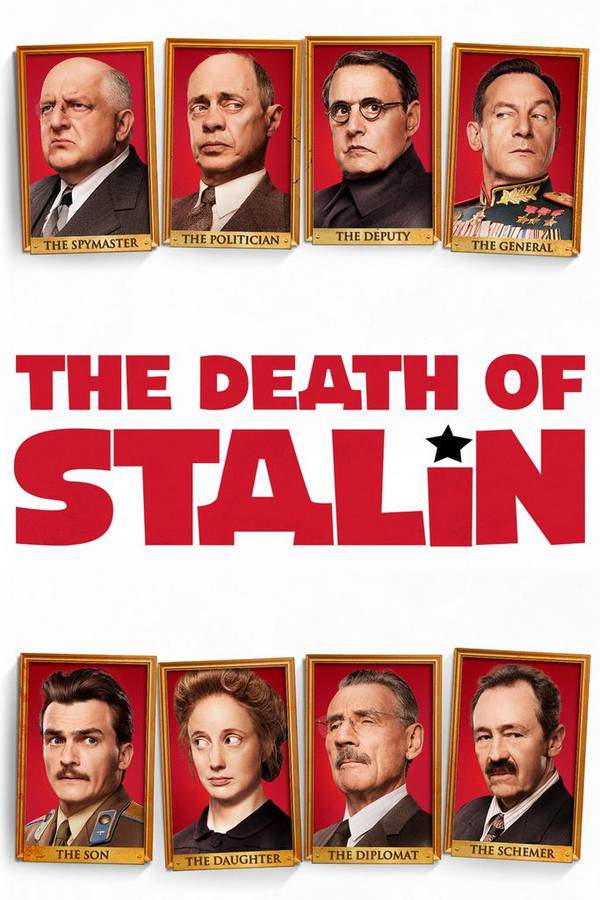
Following the sudden death of Joseph Stalin, a power vacuum erupts in Moscow. A collection of ruthless and ambitious officials, including Georgy Malenkov, Nikita Khrushchev, and Lavrentiy Beria, begin a darkly comedic and chaotic battle for control of the Soviet Union. As they maneuver for position, the nation faces a period of uncertainty and potential anarchy, leading to unexpected and often absurd consequences.
Warning: spoilers below!
Haven’t seen The Death of Stalin yet? This summary contains major spoilers. Bookmark the page, watch the movie, and come back for the full breakdown. If you're ready, scroll on and relive the story!
Read the complete plot breakdown of The Death of Stalin (2018), including all key story events, major twists, and the ending explained in detail. Discover what really happened—and what it all means.
On the fateful night of March 1, 1953, a demand from Joseph Stalin puts the future of several powerful men at stake. He urgently instructs the director of Radio Moscow to obtain a recording of the recently completed live performance of Mozart’s Piano Concerto No. 23. To his dismay, the performance was not captured. In a frantic bid to avoid Stalin’s wrath, the director quickly refills the dwindling audience, secures a new conductor to replace the original, who has suffered a collapse, and instructs the orchestra to perform once more.
Amidst this chaos, Maria Yudina, portrayed by Olga Kurylenko, initially resists the dictator’s demand to play but is ultimately coaxed into compliance through bribery. Meanwhile, at Stalin’s home, the Kuntsevo Dacha, a tumultuous gathering of Central Committee members unfolds. As Vyacheslav Molotov, played by Michael Palin, is about to leave, Lavrentiy Beria reveals to Nikita Khrushchev and Deputy Chairman Georgy Malenkov that Molotov is marked for the latest purge.
When the concert recording makes its way to Stalin, he discovers a note hidden inside the record sleeve, one in which Maria lambastes him and utters a wish for his demise. Amused at first, his laughter quickly turns to tragedy as he suffers a cerebral hemorrhage. His guards, hearing the commotion yet fearing punitive repercussions, hesitate to enter the office.
The following morning, the housemaid uncovers Stalin lying unconscious. In the wake of this shocking news, members of the Central Committee, including Kaganovich, Mikoyan, and Bulganin, hurriedly converge on the dacha and promptly decide to summon doctors, though most leading physicians have been imprisoned on dubious charges. The medical assistance is far from adequate, and after a brief moment of clarity, Stalin succumbs to his condition. As the committee heads back to Moscow, Beria seizes control, ordering the NKVD to take over security positions previously held by the Soviet Army.
In a power play, Beria and Khrushchev manipulate Molotov and Stalin’s children, Svetlana and her erratic brother Vasily, vying for their allegiance. Beria cunningly removes Molotov from the purge list and orchestrates the release of his wife from prison. Malenkov is appointed as chairman, but he swiftly becomes a pawn in Beria’s machinations, jeopardizing Khrushchev’s proposed reforms aimed at reducing political oppression.
Khrushchev, finding an opportunity to undermine Beria, counters an order preventing transport into Moscow. This decision leads to tragedy when 1,500 mourning citizens are killed, prompting the Committee to seek a scapegoat among junior NKVD operatives. Beria vehemently opposes this suggestion, aware that it could tarnish his reputation.
Riled by the encroachment of the NKVD into military affairs, Marshal Georgy Zhukov pledges his support to Khrushchev for a coup against Beria, stipulating it occurs post-Stalin’s funeral and that Khrushchev secures the backing of the Committee. Desperate, Khrushchev struggles to engage Malenkov, yet convinces others that a unanimous agreement has been reached. With the facade maintained, Khrushchev allows Zhukov to act, and the Soviet Army regains its former positions from the NKVD. Zhukov, allied with soldiers led by Kiril Moskalenko, storms a Committee meeting and arrests Beria.
Malenkov, paralyzed by fear, reluctantly signs the death warrant. During Beria’s swift trial, Khrushchev accuses him of a litany of heinous crimes, immediately sentencing him after presenting damning evidence. Despite Beria’s desperate pleas for mercy, he is executed without delay. Zhukov then arranges for his body to be incinerated, illustrating the brutal ends of political ambition.
In a surprising turn, Khrushchev decides to send Svetlana away to Soviet-controlled Vienna while keeping Vasily close under surveillance. Aligning with Kaganovich, he deems Malenkov far too weak to serve as a credible leader. By 1956, as Maria takes to the stage once more as the soloist for Concerto No. 23, the balance of power has shifted. Khrushchev, having solidified his control over the Soviet Union, attends the performance, with future leader Brezhnev keenly observing him from the audience.
Last Updated: November 08, 2024 at 01:56
Discover curated groups of movies connected by mood, themes, and story style. Browse collections built around emotion, atmosphere, and narrative focus to easily find films that match what you feel like watching right now.
Darkly comedic dramas where ruthless figures battle for control of chaotic systems.If you enjoyed The Death of Stalin, discover more movies about ruthless political power struggles that mix high-stakes tension with darkly comedic absurdity. These films feature chaotic plots, cynical characters, and satirical takes on totalitarianism, providing a similar blend of history, humor, and high-intensity drama.
These narratives typically begin with a sudden shift in power—a death, a coup, or a crisis—that triggers a frantic and often ridiculous free-for-all among ambitious, morally bankrupt officials. The plot unfolds through a series of strategic maneuvers, betrayals, and escalating absurdities, leading to a conclusion that is seldom a clear victory for good but rather a cynical change in leadership.
Movies in this thread share a unique tonal blend: the high-intensity dread of a serious political thriller mixed with the farcical humor of watching powerful people act in petty, chaotic, and illogical ways. They are united by a cynical view of power, a fast-paced and chaotic structure, and a darkly comedic sensibility.
Stories where institutional madness creates intense, fast-paced, and absurd consequences.Find more films like The Death of Stalin that depict the intense chaos within powerful bureaucracies. These movies share a fast pace, high tension, and an absurdist tone, exploring what happens when rigid systems fracture and the people inside them engage in a desperate, often darkly humorous struggle for survival and control.
The narrative pattern involves a large, rigid system suddenly becoming unstable. A diverse cast of characters, each with their own agenda, must navigate the new chaos, leading to a domino effect of bureaucratic blunders, strategic miscalculations, and frantic attempts to seize control. The journey is less about a single hero and more about the collective, often futile, maneuvering within a broken system.
These films are grouped by their shared focus on the collapse of order within complex systems. They create a specific vibe of high-intensity confusion, where the pacing is urgent, the tone is bleakly humorous, and the setting feels both oppressive and foolish. The similarity lies in the experience of watching smart people make desperate moves in an absurdly broken world.
Don't stop at just watching — explore The Death of Stalin in full detail. From the complete plot summary and scene-by-scene timeline to character breakdowns, thematic analysis, and a deep dive into the ending — every page helps you truly understand what The Death of Stalin is all about. Plus, discover what's next after the movie.
Track the full timeline of The Death of Stalin with every major event arranged chronologically. Perfect for decoding non-linear storytelling, flashbacks, or parallel narratives with a clear scene-by-scene breakdown.
Discover the characters, locations, and core themes that shape The Death of Stalin. Get insights into symbolic elements, setting significance, and deeper narrative meaning — ideal for thematic analysis and movie breakdowns.
Get a quick, spoiler-free overview of The Death of Stalin that covers the main plot points and key details without revealing any major twists or spoilers. Perfect for those who want to know what to expect before diving in.
Visit What's After the Movie to explore more about The Death of Stalin: box office results, cast and crew info, production details, post-credit scenes, and external links — all in one place for movie fans and researchers.