The Cassandra Crossing

The Cassandra Crossing

JustWatch#15,0857

Year: 1977

Runtime: 129 min

Language: English

Director: George P. Cosmatos

DramaThriller

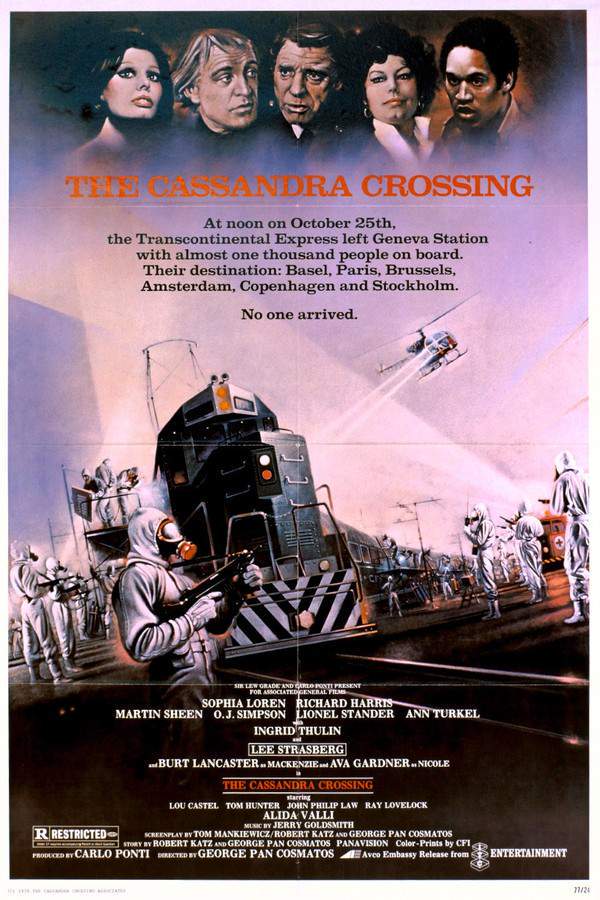
A deadly virus sweeps across a transcontinental train, triggering widespread panic among its sophisticated passengers, including Jennifer Chamberlain and her former spouse, Jonathan. Trapped and with no apparent escape, they find themselves facing terrorists and a terrifying choice: risk everything by attempting a dangerous crossing of the precarious Cassandra Bridge, or make a heartbreaking sacrifice to protect the lives of others.

Where to Watch The Cassandra Crossing?

Find where to stream, rent, or buy The Cassandra Crossing (1977) in the US with current JustWatch availability, up-to-date pricing, and platform listings for subscription, rental, and digital purchase options.

Warning: spoilers below!

Haven’t seen The Cassandra Crossing yet? This summary contains major spoilers. Bookmark the page, watch the movie, and come back for the full breakdown. If you're ready, scroll on and relive the story!

The Cassandra Crossing (1977) – Full Plot Summary & Ending Explained

Read the complete plot breakdown of The Cassandra Crossing (1977), including all key story events, major twists, and the ending explained in detail. Discover what really happened, and what it all means.

As the alarming discovery of a pneumonic plague strain at the U.S. mission within the International Health Organization comes to light, a trio of terrorists hatches a plan to unleash chaos across America. Two of these malicious figures are taken down by security forces, with one even dying despite heroic rescue attempts. However, the last remaining terrorist manages to escape and ends up hospitalized, revealing his Swedish identity. This prompts an intense exchange between Dr. Elena Stradner and Colonel Stephen Mackenzie regarding the true nature of the plague strain. Stradner fears it could be a biological weapon of mass destruction, while Mackenzie argues it's merely a strain meant for disposal.

Meanwhile, the third conspirator, Eklund, cleverly evades capture by hiding on a train traveling from Geneva to Stockholm. As Stradner pushes for the authorities to intercept this potential threat, Mackenzie voices his fears about the risk of infecting the train’s passengers. He proposes rerouting the train to an abandoned railway that leads to Janov, a former Nazi concentration camp, where the travelers could be adequately isolated. This plan, however, poses a perilous risk as it crosses the Kasundruv Bridge, an unstable steel arch structure that has been out of service since 1948.

Mackenzie is acutely aware that traversing such a treacherous route could bring about disaster, heightening the stakes for the passengers, which include a diverse array of individuals: the acclaimed neurologist Jonathan Chamberlain, accompanied by his ex-wife Jennifer Rispoli Chamberlain, a writer; Herman Kaplan, a Holocaust survivor; and Nicole Dressler, the wife of a German arms dealer involved in an affair with Robby Navarro, a young drug trafficker pursued by Haley, an undercover Interpol agent masquerading as a priest.

As Chamberlain learns about Eklund's presence on the train from Mackenzie, he is also informed of a caged basset hound inadvertently infected with the plague found among the bags. In a desperate attempt to contain the spreading disease, Mackenzie attempts a helicopter evacuation of Eklund, which ultimately fails. As the train nears a tunnel, the potential carrier dog must be hurriedly transferred to the Institute of Health Organization's laboratory, where Dr. Stradner will oversee its analysis.

Chamberlain is faced with the grim realization that the plague's mortality rate stands at an alarming 60%. Meanwhile, Mackenzie, seemingly disconnected from the dire circumstances, fabricates a story about anarchist bombs along the rail line, declaring that the train will now be redirected to Nuremberg, sealing it within an oxygen supply system and stranding it with a U.S. Army medical team. The lifeless body of the deceased terrorist lies in a hermetically sealed coffin, lingering ominously over the unfolding crisis.

Chamberlain grows increasingly uneasy as he comes to a disturbing conclusion: the disease might not be as lethal as originally feared, as only a few passengers have actually fallen ill. Taking the initiative, he radios Mackenzie to propose isolating the infected section from the rest of the train. However, Mackenzie remains rigid, adhering to orders that obscure the truth about covert biological operations conducted by American military forces in neutral territories — a scandal set to be buried beneath the rubble of the Cassandra Crossing.

As tensions heighten, Chamberlain joins forces with Haley to seize control of the train, knowing that failure to act could lead to a disastrous finale at the bridge. Back at the lab, Stradner diligently studies the recovering canine subject, but Mackenzie remains indifferent and unyielding regarding his plans. In a gripping turn of events, Navarro makes a brave bid to access the engine compartment, but his heroic attempt is thwarted by merciless guards, marking a crucial moment in the escalating tension.

Haley ultimately makes the ultimate sacrifice, selflessly giving her life to protect a young passenger amid chaos. Meanwhile, Kaplan, fueled by a desire for justice, uncovers a sinister plot to sabotage the train’s gas supply and critical coupler. Resolute, he ignites an explosion using his lighter, a courageous demonstration of his unwavering commitment.

After Kaplan's sacrifice, Chamberlain takes decisive action , successfully disconnecting the train’s rear segment to lighten the load and allow the remaining cars to cross safely. Tragically, fate intervenes as the hoped-for bridge collapses under the strain, resulting in the loss of everyone in the doomed front half.

As the surviving passengers are evacuated, they must face the stark reality of their newfound freedom — liberated from confinement and quarantine. In Geneva, a somber atmosphere envelops Stradner as he departs, weighed down by the haunting hope of potential survivors, while Mackenzie grapples with the guilt stemming from the catastrophic events that have transpired.

In a final twist, Major Stack discreetly relays to Mackenzie’s superiors that both he and Stradner are under vigilant surveillance, highlighting the relentless scrutiny awaiting them.
Last updated: November 17, 2024 at 22:09

Was this helpful?

The Cassandra Crossing (1977) Plot Questions Answered – Summary FAQ

Explore frequently asked questions about The Cassandra Crossing (1977) with spoiler-rich answers covering the full plot summary, major story beats, character motivations, hidden details, and ending meaning. This movie summary FAQ helps explain confusing scenes, plot twists, and narrative decisions in clear, searchable detail.

Q1

Why was the train rerouted to the unstable Cassandra Bridge?

A.

Colonel Mackenzie deliberately rerouted the train through Janov to cross the abandoned Kasundruv Bridge, claiming it was for quarantine isolation at a former concentration camp. However, his true intent was to contain the biological weapon scandal by eliminating all witnesses. The bridge had been out of service since 1948 and was structurally unstable, making the journey extremely dangerous.

Earlier, Mackenzie had argued with Stradner about whether the plague was a weapon meant for disposal, hinting at his willingness to bury the truth at any cost.

cassandra bridgereroutemackenziequarantinebiological weapon
Q2

What was Mackenzie hiding about the plague outbreak?

A.

Mackenzie was covering up a covert biological weapons operation conducted by American military forces in neutral territories. The pneumonic plague strain was not a naturally occurring virus but part of a secret weapons program. He fabricated stories about anarchist bombs and rerouted the train to ensure no survivors could reveal the scandal.

The debate between Stradner and Mackenzie early on reveals his insistence that the strain was 'meant for disposal,' contradicting his public messaging.

mackenziecover-upbiological weaponamerican militaryconspiracy
Q3

Was the plague actually as deadly as portrayed?

A.

Jonathan Chamberlain realized the plague was not as lethal as initially feared. While the mortality rate was 60%, only a few passengers actually became ill despite the entire train being exposed. Chamberlain proposed isolating just the infected section, but Mackenzie refused, insisting on total quarantine and redirecting the train to the dangerous bridge.

The initial panic at the International Health Organization emphasized the plague as a weapon of mass destruction, creating exaggerated fears.

plaguemortality ratechamberlaindiseaseinfection
Q4

Why did the Kasundruv Bridge collapse?

A.

The bridge had been out of service since 1948 and was a deteriorating steel arch structure. After Kaplan sabotaged the gas supply and coupler, Chamberlain disconnected the rear cars to lighten the load for the front section. However, the bridge was already weakened and could not support even the reduced weight, causing it to collapse under the strain.

Mackenzie was acutely aware from the beginning that traversing such a treacherous route could bring about disaster.

bridge collapsekasundruv bridgestructurecars crossing
Q5

Why did Herman Kaplan sacrifice himself on the train?

A.

Kaplan discovered a plot to sabotage the train's gas supply and critical coupler, likely part of Mackenzie's plan to ensure the train couldn't be stopped and everyone would perish. To prevent this and give the other passengers a chance, Kaplan deliberately ignited an explosion using his lighter, destroying the sabotage equipment but losing his life in the process.

As a Holocaust survivor, Kaplan had personal experience with institutional cruelty and recognized the authorities' malicious intent.

kaplansacrificeexplosionsabotageholocaust survivor
Q6

What happened to Haley and why did she die?

A.

Haley, an undercover Interpol agent disguised as a priest, sacrificed herself to protect a young passenger during the chaos aboard the train. While helping Chamberlain take control of the train, she gave her life to save the child, demonstrating the human cost of the crisis and the bravery of those trying to help passengers survive.

Haley's true identity as an Interpol agent was revealed earlier, establishing her as an ally working outside official channels.

haleysacrificeinterpolpriestdeath
Q7

Why did Chamberlain disconnect the train cars?

A.

After Kaplan's sacrifice, Chamberlain disconnected the rear segment of the train to lighten the load. The hope was that the reduced weight would allow the remaining cars to cross the unstable Kasundruv Bridge safely. However, the bridge still collapsed, killing everyone in the front section despite the attempt to save them.

Earlier failed attempts at helicopter evacuation and the need to transfer the infected dog showed the escalating desperation to contain the situation.

disconnectcarsbridgecrossingchamberlain
Q8

What happened to Eklund, the escaped terrorist?

A.

Eklund was the third terrorist who escaped capture by hiding on the train traveling from Geneva to Stockholm. Mackenzie attempted a helicopter evacuation of Eklund to isolate him, but the operation failed. The summary does not explicitly state Eklund's final fate, but he was still aboard when the train was rerouted, and the subsequent bridge collapse likely resulted in his death along with other passengers.

The opening scenes established Eklund as the remaining terrorist threat that prompted the entire crisis.

eklundterroristescapedhelicopterplague
Q9

What does the Cassandra Crossing refer to?

A.

The Cassandra Crossing refers to the perilous journey across the Kasundruv Bridge. The name evokes the Greek myth of Cassandra, who foresaw disaster but was never believed, a parallel to the characters who tried to warn about the danger but were ignored. The crossing becomes a literal and metaphorical journey toward inevitable catastrophe.

The bridge was known to be dangerous and out of service since 1948, making the decision to use it appear deliberately catastrophic.

cassandracrossingbridgemythdisaster
Q10

Why did the authorities face no consequences for the disaster?

A.

The film ends with a cynical view of institutional power. Mackenzie and Stradner are placed under surveillance by Major Stack, but there is no indication of legal consequences. The surviving passengers are freed from quarantine, but the truth about the biological weapons scandal remains buried, and those responsible for the disaster escape accountability.

From the beginning, Mackenzie prioritized orders and covering up the biological operations over passenger safety.

mackenzieauthoritiesaccountabilitycover-upconsequences
Q11

Why were Jonathan and Jennifer on the same train?

A.

Jonathan Chamberlain, a renowned neurologist, and his ex-wife Jennifer Rispoli Chamberlain, a writer, were both passengers on the train traveling from Geneva to Stockholm. Their presence together suggests they may have been traveling jointly despite their divorce. Their relationship becomes part of the character dynamics as they face the crisis together.

The summary mentions them as a pair from the beginning, indicating their pre-existing connection.

jonathanjenniferex-couplechamberlainpassengers
Q12

What was the Nuremberg redirect and oxygen supply system?

A.

Mackenzie fabricated a story about anarchist bombs along the rail line and announced the train would be redirected to Nuremberg. There, he planned to seal the train within an oxygen supply system and strand it with a U.S. Army medical team, effectively trapping all passengers to ensure the biological weapon scandal would never be revealed.

This extreme measure demonstrated Mackenzie's willingness to sacrifice everyone on board to protect the covert operation.

nurembergoxygensealedtrappedmackenzie
Mobile App Preview

Coming soon on iOS and Android

The Plot Explained Mobile App

From blockbusters to hidden gems - dive into movie stories anytime, anywhere. Save your favorites, discover plots faster, and never miss a twist again.

Sign up to be the first to know when we launch. Your email stays private, always.

Explore Movie Threads

Discover curated groups of movies connected by mood, themes, and story style. Browse collections built around emotion, atmosphere, and narrative focus to easily find films that match what you feel like watching right now.

Claustrophobic Containment Thrillers like The Cassandra Crossing

Characters are trapped in a confined space with a ticking-clock threat.If you liked the high-stakes panic of being trapped on a train in The Cassandra Crossing, you'll find similar tension in these movies. This thread features stories where characters are confined with a deadly threat, creating a desperate fight for survival in a limited space.

claustrophobicsuspensefulanxiousdesperateparanoidgrippingrace against time

Narrative Summary

Narratives typically begin with an ordinary situation that rapidly turns catastrophic, trapping a group of diverse characters. The plot revolves around their struggle to understand and survive the threat, often exacerbated by internal conflict, sabotage, or deception from those meant to protect them, culminating in a dramatic and costly escape or sacrifice.

Why These Movies?

These movies are grouped by their shared core experience: the visceral fear of being trapped. They consistently deliver high intensity, fast pacing, and a tense, anxious tone, making the viewer feel the characters' claustrophobia and desperation firsthand.

Movies about Institutional Paranoia like The Cassandra Crossing

Stories where the protectors become the villains in a cover-up.Fans of The Cassandra Crossing's military conspiracy will appreciate these films about authority betrayal. Explore stories where government or corporate cover-ups put innocent lives at risk, creating a mood of deep paranoia and heavy ethical dilemmas.

paranoidconspiracyethical dilemmabetrayalgrippingtragicdesperatesuspenseful

Narrative Summary

The narrative follows characters uncovering a shocking truth that those in power are orchestrating a crisis or covering up a catastrophic error. The journey involves piecing together clues despite obstruction, facing the moral horror of the conspiracy, and often ending with a bittersweet or bleak resolution where the system remains unpunished despite individual sacrifices.

Why These Movies?

These films share a common thematic core: the betrayal of trust by authority. They evoke a specific mood of paranoia and generate heavy emotional weight by exploring ethical dilemmas and the helplessness of individuals against a corrupt system.

Unlock the Full Story of The Cassandra Crossing

Don't stop at just watching - explore The Cassandra Crossing in full detail. From the complete plot summary and scene-by-scene timeline to character breakdowns, thematic analysis, and a deep dive into the ending - every page helps you truly understand what The Cassandra Crossing is all about. Plus, discover what's next after the movie.

The Cassandra Crossing Timeline

Track the full timeline of The Cassandra Crossing with every major event arranged chronologically. Perfect for decoding non-linear storytelling, flashbacks, or parallel narratives with a clear scene-by-scene breakdown.

The Cassandra Crossing Timeline

Characters, Settings & Themes in The Cassandra Crossing

Discover the characters, locations, and core themes that shape The Cassandra Crossing. Get insights into symbolic elements, setting significance, and deeper narrative meaning - ideal for thematic analysis and movie breakdowns.

Characters, Settings & Themes in The Cassandra Crossing

The Cassandra Crossing Spoiler-Free Summary

Get a quick, spoiler-free overview of The Cassandra Crossing that covers the main plot points and key details without revealing any major twists or spoilers. Perfect for those who want to know what to expect before diving in.

The Cassandra Crossing Spoiler-Free Summary

More About The Cassandra Crossing

Visit What's After the Movie to explore more about The Cassandra Crossing: box office results, cast and crew info, production details, post-credit scenes, and external links - all in one place for movie fans and researchers.

More About The Cassandra Crossing