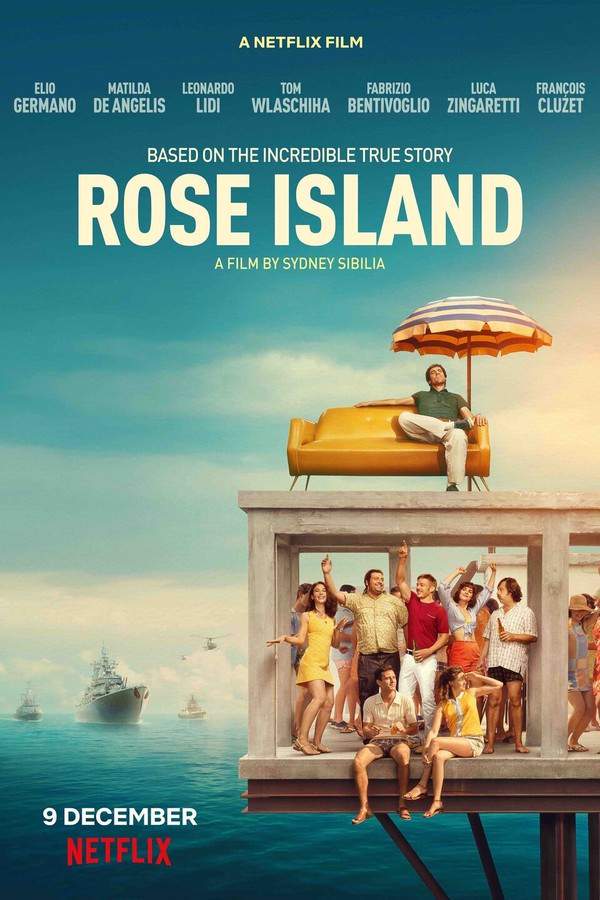
In 1968, Giorgio Rosa (Elio Germano) makes a bold move by petitioning the Council of Europe, represented by Jean Baptiste Toma (François Cluzet), to protect his self-made island. This ambitious project is a result of his innovative partnership with his friend Maurizio Orlandini (Leonardo Lidi).
The narrative transports us back a year, where we witness the rekindling of Giorgio's relationship with his ex-girlfriend Gabriella (Matilda De Angelis) in Bologna. After a fateful incident during a football match between Italy and Russia, which leads to a tragic accident involving her father’s television, their relationship hits rock bottom. Offering to drive her home, they are detained by the police due to Giorgio's makeshift car (which features his grandmother's couch as interior). His lack of a driving license lands him in jail for the night, bailed out by his father Ulisse Rosa (Andrea Pennacchi). The tension escalates when Gabriella, an International law instructor, expresses her frustrations about how Giorgio's reckless behavior has tarnished her reputation with a criminal record.
Fast forward three months, and Giorgio, now working under motorbike racer Bruno Spaggiari (Marco Pancrazi), becomes inspired by an oil platform billboard. He persuades Maurizio, who is discontent with his family business, to help him construct an island outside Italian territorial waters. With a stolen sum of 700,000 lire, they devise methods to use hollow steel poles as a floating construction system. Their ingenuity pays off, resulting in an island equipped with fresh water.
However, trouble brews that very first night as a fierce storm strikes the island, leading them to shelter a castaway welder named Pietro Bernardini (Alberto Astorri), who becomes the island's first resident. Wolfgang Rudy Neumann (Tom Wlaschiha), a stateless former German soldier, arrives next, eager to promote this newfound paradise as a tourist destination now dubbed Rose Island. Its allure attracts individuals across Europe, offering the freedom that many seek, and soon, media attention follows.
Among the new arrivals is Franca (Violetta Zironi), a young pregnant woman who, intrigued by the island's unique charm, becomes the barmaid at its only tavern. Gabriella comes to the island, prepared to confront Giorgio about her impending marriage but dismisses the legitimacy of the island, deeming it merely a "disco" without official status. Giorgio passionately counters, explaining that Rose Island has cultivated its own customs, currency, postal system, and a planned citizenship process.
As tensions rise, Franco Restivo (Fabrizio Bentivoglio), the Minister of Internal Affairs, takes notice, leading to the Italian government dispatching officers to the island. When these officers fail to report back, the situation escalates, drawing global attention. Giorgio's father is employed in a heated discussion with government officials who urge him to dismantle the island in exchange for beach club permits, and when he adamantly refuses, their retaliatory measures grow severe.
As pressure mounts, Giorgio seeks advice from Gabriella, who suggests appealing to the Council of Europe for support, further compelling Toma to analyze the situation. The Italian government issues a dire ultimatum, threatening to eradicate Rose Island. However, Giorgio stands firm, gaining the unwavering support of other residents, including Gabriella, who leaves her fiancé to join him. In solidarity, they resist the Italian navy, despite threats and cannon fire aimed at dispersing the demonstrators.
In a heart-wrenching finale, the island is ultimately blown up, yet the film poignantly closes on the rekindled romance between Giorgio and Gabriella. The historical implications of Rose Island echo through time, marking it as a significant moment — the only nation ever attacked directly by the Italian Republic. In response to this event, the UN later extends international waters from six to twelve nautical miles, ensuring that such occurrences remain a part of history.