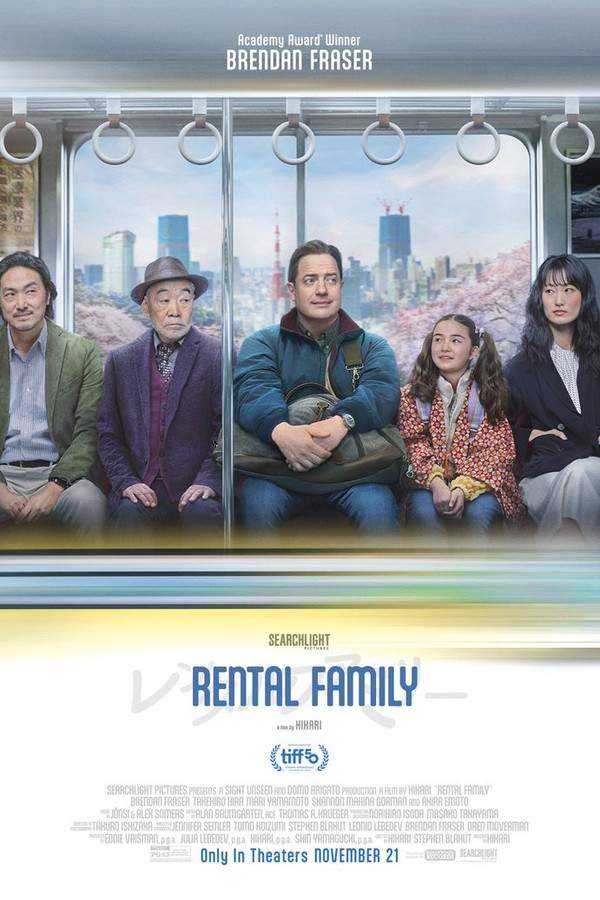
In contemporary Tokyo, a disillusioned American actor (Brendan Fraser) takes a job with a Japanese “rental family” agency, where he is hired to pose as family members for strangers. While inhabiting these temporary roles, he slowly forms real connections with his clients, causing the boundaries between his performance and his own life to dissolve. He must confront the emotional fallout and question what truly defines family.
Find where to stream, rent, or buy Rental Family (2025) in the US with current JustWatch availability, up-to-date pricing, and platform listings for subscription, rental, and digital purchase options.
Warning: spoilers below!
Haven’t seen Rental Family yet? This summary contains major spoilers. Bookmark the page, watch the movie, and come back for the full breakdown. If you're ready, scroll on and relive the story!
Trace every key event in Rental Family (2025) with our detailed, chronological timeline. Perfect for unpacking nonlinear stories, spotting hidden connections, and understanding how each scene builds toward the film’s climax. Whether you're revisiting or decoding for the first time, this timeline gives you the full picture.
Last updated: December 04, 2025 at 15:32
Find frequently asked questions about the Rental Family (2025) timeline, including chronological order, nonlinear jumps, cause-and-effect links, and scene sequence clarifications. This timeline FAQ helps explain when key events happen, how moments connect, and why the story unfolds in that specific order.
Phillip accepts the job because he needs steady income while living in Japan as a struggling actor. Although the role feels awkward, he discovers that even a fabricated commitment can carry real emotional weight, and the experience gives him a sense of purpose his other auditions haven't provided.
Earlier, Phillip is described as constantly hustling for small acting jobs after his toothpaste commercial fame faded, making his financial desperation clear from the start.
Phillip turns down a coveted acting role because he wants to continue supporting Mia through her school placement process. He recognizes that his presence has become meaningful to her and that abandoning the assignment for professional gain would undermine the trust he's built.
Earlier, Hitomi warns Phillip that getting too close could blur professional lines, but Phillip's growing attachment makes him choose the relationship over his career.
Phillip arranges the countryside trip because he sees it as a chance to help Kikuo reconnect with lost memories. The journey allows Kikuo to rediscover a buried time capsule from his past, giving Phillip a sense of purpose beyond mere performance, he becomes someone who helps others reclaim meaningful pieces of their history.
Earlier, Phillip forms a bond with Kikuo while profiling him as a journalist, and Kikuo's nostalgic stories about the countryside awaken something in Phillip about the value of genuine presence.
Shinji reveals that many of the people Phillip believed were real family members or clients, like the wife and teenage son in certain assignments, are actually actors hired by Rental Family. This devastating truth exposes how the company manipulates both clients and employees, making Phillip question whether any of his connections were genuine.
Earlier, Shinji casually mentions that endings with clients are a natural part of the work, hinting at the transactional nature underlying the operation.
Mia forgives Phillip because she recognizes that despite the deception, his care for her was genuine. Watching him in a TV movie reveals his true identity, but his consistent presence, patient listening, and support during her school interview demonstrated real emotional investment rather than hollow performance.
Earlier, Mia initially resents the idea of a stranger as a father figure but gradually warms to Phillip's patient presence, showing her capacity to recognize authentic care.
Aiko breaks character and tells the wife the truth because the work has become dangerous and emotionally harmful. Her assignments as a pretend mistress often lead to abusive situations, and reaching her breaking point represents her refusal to continue being complicit in harm while maintaining the company's exploitative business model.
Earlier, Phillip learns that Aiko's apology-service jobs frequently result in physical abuse, making clear the personal toll the work takes on employees.
Shinji accuses Phillip of kidnapping because taking Kikuo to his childhood home violated the company's rules and raised legal concerns, especially given Kikuo's fragile health and Masami's surveillance. The confrontation also stems from Shinji's fear that Phillip's growing emotional involvement threatens the transactional nature of their business.
Earlier, Masami insists on keeping Kikuo under constant surveillance, and Phillip is pressured to decline taking him to the countryside, showing the tension between genuine care and company policy.
Kikuo's death affects Phillip profoundly because their relationship transcended the professional boundary, Phillip helped him reclaim memories from his past and witnessed his vulnerable humanity. The funeral marks the end of someone who became a genuine friend rather than a client, representing the real emotional cost of the work.
Earlier, Phillip and Kikuo share quiet moments exploring Kikuo's past and the countryside, building a connection that clearly moved beyond performance.
Rental Family discontinues the apology services after Aiko breaks character and exposes the truth, revealing how harmful the work has become. The company recognizes it cannot continue exploiting employees in dangerous situations, and Phillip's confrontation with Shinji about the hollow nature of their business accelerates the reform.
Earlier, Aiko's experiences demonstrate the personal cost of these services, and Phillip's critique of the company as filling hollow spaces rather than creating real connections sets the stage for change.
After the truth emerges, Phillip and Mia's relationship transforms from a fabricated father-daughter dynamic into a genuine friendship based on mutual care. Mia gets accepted to school, and they continue spending time together without pretense, representing an authentic connection born from the unusual circumstances.
Earlier, Mia warms to Phillip despite initially resenting the stranger-as-father concept, showing the foundation for their real bond.
Phillip visits the shrine where Kikuo once prayed as a way to honor his memory and find closure. The gesture represents his acceptance of the bittersweet nature of his work, acknowledging the genuine connections formed within the artificial framework while seeking a quieter, more honest path forward.
Earlier, Phillip and Kikuo share a moment at the shrine or similar reflective space, establishing its significance to their relationship.
Hitomi warns Phillip that becoming too emotionally involved could blur the lines of his work and hurt Mia. She fears the consequences for her daughter's emotional wellbeing when a hired stranger becomes a meaningful presence, then inevitably leaves, highlighting the ethical tension between genuine connection and professional distance.
This warning occurs early in Phillip's relationship with Mia, foreshadowing the eventual revelation and the complicated feelings that follow.
Discover curated groups of movies connected by mood, themes, and story style. Browse collections built around emotion, atmosphere, and narrative focus to easily find films that match what you feel like watching right now.
Unlikely connections bring warmth and healing in the face of loneliness.Discover movies like Rental Family that explore the poignant theme of found family. If you liked the heartfelt connections and emotional healing in this film, you'll appreciate these similar stories about characters building families from unexpected bonds against a backdrop of loneliness.
The narrative pattern involves isolated characters, often due to circumstance or personal history, gradually forming deep bonds with a group of outsiders. The central conflict revolves around accepting this new, non-traditional support system, leading to a resolution that is emotionally fulfilling yet often tinged with the bittersweet recognition of what was lost or gained.
These films are grouped together because they share a core emotional arc: moving from loneliness to connection through a 'found family.' They consistently blend a melancholic tone with hopeful warmth, featuring steady, character-driven pacing that allows relationships to develop authentically, resulting in a deeply resonant viewing experience.
When playing a role becomes a journey of self-discovery.Explore films similar to Rental Family that delve into the themes of identity and performance. If you were fascinated by the main character's struggle with his professional role blurring into his real life, these movies about actors, spies, and imposters questioning their authenticity are for you.
The narrative follows a character who is paid or compelled to act a certain way, often for an audience or a specific person. As they inhabit the role, the performance begins to influence their genuine emotions and sense of self, creating internal conflict. The story unfolds as the character grapples with the authenticity of their feelings and must reconcile their two identities.
These movies are linked by a central thematic conflict between performance and authenticity. They share a mood of thoughtful melancholy and a steady pacing that allows for deep character exploration. The emotional core revolves around the tension between a constructed identity and the search for a real one, making the viewing experience intellectually and emotionally engaging.
Stories where performance blurs into genuine human connection.If you enjoyed the themes of performance and connection in Rental Family, you'll find similar stories here. Discover other movies where characters use acting or deception to find their place, exploring the bittersweet line between fiction and genuine feeling in films about found family and identity.
Narratives in this thread often follow an outsider or lonely individual who assumes a false identity or role. As they immerse themselves in this performance, the relationships they form begin to feel real, forcing them to confront the difference between the part they are playing and their true self, leading to a crisis of identity and emotional resolution.
These films are grouped by their shared exploration of performance as a pathway to human connection. They balance a bittersweet tone with a steady, character-driven pace, focusing on the emotional weight of discovering authenticity through pretend roles.
Character studies of connection and alienation in the city.For viewers who liked the portrayal of searching for connection in Tokyo in Rental Family, this section highlights similar movies. Find other thoughtful and bittersweet stories about alienation, human connection, and finding your place in a big city, featuring steady pacing and medium emotional intensity.
The narrative pattern involves a protagonist feeling adrift or isolated in a major city. Through chance encounters or deliberate choices, they slowly build connections with other lost souls, leading to a gradual sense of belonging. The story unfolds at a measured pace, focusing on small, meaningful interactions rather than high-stakes plot twists.
These movies share a specific mood: a melancholic yet heartwarming vibe born from exploring loneliness in a crowded place. They have a steady pacing that allows for reflection, a medium emotional intensity, and a bittersweet tone that acknowledges the fragility of the connections formed.
Don't stop at just watching - explore Rental Family in full detail. From the complete plot summary and scene-by-scene timeline to character breakdowns, thematic analysis, and a deep dive into the ending - every page helps you truly understand what Rental Family is all about. Plus, discover what's next after the movie.
Read a complete plot summary of Rental Family, including all key story points, character arcs, and turning points. This in-depth recap is ideal for understanding the narrative structure or reviewing what happened in the movie.
Discover the characters, locations, and core themes that shape Rental Family. Get insights into symbolic elements, setting significance, and deeper narrative meaning - ideal for thematic analysis and movie breakdowns.
What really happened at the end of Rental Family? This detailed ending explained page breaks down final scenes, hidden clues, and alternate interpretations with expert analysis and viewer theories.
Discover movies like Rental Family that share similar genres, themes, and storytelling elements. Whether you’re drawn to the atmosphere, character arcs, or plot structure, these curated recommendations will help you explore more films you’ll love.
Rental Family (2025) Plot Summary & Movie Recap
Rental Family (2025) Scene-by-Scene Movie Timeline
Rental Family (2025) Ending Explained & Theories
Rental Family (2025) Spoiler-Free Summary & Key Flow
Movies Like Rental Family – Similar Titles You’ll Enjoy
Family Romance, LLC (2020) Movie Recap & Themes
Summer Rental (1985) Story Summary & Characters
Rent a Friend (2018) Plot Summary & Ending Explained
Family Romance, LLC (2019) Detailed Story Recap
The Family Game (1983) Film Overview & Timeline
The Yen Family (1988) Spoiler-Packed Plot Recap
Tomorrow’s Family (2020) Detailed Story Recap
Return to Toyama (2020) Film Overview & Timeline
Living on Tokyo Time (1987) Complete Plot Breakdown
Mom, Is That You?! (2023) Spoiler-Packed Plot Recap
Living on Tokyo Time (1987) Story Summary & Characters
Family Happiness (1970) Ending Explained & Film Insights
#bemyfamily (1000) Complete Plot Breakdown
An Inn in Tokyo (1935) Film Overview & Timeline
We Are Family (2022) Story Summary & Characters