Plot Explained Spoilers guaranteed!
Plot Explained

Browse by genre

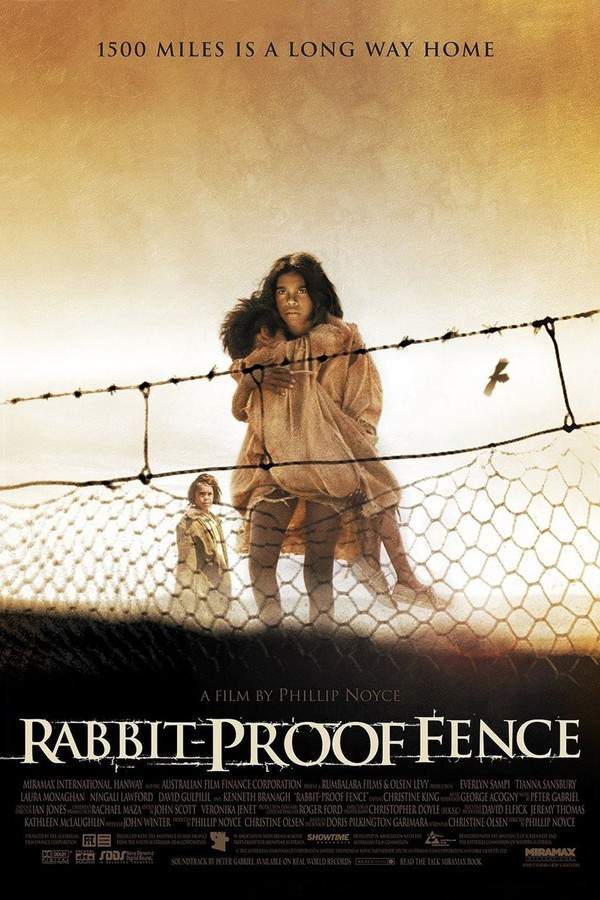
Rabbit-Proof Fence (2002) movie poster

Plot Summary

Rabbit-Proof Fence (2002) Plot Summary Explained

Release, runtime and language
2002 · 94 min · English
Starring
Everlyn Sampi

In 1931, three young Aboriginal girls are forcibly removed from their families and sent to a settlement as part of a government assimilation policy. Determined to resist, they escape and embark on a remarkable 1,500-mile journey across the harsh Australian outback, following the rabbit-proof fence. Pursued by authorities, the girls demonstrate incredible resilience and determination as they navigate the challenging landscape and fight to return home.

On this page (7)
  1. 1 Where to watch
  2. 2 What happens: full plot
  3. 3 Plot questions answered
  4. 4 The book behind the movie
  5. 5 Movie threads
  6. 6 Movies like Rabbit-Proof Fence
  7. 7 Every angle

Where to watch

Where to Watch Rabbit-Proof Fence (2002)

Where can you watch Rabbit-Proof Fence? Stream, rent or buy it in the US, including on Google Play Movies and YouTube: current JustWatch availability with up-to-date prices.

Streaming availability powered by JustWatch

Full plot summary · contains spoilers

What Happens in Rabbit-Proof Fence: Full Plot Summary

The whole story of Rabbit-Proof Fence (2002) explained, from the opening scene to the final frame: every key event, every twist and what it all adds up to. Read it as a quick recap before the sequel, to check a scene you missed, or to finally understand what really happened.

In 1931, two sisters, 14-year-old Molly and 8-year-old Daisy, along with their 10-year-old cousin Gracie, find themselves living in the remote town of Jigalong, located in Western Australia. This town is positioned along the northern section of the rabbit-proof fence, also known as Number One Fence, which stretches over a thousand miles across the country.

Meanwhile, in Perth, over a thousand miles away, the Protector of Western Australian Aborigines, A. O. Neville, often referred to as "Mr. Devil," authorizes an order to relocate these young girls to the Moore River Native Settlement. He refers to the girls as "half-castes," a term used for those with Aboriginal mothers and white fathers. In his misguided belief, Neville sees the Aboriginal people as a danger to themselves, and he is determined to ensure that the "half-castes" are bred out of existence. His plans include placing the girls in a camp where they would grow up, training them to serve as laborers and housemaids for white families, presumed to lead to eventual intermarriage and, consequently, the dilution of Aboriginal heritage within society.

The three girls are forcefully taken from their families in Jigalong by local constable Riggs and sent to the Moore River Native Settlement, situated about 90 km (55 miles) north of Perth.

At the settlement, the girls endure life in a large dormitory alongside numerous other children, tightly regulated by nuns. They are forbidden from speaking their native language and are coerced into performing Christian prayers, facing corporal punishment for any infraction against the camp's harsh rules. Attempts to escape are met with severe consequences. During an approaching thunderstorm that could cover their escape, Molly takes on the leadership role and persuades the girls to flee and find their way back home.

As they embark on their perilous journey, the girls are relentlessly tracked down by Moodoo, an Aboriginal tracker assigned to the camp. They eventually locate the rabbit-proof fence, a guide that will lead them toward home. Following this fence for several months, they narrowly avoid capture time after time. Meanwhile, Neville spreads rumors that Gracie's mother awaits her in the town of Wiluna. This misinformation reaches an Aboriginal traveler who deceives the girls.

He assures Gracie that they can reach Wiluna by train, prompting her to break away from her sisters in an effort to catch the train. Molly and Daisy pursue her and find her at the train station, but their reunion is short-lived as Riggs reappears and swiftly recaptures Gracie. The betrayal unfolds as Riggs reveals to the traveler that he will be rewarded with a shilling for his part in this deception.

Recognizing their inability to save Gracie, Molly and Daisy persist on their journey. Ultimately, after an arduous nine-week trek through the unforgiving Australian outback, they manage to cover an impressive 1,600 km (990 miles) along the fence, finally returning home to find refuge in the desert with their mother and grandmother. Meanwhile, Neville comes to the grim realization that he can no longer sustain the search for Molly and Daisy, prompting him to call it off.

Last updated: November 16, 2024 at 15:27

Was this helpful?

Plot questions answered

Rabbit-Proof Fence Plot Explained: Your Questions Answered

The questions people ask most about Rabbit-Proof Fence (2002): what happens in the confusing scenes, why the characters do what they do, the twists, hidden details and what the ending means. Each answer contains spoilers.

Q1

Why were Molly, Daisy, and Gracie taken from their families?

The three girls were forcibly removed from their families under a government assimilation policy. A.O. Neville, the Protector of Western Australian Aborigines, referred to them as "half-castes" (children with Aboriginal mothers and white fathers). Neville believed Aboriginal people were a danger to themselves and sought to eliminate the "half-caste" population by removing children from their families, placing them in camps to train as laborers, and encouraging intermarriage with white people to dilute Aboriginal heritage over time.

  • forced removal
  • half-caste
  • assimilation policy
  • government
  • children
Q2

What was A.O. Neville's motivation for removing the children?

Neville operated under a racist belief that Aboriginal people needed to be "protected" from themselves. He genuinely believed that removing "half-caste" children would prevent them from becoming a danger and that assimilating them into white society through labor training and eventual intermarriage would eventually eliminate the Aboriginal population altogether. He saw his actions as beneficial, referring to himself as the girls' protector while ordering their removal from loving families.

  • Neville
  • assimilation
  • half-caste
  • government policy
  • racism
Q3

Why did Molly decide to escape during the thunderstorm?

Molly chose the thunderstorm as cover because the loud thunder and heavy rain would mask the sounds of their escape, making it harder for the settlement staff to hear them leaving. As the oldest of the three girls at 14, Molly took leadership and convinced her sisters that the storm provided their best opportunity to flee the oppressive camp and begin the dangerous journey home.

Foreshadowing: Earlier in the settlement, the girls witnessed severe punishment for escape attempts, making Molly realize they needed maximum cover to succeed.

  • Molly
  • escape
  • thunderstorm
  • leadership
  • planning
Q4

How did the rabbit-proof fence help the girls during their journey?

The rabbit-proof fence, also known as Number One Fence, was a massive structure stretching over a thousand miles across Western Australia. Since Jigalong was positioned along the northern section of this fence, the girls used it as a constant guide to navigate home. They simply followed the fence south, knowing it would lead them back to their families in the remote town where they originally lived.

  • rabbit-proof fence
  • navigation
  • journey
  • Jigalong
  • home
Q5

Why did Gracie decide to separate from Molly and Daisy?

Neville deliberately spread false information that Gracie's mother was waiting for her in Wiluna. An Aboriginal traveler, who was deceived by authorities into believing he would receive a reward, told the girls they could reach Wiluna by train. Believing she would see her mother, Gracie broke away from her sisters to catch the train to Wiluna, not realizing it was a trap set by the authorities.

  • Gracie
  • Wiluna
  • betrayal
  • separation
  • train
Q6

Who was Moodoo and why was he tracking the girls?

Moodoo was an Aboriginal tracker assigned by the Moore River Native Settlement to find the escaped girls. As a tracker with extensive knowledge of the Australian outback, he was tasked with locating Molly, Daisy, and Gracie and returning them to the settlement. Despite being Aboriginal himself, Moodoo was employed by the system to capture the runaways, creating a painful dynamic of Aboriginal people being used to hunt other Aboriginal fugitives.

  • Moodoo
  • tracker
  • pursuit
  • capture
  • Aboriginal
Q8

What happened to Gracie after she was recaptured?

After Riggs recaptured Gracie at the train station, she was returned to the Moore River Native Settlement. The summary does not provide specific details about her subsequent life, but she remained separated from her mother, grandmother, and cousins. This separation represents one of the tragic outcomes of the forced removal policy, as thousands of Aboriginal children were never returned to their families.

  • Gracie
  • recaptured
  • settlement
  • separation
  • fate
Q9

How far did the girls walk and how long did it take them?

Molly and Daisy walked over 1,600 kilometers (approximately 990 miles) along the rabbit-proof fence over the course of nine grueling weeks. They survived extreme heat, harsh terrain, and constant threat of capture during this remarkable journey across the Australian outback. This distance exceeds the 1,500-mile journey mentioned in the movie description.

  • journey
  • distance
  • nine weeks
  • miles
  • survival
Q10

What was the government policy that allowed the forced removal of Aboriginal children?

The policy was part of what later became known as the "Stolen Generations" - a systematic Australian government practice spanning from approximately 1905 to 1969. Under various state and federal laws, Aboriginal children deemed "half-caste" were legally removed from their families and placed in institutions or with white families. The stated goal was assimilation - to eventually breed out Aboriginal heritage. This policy caused lasting trauma to generations of Aboriginal families and communities.

  • Stolen Generations
  • government policy
  • assimilation
  • forced removal
  • history
Q11

What happened when Molly and Daisy finally returned home?

After their nine-week journey, Molly and Daisy successfully reached home and found refuge with their mother and grandmother in the desert near Jigalong. Their return was a remarkable achievement of survival and determination. However, their victory was bittersweet - while they escaped capture, their cousin Gracie remained in the settlement, and the oppressive system that had taken them remained intact.

  • return
  • home
  • mother
  • grandmother
  • desert
  • survival
Q12

Why did Riggs trick Gracie with false information about her mother?

Riggs was the local constable who originally forced the girls from their families in Jigalong. The false information about Gracie's mother waiting in Wiluna was part of a deliberate strategy devised by Neville to split up the escaping girls. Riggs coordinated with the Aboriginal traveler, promising him a shilling (a small monetary reward) for his role in deceiving the girls. This betrayal was designed to make the capture of at least one of the runaways easier.

  • Riggs
  • deception
  • Wiluna
  • betrayal
  • reward

Movie threads

More Movies Like Rabbit-Proof Fence, by Mood & Story

Curated lists built around what makes Rabbit-Proof Fence tick: the same mood, the same kind of story or the same emotional payoff. Each list explains why these movies belong together.

Epic survival journey movies like Rabbit-Proof Fence

Against overwhelming odds, characters endure an epic physical and emotional trek. If you were captivated by the grueling cross-country trek in Rabbit-Proof Fence, explore these movies featuring similar epic journeys of survival. These films focus on characters pushed to their physical and emotional limits as they navigate vast, dangerous landscapes in a desperate fight to live or return home.

  • harrowing
  • desperate
  • determined
  • lonely
  • hopeful
  • grueling
  • Tone: tense, desperate, hopeful
  • Pacing: steady, journey-driven
Why these movies?

The story pattern: Movies in this thread follow a linear, goal-oriented structure: a protagonist or group is displaced and must traverse a challenging landscape to reach safety or home. The plot is driven by a series of obstacles—nature, pursuers, starvation—testing the characters' resolve and forging their resilience in a straightforward survival narrative.

Why they belong together: These films are grouped by their core premise of an epic, physical journey underpinned by high-stakes survival. They share a tense, oppressive mood, a steady pacing that mirrors the long trek, and a heavy emotional weight derived from the constant peril and the profound determination of the characters.

Movies about bittersweet resistance like Rabbit-Proof Fence

Stories where personal victory is achieved, but systemic injustice remains. For viewers moved by the resilient but incomplete victory in Rabbit-Proof Fence, this list features films with similar themes of fighting systemic oppression. These stories highlight courageous personal acts of defiance that result in bittersweet endings, where a small win is cherished even as the larger battle continues.

  • gut-wrenching
  • resilient
  • hopeful
  • oppressive
  • defiant
  • heartbreaking
  • Tone: tense, bittersweet, heavy
  • Pacing: steady
Why these movies?

The story pattern: The narrative pattern involves characters confronting a powerful, unjust institution (like a government or corporation). Their struggle is defined by resilience and a fierce desire for autonomy. The climax often brings a hard-won personal success—such as an escape or reunion—but the story acknowledges that the oppressive system itself endures, creating a poignant and realistic conclusion.

Why they belong together: These films share a heavy emotional weight derived from themes of injustice and resilience. They are united by a bittersweet ending feel, where the emotional payoff is a mixture of hope for the characters and sadness for the unchanging world, creating a complex and thought-provoking viewer experience.

If you liked this

Movies Like Rabbit-Proof Fence

Similar movies to Rabbit-Proof Fence: the same genre, themes or kind of story. Each one comes with its own plot summary, timeline and ending explained.

Browse all movie summaries

Every angle

Rabbit-Proof Fence (2002) Explained: Plot, Timeline & Characters

Everything about Rabbit-Proof Fence in one place: what happens in the plot summary, the timeline in chronological order, the characters and meaning and a spoiler-free summary. What's After the Movie adds the cast, box office and post-credit scenes.

Coming soon on iOS and Android

The Plot Explained Movie Summary App

Plot summaries, endings explained and timelines on your phone. Catch up on any movie in minutes, save your favorites and never miss a twist again.

Be the first to know when we launch. Your email stays private, always.

Learn more about the app