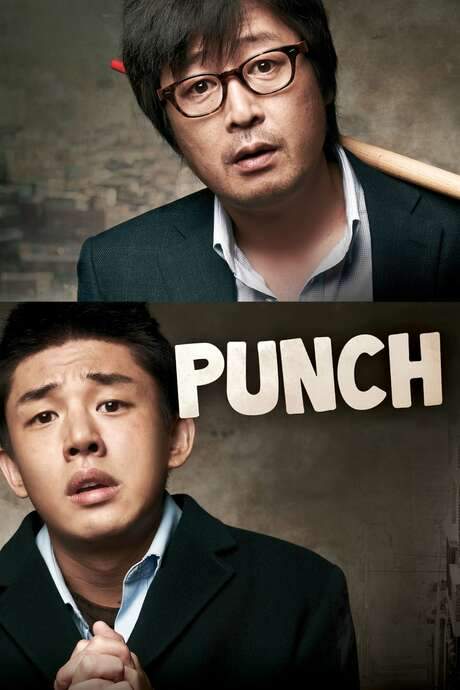
Eighteen-year-old Do Wan-deuk navigates a rough, crowded life in which family history weighs as heavily as the day-to-day grind. He lives with his hunchback father Park Soo-young and his stuttering uncle Nam Min-gu, two former cabaret clowns who now eke out a living in open-air markets after the nightclub they depended on finally closed. Wan-deuk has never known his mother, Lee Suk-hee, who walked out seventeen years earlier, and that absence has shaped him into a young fighter who channels frustration into fists.
His life takes an unexpected turn when his unconventional high school teacher, Lee Dong-joo—a man who wields a strict, unforgiving presence with his students—lives on the rooftop next door and makes it his mission to push Wan-deuk toward discipline and focus. The two men repeatedly clash, each challenging the other in ways that slowly reshape Wan-deuk’s view of himself and his world. Both are constantly subjected to barbs from a grouchy neighbor, Kim Sang-ho, who lives with his younger sister, Lee Ho-jeong. Ho-jeong is a writer of existential martial arts novels who becomes a quiet focal point in Wan-deuk’s life, offering a peculiar kind of encouragement and perspective as the story unfolds.
As circumstances force Jeong-bok and Min-gu to hit the road in search of work, Jeong-bok entrusts Dong-joo with keeping an eye on Wan-deuk, and the two men grow closer through shared responsibility and care. Dong-joo then reveals a crucial truth: Wan-deuk’s mother, Lee Suk-hee, is indeed a Filipina working in a Seongnam restaurant, a revelation that shifts Wan-deuk’s sense of belonging and kinship. This newly forged connection allows mother and son to meet for the first time, adding a layer of complexity to Wan-deuk’s loyalties and his quest for identity.
Amid these emotional currents, Jeong Yun-ha, the class’s brightest pupil, develops a soft spot for Wan-deuk after a break with her own boyfriend, Hyeok-ju. Yun-ha’s support lends Wan-deuk a fragile sense of hope as he experiments with new paths for himself, including kickboxing, which becomes a vessel for his aggression and a route to self-control. Yun-ha’s presence adds tenderness to the story, balancing Wan-deuk’s rough edges with moments of generosity and care that hint at a possible future beyond the streets and the fights.
Yet the fragile balance is threatened when Wan-deuk begins to lean heavily on Dong-joo’s mentorship. The teacher’s hard-won guidance is put to the test when Dong-joo is arrested by the police for aiding illegal immigrant workers, a turn that strips Wan-deuk of a critical anchor at a moment when he may need it most. The arrest raises questions about loyalty, resilience, and the costs of standing up for what is right, even when doing so puts those you care about at risk.
In the end, the film is a portrait of a young man coming to terms with a fractured family history while discovering the possibility of connection, responsibility, and growth in unexpected places. It explores how mentors, friends, and sometimes even rivals can push a person toward a more hopeful version of themselves, even as the world around them remains flawed and unpredictable. The story is grounded in quiet, intimate moments as much as in its larger social tensions, painting a compassionate, nuanced map of a boy who refuses to surrender to circumstance.