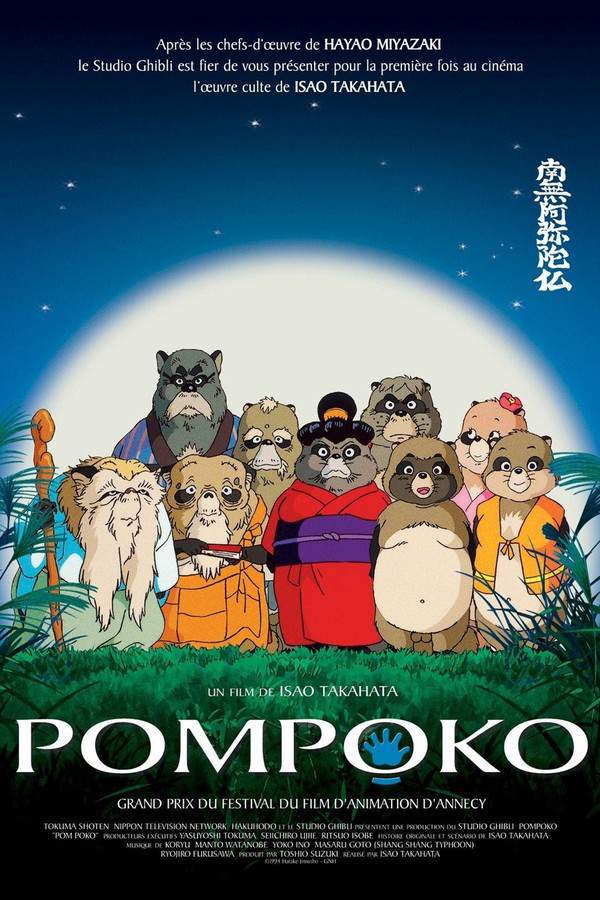
Driven by a deep connection to their forest home, a lively group of raccoons use their shape-shifting abilities to playfully disrupt and challenge the plans of developers who threaten to destroy their habitat. They employ clever disguises and mischievous tactics in an attempt to protect the natural world they cherish.
Find where to stream, rent, or buy Pom Poko (1995) in the US with current JustWatch availability, up-to-date pricing, and platform listings for subscription, rental, and digital purchase options.
Warning: spoilers below!
Haven’t seen Pom Poko yet? This summary contains major spoilers. Bookmark the page, watch the movie, and come back for the full breakdown. If you're ready, scroll on and relive the story!
Trace every key event in Pom Poko (1995) with our detailed, chronological timeline. Perfect for unpacking nonlinear stories, spotting hidden connections, and understanding how each scene builds toward the film’s climax. Whether you're revisiting or decoding for the first time, this timeline gives you the full picture.
Last updated: November 16, 2024 at 18:48
Find frequently asked questions about the Pom Poko (1995) timeline, including chronological order, nonlinear jumps, cause-and-effect links, and scene sequence clarifications. This timeline FAQ helps explain when key events happen, how moments connect, and why the story unfolds in that specific order.
The tanuki were driven to resist because the New Tama development project was destroying their forest habitat in Tama Hills, fragmenting their territory and depleting essential resources. As their living space shrank and food became scarcer during the 1990s, conflicts erupted among them over dwindling supplies. Their wise matriarch Oroku urged them to band together rather than fight each other, leading them to relearn their forgotten illusion powers to protect their home.
Early scenes show the development project encroaching on the forest, establishing the existential threat that motivates their resistance.
The ghost parade was a grand illusion created by the tanuki and three elders from Shikoku to make humans believe the area was haunted, hoping to stop the development by invoking fear of the supernatural. One elder died from the strain during the raigō ceremony, making the sacrifice profound. However, a local theme park owner falsely claimed the parade was a publicity stunt, completely undermining its impact and turning it into a marketing gimmick instead of a genuine supernatural warning.
The timeline establishes that the elders came specifically to revive respect for the supernatural, setting up the parade's purpose.
After the ghost parade failed, the tanuki's unity shattered because they disagreed on how to handle the ongoing threat. Different groups adopted radically different approaches: Gonta's faction resorted to eco-terrorism, one group sought media attention through television appeals, another elder started a Buddhist dance cult, and a few contemplated forging direct bonds with humans. This fragmentation weakened their collective resistance and reflected their desperation as conventional methods failed.
The failed ghost parade marked the turning point where hope turned to division, as the tanuki lost their shared strategy.
The tsurube-otoshi was a monstrous form created when Gonta merged with other tanuki during a desperate eco-terrorism attack. In their heroic last stand against law enforcement, they used this massive transformed body to halt a massive construction truck, sacrificing themselves in the process. Gonta's sacrifice represented the ultimate expression of commitment to protecting their habitat, choosing death over watching their home be destroyed.
Gonta was established as the fierce chief leading the resistance, making their radical choice consistent with their character.
The tanuki who lacked transformation abilities were left behind as the others blended into human society. These non-transforming tanuki struggled to survive in urban environments, forced to scavenge for food amid busy human traffic. Some ventured to the countryside where they competed with resident tanuki for territory. The parks that developers allocated for protection were too small and insufficient to support these non-transforming tanuki, leaving them in precarious situations.
The narrative establishes that not all tanuki possessed strong transformation abilities, creating a vulnerable subgroup.
In their last act of rebellion, the remaining tanuki conjured a breathtaking illusion that temporarily restored their former forest habitat in all its glory, creating a bittersweet moment of nostalgia for what was lost. Later, Shoukichi discovered a hidden clearing where non-transformed tanuki had gathered, transforming back into his tanuki form to reunite with his companions. This ending suggests that even as their physical habitat was destroyed, the tanuki community persists in hidden spaces, and those who could blend into human society found their way back.
The tanuki were established as masters of illusion, making the final spectacle a culmination of their greatest skill.
The tanuki's media campaign through television appeals did manage to garner public sympathy, which forced developers to allocate a few small parks for their protection. However, these parks were insufficient in size and number to support the entire tanuki community, especially the non-transforming members. The development continued unabated, and the small protected areas represented only a partial, inadequate victory rather than a true preservation of their habitat.
The media campaign was one of several factions' strategies after the unity broke down, showing different approaches to survival.
The tanuki sent messengers to seek legendary elders from distant lands because they needed help reviving their forgotten illusion skills and wanted to strengthen their resistance. The three elders who arrived from Shikoku, where tanuki still lived harmoniously without development threats, helped orchestrate the grand ghost parade. One elder died from the strain of the effort during the raigō ceremony, showing the physical toll these supernatural abilities required.
The timeline shows the tanuki recognized their own skills had atrophied and needed outside guidance.
After their habitat was destroyed and they grew weary from resistance, the tanuki began blending into human society, using their transformation abilities to adopt human appearances. Some succeeded in navigating urban life, while others struggled. The tanuki who couldn't transform either survived by scavenging in cities or moved to the countryside, where they faced competition from resident tanuki. Despite the loss, some found small pockets of peace in the protected parks or hidden clearings.
The narrative establishes that tanuki could assume human form, making this transition possible.
One faction of tanuki, led by an elder who descended into senility, started a Buddhist dance cult during the period of fragmentation. This group embarked on a perilous voyage that ultimately led to their doom. This storyline illustrates how the tanuki's desperation after their unity broke down led some groups to pursue increasingly erratic and self-destructive strategies.
The breakdown of unity created chaos, with different factions trying various approaches with varying degrees of sanity.
At the end of the film, Ponkichi breaks the fourth wall and directly addresses the viewer, pleading for compassion toward tanuki and other animals who lack transformation abilities. This meta-fictional moment serves as the film's emotional crescendo, transforming the story from a narrative about fantastical shape-shifters into a real-world plea for habitat preservation and empathy toward wildlife that cannot adapt to human encroachment.
The film consistently blends fantasy elements with environmental themes, building to this direct message.
The final image shows a golf course swallowing what was once the tanuki's forest, an eye-opening visualization of suburban sprawl consuming natural habitats. This stark visual represents the consequences of unchecked development - not just the loss of the tanuki's home, but the broader environmental destruction that replaces diverse ecosystems with human recreational spaces. It serves as both a literal and metaphorical closure, showing what was lost forever.
The film consistently contrasts the natural forest with human development projects throughout the narrative.
Discover curated groups of movies connected by mood, themes, and story style. Browse collections built around emotion, atmosphere, and narrative focus to easily find films that match what you feel like watching right now.
Communities use ancient magic and trickery to fight the encroachment of progress.Explore movies like Pom Poko where communities use ancient magic and folklore to resist modern development. These films blend environmental themes with mythical elements, offering bittersweet tales of resistance, adaptation, and the poignant clash between tradition and progress.
These narratives follow a community as it rallies against an existential threat, using its unique cultural or magical strengths. The conflict often escalates from mischievous pranks to more serious confrontations, leading to a resolution that involves sacrifice, adaptation, or a bittersweet acknowledgment of change.
Movies are grouped here by their shared focus on a collective struggle against modernization, the imaginative use of folklore as a narrative device, and a tone that balances whimsical antics with the serious, melancholic stakes of cultural and environmental loss.
Animated animal stories with deep, bittersweet themes about community and survival.Find movies similar to Pom Poko that use animal characters to tell profound, bittersweet stories. These animated allegories explore environmentalism, community, and change with a mix of humor and heartbreak, perfect for viewers who appreciate depth in family-friendly animation.
The narrative follows an animal community facing a crisis that mirrors human society's challenges. The journey is character-driven, blending comedic moments born from the animals' nature with serious dramatic stakes. The ending is typically nuanced, offering neither a perfect victory nor utter defeat, but a realistic, bittersweet compromise.
These films share a specific tone mix: they are accessible and often humorous yet ultimately serious in their thematic concerns. They use the animal perspective to create allegories that are both universal and deeply moving, resulting in a consistently bittersweet viewing experience.
Don't stop at just watching - explore Pom Poko in full detail. From the complete plot summary and scene-by-scene timeline to character breakdowns, thematic analysis, and a deep dive into the ending - every page helps you truly understand what Pom Poko is all about. Plus, discover what's next after the movie.
Read a complete plot summary of Pom Poko, including all key story points, character arcs, and turning points. This in-depth recap is ideal for understanding the narrative structure or reviewing what happened in the movie.
Discover the characters, locations, and core themes that shape Pom Poko. Get insights into symbolic elements, setting significance, and deeper narrative meaning - ideal for thematic analysis and movie breakdowns.